“Today was the hardest recovery ride ever! I complained the entire way and had three different plans to abort and shortcut the ride throughout the route.”
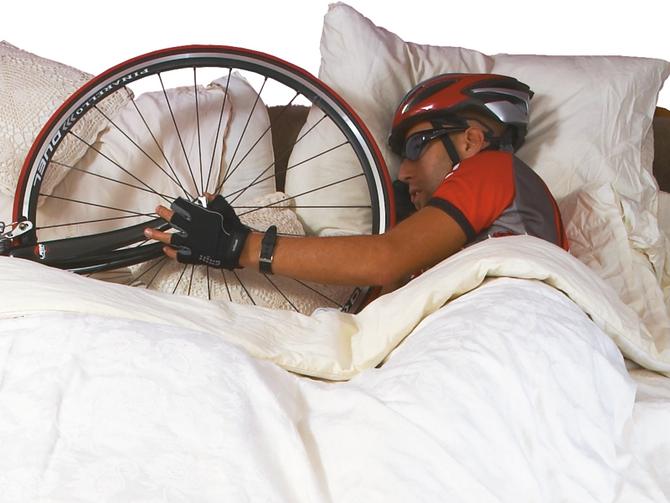
That’s an actual comment sent to me by a former student of mine. The rider is dedicated, committed and strong. And the statement raised so much conflict in me, I felt obliged to write another post about the all-too-real dangers of overtraining. (Please see my earlier post, “Endurance Exercise and Heart Damage”.)
Being able to ride long distances makes you feel like a cyclist, regardless of how fast you are. Riding long gives a feeling of accomplishment. It’s the kind of training that can easily become overtraining because the conditioning increases your ability to endure whatever happens on the bike. Aches, pains, bad weather, lousy traffic are all part of it. You get tough. The tougher you get, the more you ignore the signs that it’s time to let the miles go.
Many of my students have graduated from my classes to the road. Some have gone on to become accomplished cyclists. Several have gone in the direction of riding long distances.
If you’ve never racked up a lot of miles, it’s important to understand that there’s a “buzz” to it. Each week, you end up riding many more miles than are good for you, but it’s gratifying to have finally reached the point where you can ride that many miles. All the training has culminated in considerable ability; you don’t want to let go of the conditioning. Couple that with the resilience you had to develop and, before you know it, you’re no longer getting stronger. You’re doing whatever you can to keep yourself from breaking down.
This kind of overtraining syndrome can be hard to discern. The intensity isn’t high, a day or two of rest helps you feel better, and there’s a mindset that this is what it takes to get strong on the bike. It’s difficult to know when you’ve crossed the line.
Dr. Philip Maffetone talks about three stages of overtraining. He calls Stage 1 Functional Overtraining. It may include a seemingly minor plateau or a slight regression in trainingperformance. While that may be noticeable in a professional athlete receiving close observation, it’s likely to be overlooked in the situation I’m describing.
Maffetone refers to Stage 2 as Sympathetic Overtraining. The sympathetic part of the nervous system becomes overactive, which results in a classic overtraining sign — increased resting heart rate. This is discussed by cyclists and indoor-cycling instructors all the time. I can say from experience is that it’s easy to keep training through this.
Stage 3 is Parasympathetic Overtraining. Chronic overtraining has led to more serious hormonal, neurological and mechanical imbalances that parallel adrenal dysfunction. Eventually the sympathetic nervous system becomes exhausted, and most, if not all, hormone levels are significantly reduced, including cortisol. Believe it or not, this is not an uncommon state for many of our students who like to ride long distances. At this point, negative feelings increase, such as depression, anger, fatigue and irritability. Ratings of perceived exertion increase, as well. (Consider the statement at the beginning of this post.) Serious injury is possible, as is an increased likelihood of crashing. Yet getting on the bike for another ride is still within reach, still feels accessible.
My question for discussion is: What can be done with students in this state? I know from experience they don’t want to hear anyone tell them to stop riding so many miles. They know from experience that their conditioning will lose its edge and they’ll detune. That’s hard to accept. The ego is engaged here because they’ve reached a level of conditioning that makes them proud of their training.
I’ve often tried to intervene — to little avail — with students going through this. A coach of mine once told me that life is the only real coach when it comes to ego, and that everyone needs to go through significant downturns and trauma to learn life lessons.
I’m interested in what the rest of you have experienced.
Ready to try out some brand new music in your next class? This week's favorite track is a climb at around 65 RPM from “dark pop” girl band MUNA. From their just released album titled About U, Around U has a steady beat with a few slow-downs in the music at :44 and 3:26. It finishes a bit slower starting around 4:30. You can use that final :45 as a recovery or pick up the climb to the end. Some of the other tunes worth checking out on the same album: Loudspeaker, I Know a Place and Crying on The Bathroom Floor.
If I could tell you that I had access an incredibly effective performance enhancer that couldn’t be picked up on any drug test and is completely and utterly free, I’m fairly sure you accuse me of lying.
What about if I then said that you had unlimited access to it too? You’d probably just shake your head and walk away. Well it’s all true. What is this wonder drug? Sleep. That’s what.
Sleep has been called the most potent natural performance enhancer known to humankind. With very good reason. Below we take a brief look at exactly how sleep and athletic performance are linked…
Sleep and training
Getting sufficient rest is vitally important for all of us, athlete or not. It plays a role in just about every single thing we do, The Sleep Advisor team discuss this in great detail. But it’s importance takes on new levels when you start putting your body under unusual amounts of physical strain — like training for a race for instance.
No amount of hours spent on the track or gym will make you into a top athlete if you are not sleeping well. Those hours pumping iron or pedaling furiously are actually doing your body harm, you are tearing muscle fiber down. it's only with sufficient down time that the body is able to repair and reinforce.
Any training regime that clocks up the hours spent in the gym or on the track, without making account for sufficient time to allow the body to repair itself, is doomed to end in failure.
So if you are looking for things to cut out of your schedule to make space for more training don’t you dare thing about cutting your sleep shorter. Dump the girlfriend, quit the day job or cancel your Netflix subscription. But don’t cut out on sleep. If anything you should be sleeping more.
Sleep and motor skill acquisition
When it comes to learning new skilled actions and behaviors such as those needed for athletic success, it has long been thought that practice is the only thing required for improvement. Studies now suggest this view to be too simplistic.
Research now suggests that the brain continues to learn even when the day’s practice session is over. In fact it’s during sleep that night that the brain consolidates any new techniques learnt during the day. Say for instance you’re working on a new tennis swing, it’s during your sleep than the brain replays the action over and over again.
So remember, it's no longer just ‘practice that makes perfect’ when it comes to mastering a new technique. It’s ‘practice, sleep, practice again, makes perfect’. Not quite as catchy I will give you that, but more accurate.
Sleep and performance
The gap between medal winners and also rans (or also-cycled), often involves little more than hundredths of seconds. Sleep has a huge impact on cognitive performance. The difference between winning a race and finishing dead last could be as little as an hour more (or less) in bed.
Don’t believe me? Ok. Just as a thought exercise, try and recall the last time you had a bad night’s sleep. Statistics suggest you won’t have to think too hard on this. Now consider for a moment what your reaction times were like. I bet it took you a good five minutes to even decide what breakfast cereal to have. Now imagine you’re on the starting line waiting for the gun to go off. Yikes!
The impact poor sleep has on reaction times has been compared to the impact alcohol has. And no athlete looking to perform at the highest level would dare turn up to race after a couple of pints. In terms of performance that’s exactly what they’re doing if they turn up after a bad night’s rest.
Sleep and injury
Excelling at your chosen sport is a lot to do with consistency, are you able to get out there week after week and perform at a high level? If the answer is no, it might not be because of a lack of talent but because your body simple can't cope.
Study after study has shown that one of the most reliable predictors of injury in athletes is how well they sleep. It’s quite simple, athletes who got eight or more hours a night have been shown to get injured far less than athletes who sleep less than eight hours.
There seems to be two main reasons for this. The first relates to what we discussed above, our body needs time to repair and prepare, sleep is this time. If we don’t get enough sleep or our sleep is broken then those repairs and preparations aren’t properly carried out. The result is injury.
Training without sufficient sleep is kind of like driving the car out of the garage before the mechanic has put the engine back together and bolted the wheels back on. You might get a little way down the road but it ain’t gonna be pretty!
The second reason for the upturn in injury amongst sleep-deprived athletes relates to cognitive performance. When we’re tired we’re low on energy and our reaction times are significantly impaired. To make up for these shortfalls we overcompensate. We stretch further than we should. Tackle harder than we need to. This overexertion leads to poor technique. Both of which can lead to injury.
If you’re an athlete and you’re trying to work out why you keep getting injured or why your times simply aren't improving as you’d hoped — maybe it’s not your training or your diet that needs altering — but your bedtime. Sweet dreams!
How much planning did you do (or should you do), before launching your new cycling studio?
What research did you complete to understand the difference between successful studios and those that are struggling?
Fitness entrepreneur Callie Bowling has completed an exhaustive planning process in anticipation of opening a new Indoor Cycling Studio in Boise Idaho next fall. Callie interviewed over a dozen studio owners and she shares what's working… what's not and what she sees as the future of boutique Indoor Cycling studios.
This interview is an hour long, and needed to be to record much of what Callie has learned.
If you own a studio, or are considering opening one, I suggest grabbing a pen and paper, find a quiet spot (maybe with a hot tea) and listen to the podcast below in it's entirety, while taking notes – I consider this one of my top five episodes ever, it's that good 🙂
[wlm_private ‘PRO-Platinum|PRO-Monthly|PRO-Gratis|PRO-Seasonal|Platinum-trial|Monthly-trial|PRO-Military|30-Days-of-PRO|90 Day PRO|Stages-Instructor|Schwinn-Instructor|Instructor-Bonus|28 Day Challenge']
Update: This episode wasn't showing up in the podcast feed = I republished it and it appears fixed 🙂
[/wlm_private]
I was originally alerted to Callie Bowling by Amy – she had talked with her and was very impressed by how thorough she was in her business planning and the amount of research she had done via interviews with other studio owners.
So I reached out to Callie about possibly appearing on the show. This was her response 🙂
Let me give you a little background, so you can be thinking of questions on your end:
I have learned quite a bit actually, so much that just when my business plan and financials were all buttoned-up and ready to go – I was literally sitting across the table from my lender – I decided to go back to the drawing board to lay some more ground work (A MUST) and further examine my goals for my business and a smarter implementation strategy solely based on the experiences I obtained from interviewing eight indoor cycling studios across the nation. I learned a lot, the owners of these businesses were extremely generous with their time and the truly sensitive information they were divulging (the scary icky stuff like money)… lol, perhaps it's my degree in Psychology, but I've usually never had a problem getting people to open up around me… it's a double-edged sword 😉
I've learned this “dream” for us who wish to open these studios is always opened with the best intentions and out of a passion for the “sport”; we're all fitness enthusiasts who wanted to bring our passion to our communities and also make a fortune at it! I mean why not, the preliminary financials reflect success, which is a super simple function of attendance… it seems like a no-brainer right!? Get people in the door and become profitable… minimal overhead, no accounts receivables, cash based service industry, no inventory, etc. … the business model is set up for instant success! I'm sure you see I'm being simplistic and sarcastic, because nothing in life is ever that easy, and if it looks easy… take a deeper look, because you're probably missing something 🙂
With that said, there have definitely been some strong and shared commonalities amongst the failures and the successes amongst studio owners that can't be ignored… but, they're probably taboo to talk about so no one ever does, because no one likes to admit they've failed or fallen flat on their face… but, the truth is the truth, and in the same token no wants to invest their life's savings or nest egg into a business that might be doomed from the get-go, so we need to talk about it.
I will say, I don't know what came over me, but I emailed studios in XX, YY, ZZ, BB, NN, RR, and FF (on the podcast I won't disclose which states though to respect and maintain the anonymity of these studios, because in some states there is literally just one studio, so that would probably give it away, and the information they shared is certainly sensitive – we can just accurately say I reached out to studio owners across the nation) and I didn't know what to expect. I was equipped with my generic list of questions, but those soon fell to the wayside and the conversation became personal and very much a theoretical conversation about what it takes to survive as an entrepreneur in our industry and what those basic principles are.
Alas, we can go over all of this & more on the podcast, I'm loaded with info, lol, and honestly I think the things I am ready to touch on will be useful information not just for others in the “pre-startup” phase, but also for any studio owner in general that is perhaps struggling or “hemorrhaging” (as one studio owner stated) and can draw even the smallest parallels in their own business with what I have understood has also been choke holding others.
What do you think!??! 🙂
P.S. Here's the juiciest part… I think I see the future of our industry!!! lol… that may be a bit pompous for me to predict, but I've done a lot of research and there are signs and clues I'd love to cover!
Callie Kelley Bowling
Founder & CEO
CKB Fitness, Inc.