
by John | May 8, 2026 | Instructor Training

Yes, he's a marketing tool 🙂
Question sent in from a future Spinning® studio owner.
Hi John,
I was wondering in all your travels have you heard of an indoor cycling studio that has done research on what are the best marketing tools for a new studio? There are so many. I think my marketing list contains around 45 different ways to market a business. It would be cool and cost effective to know which marketing tool brings awareness to a fitness business as this. If I had an answer to that I would obviously strategize to put more capitol towards the tool that brings the business. We have different ideas on how to market initially using promotions/discounts/etc. We don't plan to open our studio until late summer and we just found out that another studio is going in the next town to us approximately 3.5 away.
Any input would be appreciated.
Thank you – Nancy
Nancy provided me some additional detail, explaining that she's waiting on some local permitting approvals. Once they're cleared she's purchasing a room full of Spinner® Blade Ions. She's installing Performance IQ and LiveEdit is building her website which will integrate with MindBody, provide the bike reservation system and deliver all of the performance metrics to each rider.

I passed Nancy's question on to our resident marketing expert, Courtney Lee for here thoughts. Here's her response:
While I haven't heard of any research on what is best these are some of my initial thoughts and things I would do if I were opening my studio. Social media is great but should be a complimentary tool to more brick and mortar approaches at first and then you can switch over to social media more when you're following is in place and actively engaging.
- Try not to discount the actual price as that can discredit the value – instead word it such as “Bring a Friend and You RIDE FREE – a $30 value” or something like that. “Buy 10 Rides & We'll add a bonus Thank You Ride for FREE (a $30/value)”
- Social media is excellent, HOWEVER, we can not count on Facebook to deliver our message to everyone without paying to play essentially. Think direct – is there a local bike shop, coffee shop etc where the target market hangs out? Get in there and connect, offering a SELECT few a VIP Ticket (again – stating the value on it) to the first ride. You're creating exclusivity by offering VIP tickets and making it feel like a big event (which of course it is!).
- Highlight your “difference maker” from the competition. Do you have extra showers? A super easy booking system? Member perks at local businesses (where you swap discounts for say the employees of the coffee shop and they do the same for you etc).
- Depending on the geographic area a direct mail post card may reach the most households for the most cost effective price. List your highlights here and also say something like only 40 VIP seats for the first ride event – CALL TODAY! Then talk about the VIP event and all the things you'll have. Spend some budget and have these professionally designed – it's your image, the first impression! Typically around $50-$120 for design depending on hours spent in proofing.
- Create a big open house style event where you find the locals who are well connected in the community. Host a special pre-opening screening for these people and make it amazing. Let word of mouth do the best advertising for you. Create a swag bag for attendees where they could receive 5 complimentary guest passes – have their names on them so you can track the success.
- If you don't already have them – invest in some large window signs and/or decals saying you're coming. Create the hype – be different – get noticed. I would also add that the signs include We're Hiring Instructors! John
- Create strategic relationships with other small business in the area. Have them promote you and talk you up to their clients. Once you open you can return the favor.
- Remember, go direct to the source. If you're target audience is moms, find a local moms group – sponsor one of their events, offer to give a presentation on fitness for moms. Then mention the daycare room that your facility has – and that it's FREE – your 930am, classes will be packed 😉
- If you've got an awesome logo have some inexpensive car window decals made and hand them out to your friends, potential clients. Any promotion of your logo is a good thing at this point!
If I had to pick two things I would go with the direct mail post card and the partnerships with other surrounding business.
Hope that helps – I may get a few more as the coffee kicks in 😉
I would add that the key to any form of marketing is consistency – there's a reason you instantly recognise the Geico Gecko – you've seen multiple Gieco Insurance commercials featuring his humorous exploits. So I would consider who my target market will be (think focusing on small niches) as Courtney suggests, pick a few tools and them stick with them.
What's worked for you?
Originally posted 2014-06-09 10:34:29.
by John | May 2, 2026 | Instructor Training
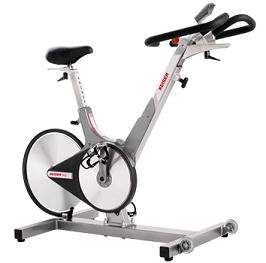
Keiser M3 Plus
As promised, I'll be posting the results from our Indoor Cycles with Power survey. I'll start with the Kesier M3 which represented about half of the total responses. Which makes sense as Keiser has been selling the M3 consistently for much longer than any of the other brands.
Please note that we didn't separate out the older M3 from the new M3 Plus which includes the new handlebar design and updated (more accurate) power meter.
Focusing on the important bits, I will be presenting a series of graphs that I feel will best represent the findings for each of the Indoor Cycles included in the survey – click here for the list all of them.
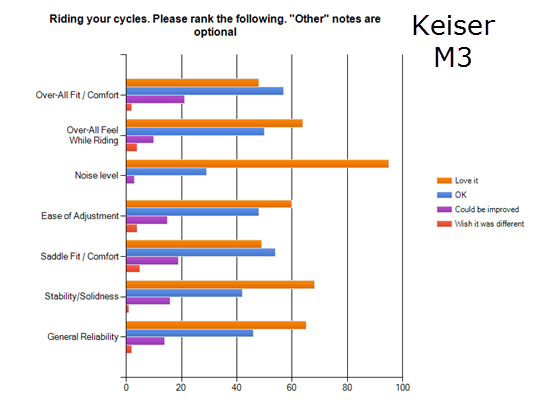
- Satisfaction while riding your cycles.
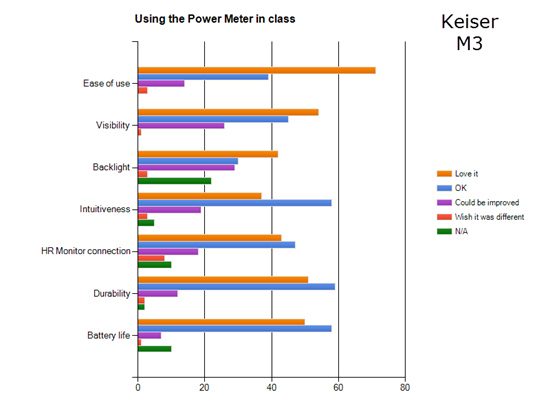
- Using the Power Meter in class.
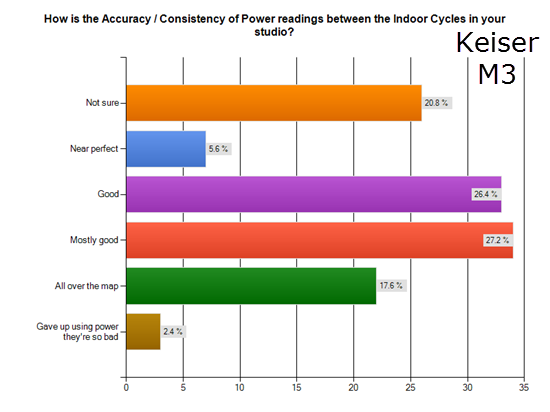
- Accuracy / consistency in power displayed.
- Would you recommend this Indoor Cycle to others?
Anyone familiar with Net Promoter Scores (NPS) understands the critically important “would you recommend us to your friends? question. It alone is the most accurate measure of someone's true satisfaction in a product or service.
First up, how do instructors like riding the Keiser M3?
Next, using the power meter in class.
How accurate / consistent are the power readings?
And then the percentage of Instructors who would recommend the Keiser M3. You can find more information and pricing for the new M3 plus here.

Originally posted 2014-02-22 12:04:57.
by John | Apr 29, 2026 | iTunes, Spotify

This makes me happy! During Sunday night's LIVE iTunes training one of the participants had what can only be described as an Aha! Moment, where she learned something that made her investment in time worth every minute.
Over the last 3 1/2 years I've answered hundreds of technical questions from Instructors. I've learned that if one Instructor has a question there are probably a bunch of you with the same frustration who would enjoy learning the answer.
The question was; “how do I restore the correct order of a playlist in iTunes if I have clicked on one of the column headers?”
I made this short video to show how to solve this 🙂
The next training date is January 8th where we will be learning Spotify Premimum for iPhones and Android devices. You can join the notification email list here.
Originally posted 2011-12-20 05:36:30.
by Tom Scotto | Apr 26, 2026 | Master Instructor Blog
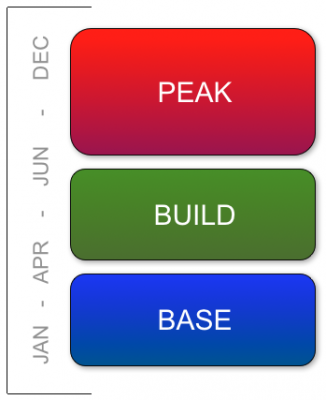 A number of instructors (and riders) have asked me how one should approach the next training phase and how to know their class is ready. These instructors are usually believers and followers of a periodized format for delivering the focus of their indoor classes. So considering we are rolling towards the end of March, this is the perfect time to address our focus beyond base training.
How Do We Know Our Class is Ready for More?
Let’s answer the easy question first. Well…sort of. The short answer is that it doesn’t matter. Hey, at least I didn’t say, “it depends”. The reason it doesn’t matter is because we have riders at all levels plus those that will pop into our class without notice, so we never really know who will be present from one week to another. Thus everyone will be in different places with their training and level of fitness. For this reason, I like to keep things on a general schedule for those faithful regulars that use our classes for consistent training (See the image for a general timeframe for each basic training phase). I also like to stay on the periodization model because it conveys the message that “we have a plan” in this class. Having a longer-term plan for how one delivers classes is also a great way to keep people coming back. For example, I will make the following announcement before introducing a new profile, “So as you know we have been focused on “X” (whatever that is) for the last 3-4 weeks and now we are going to build on that with today’s ride”. I’ve seen new riders turn to the person next to them to ask what type of rides they missed. I’ve even had people come to me after class and tell me that they are new (which I knew), wanting to know what was ahead for the next few weeks. The bottom line: they now want to be a part of what we are doing and don’t want to miss a class.
Obviously, as always, we need to provide options and give people permission to work at their own levels. Make sure to emphasis the point that everyone is at a different level and place in their training, so no one feels behind or unsuccessful during class.
What’s Next?
For those that have been following a periodized model, our focus has been on aerobic development / endurance, leg speed and muscular endurance (moderate climbing). With this foundation in place, from both a physical and educational sense, we can now get more specific in our focus and start shifting from volume to intensity. So what does this mean? The training done during base is designed to target general fitness and conditioning. The training performed during the next phase (often referred to as Build) begins to focus on developing muscular strength and power. With this shift in focus also comes an increase in intensity (bringing with it more recovery — hopefully). This can be a hidden trap for instructors because many will continue to increase the intensity, but not provide more time to recovery. In effect, intensity is not effectively increased because without appropriate recovery, people can work as hard as they need. Hence mediocre-ville and a dreaded plateau in fitness often follows.
This is often where taking the time to educate your class goes a long way. Having gone through 12 weeks of base training and understanding the purpose makes it easier to transition their mind to the concepts of training at a higher level.
Keep an eye out for my latest Audio PROfile entitled “CycleSTRONG” for an introduction to pure strength training — a perfect ride for the next phase of training.
Originally posted 2012-03-15 17:35:29.
by Karen Casler | Apr 20, 2026 | Instructor Training, KEEPING IT FUN

My brain started spinning (pardon the pun)… the door swung open… and I stepped out.
Once I realized that the indoor cycle doesn't move, I opened my mind to many things previously deemed unacceptable.
Hello
My name is Karen and I stepped out of the box last year. I am also the self proclaimed spokesperson for KEEPING IT FUNâ„¢ Indoor Cycling. I'm committed to helping other indoor cycling instructors who aren't afraid to approach indoor cycling differently.
Here is my story…
KEEPING IT REAL Indoor Cycling is where I come from. It was also where I thought I was going when I opened my indoor cycling studio a little over year ago. I was determined to maintain the integrity of the road and to honor the spirit of SPINNING®. Never did I entertain the idea of lunges, crunches, tap backs, push ups, BootiePops or hand weights on my indoor bike. NEVER, EVER……EVER would I allow that to occur on my instructor stage!!!!!!!! N E V E R.
Enter…..the shiny monkey.
I am plagued by, or shall I say blessed with SMS (Shiny Monkey Syndrome). The Shiny Monkey is fun, flirty, happy, and IRRESISTIBLE. After reading many KEEPING IT REAL articles, the Shiny Monkey bounced into my brain and pointed out something obvious about my indoor bike. The indoor bike is STATIONARY. It does NOT move, and nothing around it moves. There is no traffic, no way to get lost, no forward motion, no inclement weather, and no physical obstacles. Factors that keep us from doing things on an outdoor bike need not apply to the indoor bike. BooYah and three cheers, go to the Shiny Monkey!!! Thanks for changing my life, little guy!!!
Today, indoor cycling offers riders a diversity of classes that they have never had before! Understanding and identifying KEEPING IT REAL and KEEPING IT FUN, as two completely different forms of group exercise, is what gave me courage to step out and teach something different.
Don't get me wrong, I like a KEEPING IT REAL class. I don't want KEEPING IT REAL to change. I have simply departed from KEEPING IT REAL and celebrate KEEPING IT FUN! I want to build a community of instructors who share my embrace of the evolution of indoor cycling.
There needs to be a forum for “KEEPING IT FUN” instructors. A place to share their love of sweaty indoor awesomeness, on bike that has just one wheel and goes nowhere. I want to share my story and help other instructors who are trained in the traditional indoor cycling formats; Mad Dogg, Schwinn, Stages, etc. feel comfortable stepping away from what's deemed “REAL” and into the “FUN” world.
There are safe and effective ways to teach a lil “party on a bike.” There are also safe and effective ways to add upper body resistance training to an indoor cycling class. We are NOT outdoors. KEEPING IT FUN indoor cycling is a group exercise that can appeal to everyone. It is growing in popularity (without injury), among elite athletes, weekend warriors, all age groups, both genders, and most importantly…..with people who haven’t had a work out routine, or haven’t stuck to consistent fitness plan in years. I've seen in my studio how KEEPING IT FUN, keeps everyone coming back!!!
“If you wouldn't do it on the road, don't do it in class,” may be the ultimate KEEPING IT REAL rule. I break this rule, EVERY ride.
Cuing from a KEEPING IT FUNâ„¢ instructor, may go like this…..
“Find your hill. Now, add some gear. Relax your shoulders and close your eyes. Create weightlessness on your pedals and get lost, in the rhythm. Follow the beat. Up 2, Back 2. Let’s GO!!!”
When I ride, I close my eyes. This breaks the KEEPING IT REAL rule. You can't close your eyes and ride outdoors. On a stationary bike you CAN close your eyes. With my eyes closed, and when my optic nerve is completely relaxed, cardio therapy follows. I let the music penetrate my mind, my body, and my soul. I harness the power of those who ride with me and we ride, together. Everyone is connected through movement and the entire room moves like a jellyfish. I think this is what Les Mills referred to as FitnessMagic. FitnessMagic connects people with people AND it connects people with themselves. I live for FitnessMagic!!!
I am an indoor cyclist.
My cycle goes nowhere and yet, my cycle takes me anywhere I want to go 🙂
Originally posted 2014-02-16 18:13:31.
