by John | Nov 27, 2018 | Best Practices, Instructor Training, KEEPING IT FUN

I feel that “jumps” (the controlled/rhythmic/on-the-beat type – not the random “popcorn” or David Lee Roth varieties) have gotten a bad rap as of late. I love when they're a part of a class, enjoy teaching jumps and see them as beneficial for multiple reasons… here are five* for you to consider:
#1 Jumps can provide Cognitive Dissociation
I found this description at craigharper.com.au
Picture yourself riding an exercise (stationary) bike for forty-five minutes (alone) in your garage while staring at a blank wall in total silence. No company. No music. Nothing (interesting) to look at. I get bored just thinking about it.
Now, relocate your bike to a bright room with lots of inspirational posters on the walls, a few flat-screen TV’s, a great view out of the numerous windows, some awesome music pumping through the place, a room full of motivated people peddling beside you and a hot-looking bloke (or chick) up the front inspiring you through a great work-out.
Some people call this scenario Spinning® (RPM, etc.). I call it cognitive dissociation.
It’s the same but different. Find a way to make it work for you.
A major part of our role as Instructors is to provide a distraction from the monotony of exercise. We do it with our music, structured profiles, our presentation of the class and video/virtual rides. All of these things can provide helpful distractions for the visual and auditory learners in the room. But what about the third type… the Kinesthetic learners in your class?
Kinesthetic Learning (also known as Tactile Learning) is a learning style in which learning takes place by the student carrying out a physical activity, rather than listening to a lecture or watching a demonstration.
Those are people who can't sit still and have got to move! I'll bet that you have participants in that category and they hate being forced to just sit there and pedal. My older daughter Abby is a super Kinesthetic Learner. It would drive her crazy to have to sit still to study. But give her something she could move/play with and problem solved.
Jumps can provide this cognitive dissociation because they force participants of all learning styles to mentally focus on the activity, not the effort. I can remember vividly how Amy used to teach classes where we would do 50, 80, 100 or more jumps in a row. I'd be so intent on staying with the music and counting down each jump, I would completely lose touch with the actual intensity – which for me made exercising fun!
Question for you: Do you have a few participants who won't sit still and occasionally do their own thing? I'd like you to consider why they are acting out. Could they be kinesthetic learners and you aren't offering them enough variety of movement?
Or asked a different way: could requiring everyone to “just sit there and pedal” be alienating a segment of the population who can't help the fact that they can't (and won't) sit still?
#2 Jumps can become Tribal Movements
Have you ever been to a sporting event where they did “the wave”? Try to remember the feelings you had when it happened:
- Do you remember how you felt as you watch “the wave” slowly approach your section?
- The feeling of being part of that massive, collective group?
- Pretty cool, right?
Feeling like you're part of the “Tribe” goes a long way toward a feeling of connection with, or being part of, something bigger than yourself.
- Did you maybe have just a touch of anxiety, worrying that you would stand up at just the right moment?
- How did you feel when the “wave” started to become disorganized?
- Were you a little frustrated with the others in the stadium?
- Maybe you exerted your leadership skills by trying to reorganize the wave?
Tribalism is the state of being organized in, or advocating for, a tribe or tribes. Got an iPhone, iPad or Mac? Chances are one reason you choose an Apple product, over a PC, is because you wanted to join the “Apple Tribe”.
SoulCycle, if you haven't noticed, has an amazing tribe. I'm convinced that part of their appeal is directly connected to having everyone moving together as one. It truly is a thing of beauty. If you've never experienced a class like this, I highly recommend trying one.
Studio owner Paul Harmeling understands the value of building a passionate tribe, as demonstrated by his three successful Full Psycle Indoor Cycling Studios. If you didn't hear my interview with him, where he describes the importance of developing a tribe through specific movements, you can find it here.
#3 Jumps – help for the rhythmically challenged
I'm personally in the demographic that (had) a problem with rhythm. For most of my life, I had no ability to hear and then follow the beat of the music. Dancing? Let's just say that I'm really glad that pocket video recorders didn't exist back in the Disco era – my moves were not pretty and rarely connected to anything close to the beat. That all changed when I learned to jump as a participant in cycling classes.
Early on I found that, with practice, I could learn to pedal to the beat of somewhat slow music > in the 60ish RPM range. Having to rise and fall along with the Instructor (and other riders in the class) became a sort of gauge that helped me to understand if I was actually on the beat. Amy helpfully explained how coming up on the same leg, in the same point in the crank rotation, identified that I was truly “on the beat”. It took a long time for me to feel comfortable doing jumps without needing to think about each action – and it may for some of your regulars. I can't think of a better example of the “practice makes perfect” cliche – it really does take time.
So if you have men people like me in your classes, do them a big favor and teach them how to jump. I'm willing to bet that there's a significant other in many of their lives who will thank you for it 🙂
#5 Jumps are challenging
Why are extreme endurance events like the Spartan Race so popular? OK, that's a dumb question. Pretty much anyone who knows what these events are, know why people flock to them by the tens of thousands… they're crazy challenging both physically and mentally. Everyone who finishes has a sense of accomplishment that only comes from overcoming the challenges faced during the race.
Can all agree that there's little challenge in pedaling a bicycle? That's a big part of the appeal of Indoor Cycling, anyone can do it. Sure you can make the class hard – challenging physically. But why not add a few jumps, which for many people are mentally challenging as well? The end result is that once mastered, jumps can create a small, but similar, feeling of accomplishment at the end of your class.
#5 Jumps are FUN
Please don't underestimate the FUN factor of jumps. Not everything in your class has to (or should) be focused on some specific element of training. There's a lot of good arguments that playful exercise is as beneficial as structured workouts – especially with people who are burned out or bored by rote workout regimens. Recognise that many of your participants come to your class to have fun and want to enjoy their time exercising. My feeling is that adding a few jumps will go a long way to keeping them happy with you and your classes.
Stay tuned for Pt2: Jumps – 5 possible reasons why you aren't offering them…
* I'm tempted to add a #6 here: Jumps help cyclists learn to smoothy come out of the saddle. I know it has helped me, but there's a lot of conflicting opinions about if it does or not. The majority of your riders are probably not cyclists anyway, so this point really doesn't matter… does it?
by Amy Macgowan | Nov 21, 2018 | Health and Wellness, Melissa Marotta
 Pain sucks. When we get injured or sore or uncomfortable, we instinctually try to fix it. We reach into our medicine cabinets, pop some pills, and “get back out there.” But are we really doing ourselves a service? Can we actually be inadvertently putting ourselves at risk? Turns out, maybe so.
Non-steroidal anti-inflammatory drugs (NSAIDs), which include ibuprofen (Motrin, Advil), naproxen (Aleve), celecoxib (Celebrex) and a ton of others, are available over-the-counter and are widely used by the general population for, well, everything. Studies have found a disproportionately high use of NSAIDs amongst athletes, particularly elite athletes, as well as a lack of awareness of key dangerous side effects.
Standard care in medical practice is to discourage prophylactic use (taking medications in advance of preventing a problem, as opposed to treating an existing problem) of NSAIDs. But what about NSAID use after injuries? NSAIDs have traditionally been part of hallmark treatment, particularly for facilitating an early return to activity. But there is a controversy in sports medicine about whether NSAID use in the first few days after acute sports injuries can actually compromise the healing process. Let’s examine how that might be so. (more…)
by Gino | Nov 20, 2018 | Training With Power
 Watt Is Power? Or rather what is power?
With a title like that, we could be here for days. Perhaps a better title would have been: What Is Power As It Relates To Cycling or even more to the point would be: Training on Indoor Cycling or Spinning® Bikes With Power. But as you see, that would have been quite a long and clunky title. So I spared you. Naturally, we will be confining our discussion to how the dynamics and science of Power has been applied to the sport of cycling. More specifically how it relates to the world of Indoor Cycling or Spinning® and the equipment used for this in most fitness facilities; stationary bikes. While most of our work was done on the Keiser M3 indoor bike, we are currently in the process of acquiring other power bikes for continued independent research.
Definition
Power is the product of strength and speed or put in terms of indoor cycling, the resistance applied to the fly wheel, and the RPM or cadence of pedaling. That seems pretty easy to understand right. The equation that comes to mind is:
Power = Resistance X Cadence
Oh if it were only this simple. Well, for the purposes of Indoor Cycling or Spinning®, this is all we need to know, and thuse, we have made it that simple. However, if you ride outside, you need to know that there are quite a few factors that also impact power as it relates to cycling. While we enjoy the perfection of a controlled environment for training, riding outside is anything but a perfect and consistent. Consequently, there are lots of factors that can affect one’s power. A bunch of very smart people from Penn State put together a nifty Power Calculator for those of you who are even bigger data geeks than myself. You can find it at: http://www.me.psu.edu/lamancusa/ProdDiss/Bicycle/bikecalc1.htm
Here is a sneak peak at all the factors that go into calculating power when we move outside:

As you can see form the screen shot above, at least 65 thousand other people have a similar curiosity about power. You can also find a kazillion references to power as it relates to cycling on the internet, but our discussions will be squarely focused on how power is measured and used for Indoor Cycling or Spinning®.
This does not mean that the power generated indoors is not the same as the power generated outdoors. Essentially they are the same. It simply means there are different methods used to measure that power due to differences in equipment, environment and cost. Yes, there will be differences in the Watts you generate indoors, and what your power meter measures outdoors. Even cyclists who use the exact same bike, with the exact same power meters indoors and out will experience differences. Shocking as it may seem, the most expensive equipment available will still produce variations due to the enormous influence environment has on the rider and the equipment.
Nevertheless, this does not take away the value of training with power. Power meters still represents one of the best tools for improving your general fitness and/or performance on a bike that has hit the Indoor Cycling or Spinning® market in a very long time. The differences between indoors and out will not negate these positive effects. At the end of the day, it’s the results we are looking for, and training with power will surely deliver!
Read more of Gino's Training with Power Articles – Here
by John | Nov 1, 2018 | Best Practices, Engage Your Students, Instructor Training, Master Instructor Blog, Training With Power, Zone based Heart Rate Training

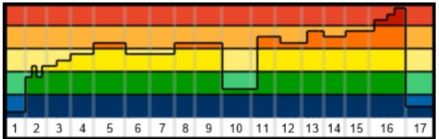
If your objective is to communicate (sell) the value of either Training With Heart Rate – or – Training With Power, teaching your class using Three Zones will be the most easily understood, accepted and remembered… here's why.
The Rule of Three
It's no accident that throughout history – thousands of years in fact – three (3) is the magic number in many, memorable fairy tales, myths and marketing campaigns. They're easily remembered and shared because they follow The Rule of Three…
There were three little pigs, three blind mice, Goldilocks and the three bears, Three Musketeers, three wise men and the Three Stooges.
{Reduce, Reuse, Recycle} {Earth, Wind and Fire} {Good, Better, Best} {Hot, Warm, Cold} {High, Medium, Low} {Small, Medium, Large} {Gold, Silver, Bronze}
1st, 2nd, 3rd – who ever remembers (or cares) who came next?
This copy writing blog explains the Rule of Three very well in the context of effectively communicating ideas.
It all comes down to the way we humans process information. We have become proficient at pattern recognition by necessity, and three is the smallest number of elements required to create a pattern. This combination of pattern and brevity results in memorable content, and that’s why the Rule of Three will make you a more engaging writer.
Sticky Ideas
You see the Rule of Three used all the time across diverse areas of life. Why?
Because information presented in groups of three sticks in our heads better than other clusters of items. For example:
- “Life, liberty, and the pursuit of happiness”
- “Government of the people, by the people, for the people”
- “Friends, Romans, Countrymen”
- “Blood, sweat and tears”
- “Location, location, location”
- “Father, Son and Holy Spirit”
- “Faith, Hope and Charity”
- “Mind, body, spirit”
- “Stop, Look and Listen”
- “Sex, Lies and Videotape”
- “I came, I saw, I conquered”
I'm confident you can add a bunch more to this list, which kind of makes my point. All of our brains are hard wired to create and retain patterns of three concepts… not four, five, six or seven – three is the magic number.
Sally Edwards understood The Rule of Three. Her three heart rate training zones concept called Zoning is designed to appeal to as many people as possible.
Please note that I didn't ask; What's the most accurate/precise/correct number of HR or Power zones? My question was; What's the best number of Heart Rate and/or Power Zones in our classes?
Cameron Chinatti with Stages Indoor Cycling says the answer is 7 Power zones. So does Joe Friel, Dr. Andrew Coggan. Chris Carmichael appears to use five. All super smart and knowledgeable people to be sure. Administered properly to a committed endurance athlete, 7 power zones is probably the most accurate/precise/correct number of HR or Power zones for them to train with.
But 7 Power training zones is too many IMO for our classes filled with Club Athletes.
The ICI/PRO Power Training Zones follow The Rule of Three.

I'll follow up with more detail later this week.