Protein Power: It’s Not Just for Muscles (Part 2 — Appetite Control)
By Joan Kent, PhD, and Shawn Bevington
Protein is used to make hormones, which are messengers in the body. They’re produced in one part of the body and then distributed — through blood, interstitial or other body fluid — to other organs or tissues. There they modify activity and function.
This brief post will focus on just a few hormones and how they affect appetite.
*CCK (Cholecystokinin) – Satiety is the feeling that you don’t need another meal because you’re still satisfied from the last one.
CCK is arguably the most powerful satiety hormone in the body. It reduces appetite by stimulating the function of the brain’s key satiety center, the VMH (ventromedial hypothalamus).
CCK is released when we eat protein and fats. It affects our food preferences by reducing the desire for carbs.
Anyone who suffers from an exaggerated desire for carbs probably needs to eat more protein. Vegans, for example, may experience strong cravings for carbs, including sugars. Finding a true protein source is a key factor in reducing vegans’ cravings. More on that in Part 3.
Eating adequate protein can also be key in conquering sugar addiction for this same reason.
*Ghrelin – Ghrelin increases appetite by stimulating the brain’s lateral hypothalamus. The LH can be seen as a ‘feeding’ center.
Eating protein can help to reduce ghrelin release. In healthy men, a high-protein breakfast decreased post-meal ghrelin levels more than a high-carb breakfast. The high-protein meal also slowed gastric emptying. Researchers attributed both effects to the secretion of CCK and glucagon, both triggered by protein.
*Glucagon – Glucagon is a hormone made in the pancreas. Insulin is, as well, but the functions of the two hormones are oppositional and work to balance glucose levels.
Insulin also tends to be a fat-storage hormone, while glucagon moves fats out of storage and into the blood stream so they can be utilized as fuel, rather than stored.
While many foods trigger the release of insulin, only protein foods trigger glucagon. Glucagon is also secreted when we exercise.
As mentioned above, glucagon and CCK seem to control appetite by modifying ghrelin levels.
Don’t miss protein and brain chemistry, age, and the vegan solution in Part 3, right here this week!
Shawn Bevington is a holistic health coach, certified by the National College of Exercise Professionals (NCEP). He has been a fitness trainer for six years, and boasts another seven years of activity in various programs, including football, shot-put, pro wrestling and other strenuous sports. Self-motivated, Shawn has spent years researching on his own – and putting that information into practice with his clients. His knowledge, skill and experience have made him a sought-after fitness trainer, both by clients and by colleagues who bring questions to him.
Dr. Joan Kent has a PhD in Psychoactive Nutrition. She was the first to document the brain chemical pathways of sugar addiction and to explain the sugar/fat seesaw hormonally and chemically. Joan has helped hundreds and hundreds of clients with metabolic conditions — diabetes, hypertension, heart disease, cancer — as well as clients with inflammation and mood disorders. Joan has written 2 best-selling books: Stronger Than Sugar, on conquering sugar addiction, and The Sugar-Free Workout, on fueling before, during and after training for optimal performance. Visit www.LastResortNutrition.com and grab your free gifts.
Technology can be a great thing for our classes – as long as all of your Instructors have been trained to use it properly.
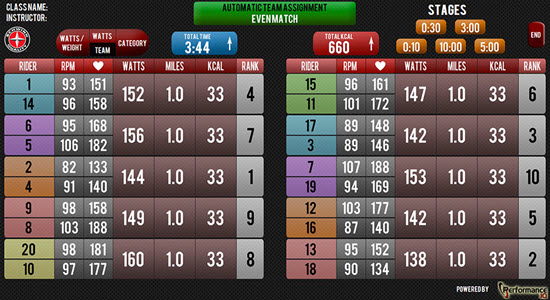
I'm seeing a bunch of clubs and studios having enormous success with performance data tracking and display systems. These systems connect to the consoles all of the new Indoor Cycle's with power and then display the information on a big screen + send out those informative emails that your participants love to receive.
Unfortunately some studios and/or Instructors aren't having the same amount of success. During many of my consultations with studio owners, I'm hearing them say that they would have appreciated (and benefited from) more in depth Instructor training, i.e. exactly how do we integrate these systems into an actual class?
So when I was at IDEA this past Summer I was encouraged to see that Schwinn Indoor Cycling has developed specific education, for the use of their Schwinn branded version of Performance IQ 🙂
To get the low down on what they are offering I invited Schwinn Indoor Cycling's Director of Education, Julz Arney, join me to discuss their education and get her thoughts on Best Practices for using Display Training.
During this interview Julz mentions that she would provide everyone with a PDF of her 10 Best Practices for using a Display Training system – here's the link to download it.
Would your club or studio benefit from additional Instructor training, regardless of the brand of cycle you're using? ICI/PRO has an experienced team that is available to provide intensive Instructor training at your location – please contact us and we can schedule a call to discuss your needs and see if we can help. We can also help you with decisions regarding Indoor Cycles, website design and performance data tracking and display systems.
This weeks ride is from Joey! – “This ride was fun to put together. You will recognize all of the music, and be tempted to sing along with most of it. This is a really hard ride. Normally, we structure endurance rides to begin with a higher cadence so that it first stresses the cardio vascular system and then the muscular system. The theory behind this is that the cardio system recovers fairly quickly where the muscles take more time. In this weeks ride, we begin with the muscles and then work toward the cardio, so you will carry the fatigue with you through the ride. Good luck and have fun.” Joey
“Today was the hardest recovery ride ever! I complained the entire way and had three different plans to abort and shortcut the ride throughout the route.”
That’s an actual comment sent to me by a former student of mine. The rider is dedicated, committed and strong. And the statement raised so much conflict in me, I felt obliged to write another post about the all-too-real dangers of overtraining. (Please see my earlier post, “Endurance Exercise and Heart Damage”.)
Being able to ride long distances makes you feel like a cyclist, regardless of how fast you are. Riding long gives a feeling of accomplishment. It’s the kind of training that can easily become overtraining because the conditioning increases your ability to endure whatever happens on the bike. Aches, pains, bad weather, lousy traffic are all part of it. You get tough. The tougher you get, the more you ignore the signs that it’s time to let the miles go.
Many of my students have graduated from my classes to the road. Some have gone on to become accomplished cyclists. Several have gone in the direction of riding long distances.
If you’ve never racked up a lot of miles, it’s important to understand that there’s a “buzz” to it. Each week, you end up riding many more miles than are good for you, but it’s gratifying to have finally reached the point where you can ride that many miles. All the training has culminated in considerable ability; you don’t want to let go of the conditioning. Couple that with the resilience you had to develop and, before you know it, you’re no longer getting stronger. You’re doing whatever you can to keep yourself from breaking down.
This kind of overtraining syndrome can be hard to discern. The intensity isn’t high, a day or two of rest helps you feel better, and there’s a mindset that this is what it takes to get strong on the bike. It’s difficult to know when you’ve crossed the line.
Dr. Philip Maffetone talks about three stages of overtraining. He calls Stage 1 Functional Overtraining. It may include a seemingly minor plateau or a slight regression in trainingperformance. While that may be noticeable in a professional athlete receiving close observation, it’s likely to be overlooked in the situation I’m describing.
Maffetone refers to Stage 2 as Sympathetic Overtraining. The sympathetic part of the nervous system becomes overactive, which results in a classic overtraining sign — increased resting heart rate. This is discussed by cyclists and indoor-cycling instructors all the time. I can say from experience is that it’s easy to keep training through this.
Stage 3 is Parasympathetic Overtraining. Chronic overtraining has led to more serious hormonal, neurological and mechanical imbalances that parallel adrenal dysfunction. Eventually the sympathetic nervous system becomes exhausted, and most, if not all, hormone levels are significantly reduced, including cortisol. Believe it or not, this is not an uncommon state for many of our students who like to ride long distances. At this point, negative feelings increase, such as depression, anger, fatigue and irritability. Ratings of perceived exertion increase, as well. (Consider the statement at the beginning of this post.) Serious injury is possible, as is an increased likelihood of crashing. Yet getting on the bike for another ride is still within reach, still feels accessible.
My question for discussion is: What can be done with students in this state? I know from experience they don’t want to hear anyone tell them to stop riding so many miles. They know from experience that their conditioning will lose its edge and they’ll detune. That’s hard to accept. The ego is engaged here because they’ve reached a level of conditioning that makes them proud of their training.
I’ve often tried to intervene — to little avail — with students going through this. A coach of mine once told me that life is the only real coach when it comes to ego, and that everyone needs to go through significant downturns and trauma to learn life lessons.
I’m interested in what the rest of you have experienced.
Ready to try out some brand new music in your next class? This week's favorite track is a climb at around 65 RPM from “dark pop” girl band MUNA. From their just released album titled About U, Around U has a steady beat with a few slow-downs in the music at :44 and 3:26. It finishes a bit slower starting around 4:30. You can use that final :45 as a recovery or pick up the climb to the end. Some of the other tunes worth checking out on the same album: Loudspeaker, I Know a Place and Crying on The Bathroom Floor.