The Power of 3 – “”My Body Tells Me “NO” But I Won't Quit Cuz I Want More”
“Turn The Levels” by DJ Lobersterdust
“Part of Me” by Katy Perry
“My Body” by Young the Giant
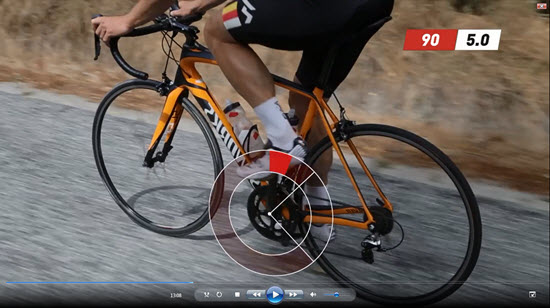
There has been a lot of talk lately about the proper range of RPM (Revolutions Per Minute) in indoor cycling classes. The general range that most indoor cycling certifications recommend is 60-110rpm. That doesn’t mean that going a little faster or slower is going immediately cause injury, it means that this range can be ridden effectively by most people in the population.
When I started teaching with power, about 2 years ago, the first thing I discovered was how a high RPM and lower resistance could elevate the HR (Heart Rate) as well as RPE (Rate of Perceived Exertion) without the associated increase in power or output. The “fast spinners”, who for years were considered the “stars” of class, were shocked at how low their power numbers were. Many of them complained that the power meters must not be working properly or were broken. I tried to calm them and explained that they were beautifully athletic riders but they may have never trained with the appropriate resistance while riding at a high cadence. I asked them to be patient and to use this new found knowledge and tool to help them reach fitness levels they had only dreamed of. By finding their most efficient cadence, that RPM where the body can produce the most power at the lowest HR or RPE, and progressively increasing cadence and maintaining power, over time, many of these riders are now able to ride at a fast cadence and maintain a high power output.
Interval sets like the one below are how I coach riders to slowly but steadily increase their most efficient cadence over time.
3 song harmonically mixed track, to download Right Click > Save As / Save Target As to download. Open in iTunes and then you'll see this in your Spotify Local File folder.
Hey – I just got an email explaining that Spivi has added a FTP (Functional Threshold Power) Test to their display training system. I can't begin to tell you how beneficial these short threshold/best efforts are for engaging participants in your power based classes. That's why I describe these as a Best Practice for anyone teaching with power.
Like PIQ, Spivi offers the option for riders to manually add their FTP / PTP wattage into a user profile. Another option is to enable the Fitness Test option where you can select an 8 or 20 minute FTP test that will record each riders average watts for the period and then add either 90% (8 minute) or 95% (20 minute) of it to their user profile.
To start the FTP tests wizard, press the left analog stick once, just like if it was a button. Now select the requested test from the menu and press the “Start” button to start.
Don't forget to Instruct the group how to ride and what to do during the test. The FTP test lasts as long as the progress bar on the bottom right side of the screens appears.
Do you remember the old days of indoor cycling when it felt like the only cues instructors knew were “turn it to the right” or “add more resistance” or “turn it up”? It seemed like these were the only cues they were ever taught and eventually everyone in class was doing a phantom turn because there legs, lungs and heart couldn't handle any more intensity. Well, those “good old days” are what helped me dream up this “No Left Turn” set. The goal of this set is to finish every interval with a higher average wattage than the previous interval and to “turn it to the right” for every new interval. With the proper “anchoring” of time and effort and pacing this set can be successfully completed. The timing of this set consists of 3 intervals of 3 minutes with 1 minute recover after each, followed by 3 intervals of 2 minutes with 1 minute recovery after each, followed by 3 intervals of 1 minute with 30 seconds recovery after each. The first interval of each set should be ridden seated with a cadence range of 80-110 rpm, the second interval of each set should be ridden seated with a cadence range of 60-80 rpm and the third interval of each set should be ridden standing with a cadence above 60 rpm.
After a proper warm-up, explain the set to your class, you can even ask them if the remember the days of instructors asking them to turn it up 20 or more times in a song or set and how we all used to “fake turn” so it didn't look like we are cheating. I like to tell them that we are going to do 9 intervals and that I'm expecting a higher average wattage after each and every interval AND an increased resistance for every new interval. I'll joke that “Yes, it sounds like the old day, but I promise if you follow along and pace properly you CAN do this set without any phantom turns.”
In order to be successful with this set it's important not to go too hard on the first 3 minute interval. I recommend a slightly below threshold effort. At the end of the first interval make sure everyone remembers their average wattage. The second interval is at a slower cadence, so more resistance is needed to “beat” the previous interval and the third interval is standing and most likely at an even slower cadence so even more resistance is needed. Moving through riding positions that require slower and slower RPM's is how we can successfully add a “turn to the right” after each interval. After the three 3 minute intervals the interval time drops to 2 minutes. Riders should be able to ride at a higher output or wattage for 2 minutes than they did for 3 minutes so the average wattage and resistance should continue to rise they work through the three riding positions and RPM ranges. The same should hold true for the 1 minute intervals as well. I recommend that riders only increase their average wattage by 1-2 watts for each interval, more than that and they are setting themselves up for failure, pun intended.
My riders love this set it teaches pacing, patience and focus as well as being a great Lactate Threshold workout.
Please leave a comment letting me know how it goes in class.
7 song harmonically mixed track, to download Right Click > Save As / Save Target As to download. Open in iTunes and then you'll see this in your Spotify Local File folder.
Recording of me teaching this 7 song set in a CardioVascularIntervals Class (CVI), CVI is a class that is taught on ANY piece of cardiovascular equipment, it is not limited to the bike. Right Click > Save As / Save Target As to download on PC or Download Linked File As on Mac. Open in iTunes and then you'll see this in your Spotify Local File folder.
Did you know that all of the Indoor Cycles that use magnetic resistance (FreeMotion S11.9, Keiser M3i and Schwinn AC) have a built in feature that will help your riders get stronger, create more power and burn more calories if you recognise and cue to it properly?
The feature I'm talking about doesn't have a label to identify it or a button to push to turn it on or off. It's not found in any manual that I'm aware of and there's a good chance it wasn't even mentioned in your training. That doesn't mean it doesn't exist – it's just poorly understood… which is where I come in 🙂
The feature I'm referring to is how cycles with magnetic resistance get progressively harder to pedal as cadence increases.
Now if you're reading this and are thinking; everyone already knows this John. I am going to challenge you and say most don't. I've taken a lot of classes recently on Schwinn AC's, taught by multiple Instructors. In each class the studio was using PIQ to track rider stats and the Instructor explained that they were committed to helping everyone work hard and burn the maximum amount of calories. But none of them took advantage of this unique feature.
This feature, by the way, doesn't exist on Indoor Cycles that uses a friction pad to create resistance.
I described a short experiment I ran in this post, comparing the new Spinner® Blade Ion (friction) with the bike I teach on regularly, the FreeMotion S11.9 (magnetic). I was pretty excited with the results as it confirmed what I had perceived after our club switched from Spinner® NXT's to FreeMotion S11.9's.
You can try a similar experiment on your own.
Riding by yourself, find a seated cadence of ~ 70 rpm and add resistance until you would feel comfortable coming out of the saddle and standing – a medium grade hill.
Stay seated and accelerate your cadence up to 100 + RPM and beyond if possible.
One of two things will happen, depending on which type of resistance is used on your bike.
On a Friction Resistance bike you'll typically feel that the amount of force need to turn the pedals becomes easier, with less and less force required as your RPM increases. Depending where you started from, you'll probably feel the flywheel taking over and begin to feel it run away on you as you get over 100 RPM.
A magnet bike will feel very different. The resistance gets harder and harder, the faster you turn the cranks. If you started with an honest hill there's a good chance you'll quickly reach the point where you simply can't go any faster, because you can't produce the rapidly increasing amount of power needed.
So how do I use and cue this feature if I have it available?
When you want to motivate your class to work hard it's actually very simple > always add/increase cadence to existing resistance.
Here's an example of how I cue this for a typical 3-4 minute “Best Effort” PTP (Personal Threshold Power) interval I include in every class. I include these to give everyone a working PTP for that day, on that specific bike – which helps to negate issues around variances between bikes.
NOTE: This is very effective when you are using the PTP feature on PIQ. From the PIQ manual page 16:
Personal Threshold Power (PTP) Mode In the PTP mode, riders are asked to spend 3 minutes riding as hard as they can to find their “critical power” level. 90% of the Average Power generated during the 3 minute PTP test is used as the PTP number. For example, if a rider rides for 3 minutes at an average of 100 Watts, their PTP would be 90 Watts. At the end of the 3 minute test, a purple PTP number will be displayed for 10 seconds. Using this PTP number, riders will be able to perform zone training based on each individual’s sustainable power level.
For this PTP segment I'll choose a song with a strong 85-95 RPM cadence, with the intent of having everyone at or near the track's RPM during the effort. I used this 88 RPM remix of; “Ain't no rest for the wicked” from Cage the Elephant last week
During the song's intro I'll ask everyone to go to ~70 RPM and add load until they're feeling they could stand.
At the right point in the song (where there's enough time till the end) I'll cue everyone to accelerate to the song's actual tempo 85-95RPM.
Cue thumb over stage button in three… two… stage button and/or click CALC PTP in PIQ to start recording the effort.
After the first minute I'll suggest making any small changes in load to make sure they can sustain the chosen cadence until the end.
I've found through experimentation and rider feedback (I've been doing this in every class I teach for ~ 2 years) that this is the easiest and most effective method I've found to ensure everyone works their hardest during these timed and recorded efforts = a more accurate PTP that I'll use to guide efforts during the rest of the class. I don't have PIQ where I teach – I just ask everyone to remember their PTP average watts once we get to the end.
Please give this a try and let me know your experiences.
Not only do I think there's something special about 3 song mixes I also think there is something powerful about 3 interval sets. One of my favorite 3 interval sets is to go HARD, HARDER, HARDEST. This teaches pace and control but also forces riders to “dig deep” on the third interval. If you are lucky enough to have bikes with power these sets are easy to teach, simply finish each interval with a higher average wattage. If you do not have wattage you can use more gear\resistance and the same cadence or the same gear\resistance and a faster cadence for each interval.
This 3 song mix is perfect for this type of interval set. All 3 songs are about 4 minutes long so you can simply have the riders go hard for 3 minutes and recover for 1 minute and repeat 3 times. This HARD, HARDER, HARDEST interval can be done in a variety of ways. I sometimes teach it in the same position for all three intervals, other times I teach it: seated with a fast cadence, seated with a slow cadence followed by standing. Other times I let the riders choose their position, but I remind them that each interval has to be harder than the previous one.
These types of intervals are both fun and challenging. Let me know how it goes.
I'm a huge believer in the concept of including a “Best Effort” in every class I teach. “Best Effort” as in; what is your sustainable power over 3-4 minutes? The reason is simple – I want every participant, in every class I teach, to have an understanding of their estimated threshold wattage. Why? Because when I teach with power (always) I feel knowing where you should be is super important. It makes my cuing much more understandable to even the first-timer. I can then ask for efforts Below/@/Above threshold and there's no confusion.
And I'm not the only one doing this. In his upcoming Audio Class Profile, Master Educator Dennis Mellon uses these “Best Efforts” for exactly the same reason 🙂
But my regulars would get a bit bored if I did the same class every week, so I mix up how we do these… Climbing, Fast Flats and occasionally we'll even do them out of the saddle! Regardless of the cadence or position, these are very popular (OK, sometimes I get a few groans) with my class. Throw one in at around the 20 mark, and then as the “Big Finish” at the end of class – except during round two your expectations are for even a BIGGER “Best Effort” as a close.
A fun “Best Effort” takes the right music and I'm providing a few remixes from Instructor/DJ Peter Gonzalez, better known as Peter G, that should work nicely for you to add in to your next playlist.
65 RPM “Best Effort” track – at 4:37 you'll start with the first spoken lyric and ride for 4 minutes.