
by John | Apr 19, 2011 | Latest News, Training With Power

I was wearing my ICI/PRO t-shirt this weekend and a random person in line at the grocery store asked me; “what's ICI/PRO and Indoor Cycling 2.0?” “Is that a new form of Spinning or something?” I explained that ICI/PRO is my business and the abbreviated name for a website devoted to providing resources and a community for Professional Indoor Cycling Instructors who are committed to delivering the absolute best results for their participants.
I told her that Indoor Cycling 2.0 is my description of a methodology (maybe ideology would have been a better word) where we teach Indoor Cycling classes that move beyond 60 minutes of exercise, to more results driven training using the tools and training techniques used successfully by endurance athletes to get fitter, faster and more effectively maintain their body weight.
She told me that she had been taking “Spin Classes” (her words) on and off for over ten years. She said she enjoyed them, but after a while they got a little stale for her, so she moved on to other Group Fitness classes. ZUMBA is now her favorite! After telling her when and where I taught we went our separate ways.
I think about this stuff constantly. When I got home I looked up when Spinning® officially started. Mad Dogg Athletics has their own website that includes a page about the history of Spinning. In 1993 Crunch gyms in New York were the very first to offer a Spinning program. Mad Dogg Athletics incorporated in 1994. As best as Amy and I can remember the Flagship Athletic Club, where Amy has taught since 1991, was the second club in Minneapolis to offer this new Spinning program in 1995.
Depending on how you do the math that means 17 years or so. Many of you probably remember some of the spin-off programs from Reebok, Keiser, Schwinn, Bally, LeMond, etc… Some are still around…. some are not. Those who still are have been through one (if not more) revisions and yet all were really just variations on the same original Spinning theme.
It's only now, with the addition of Power measurement on IC cycles and the encouragement of using Heart Rate monitors, that we are really seeing a fundamental change.
After 17 years it really is time for something different – Indoor Cycling 2.0â„¢ *
It's very exciting for me to be part of this community who has been embracing this concept as the way for all of us to truly help our students reach their personal fitness goals.
* I put the little â„¢ at the end of Indoor Cycling 2.0 to identify that I first introduced the concept. I offer it's use freely to any Indoor Cycling brand who would like to use it to identify that they too embrace this concept. Just email trademark@indoorcycleinstructor.com for permission.
by Gino | Apr 17, 2011 | Training With Power
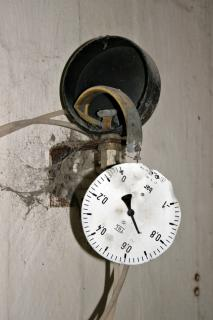
It’s time to start thinking about developing our power, but what do we do if we don’t have a power meter?
First, you will want to build on that good cardiovascular foundation that you now have underneath you from base building this winter. What’s that? You mean you didn’t do any base building during the heart of the winter season? Oh well, this may hurt a bit, but, you’ll get over it. Most riders don’t do base building and figure that the “Man, am I outa’ shape” feeling is an annual ritual all cyclists must endure. So you won’t be alone.
As we north easterners are joined by the other snow and cold winter states across the continent, it’s time to start developing our climbing legs. If you live in a flat state, consider this work applicable to time trials and power that will become useful for spitting people “out-the-back.”
The first question I get whenever I begin addressing a mixed crowd (not men & women, but power bike & non-power bike users) is “How do we do this if we don’t have Watts on our bikes?”
Developing power without a Power meter is not as hard as you might think. But we will require the other training tool; the Heart Monitor. This should not be a surprise since our cardiovascular system (especially our VO2 max) is our biggest limiter to power generation. Even the most zealot non-heart rate monitor cardiovascular atheist will tell you that. Look at their power workouts and you will find a lot of their power improvement drills are aimed at boosting VO2.
But enough side-bar fun, let’s get to the nitty gritty. Ideally, even if your main class or health club does not use Power bikes, you will want to find out where your power now stands, as a baseline. This will help you validate the upcoming training afterwards so that you can learn what works for you, what doesn’t and how your unique physiology reacts to training. Since we are talking about power, let’s do before and after tests on a power bike. You may just have to call around and locate a health club or studio that has them. This will give you the most accurate analysis of your results. However, barring that, we will use your speed and heart rate while riding outside to analyze your results. If you only ride inside, and you don’t have access to a Power bike at all… well,… you will have to look for some other manifestation of your power increases – longer hair on your chest? I guess that wouldn’t work for everyone :-0
Step 1: Establish T2 or “High Threshold”
Get a heart rate monitor and determine your high threshold. If you can’t get a metabolic / VO2 type test, here is a quick link to the standard field test that we use at Cycling Fusion compliments of Sally Edwards founder of Heart Zones® – its’s the complete protocol as well a Threshold chart.
Step 2: Sustainable Power Test
Ride for 20 minutes at the highest power you are able to hold steady or fairly steady for the entire 20 minutes, keeping your cadence between 75 and 90. Note when your heart rate hits T2 and does not come back (continues increasing or staying steady above threshold). Also record your approximate HR Average for the final 5 minutes of the test.
Step 3: Recovery
Recover for 5 minutes – Zone 1 at 85-100 RPM, just spinning the legs out.
Step 4: Repeat Test At A Lower Cadence (Climbing Power)
Maintain no more than 75 RPM (say 60 to 75), hold the same watts, and yes, that means you will be using a higher/heavier gear. Note when your heart rate hit T2 and once again doesn’t retreat. Also record your approximate HR Average for the final 5 minutes of the test.
Step 5a: Recreate The Power Requirements Outdoors
Label the 1st test Long Seated Climbs and the second one Standing Climbs (which you can do either seated or standing – the position is your call). Take these notes with you on an outside ride and when you are presented with a mild grade of a hill (say 5 to 7 percent), stay in the saddle find a speed that gets your heart rate to the average of your last 5 minutes of test 1. On this hill, do not let your cadence drop below 75. Try to hold that speed for at least 5 minutes or more (unless you run out of hill). You will likely need to stay in the big ring. You will need a bike computer that will tell you how fast you are going, or you will have to do the math based on how far you traveled in a given time period (meaning you will also need to make note of the exact time you started, and the exact time you finished) to derive your speed mathematically. This will establish your seated climbing speed for that specific hill.
While you will not be able to determine speed on an indoor bike (no matter what anyone tells you to the contrary) when you go to your next indoor class, you will have to do your best to simulate the relative resistance of a rolling or mild grade of a hill.
Step 5b: Recreate The Power Requirements Indoors
Regardless if you ride exclusively indoors or out, it is assumed that you will be still taking indoor classes from time to time. When your instructor calls for a seated climb, execute the Sustainable power numbers; HR of final 5 min of your Sustainability test, within the 75-90 RPM. Similarly, you can extrapolate this procedure for standing climbs when the instructor calls for a Standing Climb.
These type of workouts (indoors or out) should have you producing at least 4 to 8 climbs in or out of the saddle during each workout.
Getting Results
You are using cadence and heart rate to work on your power indoors and you are adding speed to the equation outside. After a couple of weeks of recreating these power requirements for your workouts (at least twice per week) some riders may begin to see speed increases, but this will vary greatly by individual. More likely the results will come after 4 to 6 weeks. This will be an easy indicator that your power is increasing. However, make sure you don’t work at holding the initial speed when you repeat the same route outside. Your focus must be on managing the heart rate and cadence, and let the speed be what it is, even if it is less on a given day. These drills call for a focus on cadence and resistance, and not speed per se. Speed will be a by-product; a hopeful bit of evidence that you put in the time, and did the hard work.
If you are an indoors-only rider, the only way you will know for sure that you have increased your power, is to go back to the power bike you did your initial test on, and repeat the effort. Make sure to do the test on the same exact bike by bike ID, and not just any bike of that brand – power can vary bike to bike in older models of some manufacturers. This time you should be able to hold a higher number of watts for each test. The results will speak for themselves.
Why It Works
The repeated physiological stress at and above T2 will eventually produce an adaptation in your cardiovascular system, and the cadence guidelines are meant to guide you to gears that will help develop the muscular endurance as well.
However, it your watts are not higher or if you hold only the same power numbers, you should note the time you hit T2 or higher in the test. The Threshold should now be encountered later (during the 20 minute re-test) than the first test, and the average heart rate should also be lower both overall, and especially in the last 5 minutes.
I’d be very interested in specific feedback from riders who give this training a try, and how they went about assessing their changes without an actual power meter. After all, there were many a year that the pros themselves never trained with a power meter, and somehow they were able to get stronger and more powerful along their data-less journey.
by John | Apr 11, 2011 | Freemotion - Foundation Fitness, Latest News, Training With Power

In an earlier post I alerted you to the new FreeMotion Indoor Cycle with power from Foundation Fitness. I've been doing research about the FreeMotion Indoor Cycle and Foundation Fitness, specifically on their educational programing and when will they be shipping product.
First; their Stages Indoor Cycling programming is headed up by Cameron Chinatti who, believe it or not, is an ICI/PRO member!
Cameron contacted me after seeing my first post, offering to help me understand what they had planned. After talking to her I got the impression that they really get it. Stages Indoor Cycling is based on the concept of Functional Threshold Power (FTP) with the intent of delivering measurable progress, using data collection tools = Indoor Cycling 2.0 🙂
From Cameron's IDEA Fitness Connect Profile
This is a good example of a completed Fitness Connect profile that you could follow.
Cameron is the Director of Education for Foundation Fitness and lead developer of Stages Indoor Cycling. Concurrently, she serves as CEO of Sounds Fit Solutions Inc; a company dedicated to fitness and audio systems education. As an international presenter/lecturer, Cameron has had the opportunity to educate on numerous topics ranging from indoor cycling to fitness career development. Her recent publishing credits include work for Foundation Fitness, Wexer.com and multiple contributions to the IDEA Fitness Journal and IDEA Fitness Manager. A background in Opera Performance and Vocal Pedagogy has led Cameron to create a specialty niche for fitness professionals wishing to develop the health, clarity and endurance of the human voice- a teacher’s greatest asset. Cameron is currently a Master Trainer for BOSU® by Fitness Quest as well as Gliding by Savvier . She is a continuing education provider for ACE and AFAA and holds specialty certifications through numerous organizations. When not EduTaining in Nashville, TN., Cameron can be found entertaining and singing with Hi-Phi Entertainment based in Boulder, CO.
I have an interview scheduled with Cameron for the 22nd of this month and would be happy to ask her any questions you may have about their cycle or programming.
Second; when will FreeMotion Indoor Cycles be available for delivery? The short answer is they hope to have them available this summer. The long answer I'm guessing is will be; “we'll wait and see.” As other manufactures are finding, developing a reliable monitor/counsel for an Indoor Cycle that functions properly and doesn't cause a bunch of maintenance headaches, is no easy task.
As I learn more you will be the first to know.
4/12 update: I just learned that they have two test studios;
- Rally Sport Health and Fitness in Boulder, CO
- Sports Academy in Logan, UT
If you are near either one of these locations I would love for you to take a class there and report back to us.
by John | Mar 30, 2011 | Indoor Cycling Bikes, Training With Power
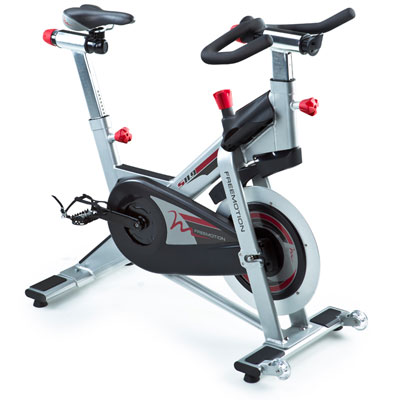
More evidence of Indoor Cycling 2.0
Gene Nacey tipped me off about this new Freemotion S11.0 Indoor Cycle
with power from a company called Foundation Fitness. What's interesting about this Indoor Cycle is that it uses magnetic resistance (the best system in my opinion) and it's wattage readings are based on measured power, through a strain gauge in the left crank. This may prove to be an improvement if it reduces or eliminates the need for frequent calibration. Why is this important? Because some question the accuracy and repeatability (consistency between one bike to the next) from a system based on calculated power; i.e. the Keiser M3 and the Schwinn AC performance.
Update: July 2011 – I am now teaching on the FreeMotion s11.9 and have a page dedicated to my review of this indoor cycle.
I did some research on them and they're promoting this Freemotion S11.0 Indoor Cycle that includes a Power Sensor Console
I see that they are connected to a new Indoor Cycling Certification program called Stages Indoor Cycling. No info there yet, but they do have a place where you can signup for email notifications.
I'll be digging in further and will report more soon. I find all of these new bikes with power to be simply fascinating. We all have a front row seat to watch Indoor Cycling 2.0 unfold and blossom right before our eyes 🙂
You can find more information about the FreeMotion s11.9 Indoor Cycle with power here.
by Gino | Jan 21, 2011 | Training With Power
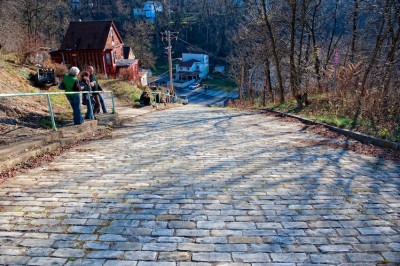
Training for improved climbing is one thing. Training for the Dirty Dozen is another. Given the fact that probably less than 1% of the hills one normally climb are as steep as those of the Dirty Dozen, it doesn’t make sense to train for this level of power requirement. That is, unless you actually want to survive the 5 plus hours in November as you climb more steep ascents in one day than you normally do in an entire season. Throw in the fact that I am prone to cramping if I don’t really keep the legs fresh, and this is not something I can take lightly.
When I put a training plan together for myself or a student, I’ve gotta’ work backwards. Where do we want to end up, and then back it up to where we are, and the rest will fill in by measured and deliberate progression. As an endurance rider, and someone who helps people do their first epic ride or century, we have the luxury of focusing on a slow periodized program from start to finish with more and more time in the saddle.
However, this total event is only about 50 miles in length, with 3 food breaks. Endurance is not what I need to train for. My focus needs to be on producing the required power for each grade of hill I will encounter, sustaining heart rates above threshold for varying amounts of time, and keeping the legs from siezing up in the process.
Consequently, instead of a 6 day a week riding schedule with rides between 1 and 3 hours long, I’ll be training 3 to 4 days per week where all but one of those days each week will be fairly intense; very little time in Zone 1 & 2, about 50% in Zone 4, and a progressive increase of time above threshold. In most cases, I will want a day off or activer recovery after each day of training.
I will be focusing on improving lactate buffering, and increasing my threshold. Starting my “pre-training” routine a couple weeks ago, I’ve already begun to feel an increase in my threshold, but I will do a New Leaf metabolic test this week to establish a true baseline.
While at first blush this doesn’t seem like a lot of training, the intensity creates a significant challenge. In fact, I’ve averaged over 1000 points per week just for the pre-training weeks. So, I’ll be using 1150 training load points as my starting baseline, and shoot for a 5% increase each week to keep the body honest. This will get to about 1800 points at the week I will begin to taper. I need to get fitter, stronger and more tolerant of the inevitable pain, and this seems to be the right approach.
So here’s the outline of the training plan:
3 days intense training: 2 days outside, 1 day inside
1 day of active recovery riding inside
1150 starting points, and % splits: Zones 1: 0%, 2:10%, 3:30%, 4:50%, 5:10%
Ending targets 1800 points, 20% in Zone 5, Threshold increase of 10 – 15 BPM
by Gino | Sep 24, 2010 | Training With Power

As is customary, I’ve opened my big mouth and am faced with the proverbial “put up or shut up”. Don’t get me wrong, I’m not one to trash talk and overstate my abilities. However, I am one that is always challenging others to accomplish things they think are bigger than themselves; to push past their own perceived limits and discover things about themselves they never knew. Sounds all good so far, but I have a basic life philosophy that tends to get me in trouble. To wit, I believe that whatever you teach, you should experience first. Consequently, all my challenges to others end up first putting me to the test.
Way back in January when our annual Winter Training Program kicked off, each participant was required to have a goal to train for. Goals ranged from doing a 50 mile charity ride to having 2 separate peaks during the race season. For me however, having just finished filming the Pittsburgh Dirty Dozen as a charity project for Livestrong, and watching some of the strongest riders I know struggle just to finish, that event seemed to be the logical choice. So I said it, I would train to complete – NOT COMPETE – in the Pittsburgh Dirty Dozen Race.
Starting this weekend, September 4th, I will have exactly 12 weeks to prepare for The Pittsburgh Dirty Dozen. I’m going to post my training plan (both Heart Zones® as well as Power Training), and pre-ride schedule on this blog for others in the Pittsburgh area who would like to train along with me. The training plan will provide some structure to follow even though we will train in different areas. Every 2 weeks I will take on at least 2 (or more) of the 13 climbs as part of the overall training plan as well. Exact times and dates will also be posted here so riders who want to share the pain can join me if they like.
Point of fact is: this IS a race. Point of reality is: only about 10 to 15 of the 180 riders that rode last year were strong enough to garner any points at all. The format of this “race” is that the entire field is together at the bottom of every hill, and then the organizer, Danny Chew blows the whistle (by the way, someone needs to buy him a new whistle this year, it was sketchy at best last year), and the first 5 riders to the top get points.
While a few supermen and wonder women surge to the top like they have hidden motors in their bikes, the rest of the field climb at varying speeds, with an inevitable group on every hill pushing their way if they can’t maintain at least 4 to 5 mph. In surveying the group last year, it was clear that a lot of the field were experienced amateur racers, and that this was not bringing out the average casual rider. So when I say people were pushing, and there are always people pushing, it does not mean they were weak or inexperienced riders.
The graphic above is from the training DVD we created (Global Ride Productions) from last year’s race. It is slated to be released in 2 to 3 weeks, just in time to mix up some great indoor cycling with the outdoor application. Stay tuned, as I will endeavor to keep this updated once per week as we head towards this epic event.
