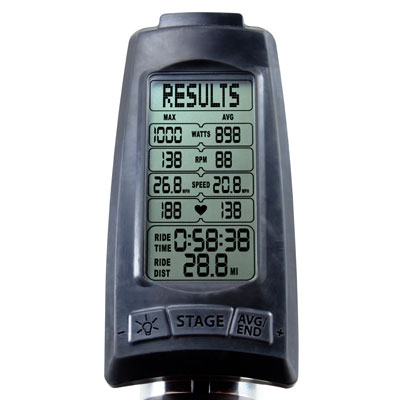
Better late than never they say. It certainly applies to this season's Performance Cycle classes – now we're in full swing after some initial confusion that came from a sudden change on GFDH's.
We kicked off this past Sunday with an assessment to find the wattage numbers we will be using going forward. I like to use very simple terminology that minimises any mathematical computations.
… Instead I base my Life Time Performance Cycle classes on two numbers; PTP (Personal Threshold Power) and JRAP (Just Riding Along Power — AKA > Base Watts > VT1 / First Ventilatory Threshold Power). From these two rider identified threshold wattages, we can construct three meaningful power Zones;
Recover zone — watts below JRAP
Perform zone — watts between JRAP and PTP
Improve zone — watts above PTP
Today we added one more wattage number – their 20 minute FTP watts. As you can guess, riders should have a lower 20 min average than a 3-4 minute PTP / Best Effort and be above JRAP / Base Watts.
Wait John, you just said you only use the two thresholds in class.
What's the point of adding a third number?
Adding the third point of reference helps you draw a straighter line. At least that's what my high school drafting teacher taught me. It's much easier to draw between two distant points, if you add one in the middle = it helps you understand if you're on the right path between the two known points!
[wlm_private ‘PRO-Platinum|PRO-Monthly|PRO-Gratis|PRO-Seasonal|Platinum-trial|Monthly-trial|PRO-Military|30-Days-of-PRO|90 Day PRO|Stages-Instructor|Schwinn-Instructor|Instructor-Bonus']
The process of sustaining a 20 minute effort is helpful to many riders – it validates and reinforces the two threshold numbers and confirms that people are understanding my cuing.
Before/during and after these twenty minute efforts I tell everyone; this effort should fall between the two thresholds. Which you would think I shouldn't even have to mention… until you hear the confusion I heard after the effort was completed:
I really surprised myself – my 20 min watts was the same as my 3 minute level!
There must be something wrong with me – I couldn't sustain my base watts for the whole ride 🙁
Teachable moments here
In the first example; my 20 min watts was the same as my 3 minute level! I was able to ask him; “what does that say about your 3 minute effort?” He understood before I completed my sentence; “I'm not working hard enough!”
The women who told me I couldn't sustain my base watts for the whole ride also had a revelation and asked me; “Do you think I'm working too hard at my base level?” I didn't even need to answer her.
Do you now see the value of adding that third number?
A continuous state of observation
I asked my class on Sunday; how many of you are on a specific training plan? None. Not a single hand went up. This is very typical for my very diverse group of middle age men and women. Yes most ride outside – but their objectives aren't structured beyond not rolling over and hitting the snooze button. They come to my Performance Cycle class to get a nice combination of intensity and endurance work, in a fun group.
My object in this class is that everyone learn from observing their performance, make adjustments and observe again. Over time they learn exactly where they need be. When it's time to work hard – they WORK HARD and when they should work easy – it really is easy.
Make sense?
Here's my playlist –
I'll get the rest of the profile up later in the week if you want to try this in your class.
No more hunting for new music or counting out cues to develop your ride profile. Here is your ready to ride profile for a fully choreographed ride, that can be displayed from your phone, or printed out onto cue cards for your class. This ride is timed out, down to the second, to make your life as easy as possible!
Guest post by Instructor & Studio Owner Pauline Geraci
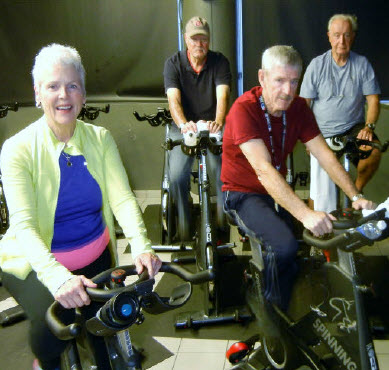
According the Administration for Community Living (ACL), people 65-plus represented 12.4 percent of the population in the year 2000 but are expected to grow to be 19 percent of the population by 2030.
Let’s face it, we are not getting any younger. As we age, the more important it is for us to stay active. But the older we get, the harder it is activity becomes.
We start developing muscle and joint pains and other issues which we sometimes use as an excuse to become less physically active which in turn makes us more prone to injury and the aging process. What to do?
Indoor cycling meets many of our aging population’s needs. For starters, it is a great cardiovascular workout. The American College of Sports Medicine (ACSM) recommends that healthy adults ages 18-65 years old should participate in aerobic physical activity for a minimum of 30 minutes, five days per week or vigorous intensity, aerobic activity for a minimum of 20 minutes, three days per week.
An indoor cycling class will keep your heart rate up long enough to provide health benefits. A physical activity that includes continuous cardiovascular activity can help lower your risk of coronary artery disease, can help lower blood pressure and LDL cholesterol, and can help lower your overall resting heart rate.
As we age, we start to develop balance issues because of inactivity or inner ear problems. Maybe we have fallen once and now are afraid to do activities without relying on a walker or cane. You certainly don’t feel comfortable riding a bike outdoors. Indoor cycling eliminates your concerns with balance issues. Indoor cycling removes the element of risk and the fear of falling so you can experience its health benefits. A good cycling class allows you to go at your own pace and push yourself, yet feel safe and comfortable.
Another worry for seniors is finding a cardiovascular workout that is low to no impact. Indoor cycling offers a high intensity low impact workout. Many people who recently have recovered from orthopedic injuries turn to indoor cycling to help them get back on track.
Remember, as with all physical activity you are about to embark on, make sure you get clearance from your doctor. Indoor cycling, when done correctly, provides minimal impact on the hip, knee and ankle joints.
Because of the circular motion of riding a bike, your knees properly flex and extend, while avoiding the high impact pounding of other activities such as running or certain aerobic type classes.
Another issue of aging is age-related sarcopenia. People who are physically inactive can lose as much as 3-5 percent of their muscle mass per decade after age 30. Even if you are active, you still will experience some muscle loss.
A benefit of indoor cycling is increased muscular endurance. This refers to the ability of a muscle to continually and repeatedly exert force over an extended period of time. In an indoor cycling class, you pedal against resistance which increase the endurance of the leg muscles: legs, quadriceps, hamstrings, gluteus and even the calf muscles.
Working out these muscles also will help to strengthen the surrounding bones, tendons and ligaments which also help you with balance issues.
In turn, this increased strength means you’ll be able to perform your daily activities with greater ease.
Riding outdoors is great but there are safety and weather issues to contend with. You can’t make excuses about not working out because of the weather when you ride indoors. Indoor cycling also allows you to be free from concerns such as negligent motorists, narrow road shoulders, going downhill too fast and bike malfunctions (flat tires, loose chains, etc.).
It’s good to get outdoors and exercise whenever possible, but it’s also important to keep from putting yourself at unnecessary risk, especially at an age when each fall is a little harder to get up from than the last.
The ability to choose your own resistance also makes indoor cycling an ideal fitness class for seniors. On an outdoor ride, your resistance level is dependent on your surrounding terrain. On any given route in Sequim you will find inclines that you are not prepared to handle. You also may not feel challenged during an outdoor ride.
Indoor cycling will definitely challenge you! Indoor bikes come with resistance knobs. This allows you to raise or lower the intensity of the workout to meet your physical restraints and/or fitness goals.
Many people, not just seniors, would like to lose some weight. If your fitness goals include weight and/or fat loss, you’ve come to the right place.
According to spinning.com, you can burn anywhere between 400-600 calories per average 45-minute class.
Since it takes 3,500 calories to burn one pound of fat, just 5-8 indoor cycling classes, combined with a healthy diet can help you meet your New Year goals!
Unfortunately, it’s impossible to stop the aging process. But don’t let that excuse you from engaging in your favorite activities. Come and enjoy a safe and exhilarating workout experience at indoor cycling classes nearest to you!
Pauline Geraci is owner of Fit4Life Studio, 1245 W. Washington St., Sequim. See www.fit4lifesequim.com.
No more hunting for new music or counting out cues to develop your ride profile. Here is your ready to ride profile for a fully choreographed ride, that can be displayed from your phone, or printed out onto cue cards for your class. This ride is timed out, down to the second, to make your life as easy as possible!
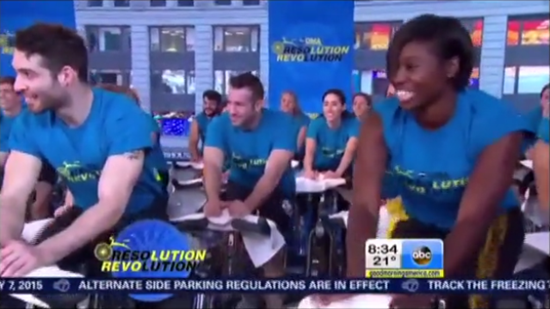
Five million viewers of ABC's “Good Morning America” TV program were treated to a wonderful promotion for Indoor Cycling this past week. As I watched I just couldn't help myself and began humming REM's Shiny Happy People. That was exactly what I was seeing > hundreds of shiny, happy people enjoying riding inside. I can't think of a better way to kick off 2015!
I'm of course describing the nationwide 2015 SoulCycle resolution ride that aired Jan 7th live on “Good Morning America.
What a way to jumpstart January! SoulCycle joined Good Morning America today for its Resolution Revolution. We tapped it back on SoulCycle bikes in their dressing rooms and hallways as well as in Times Square – while GMA showed live feeds from Soul classes happening in Bethesda, Chestnut Hill, Coral Gables, Short Hills and West Hollywood! Check out this video clip of all the action, including an interview with instructor ANGELA DAVIS on how to stay motivated as well as an update on our SoulScholarships Program. It was a good morning, indeed!
Here's the video of the event if you haven't seen it.
I hate math, especially when I'm forced to do quick calculations in my head.
Figuring (forgive the pun) that many other people dislike math, I won't ask anyone to do any calculations in my classes. For example, I would never cue something to the effect of;now I need everyone at 85% of AT for one minute… and then we'll push up to 95% for the final 30 seconds! Against a background of loud, pounding music, at that point I've got my head up and I'm mouthing to you:
Wait… what are you asking me to do?
Won't do it. Instead I base my Life Time Performance Cycle classes on two numbers; PTP (Personal Threshold Power) and JRAP (Just Riding Along Power – AKA > Base Watts > VT1 / First Ventilatory Threshold Power). From these two rider identified threshold wattages, we can construct three meaningful power Zones;[wlm_private ‘PRO-Platinum|PRO-Monthly|PRO-Gratis|PRO-Seasonal|Platinum-trial|Monthly-trial|PRO-Military|30-Days-of-PRO|90 Day PRO|Stages-Instructor|Schwinn-Instructor|Instructor-Bonus|28 Day Challenge']
Recover zone – watts below JRAP
Perform zone – watts between JRAP and PTP
Improve zone – watts above PTP
That's all I need to coach and cue an easily understandable class, to a variety of riders. Regulars include committed endurance athletes, Cat 2 cyclists (A group riders), weekend warriors (B group) and lots of; “I'm not training for anything John… I just like your class” regular folks.
Using these three simple zones makes the cuing each task much easier to communicate and, without a lot of numbers and percentages flying around the room, much more actionable by my riders.
Now I need everyone in the upper part of their Performance Zone for one minute… and then we'll push up to the Edge of your threshold the final 30 seconds!
This is an expanded version of Dennis Mellon's Below/@/Above threshold cues he uses and similar to the well documented heart rate based concepts that makeup the Zoning Program.
Using this system to cue wattage intensity, I've successfully taught this class for past two years – this is our third on the FreeMotion S11.9 Indoor Cycles. We do not have a Display Training system like Performance IQ or Spivi to project rider metrics on a screen and/or do the “math” for you to display percentage based power zones. The numbers on the console are what we have to work with.
Over this times I have had numerous (dozens maybe) participants thank me for NOT using percentages of “something” to communicate intensity levels of heart rate or wattages. That makes me happy and it really simplifies my job as the Instructor/Coach > Coach is a much better description of my role in these classes training sessions as I will typically ride side by side with them, rather than up front in the normal Instructor position.
NOTE: I still have control of my music when I'm riding with the group. See this post about using an inexpensive bluetooth receiver so your iPhone is wirelessly connected to the sound system.
Today's 75 minute session > Pinning Down Two Numbers
I you look at the song lengths of my playlist you'll quickly understand the class format >
A long (9-13 minute) song where we play around finding JRAP / Base Watts
Followed by a short (3-4 minute) track where we explore PTP
Rinse and repeat
The first track is of course a warm up that includes 3-4 x 30 second accelerations / openers near the end to get everyone ready to work.
Track #2 – the first PTP track is important. We'll use this average wattage for each of the four PTP efforts to follow. Everyone seemed to enjoy Billy Idol — Rebel Yell – 1999 – Remaster – maybe suffered a bit as well. At 4:47 there's plenty of time to explore PTP. We use the Stage button to reset the averages at the beginning of what I describe as; Your Best Sustainable Effort. It's normal for riders to miss-judge where they should be, so I'll often have everyone make needed adjustments and hit the Stage button again to reset the averages.
Track #3 is for finding JRAP / Base Watts. The very recognisable Peter Frampton — Do You Feel Like We Do – Live is perfect for this. We used the first few minutes of the long track to recover and then begins of dialing in the wattage that has everyone at JRAP/Base Watts. It's fast @ 108 RPM – I don't demand they follow it exactly, encouraging cadences above 90RPM. With one hand on the resistance knob, we add / subtract load in small increments… and then wait for our breathing response. I cue the feeling where you're just above “chatty” = you are first noticing you'd prefer breathing through your mouth.
My own unscientific research has be seeing JRAP / Base Watts ~ 65-70% of PTP. Sorry, there are those damn percentages I hate > I offer that just for your perspective.
If using VT1 / First Ventilatory Threshold Power or heart rate is new for you this series of posts have a bunch more detail. This video from ACE does a great job demonstrating VT1 / First Ventilatory Threshold.
I get questions; John, they're talking about heart rates here, not power, so how does this apply?
Heart Rate BPM's are just an indication of effort (how hard you're working). Watts are the same. You work “X Watts” hard, it feels like “Y RPE” and your HR is “Z BPM”. Does that make sense? It doesn't need to be any more complicated than that. Remember, I hate math 🙂
Rinse & Repeat
Self direction is a key component of how I coach my Performance classes. After all, I'm not going to be there with them on the road. So once everyone understands the drills and what what they're supposed to accomplish, I pretty much turn them loose.
Please let me know if you use this > or your questions.