by Joey Stabile | Mar 1, 2021 | Best Practices, Class Work-Sets, Creativity Indoor Classes, Instructor Training, KEEPING IT FUN, Master Instructor Blog, Training With Power
Welcome to the The Weekly Ride by Cycling Fusion:
No more hunting for new music or counting out cues. Here is your ready to ride document, that can be displayed from your phone, or printed out onto cue cards. This ride is timed out, down to the second, to make your life as easy as possible!
(more…)
Originally posted 2018-03-13 15:36:45.

by John | Mar 1, 2021 | Engage Your Students, Featured Studios, KEEPING IT FUN

Image from Rate your Burn
Saw this posted on Facebook and just had to share it. The author, Victoria, is a triathlete, runner and fashion blogger at alltheshoesfit.com – she's also a raving fan of GRIT Cycle in Costa Mesa, California.
TOP 10 SIGNS YOU’RE ADDICTED TO YOUR SPIN CLASS
-
You plan your entire week around the spin class schedule.
-
You’ve lost interest in designer clothing and shoes and are suddenly obsessed with seeking out the latest “on trend” spin leggings.
-
The mere thought of your favorite instructor switching schedules, going on vacation or (god forbid) leaving, throws you into a tail spin.
-
Whenever you hear a new song you immediately categorize it by BPM and if it would be a sprint, climb, or push and tap song.
You'll find the rest of Victoria's 10 signs you are addicted here.
GRIT Cycle was a project of Barbara Hoots from Indoor Cycle Design. One of owners is Marisa Wayne, daughter of The Duke – actor John Wayne. I haven't been there myself, but the place sounds like it incorporates Barbara's usual attention to detail – described here in an earlier post from Victoria:
These guys did it right from the moment of conception to the day they opened the doors and they continue to do it right. Nothing is an afterthought. Every attention to detail has been carefully planned and executed. The saddle room (more about the name later) has wide sliding glass doors that open to a deck with lounge furniture where you can bask in the sun before or after class. You may be temporarily blinded to the fact that you are about to work your ass off and think you are at a resort in Palm Springs, the only thing missing being the pool.

Notice that these are custom painted Schwinn Performance AC Indoor Cycles and the Instructor bike on the stage is a unique color.
Originally posted 2018-02-05 09:00:29.

by John | Feb 20, 2021 | Best Practices, Engage Your Students, Instructor Training, KEEPING IT FUN, Learn Leadership Skills

4/1/16 update – not an April Fools joke, rather I'm re-publishing this today to help a friend with this issue.
I heard a very disturbing story this morning, from a regular in my 6:00am class.
What follows is a sad example of what happens when an Instructor isn't the leader in the class and tolerates disruptive behavior by one or more members.
Member: Did you hear what happened yesterday? I'm really curious what will happen tomorrow.
Me: No… what happened, tell me.
Member: It was total anarchy. The guy behind me completely lost it. I guess he couldn't take her non-stop talking anymore and yelled, SHUT THE F*** UP at the women who was riding two places to his right, while she was talking loudly on her phone.
Me: Wait, she was on her phone… in the middle of class?
Member: Yeah, she had on hand covering her ear and was talking really loudly in a conversation that seemed to go on forever. A number of us gave the instructor pleading looks to ask her to do something. She just shrugged her shoulders with a “I can't do anything” look.
Me: That's crazy.
Member: That was only the beginning. What happened next was complete chaos. People started yelling at each other. It's was almost like the people who come to focus and really work hard were empowered by that guy expressing his frustrations with the talkers. They'd also had had enough and many joined in to support him. I couldn't believe all this was happening…
I can believe it. Our riders pay a lot of money to be members. They're also polite people who tend to sit quietly, even though internally they're seething inside, being forced to endure frequent (in some classes constant) disruptions, when all they want is to listen to the music and work hard. I've been told by members, on multiple occasions, that they appreciate how I try to keep disruptions to a minimum.
I can also understand how, for some Instructors, it is difficult to be the leader and impose order on his/her class. Indoor Cycling classes are supposed to be a fun experience – not a contentious time when we need to act more like a strict parent, than a personable, fitness Instructor.
Thinking back, I don't remember “Leadership Skills” being included in any of the certification programs I've taken. Which I feel is a mistake. It's my belief that learning to be the leader in your class is the most important role you have in your studio – especially for new Instructors and a critical skill for anyone teaching in a Big Box studio with a large & diverse membership.
Understanding that many Instructors aren't natural “leaders” I have written a bunch of articles that I hope will explain; WHY your class needs you to be the leader, signs that some in class don't accept and/or respect your leadership, and what you can do to assert your proper role – even if you haven't in the past.

Stop the Talkers — Step One… Identify The Real Issue
There’s a recurring issue that keeps popping up on Facebook and Pedal-On forum:
Does anyone have a suggestion about to do about the consistent talkers in my classes? They’re really disruptive, but I don’t what to offend anyone. What should I do?

Stop the Talkers — Step Two… It’s an issue of disrespect, but why?
So if in one instance people are disrespecting you and the other’s in your class by talking, but in a different situation they wouldn’t, the obvious question to ask is WHY? Why do people act disrespectfully?
The whole concept of why people do what they do is fascinating to me. Back in 2011 I introduced you to the concept of Start with WHY and that it’s important to understand WHY you are doing what you do… and WHY some of your participants do what they do.
 Stop the Talkers — Step Three… Let’s Fix This Today!
Your class participants and manager/owner are expecting you to be the leader of your class.
So let’s end these Talker problems today!
You'll find additional suggestions on developing as the leader of your class (or outdoors as a ride leader) here.
Originally posted 2016-04-01 01:33:59.
by John | Jan 14, 2021 | Engage Your Students, Instructor Training, KEEPING IT FUN, Master Instructor Blog, Training With Power
Image from http://www.thesecretlifeofdee.com/
John, I'm still confused by this power stuff… where should I be riding? How many watts should I be seeing on my monitor, because I'm no where close to my body weight?
I get questions similar to this frequently from members. My answers has evolved over time:
- I used to give into the pressure; “please tell me a number” and would throw out a vague target – “your first goal could be seeing watts equal to your your body weight”.
- Later I revised it down a little; “what would be your desired, lean body weight?” “Let's try to reach that as an early power goal.”
But now I'm learning that throwing out watts = body weight (lean or actual) isn't as helpful as I intended. Sure for some it works. Those who are reasonably fit looking (read not overweight) and with a good fitness base. For others I've found I was asking them to work too hard, using a kind of formula that wasn't personalized for each individual. Which sounds is a lot like using the 220 – age for MAX HR 🙁
Now my preference is to conduct a short “Best Effort”, about a quarter of the way through class, to give everyone an understanding of a number they can work from. Not a true FTP or PTP, but it's been reasonably well accepted… but not by everyone.
Case in point: last Thursday after class I had the “how many watts should I be making?” discussion with a female member. She's a fit 50 year old and I would guess (I never ask) she weighs about 130lbs.
So I asked her what she normally sees during the “Best Effort” interval. “I average about 80 watts.” Which confused me… a lot actually. I would have guessed she could easily make more than 80 watts. I was stuck for an answer. Rather than guess at the reason, I started asking questions:
- Do you ride outdoors? No, not regularly.
- Are you a runner? YES!! Big smile.
- How would you compare running vs. cycling? Cycling is much easier. I'm getting to something here…
- Do you run in competitive events like a 5k, 10k, Marathon, etc…? Another YES !!! I love to compete!!!
- Do you run faster & harder in a 5k vs. a Marathon? Yes, of course I do – why?
- When you're riding in here with me, does your “Best Effort” feel more like a 5k or a Marathon? She stopped to think about it and then said; like a Marathon.
- Bingo!
I didn't need to say anything more. The look on her face told me she understood exactly where her confusion was coming from. Her perception of working hard was at her Marathon level of intensity = 80 watts was exactly right, figuring an aerobic level of effort. I had been making the assumption that when I asked for hard, everyone would work at the level I perceive as “hard” – which for her was different.
She ended the conversation with; so when you ask us for our “Best Effort”, I should be working at my 5k level of effort?
Exactly, or maybe a 5k where you're chasing one of your faster friends 🙂
Originally posted 2018-06-22 07:00:33.
by Matt Wahleithner | Jan 8, 2021 | Best Practices, Engage Your Students, Instructor Training, KEEPING IT FUN, New Instructor 101
For years I have taught classes that were physically challenging to participants but when I started to bring more than the Physical Dimension of Wellness to my classes, MAGIC HAPPENED.
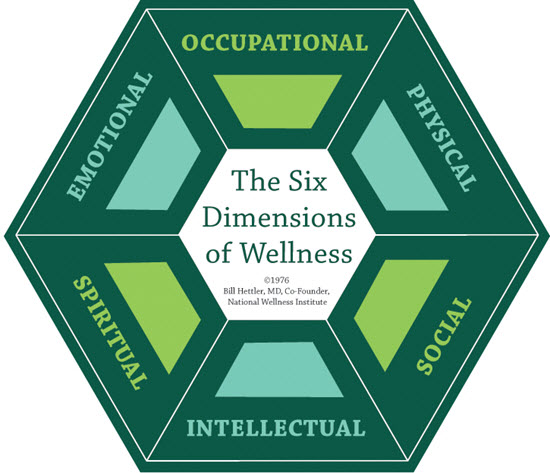
Dr. Bill Hettler, the co-founder of the National Wellness Institute (NWI), created a model named, The Six Dimensions of Wellness, in 1976. His idea of Wellness was not merely just the absence of disease, but living a life in which you become more aware and make decisions towards a more successful existence.
The dimensions from Dr. Hettler’s model are;
- Physical
- Social
- Intellectual
- Spiritual
- Emotional
- Occupational.
These 6 Dimensions when fully obtained can be thought of as a wheel, the more full your wheel is the better life may be, the less full the wheel is the harder life may be. Knowing this as a Fitness Professional, I made it a point to bring more than just the Physical Dimension to each of my classes and saw an improved mood and performance from members.
Below are a few ways to implement some of the Dimensions of Wellness into your classes and getting your participants to living more successful lives!
Social Wellness: I start each of my classes by having participants near one another introduce themselves and share their goals with each other, during the Warm-up. This really creates a sense of community and connection that might not be there unless you initiate it to happen.
The first time I tried this in class there was a silent pause and a look of hesitation of those in the room. I quickly followed up my request by sharing a stat that I read in Forbes Magazine, stating that those who share their goals with others, are 75% more likely to accomplish those goals than those who do not. This lit the fire and soon my classes were celebrating each other’s successes and helping hold each other accountable.
Physical Wellness: During the class it’s crucial you create a sense of connection with the body, whether it is Heart Rate, Perceived Exertion, or simple stating where and what they should be feeling. This help will get your participants engaged and understanding what’s happening PHYSICALLY rather than just going through the motions.
Whenever you get a chance during your classes, tell your participants exactly what they should be feeling so they know they are accomplishing the goals you have set.
For example, when I am teaching a Standing Attack Drill, I will prep the class by saying, “think of the word ATTACK, it’s strong, it’s powerful, and it’s aggressive! If you attack with those words in mind, your legs will start to warm, your breathing will become heavy, your heart rate will rise and when you finish this attack, you will be breathless and that much harder to beat! Let’s Roll!”
Your riders will now be able to connect with physical signs and feedback from their own bodies, which will be a great way to keep them engaged and working hard no matter if they are a beginner or a well-seasoned athlete.
Emotional Wellness: Towards the end of classes, I usually have a track where I give full control to the riders. I have a set directive for the drill and try to evoke an emotional attachment to their work effort and goals. I will ask again and again, “Is this the best you can do? Is this as hard as you can work, if so KEEP GOING, IF NOT MAKE THE CHANGE! BE BETTER!” I try to create a sense of pride and worthiness to their work and show them not just how PHYSICALLY strong they are but EMOTIONALLY.
This is all about song selection and coaching. The best example I can give that I use in my classes is the song, Breakn’ a Sweat by Skrillex & The Doors (Zedd Remix). The drill is simple; it’s a seated climb up the hill that scares you, the one you can BARLEY make it to the top of, the hill that when you get to the top, you feel victorious. The gear choices are up to you but the RPM’s must never go below 65. Ever rider will have a different idea of what this hill looks and feels like. It then becomes the instructor’s job to coach their team of riders up this hill and make them believe every second of the way that they can do it.
Spiritual Wellness: Finally at the end of class, during the Cool-Down, I always have participants turn to their neighbors and give them a good-job or some words of praise for their work. The Cool-Down to me has 2 parts to it, first to bring recovery and relief to the body through a controlled ride and stretches, and second to feel a strong sense of pride for the effort and work they did during class.
As soon as the last beat drops and the work part of the class is over, I always tell my class to turn to their neighbors and commend them for their effort during class. I also always make sure that the song or songs that I use for Cool-Down provide motivation or inspiration, like the song, I Lived, by One Republic. The lyrics talk about taking chances and, my personal favorite, OWNING EVERY SECOND! As the leader of your class, assure your team of riders that the effort they put in is one they should be proud of and feel good about.
Since the implementation of these techniques I have seen a steady retention and full classes. When you start to introduce these Dimensions into your classes, be authentic and go in wholeheartedly, and you too will see MAGIC HAPPEN!
Originally posted 2018-09-27 11:19:55.
by John | Dec 24, 2020 | Engage Your Students, Heart Zones USA, KEEPING IT FUN
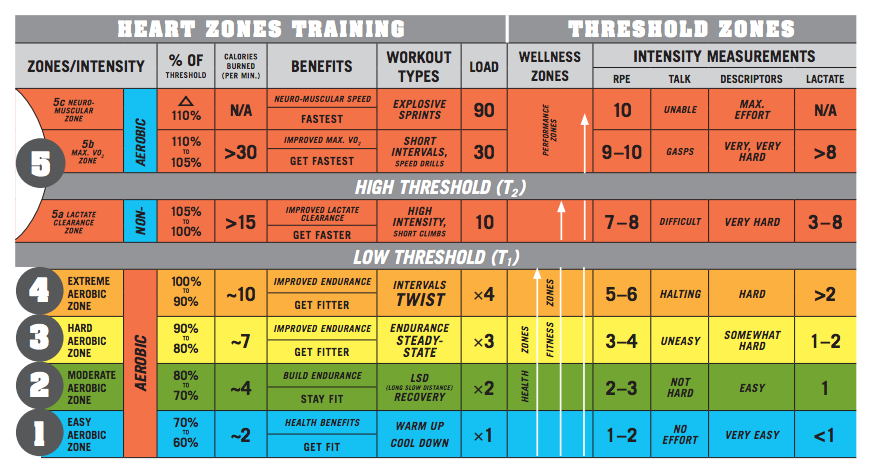
My friend Sally Edwards makes an excellent point here that applies equally to any endurance athlete and affirms our discussion from Podcast 368 — Does Intensity Trump Duration?.
It turns out that very fast runs are good for you–and that moderately fast runs (those just above threshold, in the Black Hole) are not. That’s because Black Hole runs are too slow to cause enough stress to make your body want to strengthen itself, and too fast to allow you to go long enough to improve your endurance. Studies of top runners find that they (by design or not) minimize their time in the Black Hole.
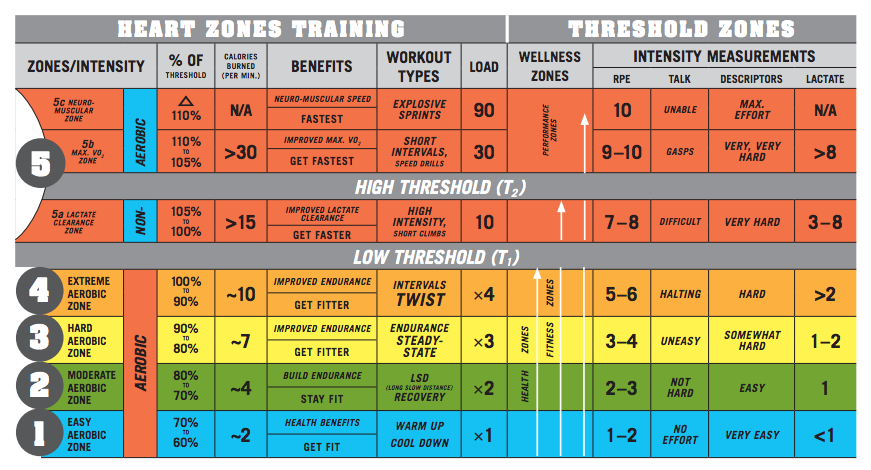
How fast is the Black Hole? In terms of pace, heart rate, and the Heart Zones chart, the Black Hole is actually a very narrow band. It starts at threshold, right as you enter Zone 5, and goes about 5 percent higher. So, if your threshold heart rate is 150 bpm, your Black Hole would extend from 150 to 157 bpm. That means if you really want to improve, your fast runs should roughly start at a second threshold: 158 bpm.
**This post is one of several in an excerpt series from the book, Be a Better Runner by Sally Edwards & Carl Foster**
But don't discount fun exercise = running/cycling that you enjoy just for how it makes you feel. Many people have no interest in structured “training”, they exercise because they find it fun.
Why There’s No Such Thing as Junk Miles
Whether you’re in training or not, every ride has a purpose–and just about every one is legit
Fun, however, is a legitimate purpose. Stress relief is a legitimate purpose. The fact that you can finally ride outside after being trapped inside by a wall of snow and ice for six weeks, structure be damned, is a legitimate purpose. The only non-legitimate purpose I can think of is if you’re out there joylessly slogging through some self imposed workout because you feel like you need more miles when those miles are not a) making you happy b) making you faster or c) building your reserves, but rather a) making you miserable, b) making you slower and c) breaking you down.
As an A type male, it was difficult to understand the whole “fun exercise” concept. What's the point of taking this class, if you're going to talk through it?
Once I understood that for some folks, Keeping It Fun is the objective, it became a lot easier to accept the appeal of SoulCycle type classes… and their wild success 🙂
Originally posted 2017-03-12 08:40:23.
