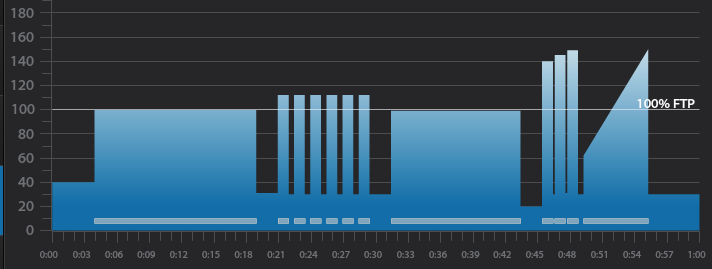
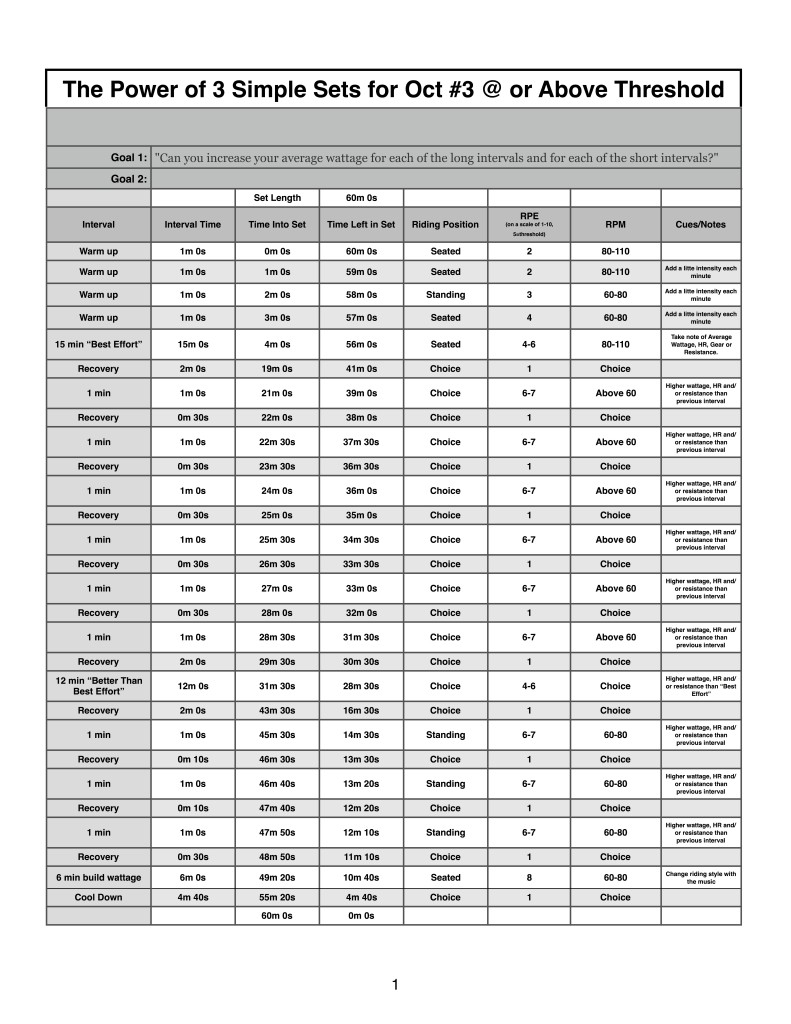
Below you'll find Week 3 of October's @ or Above Threshold Keep it Simple and Progress indoor cycling profile.
Workout Basics:
4 minute warmup
15 minute benchmark ride to find “Maximum Sustainable Wattage”
2 minute recovery
6 x 1 minute interval w/30 sec recovery after each
2 minute recovery
12 minte interval at higher wattage than the 15 minute benchmark
2 minute recovery
3 x 1 minute interval w/10 seconds recovery after each
6 minute interval increasing intensity throughout
4 minute 40 second cool down
Workout Goal:
“Can you increase your average wattage for each of the long intervals and for each of the short intervals?”
4 minute warm up
Slowly and steadily elevate the HR or Wattage to above threshold
No recovery, roll right into the next interval
15 minute “Maximum Sustainable Wattage” Test
Settle into a sustainable intensity, HR or Wattage
Ride for 15 minutes and let the songs dictate the terrain
2 minute recovery
6 x 1 minute w/30 seconds recovery after each interval goals and specifics:
Ride for 1 minute in any position and with an RPM above 60
Complete the every interval with a higher average wattage than the previous interval
30 second recovery or reset
12 minute @ Threshold Ride
Settle into a sustainable intensity, HR or Wattage
Ride for 12 minutes and let the songs dictate the terrain
Try to finish with a higher average wattage than the 15 minute interval
2 minute recovery
3 x 1 minute w/10 second recovery after each goals and specifics:
Ride for 1 minute in any position and with an RPM above 60
Complete the every interval with a higher average wattage than the previous interval
10 second recovery or reset
5 minute interval goals and specifics:
Increase intensity every minute until end of song
Cool Down
[wlm_private ‘PRO-Platinum|PRO-Monthly|PRO-Gratis|PRO-Seasonal|Platinum-trial|Monthly-trial|PRO-Military|30-Days-of-PRO|90 Day PRO|Stages-Instructor|Schwinn-Instructor|Instructor-Bonus|28 Day Challenge'].
Trainer Road Profile (If you're Trainer Road Member join my Team to get this and all profiles)
No more hunting for new music or counting out cues to develop your ride profile. Here is your ready to ride profile for a fully choreographed ride, that can be displayed from your phone, or printed out onto cue cards for your class. This ride is timed out, down to the second, to make your life as easy as possible!
I hate math, especially when I'm forced to do quick calculations in my head.
Figuring (forgive the pun) that many other people dislike math, I won't ask anyone to do any calculations in my classes. For example, I would never cue something to the effect of;now I need everyone at 85% of AT for one minute… and then we'll push up to 95% for the final 30 seconds! Against a background of loud, pounding music, at that point I've got my head up and I'm mouthing to you:
Wait… what are you asking me to do?
Won't do it. Instead I base my Life Time Performance Cycle classes on two numbers; PTP (Personal Threshold Power) and JRAP (Just Riding Along Power – AKA > Base Watts > VT1 / First Ventilatory Threshold Power). From these two rider identified threshold wattages, we can construct three meaningful power Zones;[wlm_private ‘PRO-Platinum|PRO-Monthly|PRO-Gratis|PRO-Seasonal|Platinum-trial|Monthly-trial|PRO-Military|30-Days-of-PRO|90 Day PRO|Stages-Instructor|Schwinn-Instructor|Instructor-Bonus|28 Day Challenge']
Recover zone – watts below JRAP
Perform zone – watts between JRAP and PTP
Improve zone – watts above PTP
That's all I need to coach and cue an easily understandable class, to a variety of riders. Regulars include committed endurance athletes, Cat 2 cyclists (A group riders), weekend warriors (B group) and lots of; “I'm not training for anything John… I just like your class” regular folks.
Using these three simple zones makes the cuing each task much easier to communicate and, without a lot of numbers and percentages flying around the room, much more actionable by my riders.
Now I need everyone in the upper part of their Performance Zone for one minute… and then we'll push up to the Edge of your threshold the final 30 seconds!
This is an expanded version of Dennis Mellon's Below/@/Above threshold cues he uses and similar to the well documented heart rate based concepts that makeup the Zoning Program.
Using this system to cue wattage intensity, I've successfully taught this class for past two years – this is our third on the FreeMotion S11.9 Indoor Cycles. We do not have a Display Training system like Performance IQ or Spivi to project rider metrics on a screen and/or do the “math” for you to display percentage based power zones. The numbers on the console are what we have to work with.
Over this times I have had numerous (dozens maybe) participants thank me for NOT using percentages of “something” to communicate intensity levels of heart rate or wattages. That makes me happy and it really simplifies my job as the Instructor/Coach > Coach is a much better description of my role in these classes training sessions as I will typically ride side by side with them, rather than up front in the normal Instructor position.
NOTE: I still have control of my music when I'm riding with the group. See this post about using an inexpensive bluetooth receiver so your iPhone is wirelessly connected to the sound system.
Today's 75 minute session > Pinning Down Two Numbers
I you look at the song lengths of my playlist you'll quickly understand the class format >
A long (9-13 minute) song where we play around finding JRAP / Base Watts
Followed by a short (3-4 minute) track where we explore PTP
Rinse and repeat
The first track is of course a warm up that includes 3-4 x 30 second accelerations / openers near the end to get everyone ready to work.
Track #2 – the first PTP track is important. We'll use this average wattage for each of the four PTP efforts to follow. Everyone seemed to enjoy Billy Idol — Rebel Yell – 1999 – Remaster – maybe suffered a bit as well. At 4:47 there's plenty of time to explore PTP. We use the Stage button to reset the averages at the beginning of what I describe as; Your Best Sustainable Effort. It's normal for riders to miss-judge where they should be, so I'll often have everyone make needed adjustments and hit the Stage button again to reset the averages.
Track #3 is for finding JRAP / Base Watts. The very recognisable Peter Frampton — Do You Feel Like We Do – Live is perfect for this. We used the first few minutes of the long track to recover and then begins of dialing in the wattage that has everyone at JRAP/Base Watts. It's fast @ 108 RPM – I don't demand they follow it exactly, encouraging cadences above 90RPM. With one hand on the resistance knob, we add / subtract load in small increments… and then wait for our breathing response. I cue the feeling where you're just above “chatty” = you are first noticing you'd prefer breathing through your mouth.
My own unscientific research has be seeing JRAP / Base Watts ~ 65-70% of PTP. Sorry, there are those damn percentages I hate > I offer that just for your perspective.
If using VT1 / First Ventilatory Threshold Power or heart rate is new for you this series of posts have a bunch more detail. This video from ACE does a great job demonstrating VT1 / First Ventilatory Threshold.
I get questions; John, they're talking about heart rates here, not power, so how does this apply?
Heart Rate BPM's are just an indication of effort (how hard you're working). Watts are the same. You work “X Watts” hard, it feels like “Y RPE” and your HR is “Z BPM”. Does that make sense? It doesn't need to be any more complicated than that. Remember, I hate math 🙂
Rinse & Repeat
Self direction is a key component of how I coach my Performance classes. After all, I'm not going to be there with them on the road. So once everyone understands the drills and what what they're supposed to accomplish, I pretty much turn them loose.
Please let me know if you use this > or your questions.