John, I'm still confused by this power stuff… where should I be riding? How many watts should I be seeing on my monitor, because I'm no where close to my body weight?
I get questions similar to this frequently from members. My answers has evolved over time:
I used to give into the pressure; “please tell me a number” and would throw out a vague target – “your first goal could be seeing watts equal to your your body weight”.
Later I revised it down a little; “what would be your desired, lean body weight?” “Let's try to reach that as an early power goal.”
But now I'm learning that throwing out watts = body weight (lean or actual) isn't as helpful as I intended. Sure for some it works. Those who are reasonably fit looking (read not overweight) and with a good fitness base. For others I've found I was asking them to work too hard, using a kind of formula that wasn't personalized for each individual. Which sounds is a lot like using the 220 – age for MAX HR 🙁
Now my preference is to conduct a short “Best Effort”, about a quarter of the way through class, to give everyone an understanding of a number they can work from. Not a true FTP or PTP, but it's been reasonably well accepted… but not by everyone.
Case in point: last Thursday after class I had the “how many watts should I be making?” discussion with a female member. She's a fit 50 year old and I would guess (I never ask) she weighs about 130lbs.
So I asked her what she normally sees during the “Best Effort” interval. “I average about 80 watts.” Which confused me… a lot actually. I would have guessed she could easily make more than 80 watts. I was stuck for an answer. Rather than guess at the reason, I started asking questions:
Do you ride outdoors? No, not regularly.
Are you a runner? YES!! Big smile.
How would you compare running vs. cycling? Cycling is much easier. I'm getting to something here…
Do you run in competitive events like a 5k, 10k, Marathon, etc…? Another YES !!! I love to compete!!!
Do you run faster & harder in a 5k vs. a Marathon? Yes, of course I do – why?
When you're riding in here with me, does your “Best Effort” feel more like a 5k or a Marathon? She stopped to think about it and then said; like a Marathon.
Bingo!
I didn't need to say anything more. The look on her face told me she understood exactly where her confusion was coming from. Her perception of working hard was at her Marathon level of intensity = 80 watts was exactly right, figuring an aerobic level of effort. I had been making the assumption that when I asked for hard, everyone would work at the level I perceive as “hard” – which for her was different.
She ended the conversation with; so when you ask us for our “Best Effort”, I should be working at my 5k level of effort?
Exactly, or maybe a 5k where you're chasing one of your faster friends 🙂
The focus of our conversation is on her Principle #7 – Carefully Consider Your Cues. Kymberly encourages Instructors to “Speak Boomer Language”:
Cues that motivate your younger, pain-free, joint-happy client may be off-putting or irrelevant to your 50-, 60- or 70- year-olds, no matter how fit and athletic those exercisers are.
There I was, enjoying another instructor's class JRA (just riding along) in my own little zoned out world. I get that way often, when I'm aerobic and don't have to focus on teaching. It's typical for this to happen to me in a class where the instructor tends to offer too much… of everything.
Too much droning, unrecognizable fitness music.
Too much explanation.
Too much encouragement.
Too much talking/chatter… period.
So I tune them out and ride by myself until I hear the Instructor yell “SQUIRREL” and I snap back to reality. OK, they don't exactly say “SQUIRREL” but they may as well have.
I can't repeat them verbatim, but it sounds something like this to me; “Blah blah blah, blah blah Mitochondria blah blah blah. Blah blah blah, blah blah blah blah blah blah Shoulders blah blah blah.Blah blah blah, blah blah blah blah blah blah Blah blah blah, RPE of 7 blah blah blah blah blah blah Blah blah blah, blah blah blah Scrape Mud blah blah blah Blah blah blah, blah blah blah blah Hand Position Three blah blah Blah blah blah, blah blah blah blah blah blah Blah blah blah, blah blah blah blah blah blah RECOVER!!!
My head pops up. Did she just say “SQUIRREL”? “What were we doing?” “Did I miss an interval?”
If you're missing my “SQUIRREL” reference, the Disney movie UP includes dogs who can talk, courtesy of a special collar they wear. A running joke throughout the movie how easily the dogs are distracted by one of them calling out “SQUIRREL”. Regardless of the seriousness of the conversation or situation, inevitably there's a “SQUIRREL” moment where everyone snaps to attention and scans for something furry to chase. Here's a clip.
http://youtu.be/OxYYPziLdR4?
There are certain words you may use in class that are the equivalent to “SQUIRREL” for humans, when thrown out between an endless string of chatter. Many I'll bet you use frequently; Recover, Go, Up, Down, FTP, Zone 3, Add a gear, Attack, Stand, Smooth, Breath and Climb to name a few. Notice that they describe something specific you'd like me to do. Don't get me wrong here, all of these words are perfectly fine to use in your class – just as long as you aren't inserting them into an endless string of blah blah blah's.
So what's the solution?
Please learn to be OK with silence 🙂 Understand that less is more in many situations. I'll bet that your class would be perfectly fine with you telling them to work for three minutes @ threshold and for you to ride along quietly with them until near the end. “Thirty seconds… Just ten… Recover.”
Are you OK with silence? This maybe another great reason to record yourself teaching and listen for times when you don't speak – or maybe discover that you have a little bit too much blah blah blah in your class that ends with a “SQUIRREL”.
This interview with communication expert Alexa Fischer may give you some additional ideas on what you should be listening for, in a recording of your class.
Long climbs have you bumping up against your power ceiling.
I prefer to limit the mathematical computations many Instructors typically ask of their classes. For example you'd never hear me say;
“now I want everyone at 85% of their FTP” or… “this next interval is 30 seconds in Zone 5B which is 103 to 106% of your LT/AT heart rate followed by 2 minutes in Zone 3 = 90%-93%”… everybody got that? Then let's GO!!!
I'll admit that part of this is due to my phobia of math. It's also because I recognise that there are a wide diversity of personalities riding in front of me. Sure, I've got a few engineers who could probably spit out the square root of their FTP between pedal strokes if you asked, but it's my impression that the majority of folks in your class would prefer that you leave the math for times when they have a calculator handy 🙂
Just this past Sunday I had two women in my Performance Cycle class cheer when I mentioned that I wouldn't be requiring any percentage figuring that morning.
But we still need to communicate intensities, right? That's where establishing Floors and Ceilings comes in. They're simple concepts everyone will understand – we all know what's below a floor or when we're up against a ceiling!
Master Instructor Dennis Mellon using this same Floors and Ceilings concept in his classes, except a little differently. We discuss how we each use them to (hopefully) communicate effectively, in this ICI/PRO Podcast episode.
[wlm_private ‘PRO-Platinum|PRO-Monthly|PRO-Gratis|PRO-Seasonal|Platinum-trial|Monthly-trial|PRO-Military|30-Days-of-PRO|90 Day PRO|Stages-Instructor|Schwinn-Instructor|Instructor-Bonus|28 Day Challenge']
Please let us know your questions.
You can read more about using VT1 Aerobic Threshold and VT2 Anaerobic Threshold to create easy to understand Floors and Ceilings here.
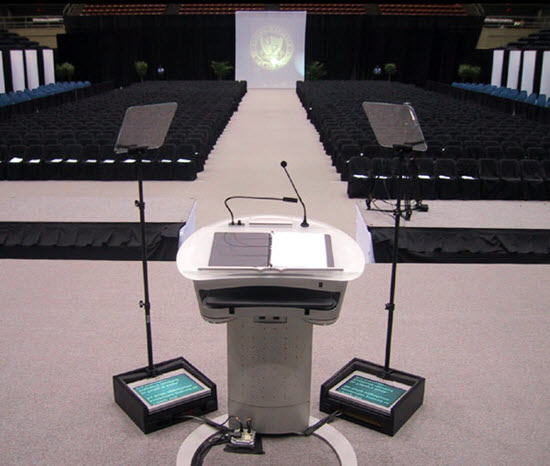
Wouldn't it be cool to have a teleprompter to work off of?
I've found myself getting a little lazy with my class introduction – that opening statement that answers the question many of your participants have before the class begins; “I wonder what we're doing today… and how hard we're doing it?” A consistent and informative opening statement is a major part of any successful class, one that I see as a Best Practice.
In retrospect, I should have committed to delivering a more informative class intro for challenge #1 of the 28 day challenge. If you aren't taking the challenge #1 was:
#1 – We all have areas where we know we could improve. Today's challenge is to publicly commit to one tangible improvement at least for the next 27 days of the challenge (e.g.: start your class on time, spend more time helping new students, not be in a hurry to leave, build in more warmup into your profile, etc..)
So better late than never, we've create a specific challenge to encourage Instructors (and Me) to create a Scripted Start for their next class:
#15 — Create a scripted class opening: “Great actors don’t show up on set and improvise as soon as the camera starts rolling. They practice putting their own personality into the words scripted for them…. Practice delivering your opening and closing scripts and you’ll be as polished as a professional actor.”
You will find a podcast transcript (includes a link) of an interview with Lawrence Biscontini in the group Files folder that will give you a lot of direction. Post your completed script.
So John… what do you have planned for us today?
In what I feel was one of, if not the best, interviews I've ever published, MI Lawrence Biscontini describes the elements of what he calls a “Scripted Start”. Lawrence explains that there are nine points you should include in your initial opening statement:
Welcome
Intensity
New Students
Gratitude
Sound and Equipment
Teaser
Theme
Issues
Purpose
I know that sounds like a lot to squeeze in, but in reality you should be able to smoothly touch on all nine points in a reasonably short paragraph. And your introduction doesn't have to these in order, you can mix them up anyway that makes sense to your personality – just be sure to include everything.
Here is the link to Lawrence's interview – we've included a transcript for those of you who prefer to read, rather than listen.
Now If you find yourself thinking; John and Lena have creating a “Scripted Start” as a challenge for this week… I wonder if one of next week's challenges is going to be about drafting a “Flawless Finally”? You're right 🙂