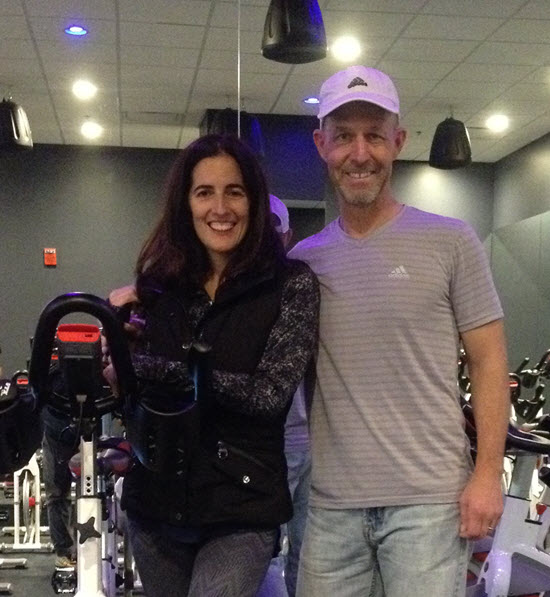
What would it be like to be losing both your vision and hearing?
Can you even imagine how challenging it would be teach?
I just had to know more about Instructor Rebecca Alexander and then share her very inspiring story with you. Rebecca currently teaches at Equinox in New York City and has taught in the past at New York Sports Club, New York Health and Racquet and SoulCycle.
Rebecca has written the book Not Fade Awayabout her challenges with Usher Syndrome III, a disease that is slowly robbing her of both sight and hearing.
It was a delight for me to interview Rebecca – please enjoy our last podcast of 2014!
After listening to Rebecca's story, I encourage your to purchase and read her book using the link below. You can learn more at her websitewww.rebalexander.com
Also, if your family tithes annually like ours, and you're looking for a place to make a last minute donation, please join Amy and me in contributing to Rebecca's Usher III Initiative. Donation information is here.
Some riders are present to train and give 100% every class. Many, however, are present simply to be…present.
Through The Customer’s Eyes
When was the last time you really looked at the Indoor Cycling experience you offer through the eyes of your customer?
The riders who consistently attend your classes relate to you. But … have you taken the time to consider how a first time rider relates to you and your teaching style. Have you taken the time to
walk in a first time riders’ shoes or ride in their saddle. If you have had new riders in your class who chose to not come back, have you asked yourself…
Am I current and relevant to today’s customer?
Keeping up with our customers’ evolving WHY means accepting the radically different concept that an increasing number of riders don’t care about the workout. It means embracing riders who are more concerned with recovery from daily stress than recovery from working effort. It means delivering a fun, safe, and effective class to riders who train for LIFE alongside riders who TRAIN for the road or for a specific event. It means making them feel safe the moment they walk through the door.
Have you ever considered that the rider on the end in the 3rd row may be…
Overwhelmed by numbers, spreadsheets, and thinking in general
Or … Suffering from an eating disorder and low self esteem
Have you ever considered that the rider in the back row, 2nd bike in may be…
Training for the Special Olympics…grateful for a 2nd chance at life
A parent whose child recently tried to commit suicide
A rider whose spouse committed suicide
An ex college athlete whose body feels older than his years…
who rides for the non impact cardio, weight loss, and because he can escape
A verbally abused housewife who quietly arrives late and leaves early every class…
not wanting to be recognized and grateful to be alone for almost an hour
A recovering addict who rides to get high…and to stay sober
A military wife who misses her deployed husband
A depressed teenager who doesn’t seem to “fit in” anywhere.
A mother battling post partum depression
A parent of a Marine that never came home
A 50 year old father with 100lbs to loose before walking his daughter down the aisle
Or … A veteran who feels lost and unappreciated.
Have you ever considered that the rider directly in front of you …worries about losing their job?
Each one of these riders is real and has a name.
Each one of these riders wants to escape, to check out, and to get lost in the music.
Accept … Don’t Judge WHY
Welcome every rider free of judgment and celebrate that they have a WHY that is different.
Accept that a rider may not want to push outside of their comfort zone. That’s OK!
It doesn’t mean they are “lolly-gagging,” “wasting an hour,” or “need to leave if they aren’t going to make an effort” because they aren’t working as HARD as you are asking them. That’s not WHY they are there. For them, it was HARD WORK, just getting there.
For these riders, the CardioTherapy benefits of Indoor Cycling outweigh any interval or strength training benefit. These riders and countless others stepped out of their comfort zone simply by walking through the door. If we, as instructors are current and relevant to their WHY … these riders have a better chance of returning. Make them feel SAFE and FUN follows. If we are doing our job correctly, EFFECTIVE falls into place and riders see results … mind, body, & spirit.
Accepting and understanding that every rider is not in your class to TRAIN like an athlete is the first step to delivering the ultimate Indoor Cycling experience, to every rider in the room, every time … regardless of their WHY.
While I was in NYC last month I rode in two classes lead by Instructor Julie Jarrett. The first class was sold out, which was cool considering Julie has only taught for a few months + the studio Prime Cycle opened in September of this year.
After Julie's class I had the chance to sit and learn about her Reality TV production company Jarrett Creative and how she uses her time teaching as a inspirational break from day job. During our chat she explained to me how beneficial teaching has been to her marriage with business partner/husband Seth + how it has motivated him to start exercising after years of inactivity.
So why is Julie having so much success, so quickly? There's a lot of reasons; Julie and I explore them during my interview below.
With 1800 articles in our archives, there's a good chance you may have missed some of our best posts. So we will be reposting a few that we feel are not only very special, but timeless in their value to ICI/PRO members.
By Team ICG® Master Trainer Jim Karanas
Organized systems of physical movement have the potential to progress toward artistry, yet most indoor cycling instructors wouldn’t call themselves artists. Still, any instructor who wants to create a compelling class experience could benefit from thinking that way.
Certain activities fall under the term “art”. A dancer of any level could reasonably be called an artist, even though many dancers are not particularly artistic. But indoor-cycling instructors are seen as fitness instructors, people who teach indoor cycling.
Are we artists? We’ll get to that in a moment. Is there any benefit in considering yourself an artist? I would definitely say yes. Being an artist implies that you transcend the ordinary and do something creative in your trade.
There are those who cook, garden, design home interiors, or cut hair and have elevated what they do to an art. Isn’t “transcending the ordinary” what many of us strive for as instructors? I don’t teach simply to be a competent exercise instructor. My class is my craft, but it’s more because I create each ride with an approach that feels, at this point, like artistry.
The assets I use to create the experience include music, lighting, voice, words and, most recently, video. I also incorporate concepts and philosophy and combine all of these elements in the cycling studio environment to create art. (I covered some of this in a previous post on The Art of Cueing.)
So can you consider your class art?
It’s an important distinction to make because art enriches our lives, sometimes more than work. When we approach something as art, it stimulates different parts of our brains, makes us laugh or cry, with the gamut of emotions in between. Art gives us a way to create and express ourselves. There are days that creating my next ride is the main reason I get out of bed in the morning.
We’re hard-wired for creativity and hone it to our specific abilities. Giving life to something original from within to share with the world purely for its intrinsic value is perhaps one of the most rewarding feelings we can have.
Originality may be a key concept in art. We’ve all heard that imitation is the sincerest form of flattery, but is the imitation art? I’d say often not, even if it’s imitating something that is.
That’s where the distinction occurs for many instructors. Approaching your class as art may be joyous and provide great return, but it takes authenticity — a willingness to share what’s really you. A copycat workout, even skillfully run, isn’t authentic.
I believe the ability to make art is inherently human, but it TAKES WORK. When I began teaching, my class wasn’t art. I was no more skilled in teaching indoor cycling than anyone else at the beginning, but I’ve poured arduous hours, days, weeks, months and years of my life into it.
My point is “art” is more than a label; “my class is art” isn’t something just anyone can claim, even a good instructor. The difference between art and craft lies in the intent behind it. If your intent is merely to design a great workout, to emulate that amazing instructor at the last conference, or to impress the class with your skill, I’m not sure you can claim to be an artist.
I make my class art because I love creating. There’s nothing more gratifying to me than working on a playlist for days, selecting just the right videos, and planning what I’ll talk about — leaving enough room to improvise that I never know how a class will turn out until it’s over. The process itself is enjoyable: I express my interests and empower my students to enjoy training and go beyond what they thought they could do.
Sometimes class participants dismiss artistic attempts, saying, “I just want to work out”. Such a statement speaks to the loss of creativity in our world and only magnifies the need for us to consider our classes as art. Fitness can be so much more than a workout.
Is your class art? Why should you consider turning your class into art? Are you willing to do the work to make it art?
Art is natural and instinctive, like language and laughter. Pablo Picasso said, “Every child is an artist,” and every culture has art. Expressing something artistically makes us feel more complete.
Art is also a medium for expressing ideas. While a class could be just a workout, treating our class as art gives us greater range of expression and helps us share thoughts, ideas and visions that may not be easily articulated in words.
It’s also healing. Creating your class from an artistic perspective will enliven and stimulate you. The process of creating engages both body and mind and provides us with time to look inward and reflect.
Finally, it’s a shared experience. When you look at your class as art, you recognize it as collaboration with the participants. It uses your skills as exercise specialist, cyclist and public speaker, which combine with the musician’s artistry in the songs you play and the cinematographer’s artistry in the videos you select. Art offers us a reason to share talents in a collective manner.
Approaching my cycling class as art has been good for my soul. It’s been good for my brain and my body. I’m a better cyclist now than I would have been if I hadn’t brought artistry to the practice of teaching indoors. I’ve been a mediocre dancer and a horrible musician, but teaching indoor cycling as art has allowed me to bring my bike to life.
I collect stuff; articles, observations, suggestions and random ideas that I feel could make for an interesting post or interview. Not everything is worthy of the time needed to research and craft into an article – but I feel are still worthy of sharing. Here are the latest:
Why So Many Women Are Crying at the Gym?
Great question and this article in Time Magazine explains a bit more of why many women love SoulCycle classes:
For a generation of stressed-out working women, exercise is as much about emotional release as it is physical training.
You could go to therapy — or you could hit the gym. Women are getting teary in SoulCycle, and misty-eyed at Pure Barre. They are letting out wails in yoga and rubbing the shoulder of the weepy woman next to them at CrossFit. “I think people have started to notice that their clients are just showing up to class and just unloading, and so they’re tailoring their classes to create space for this,” says Hayes, who is a pilates instructor by day. “When I take private clients I end up feeling like a therapist for them.”
These fitness instructors aren’t trained in that, of course. But they’ve probably been there.
It’s not an accident that just as you’re starting to relax, coming down from the adrenaline, you’re blasted with a throaty ballad. Those playlists are meticulously constructed. “I’ve been teaching for almost 20 years, so I’ve basically seen it all: crying, laughing, throwing up, overheating,” says Stacey Griffith, a Soul Cycle instructor. “There are moments in the class that are directly programmed for that reason — but it’s not like we’re trying to get people to cry. We’re giving them the space to step outside of themselves.”
Great example of how mixing in key can create energy
I was reading this article in the WSJ ANATOMY OF A SONG How the Kinks Roughed Up Their Sound If you're an old Kinks fan you'll enjoy learning how they created their special sound in the days before digital music – poking holes in the speakers with a knitting needle.
Near the end of the article Ray Davies, the song’s composer and band’s lead singer, makes a reference to key changes in the song The Kinks — You Really Got Me and the effect they had:
Once teens saw us and heard our metallic sound, the excitement built and the single took off after its release the following week. Part of what the audience was responding to was the song’s key shift from G to A. The more natural and melodic place for the song to go was from G to C or D. But I wanted it to go to A, which was quite revolutionary then. There’s something about that full step up that feels like acceleration and raises the excitement level. The progression actually made me shudder when I originally came up with it.
Turn up the volume, and listen to with your eyes closed – do you hear what he's describing? Are there time in your class where a similar change could be valuable?
http://youtu.be/S7ffgqjcH40
Will women be wearing corsets in your class soon?
I hope not. It seems that fitness expert Kim Kardashian has started a trend called “waist training” using an old fashion corset and many of her followers are lacing up these devices of torture and giving it a try:
However, “own photos” seem to be a big part of waist training. And so I decide to wear the corset to spinning class and possibly take an own photo afterward. Apparently, this is what Kim Kardashian does: She waist-trains at the gym, then she takes an “own photo.” I don’t really like spinning that much, but I go to this particular class because it’s very leisurely. For example, we keep spinning to “California Love,” which is kind of slow. Every song is the pace of a stroll in the French countryside.
Before I go to the gym, I put my corset on under a gigantic shirt. It’s slightly easier to put on today. Perhaps I am training my waist? I can even walk to the gym without getting too winded.
Unfortunately, actually spinning is a bit harder. I am only one minute into “California Love” when I start feeling very out of breath. I unbutton the first snaps of my corset. Then the spinning instructor puts on “Bang Bang” by Jessie J. She has never done something like this before, and I am quite displeased. What an energetic song. It’s almost entirely screaming. My corset can’t stand the stress. I start unsnapping more buttons under my huge shirt, even though everyone in spin class is looking at me, wondering what I am doing under the shirt. I throw the corset near my bike. I do not take an own photo. I decide to take a couple of days off from waist-training.
I'd love to hear if/when one shows up in your class 🙂