This look may not always be appropriate when you teach.
This was awkward. Have you ever had a dream where you're naked in some public space? Well yesterday I wasn't dreaming, I was dressed, but inappropriately it turned out. The feeling I had was very similar.
That's because yesterday I had the privilege of taking a class at The Firm in Minneapolis. They were the very first official Johnny G Spinning® studio in the Midwest – introducing Indoor Cycling to us here in the frozen north around 1995*. As far as I know, they could be the oldest operating indoor cycling studio. Do you know of another?
I had met the one of the owners, Neil Miyamoto, at IHRSA. I sheepishly told him that I hadn't been to his studio for about 20 years. Turned out he understood us suburban folks don't stray far from home. To remedy that, Neil invited me to come downtown to see his club and meet his wife Kelly. She actually started The Firm back in 1986. Our plan was for me to take a class and schedule a time for me to interview Kelly. I'm guessing there's a lot of new studio owners who would love to know how The Firm as been so successful, for so long.
So yesterday was the day and as I'm driving into the city, I'm thinking; who comes to a 3:00 pm class, on a Saturday?
I got checked in, quickly dressed and ran up the stairs to a nearly full studio. My quick count showed about 50 riders… many of them watched me as I walked in. And a number continued to look at me. Not in an unfriendly way, no. Their expressions seemed friendly enough, some even smiled as they continued their appraisal of me. I started getting that awkward, I'm standing out like a sore thumb, feeling as I set up my bike.
What are they looking at? Could I be the only new guy here… Is that it?
Then it dawned on me. I was the only person in the room wearing a full cycling kit – my Life Time Cycle Team bicycle jersey and matching bib shorts. There were lots of t-shirts, running shirts, ripped sweatshirts, women's workout tops, gym shorts, regular shorts and yoga pants – but nothing remotely like what I typically teach in. 50+ people and I only could see three pair of bike shorts. No wonder people were looking at me funny. I couldn't help but think how silly and out of place I looked. What was I thinking?
They're not cyclists
This experience has me re-considering something I feel I've mistakenly believed; at some level all indoor cycling participants are cyclists and I should look like a proper cyclist (to set a good example) when I teach.
These folks at the Firm seemed to really enjoy riding indoors, wearing whatever they wanted, but by no stretch were they cyclists.
Kelly (the Instructor) was wearing a cute top and yoga pants. Nothing to distinguish her role as the leader. She looked like her tribe and her tribe looked like her… and they fill the place, on a Saturday afternoon, in part because she makes everyone feel comfortable. There was no pretentious; look at how cool I look in my fancy getup.
In fact the entire club is much the same. Simple concrete floors and white walls. Quite a change from the cherry walls and bamboo flooring where I normally conduct class.
So what to wear?
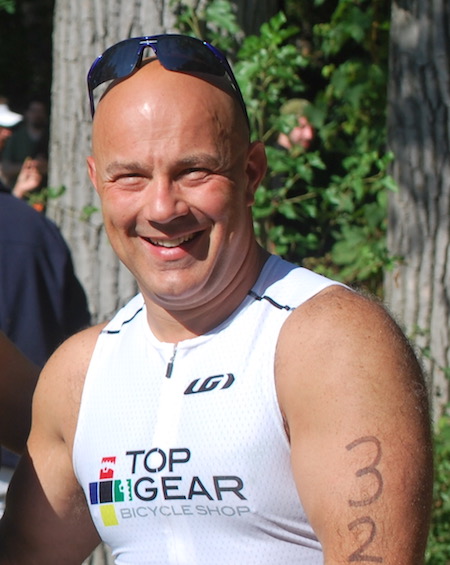
This picture is of Stages Indoor Cycling Master Trainer Doug Rusho, at a past ICI/PRO conference. Notice there's nothing that screams I'M A VERY SMART LOOKING CYCLIST in what Doug is wearing. He looks sharp and professional, but nothing about his shorts or shirt would communicate; I'm a hard-core cyclist. If you aren't a hard-core cyclist like me, well… you might not fit in here. Which I'm now concerned I have been communicating (and not always subtly) to the people who come to my classes.
*1995 is my best guess. Amy was originally certified and her club (The Flagship Athletic – now a Life Time) added Spinning around 1996.
ICI/PRO member Amy, a Cycling Fusion Master Instructor and routine contributor to The Weekly Ride on ICI/PRO, delivers a ride. THIS IS THE COMBINED FILE THAT INCLUDES THE MUSIC AND THE VOICE. IT IS NOT AVAILABLE ON ITUNES.
Amy Smith and her Race Week Ride: “This is a race week. On this course I have less hills so we have to keep them on target in the saddle pushing to zone 4 with some high zone three's for them to catch a drink or two. As always allow them to ride their own ride /race.” Amy
I lead a fairly busy life. Amy and I own both Cycling Fusion and ICI/Pro which keeps us pretty busy and I am on staff at Carnegie Mellon University in the Athletics Department and their Triathlon Coach. Add to that teaching a few classes a week to keep my edge and I do not find myself with a lot of free time. Then came Spring Break…..
At CMU our schedule generally follows that of the students, so once in a while I am presented with a lull in the excitement of college athletics and I have a few moments to myself. What do I do with some of these moments? I had the opportunity to take an indoor cycling class at one of our Pittsburgh LA Fitness locations.
I always find it a bit odd being on the other side of the bike so to speak, but at the same time fun. While my natural tendency is to look at the class as a master instructor, I work hard to not evaluate the instructor and just enjoy the ride. And enjoy the ride I did.
The young lady that was leading the class was energetic and the music was good. I knew a few others in the class, but was conscious not to talk during the class or become a distraction. At one point we did a few jumps, which I always wonder about (they are just not something I do in my classes) but I went with the program and enjoyed myself.
That is the message today; if you have the chance (and you should make the time), please take a few moments and attend another instructor's class. We got into the indoor cycling profession because we love the exercise, the music and the bike. Sometimes I can get caught up in building this week's class, or trying to find the right song, but in the end, it should all be fun!
FREE ICI/PRO PODCAST: What an exciting day, this is our second ride recording. ICI/PRO member Zack, a Cycling Fusion Master Instructor and routine contributor to The Weekly Ride, delivers a ride.
“I am very excited to be releasing an audio version with my ride this week. You get to really feel how i intended the song to be felt then. Notice the shorter than usual notes this week to really make you listen to the delivery. As always my rides can suit all riders and ill be sure to highlight that verbally. So listen up and enjoy!” Zack
The Cycle Moles camps are designed as 8-week Training Camps that are a performance enhancing, progressive training program. They are geared toward cyclists, but part of the beauty of the programs is that you do not have to be a competitive cyclist to reap the benefits. The training is periodized and designed to progress the riders through their development. This is the next best thing to having a personal coach.
The program has two levels: Level 1: Appropriate for those who have a base level of aerobic fitness. You’ll learn secrets that will change the way you ride to make you more efficient and powerful both indoors and outside. Level 1 training sessions are 60 minutes and include a coached ride plus stretching.
Level 2: for the seasoned cyclist, triathlete, endurance event enthusiast or individual with a strong aerobic base who wants to improve cycling performance. We heat up the intensity of the rides throughout the camp so that you’ll end with a much stronger level of fitness and improvements in your pedal stroke and power. Level 2 training sessions are 90 minutes and include a 75 minute coached ride plus 15 minutes for the Core 100 and stretching.
Below is the Foundation Ride information that Robin Speaks about in the episode. Take your time and look at this, it is amazing information. The jpeg files below are linked to the full PDF files.



 ICI/PRO member Amy, a Cycling Fusion Master Instructor and routine contributor to The Weekly Ride on ICI/PRO, delivers a ride. THIS IS THE COMBINED FILE THAT INCLUDES THE MUSIC AND THE VOICE. IT IS NOT AVAILABLE ON ITUNES.