Over the past few weeks I have been fascinated with the HBO series “Sonic Highways”, which features one of my favorite bands, the Foo Fighters.
“In this new series, Foo Fighters commemorate their 20th anniversary by documenting the eight-city recording odyssey that produced their latest, and eighth, studio album. Foo Fighters founder Dave Grohl directs the series, which taps into the musical heritage and cultural fabric of eight cities: Chicago, Austin, Nashville, Los Angeles, Seattle, New Orleans, Washington D.C. and New York. The band based themselves at a legendary recording studio integral to the unique history and character of each location. One song was recorded in each city, and every track features local legends. Even the lyrics were developed in an experimental, unprecedented way: Grohl held off on writing them until the last day of each session, letting himself be inspired by the experiences, interviews and personalities that became part of the process.” (from: http://www.hbo.com/foo-fighters-sonic-highways#/foo-fighters-sonic-highways/about/index.html)
What fascinated me most about this series was watching the creative process at work. Every person, city, studio and experience had profound effects on the writing of each song.
I have found that the different times, facilities and riders I teach affect the “energy” of each class and though I may have the exact same profile for each class they all “feel” different. This is where I use my music to match the “energy” of the class. I have a much different playlist for my 5:00am classes then I do for my noon classes and my 6:00pm playlist is different as well.
I believe the best instructors can feel this “energy” and use it to connect with their class.[wlm_private ‘PRO-Platinum|PRO-Monthly|PRO-Gratis|PRO-Seasonal|Platinum-trial|Monthly-trial|PRO-Military|30-Days-of-PRO|90 Day PRO|Stages-Instructor|Schwinn-Instructor|Instructor-Bonus|28 Day Challenge']
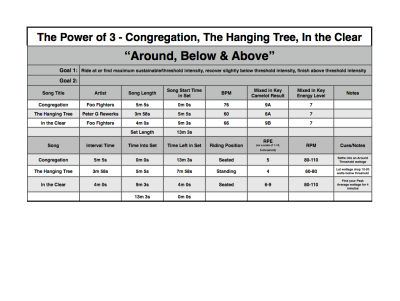
3 song harmonically mixed track, to download Right Click > Save As / Save Target As to download. Open in iTunes and then you'll see this in your Spotify Local File folder.
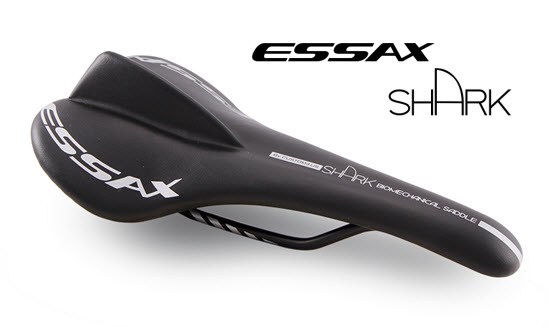
Essax is a brand of bicycle saddles located in the province of Alicante (Spain). Our company has over 25 years experience in the manufacturing of technical products in polyurethane foam and leather, which assures our knowledge and experience.
Above all, we are cyclists who manufacture for cyclist, which means that we make from our passion our work. Therefore we know from first hand what users needs and what the requirements of the sector are.
http://youtu.be/f6gnUTNbaWQ
What is the fin for?
This is the key to this whole Bike Fitters ensemble. Its position indicates the rider how to place his sit bones so that they are well supported in the seat. It interacts with the user giving information how to be seated on the saddle. In the hundreds of biomechanical studies for the development of this product, the result of them told us that the vast majority of riders had sensory perception being well positioned on their saddle as where reality showed they were rotated or only supported one of the two Ischia
So the purpose of the fin is to locate you and your sit bones correctly, fore/aft on the saddle. This, Essax is saying, is super critical on multiple levels; comfort over time, pedal force imbalances, hip stability and overall power development. That sounded really familiar…
There are multiple factors that affect how you produce power and what ultimately gets displayed by the console. A few months ago I wouldn’t have believed you, if you tried to convince me that (beyond the level of comfort you feel) a bike’s saddle design could add or subtract to the power I could create.
I believe it now.
Back in March I had a professional bike fitting on my new VeloVie with none other than the Bike Fit Guru Chris Balser. I figured that I had a few dollars left because of the incredible deal I got and, with one kid graduating for college this Friday, why the heck not?
I was a bit naive about what all was entailed in a 2 hour fitting. I thought Chris would be super focused on getting my seat height exactly right, maybe futz with the tilt of the handlebars. Stuff like that. Nope. For close to an hour we tried out different saddles, 11 in total. That’s right, Chris had me ride on a trainer, trying 11 different saddles, to find the perfect saddle that (his words) your ass can find easily. Here’s what we finally decided on… a Fizik Kurve.
As a sidenote – I have two years/~6500 miles on my Fizik Kurve Chameleon Saddle and absolutely love it. Chris was exactly right to choose it for me > Everytime I sit on it my butt finds exactly where it belongs.
Can you effectively cue proper saddle position?
Short answer IMO is you can try, but my personal feelings are that most Indoor Cycle saddles are too big (FreeMotion being the exception) and too soft, to be really “findable” for most people's derrieres. That doesn't mean you shouldn't make the suggestion to move around and see if you're in the best position.
Just don't cue this once, early in the class and then forget about it. Give everyone time to settle into their positions and then ask everyone to reacquaint themselves with the saddle. If you've taught for any length of time (and you're paying attention to small details) you have seen how many of your riders visually appear to relax at some point in class. For me, I notice it during the first welcomed recovery I give them > typically following the first “Best Effort” interval they've completed.
Like everything else you do as an Instructor, you should be experimenting on yourself and then decide what & when makes the most sense.
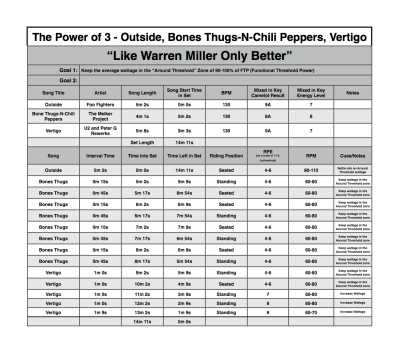
“Bone Thugs-N-Chili Peppers” by The Melker Project
“Vertigo (Redanka Power Mix” by Peter G ReWerk
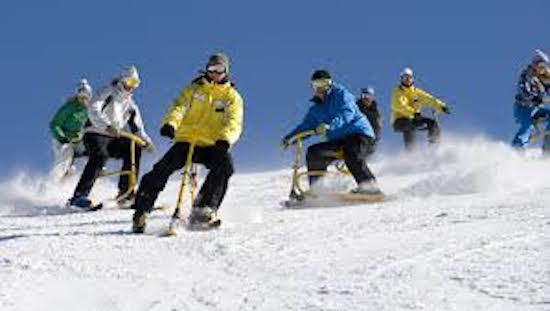
As many of you know, I live in Colorado and skiing is one of my family's favorite winter activities. Every year we used to look forward to the release of the latest Warren Miller ski movie as the unofficial start of ski season. It became a family tradition to get tickets to the Friday or Saturday night showing at the Paramount Theater in downtown Denver. The later the show the rowdier the crowd, everyone was so amped to get the ski season started. I also knew that the new release meant fresh ski footage and music for my video cycling class. Over the years the footage has remained top notch, but the music has gotten worse and worse, it has gotten so bad that we stopped attending the show two years ago. That year the music was so bad that I wished I had brought my ear buds so I could have put together my own playlist, on my phone, while watching the movie.
[wlm_private ‘PRO-Platinum|PRO-Monthly|PRO-Gratis|PRO-Seasonal|Platinum-trial|Monthly-trial|PRO-Military|30-Days-of-PRO|90 Day PRO|Stages-Instructor|Schwinn-Instructor|Instructor-Bonus|28 Day Challenge']
This got my sons, Seth and Christian, and I thinking that we should start using the awesome ski footage that is available on the internet and put it together with music that people actually listen too. Over the years we have created quite a library of ski videos, many that I use in my indoor cycling classes, that we believe is like Warren Miller, only better. I hope you enjoy the work we have done and let me know what you think.
3 song harmonically mixed track, to download Right Click > Save As / Save Target As to download. Open in iTunes and then you'll see this in your Spotify Local File folder.
“Danny, Dakota and the Wishing Well” by A Silent Film
“Can't Hold Us” by Macklemore & Ryan Lewis
“Vertigo” by U2
Last week I wrote about the “Threshold Check” or “Mini-Threshold Test” that I perform at the beginning of every class. This week I want to share how I teach the full 20 minute FTP (Functional Threshold Power) Test. With this post I have also included the playlist and video I use as well as a recording of me teaching an entire FTP class.
[wlm_private ‘PRO-Platinum|PRO-Monthly|PRO-Gratis|PRO-Seasonal|Platinum-trial|Monthly-trial|PRO-Military|30-Days-of-PRO|90 Day PRO|Stages-Instructor|Schwinn-Instructor|Instructor-Bonus|28 Day Challenge']If you are lucky enough to be teaching on bikes with power I believe it's important to use this technology and all the available metrics to their fullest capacity. I find the most powerful use of a power meter is in finding one's maximum sustainable wattage or threshold. Threshold is that state of equilibrium between high intensity exercise and the body's ability to buffer and filter the waste products produced by this intensity. With a power meter we can find a wattage number that correlates with this state of equilibrium or your FTP (Functional Threshold Power).
Exercise physiologists have devised many different ways to find one's threshold, but I have found the simplest and cheapest technique is to perform a 20 minute effort at maximum sustainable intensity. At the end of this 20 minute effort take note of the average wattage and multiply it by 95% and this number is your FTP. I'll go into greater detail on how to use this number in later posts, but now let's go over how to perform the FTP Test.
I like to have my riders warm up for a minimum of 15 minutes. I'll have them slowly increase their intensity for 10 minutes then I like to have them perform 3-4 one minute “pickups” increasing their intensity each interval while recovering for one minute after each. After a short, 3-5 minute, active recovery from the pickups I have the class perform a maximum effort 5 minute interval. This effort ensures that the lactate buffering and clearance systems are turned on and ready for the 20 minutes test that follows. I also have class participants remember their average wattage for this 5 minutes, it's a good number to refer back to when doing above threshold intervals. After another recovery, about 10 minutes long, we are ready for the 20 minute FTP test. Make sure all your participants know how to reset the bike console so they can get a new average for the 20 minute interval to come. Tell them that this is a very simple test, you want them to ride at the highest possible wattage for 20 minutes. Your job as the instructor is to motivate, but not to talk too much. Let your riders “settle in” to their maximum sustainable wattage and their most efficient cadence and just let them ride. At the end of the 20 minutes make sure they remember their average wattage, multiply it by 95% and they have their Functional Threshold Power. This “Benchmark” test is also great to see improvement over time, with proper training FTP should continue to improve.
Let me know how it goes, my classes love FTP days! They work so hard every day and once a month they get to see the payoff for all sweat and suffering.
6 song harmonically mixed FTP track , to download Right Click > Save As / Save Target As to download. Open in iTunes and then you'll see this in your Spotify Local File folder.
For years I had been patiently waiting for the facilities I instruct in to upgrade their bikes to use power. When these upgrades finally started to happen I was surprised by the different wattage readings I would see, not only, from different brands of bikes but by bikes built by the same manufacturer. I had always assumed a watt is a watt the same way a MPH is MPH or an RPM is an RPM. At first this was VERY disappointing, I have a very technical teaching style and I was hoping to have all my class participants perform a Functional Threshold Power (FTP) Test every 6-8 weeks, calculate their personal power zones and coach each and every class to those zones. Unfortunately, if every bike in the studio reads wattage, even a little bit, differently I would need to adjust my teaching style.
[wlm_private ‘PRO-Platinum|PRO-Monthly|PRO-Gratis|PRO-Seasonal|Platinum-trial|Monthly-trial|PRO-Military|30-Days-of-PRO|90 Day PRO|Stages-Instructor|Schwinn-Instructor|Instructor-Bonus|28 Day Challenge']
I needed to figure out a way to use this new technology, even with it's faults, effectively to give my participants the best workout possible. I decided that the FTP test was still going to be an integral part of my programming and I would still perform this test every 6-8 weeks. I asked my class participants to find 2-3 bikes that they believe are similar in wattage readings and ride those bikes as often as possible. Small differences are ok, large ones make zone training impossible. I also needed a technique to “dial in” new riders, those who never performed the FTP and others who may be forced to ride an unfamiliar bike. I decided to start every class with a proper warm followed by a mini threshold test that I call a “Threshold Check”. This “Threshold Check” can last anywhere between 4-6 minutes and I ask class participants to ride at their maximum sustainable intensity or wattage for the duration of this short test. If the bikes are equipped with a console that will show average wattage I ask for the class to find their average wattage for this “Check”. If the bikes do not have a way of reading average wattage I ask the class to be aware of their wattage throughout the “Check” and choose a wattage that they believe is closest to their maximum sustainable wattage. If I'm teaching on a bike that is not equipped with a power meter I still perform this “threshold check” and i do my best to “anchor” effort with threshold RPE. I also like to “anchor” effort and RPE during the FTP . Most FTP tests last 20 minutes, so 10 minutes into a FTP effort I'll explain that the feelings participants are experiencing, slight breathlessness. burning sensation in the legs and the need to stay extremely focused or wattage will drop is how a threshold effort “feels” and I ask them to associate this feeling with whatever RPE number is used as threshold in the facility I'm teaching in.
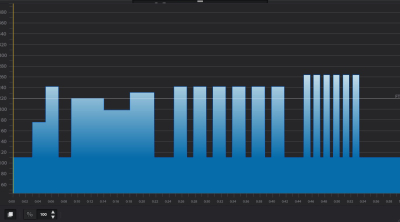
Now that each participant has a threshold wattage or RPE to work with I break my profiles down into 3 zones: Above Threshold, Around Threshold and Below Threshold. Efforts that are Above Threshold (greater than 106% of threshold) can last up to 8 minutes, efforts around threshold (90-105% of threshold) can last up to 30 minutes and below threshold efforts (less than 90% of threshold) can last up to 3 hours.
Check out the recorded classes below to hear how I use this “Threshold Check” in a class setting.
3 song harmonically mixed track, to download Right Click > Save As / Save Target As to download. Open in iTunes and then you'll see this in your Spotify Local File folder.