Time To Dig In
So we’ve painstakingly done everything possible to setup and prepare our methods for a solid research project — at least as solid as any “non-university” research setting can hope for. We’ve not only established a consistent protocol for conducting the tests, but we’ve also made sure to not do too many in any one day, nor to use different testers to eliminate potential influences to our results.
Once we executed these tests on about a dozen bikes, I wanted to start to analyze the data, and that’s when it occurred to me that we needed to make sure that the numbers I was about to analyze were reliable and repeatable from bike to bike. My last post demonstrated the process of re-testing to insure that very thing. After doing retests on about 6 of the 12 bikes, it is now finally time to review the data and see just what is what.
Let’s Start With The First 2 Bikes
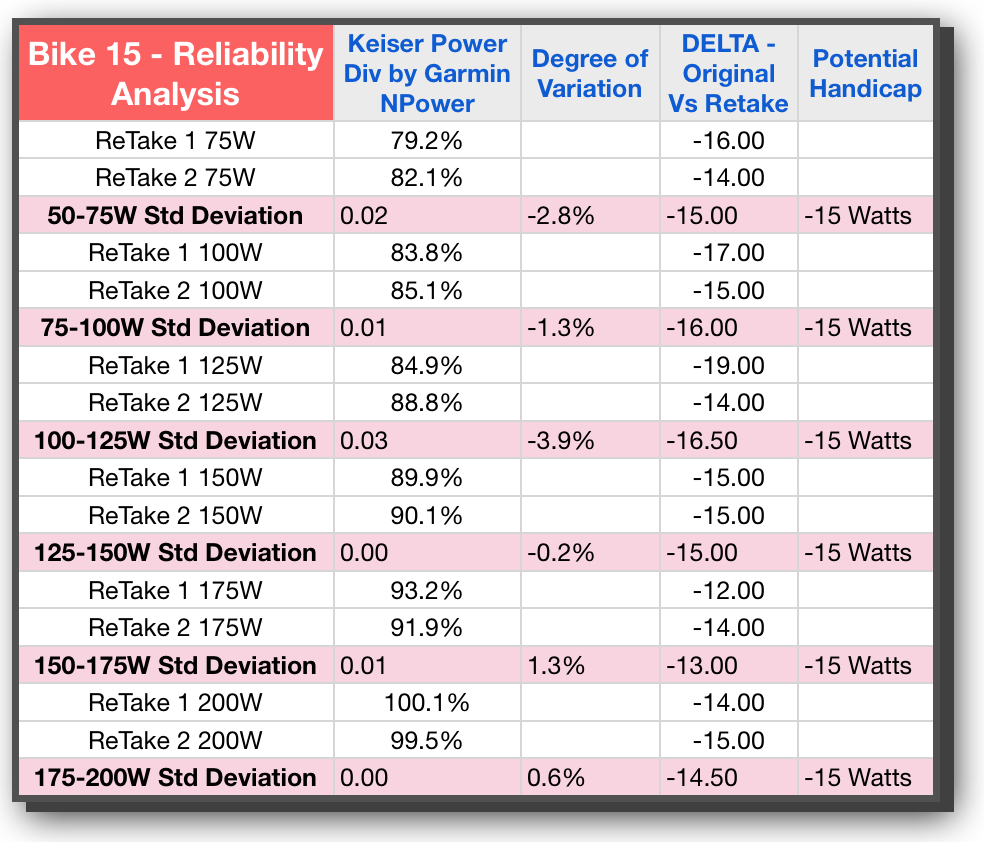
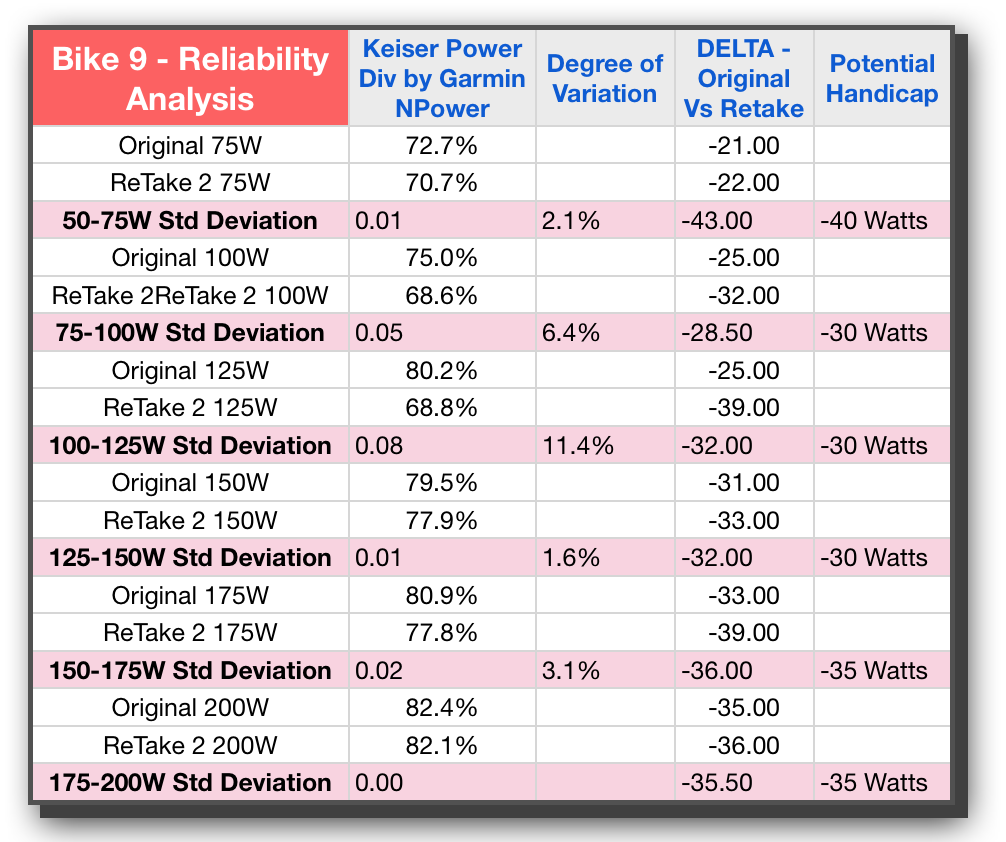
Each day I tested only 2 bikes — to make sure I was fresh each time. So naturally, my first peak at the numbers (and I try not to look at them until I am well into the research so that initial impressions do not subconsciously alter my performance as more tests are conducted) came after these first 2 retests. Remember, I’m into the research project a couple of months now without letting myself “have a taste” — that’s pretty tough for a data-geek like me ☺. So below you will see the first two bikes retested. Let’s go over the columns so we can understand what we are looking at.
1st Keiser m3 Indoor Cycling bike with power to be tested & retested.
2nd Keiser m3 Indoor Cycling Power bike tested with the Garmin Vector Pedals
The first column represents the 25 Watt stages that were used to get the average power numbers from. These were “settled into” for 2 to 3 minutes at each of these stages. More specifically I used the Keiser console to establish a steady wattage level during each stage, and then once the 2.5 minutes were up, I stopped the keiser to get the true average (which typically was within 5 watts of the target) and we also lapped the Garmin so it would later give us the average or “Normalized Power” (NPower is how I have referred to it on the table) from the Garmin Vector Power Pedals.
Column: Keiser Power Div by Garmin NPower
By dividing the calculated power of the bike by the measured power from the Vector power pedals, we will see by percentage just how close they are to each other. Remember, we are not concerned about pure accuracy per se — we know the calculated power is going to be inaccurate by its nature — we simply want to know how much it is off, and if that amount is reliable every time re ride that bike. Each percentage is a reflection of both bikes at a specific wattage on one test.
Column: Degree of Variation
If we now take the difference between the first test and the next, we can get at how reliable the bike is between test sessions. This is the KEY metric for our purposes during this phase of the study; validating that each bike within itself is reliable. From a practical standpoint, we need the difference between tests to be low if our handicaps are going to be valid and useful from one class to the next. In looking at both Bike 15 and Bike 9 we see that these are indeed fairly low — an initial good sign — and there is only one instance where the difference is over 10%. That’s actually a lot less than I expected.
Column: DELTA Original vs Retake
This is a “pre-handicap” column — showing the exact wattage differences at each stage of power averages. While this will produce precise numbers with decimals, we know that a practical application of handicaps would likely need to be in increments of 5 so that the math is easier when performing that handicapping in ones head. We could also use this to send to an automated system if one was ever created that could account for bike variations in the software (an insightful feature I would create if I were the purveyor of such software).
we use this column to evaluate the exact differences and averages before we designate a specific handicap number.
This column is the one that also really shows the amount of variation from one bike to the next. On Bike 15 we are averaging in the teens with wattage differences, whereas Bike 9 is averaging in the 20s and 30s. That’s quite a spread.
Column: Potential Handicap
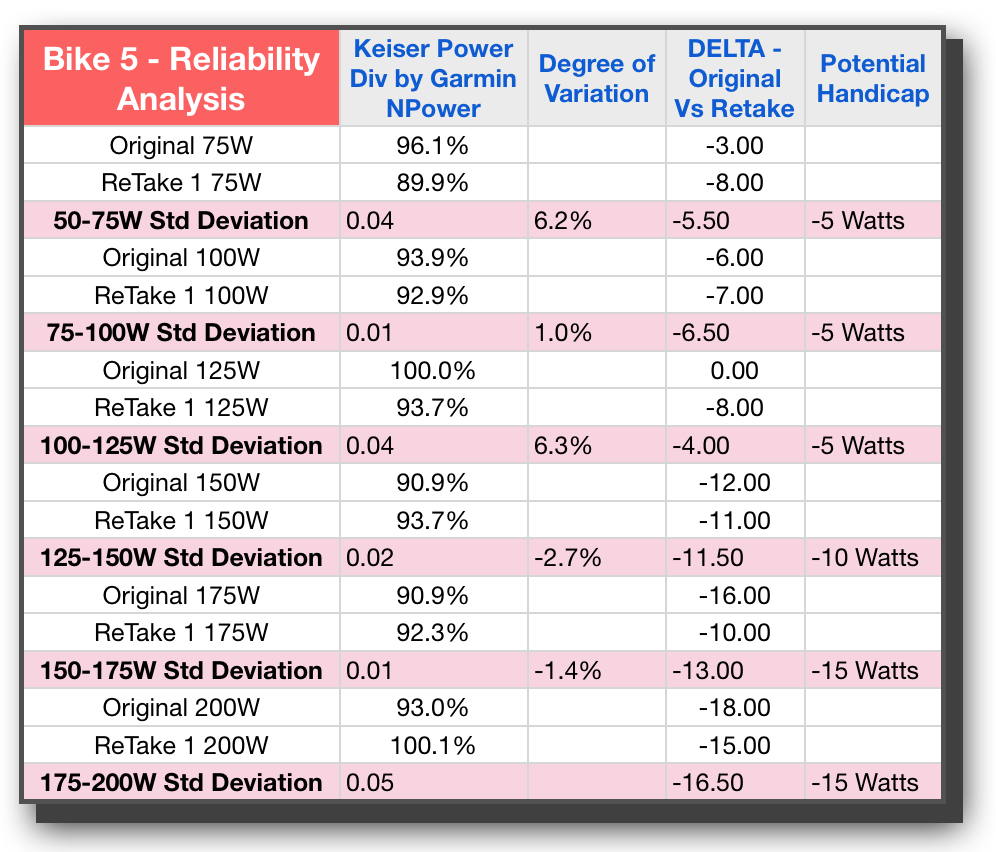
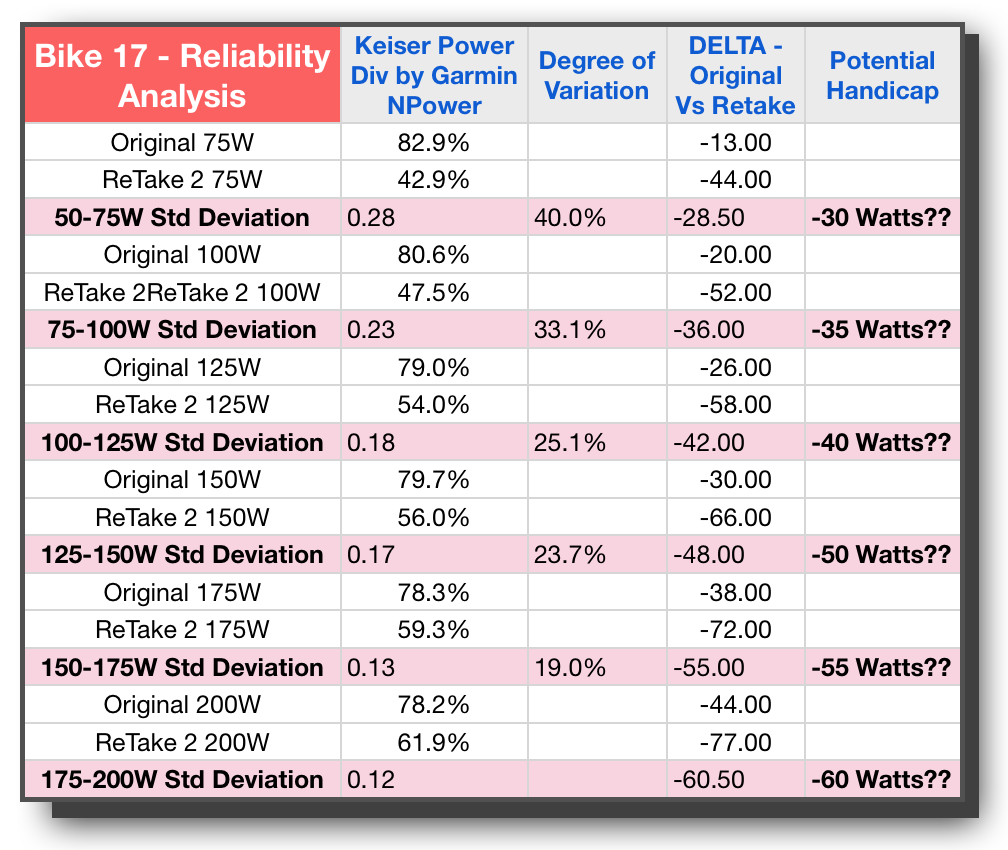
This column would represent the entire motivation and impetus for all of the time and energy being spent on this research. We want to handicap the bikes! If you’ve read my eBook on Power (if not, no worries an updated iBook is due out soon — shameless plug apologies ☺ ), you will know that Power is not linear in its progression. As such we can not just use one number as the handicap and apply that to all wattage levels. If you look at all 4 bikes, you will see, with the exception of Bike 15, the differences get bigger and bigger as the wattage level increases. This is the exponential nature of power and the reason why I propose a handicap value for every 25 or 50 watts.
How About Some Analysis
Up to now, we’ve only sprinkled the analysis or possible conclusions as I’ve described each column. However, in order to even think about drawing conclusions, we will need more data points than just 2. Lets’ show four more bikes so we can see if there are some patterns emerging when we have 6 total bikes and their retests — giving us a total of 12 tests or sets of data points to consider.
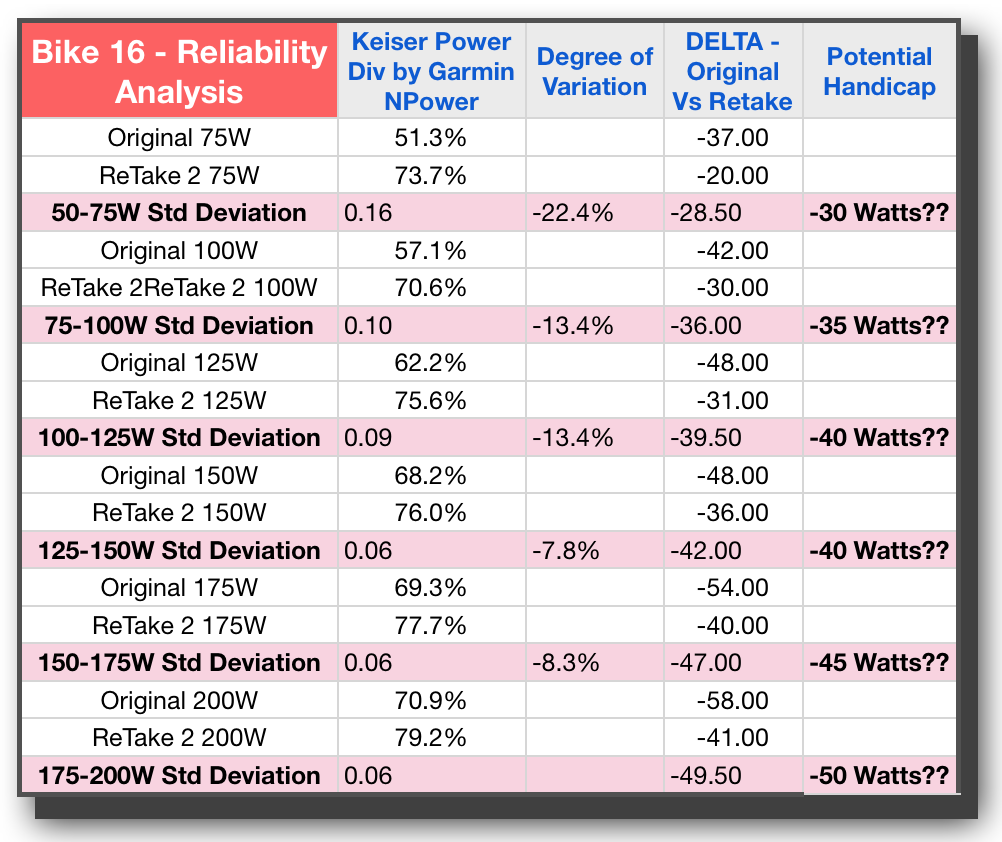
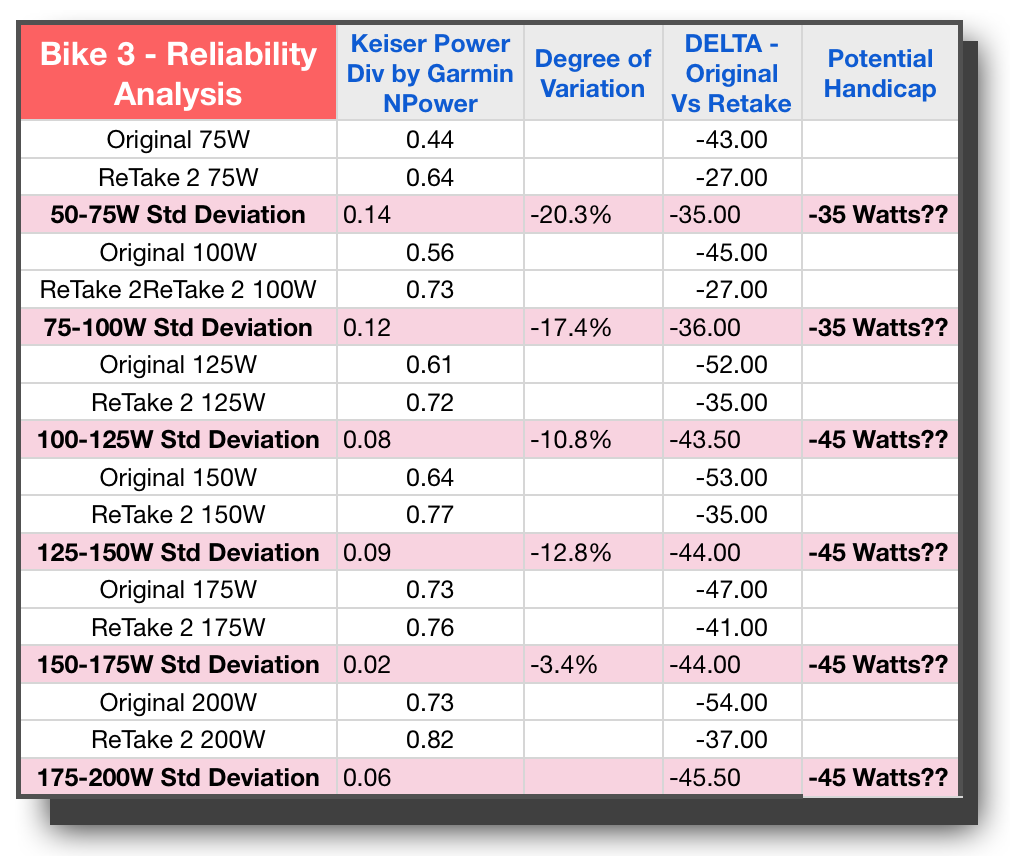
Looking at Bike 5 I’m feeling pretty good that it’s similar to #9, this time with all variation under 10% and the good power-like escalation of Potential Handicap wattage going up as a power curve would reflect. Taking a look at Bike #17 though, and I had to do a double take — WHAT?? or should I say “WAATTT!” The degree of variation is crazy. Not only that, even looking at it from a practical perspective, the Potential Handicap, aside from being huge in the 30 to 60 watt range, is simply not close to either of the trials in this study. While 30 Watts may indeed be the average between the two tests, with one being 13 and the other being 44, who knows if 30 will be too much or too little. In fact all of the stages are reflected as pretty wild for Bike 17.
Unfortunately the bad news continues with Bike 16 and Bike 3. Both of these bikes have variations well above 10% and similar wide swings in Watts for the original delta between tests. In addition, we have bike #3 not demonstrating the proper power curve through the last 4 stages, but instead settling into one consistent difference in wattage.
Looking again specifically at these last 3 bikes, and there is no way I would be comfortable handicapping these bikes and expect it to be consistent. So all in all, we have 3 bikes that look like they would lend themselves to reliable handicaps, and three that do not. With a split decision like that, we are all but a hung jury here.
Since I recognized that I might be the problem — I am the only one conducting the tests – and while it stands to reason I would get better and more consistent over time not less, I did not want to rule that out. This data left me scratching my head more than anything else — more questions that need to be anwered. It was time to bring in bigger guns than I have.
The next blog will have another video where we brought in a professional statistician to help us get to the bottom of this.
Making sure this process is repeatable with each bike tested is essential to our objectives.
Let’s recap what we’ve done so far in our video blog series:
1. We have introduced the whys and wherefores of this Indoor Cycling Power research project
2. We’ve shown exactly how the Garmin Vector pedals get mounted to the Keiser m3 indoor cycle bike
3. We’ve demonstrated from start to finish, the precise protocol used in conducting repeatable tests on each bike
4. Last week we stepped through the process for getting the data from both the Garmin bike computer and the Keiser m3 console (manually recorded) put into the a consolidated spread sheet.
Accuracy & Reliability Are Two Different Things
This week we move into the steps required to begin validating the reliability of our equipment and/or our process. This is as crucial a consideration as the pure accuracy of the data. If we can’t confirm that our process of measuring power is consistent on any one given bike from one day to the next, how can we expect to handicap the bike for accuracy with a number or even series of numbers for different wattage levels since an unrepeatable test would mean this handicap would not be valid from one day to the next.
Consider the frustration of weighing yourself each day on a scale that can not show you 50 lbs from a 50lb weight from day to day. On some days you’ll be depressed while others you’ll be “woo hooing” all the while your weight has stayed the same. It’s an absolute critical component of our findings; to know what we are doing is repeatable and reliable. If it isn’t, we need to consider if the process is changing and causing the inconsistencies, or if the equipment is doing so. While I have tried to be more than methodical about every aspect of this process from pedal calibration to bike test execution, I will not rule out tester error or inconsistency for the moment. Let’s just first see how our numbers turn out before we decide which factor to consider (test process, or equipment variability).
Coach Gino Explains Why Validation & Reliability Are Important
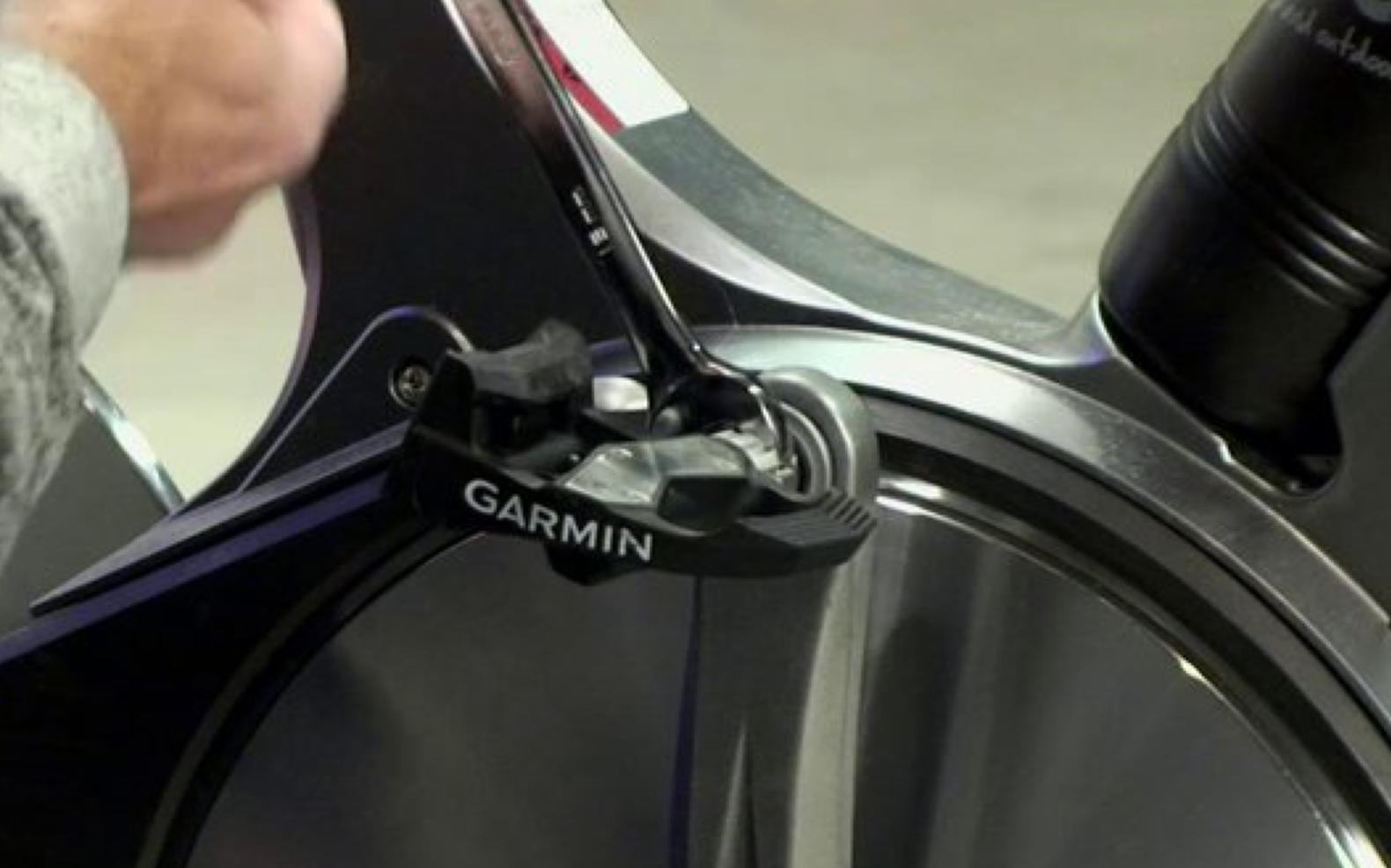
The 2 video segments that make up this post are both quite short. The first one describes in detail how to unmounts the Vector Power pedals in order to use them on a second bike. It is important that we don’t just leave the pedals on and do multiple tests on the same bike. This would not tell us if that bike will be reliable one day to the next. We must first test other bikes, and then come back to bikes we’ve tested.
The second video segment is showing one complete test again (like our 2nd video), only this time on one of the bikes already tested from a previous session.
Now that StarTrac is shipping Spinner® Blade Ion Indoor Cycles with Power, there's a bunch of Instructors who need to be educated on how to effectively use this new training “tool” in their classes.
Spinning's new education program is called the SpinPowerâ„¢ program. It was developed by well known Power Training expert Angie Sturtevant who's the Director of Power-Based Training.
When ICI/PRO member Dennis Mellon told me that his club in Greenwood Village Colorado would be hosting a SpinPower training, I asked if he would be willing to share his experiences with our listeners.
Dennis Mellon is one of those smart, talented people we love to have on the Podcast. Here's his bio…
Dennis Mellon has been working in the Fitness Industry since 1992. He's a Certified Personal Trainer/Performance Enhancement Specialist through the National Academy of Sports Medicine as well as being a certified Spinning, Energy Zone and Indo-Row Instructor. He has a Bachelors Degree in Physical Education and a Minor in Coaching from the State University of New York College at Cortland. He spends most of his time at Greenwood Athletic and Tennis Club in Greenwood Village Colorado where he is a Personal Trainer, Masters Swim Team Coach, Indoor Cycling and CardioVascular Intervals instructor. Dennis was voted the Mountain West's top Spinning Instructor by Competitor Magazine in 2012. He has completed 8 Ironman distance triathlons, ultra distance mountain bike events, marathons and numerous shorter distance events.
Listen to the Podcast below or click here to subscribe to the free show in iTunes.
Please share this with your friends.
ICI/PRO is the leader in Power related class profiles and online education. You can sample hundreds of premium member articles, Podcasts and Audio Class Profiles as part of a trial subscription. Click here to get started.
Sometimes it's just being in the right place, at the right time to move into a position as Master Trainer for a major Indoor Cycling education company.
OK, maybe you need more than that. Like having a strong passion for fitness, a bicycle racing background and (in this case anyway) an engineering mindset that helps you to understand and then communicate the true value of adding metrics to an Indoor Cycling class.
Dunte joins me to discuss how he got his start with Stages Indoor Cycling and offers his ideas on effectively communicating power training to our students.
Later this week (shooting for Friday) I'll be publishing Dunte's Race of Truth Audio PROfile. We had some audio quality issues with Skype that made take #1 unusable and plan to re-record his profile Wednesday this week.
I saw this last Tuesday and forgot to share it with you. Our club ride begins at the Minnetonka Lifetime Athletic Club. Better known as The Spa, this is a unique LTF facility. Definitely not a Big Box, this club began as a women only club before being purchased by Lifetime.
When I got there Tuesday night they were setting up for an outdoor ride. How fun is that? We rolled before they got started and I heard later that they (Manager and Instructors) did a very nice job making this outdoor class an event, rather than just a class.
The area behind the fence is a small patio. After the class participants enjoyed Hors d'oeuvres and a cash bar – this is an adults only club. They even had live entertainment from a local duet. Is that something you could do at your club or studio?
Could I keep up in a group ride?
With Amy visiting her family in Phoenix, I become the de facto sub for her Saturday AM class. Which was fine – 55 and rain this morning = no outdoor ride for John. After class a regular member asked me if I felt she could keep up in a group ride. I dislike giving answers beginning with; “well that depends” – except in this situation it really does. Riding with a group depends on a number of factors. So I asked her the following:
Do you have a suitable road bike?
Are you comfortable riding close to others?
Are you OK riding on the road?
How far (miles) can you typically ride at a consistent pace?
It surprised (and delighted) me a little when she quickly answered positively to each question and then clarified what she was asking:
How many Watts do I have to make, to keep up in a group ride?
She's been listening and wanted to equate the power/watts she seeing in class to riding outdoors 🙂
I had to think about it for a few minutes, before I could answer her. I explained that most organised group rides have multiple “levels”:
“A” groups are normally drop rides. If you can't keep up you get dropped, and ride home by yourself. Based on my purely anecdotal experience, “A” groupers can sustain 1.5 or more watts per pound of body weight for the entire ride.
“B” groups, depending on the organization and/or leaders, are partial drop rides = we may wait for you or there maybe someone who will come back to help you catch up. To hang with the “Bs” you should be comfortable producing your body weight in watts > and be able to climb at around 1.5 watts per pound.
“C” groups areno drop rides. Everyone stays together and ride at the pace of the slowest rider.
But I don't want to slow everyone up – so what's the minimum watts I need to make?
I told her that there's no way to know that number. I encouraged her to show up one night and see what happens…