As an indoor cycling instructor, you’re going to find a large percentage of your students dabble in triathlon, or engage in it as a serious sport. Either way, you don’t want to be embarrassed by using the wrong triathlon-related words or terms in your class when talking to them about triathlon (including the ever-popular pronunciation of triathlon as “triath-a-lon”).
So to help you look better and converse intelligently and confidently with your indoor cycling students who are triathletes, this is Part 1 of a five part series called “Tri-Lingo 101” that will teach you how to use the correct triathlon terms. In this article, you’ll learn common triathlon swim terms. Without further ado, let’s dive in!
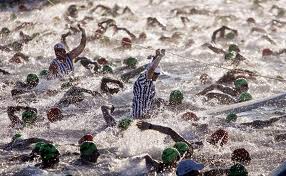
Beach start: Starting from the beach and running into the water to begin a triathlon.
Buoy: The floating markers used on a triathlon course to indicated course layout, distance and turns.
Deck: The hard surface around the pool.
Draft: To swim directly behind or beside the swimmer in front of you, which makes it easier to swim.
Floating start: Starting from the water without the feet touching to begin a triathlon.
Freestyle: The common front stroke style swimming usually used in triathlon.
Kickboard : A floating piece of styrofoam used to for kicking drills.
Lane : A sectioned area of the pool for lap swimming. Typically, a pool is divided into 3 or more lanes.
Lane Lines : The floating markers which that separate the lanes.
Lap: From one end of the pool to the other and back.
Length: From one end of the pool to the other. A “half” lap.
Flags : Small triangular pennants hung over the pool to indicate that the end of the lane is near.
Master’s: A swim class, group or club for adult swimmers.
Open Water: Outdoors swimming in a lake, river or ocean.
Pull Buoy : A floating piece of Styrofoam that goes between the legs so that a swimmer doesn’t need to kick.
Transition: Transitioning from the water to the bike portion of a triathlon.
Wall : Vertical part of the pool that is typically touched between lengths.
Wetsuit legal: A triathlon in which the water is cold enough to allow a wetsuit.
Bio:
Ben is a fitness business coach, triathlon author, and sports nutritionist. If you want more videos, aricles and audios about swimming and other triathlon related topics, visit Ben’s free blog and podcast at http://www.bengreenfieldfitness.com . Also be sure to check out Ben’s endurance sports website Endurance Planet, at http://www.enduranceplanet.com and his Rock Star Triathlete Academy, at http://www.rockstartriathlete.com . Finally, if you want to learn how to grow your fitness business and make more money, visit Ben’s fitness business advice website at http://www.trainfortopdollar.com .
Indoor Triathlons are very popular here in the frozen north, offering club triathletes the chance to swim bike and run long before its warm enough to be outside.
In the past, the Life Time club where I teach used Spinner NXTs with a Spinning computer for the bike leg. Participants would run up from the pool, jump on a bike and pedal as fast as they can until the reached the prescribed distance. The clever one's figured out that the amount of resistance they used had no effect on how quickly the computer added mileage, so you had a bunch of flailing legs @ 130 RPM with no resistance = not really doing any real work 🙁
But not this year…
With all of our NXTs being replaced with Indoor Cycles with power, the participants in the Indoor Tri actually needed to “TRY” and ended up really working for their mileage this year!
I took this picture while I was riding a FreeMotion S11.0 at 115 RPM, but with no resistance. You can see in the display that even though I was pedaling very fast, I wasn't producing any power because I had zero resistance. No power = no speed and more importantly, no distance is recorded.
I talked with a couple of finishers about their experience, especially what the bike leg was like, compared to last year.
“It was a lot harder.”
“More like riding outdoors.”
“I completely over did it trying to keep up with the guy next to me. My legs were junk by the time I started the run.”
Based on her unbroken string of last place finishes, Sally Edwards is the absolute worst Triathlete in America. But Sally has a good reason for coming in last… it's so no one else has to.
Listen as she describes her involvement in Danskins and Trek Womens Triathlons and she has a challenge for all of our female listeners; grab a girl friend and commit to training and competing in your first Tri.
Sally also has a fantastic opportunity for those of you interested in taking the step to becoming a Heart Zones Triathlon Coach.
Listen to the Podcast below or subscribe for free using
As an indoor cycling instructor, you’re going to find a large percentage of your students dabble in triathlon, or engage in it as a serious sport. Either way, you don’t want to be embarrassed by using the wrong triathlon-related words or terms in your class when talking to them about triathlon (including the ever-popular pronunciation of triathlon as “triath-a-lon”).
So to help you look better and converse intelligently and confidently with your indoor cycling students who are triathletes, this is Part 4 of a five part series called “Tri-Lingo 101” that will teach you how to use the correct triathlon terms. In this article, you’ll learn common triathlon transition terms. Without further ado, let’s dive in!
Bike In — Coming off the bike leg of the triathlon, there is typically an arch, gate or area into which you push your bike.
Bike Out — When you head out on the bike leg of the triathlon, there is typically an arch, gate or area out of which you push your bike.
Bodyglide — Various forms of lotion or lubricant materials exist, with Bodyglide being one popular brand. This can be used on arms, legs, hands and feet to enter and exit wetsuits more quickly, and also in shoes to get feet to slide into shoes more quickly.
Change Tent — In Ironman (and some Half-Ironman) events, this is a tent to run into after the swim to change into your cycling gear.
Elastic Laces — These are placed on running shoes to increase speed of transition and reduce the length of time it takes to tie a shoe.
Mat — Timing mats are placed throughout the course and in the transition areas to sense the chip on your ankle and keep track of your swim, bike, run and transition times.
Run Out – When you head out on the run leg of the triathlon, there is typically an arch, gate or area out of which you push your bike (there is no “Run In”…that’s the finish line!)
Swim In — As you come out of the water and run up to the transition area, you’ll typically go through an arch, gate or area marked “Swim In”.
T1 — The first transition from swim-to-bike.
T2 — The second transition from bike-to-run.
Transition Bags — In many events, you’ll be given separate bags in which you place things like running shoes, wetsuit and goggles, or special needs. Be sure to pay attention to what goes where!
Wetsuit Stripper — A volunteer who is there at the end of the swim to help you out of your wetsuit.
Bio:
Ben is a fitness business coach, triathlon author, and sports nutritionist. If you want more videos, aricles and audios about swimming and other triathlon related topics, visit Ben’s free blog and podcast at http://www.bengreenfieldfitness.com . Also be sure to check out Ben’s endurance sports website Endurance Planet, at http://www.enduranceplanet.com and his Rock Star Triathlete Academy, at http://www.rockstartriathlete.com . Finally, if you want to learn how to grow your fitness business and make more money, visit Ben’s fitness business advice website at http://www.trainfortopdollar.com .
As an indoor cycling instructor, you’re going to find a large percentage of your students dabble in triathlon, or engage in it as a serious sport. Either way, you don’t want to be embarrassed by using the wrong triathlon-related words or terms in your class when talking to them about triathlon (including the ever-popular pronunciation of triathlon as “triath-a-lon”).
So to help you look better and converse intelligently and confidently with your indoor cycling students who are triathletes, this is Part 3 of a five part series called “Tri-Lingo 101” that will teach you how to use the correct triathlon terms. In this article, you’ll learn common triathlon run terms. Without further ado, let’s dive in!
5K: 3.2 mile run or race. Generally the distance in a Sprint triathlon.
10K: 6.4 mile run or race. Generally the distance in an Olympic triathlon.
Aerobic: This term is used to define the intensity of a run that is primarily conversational at a slow, easy pace. Generally, you burn more fat as a fuel and produce less “painful” lactic acid.
Anaerobic: High intensity pace that allows lactic acid to build-up, and can generally not be sustained much longer than a 10K.
Chip: a device worn above the ankle or on the shoe that allows timing during a race or event.
Elastic Laces: The “stretchy” laces many triathletes have on their shoes to allow easy and fast entry into the shoe without having to tie a knot.
Fartlek: A style of running that is “random” or variably paced. For example, a Fartlek run might involve running 5 miles on a trail, and sprinting at various intervals throughout the run. Also known as “speedplay”.
Hitting The Wall: Generally happens about mile 20 of a marathon — depletion of carbohydrate and drop in blood sugar leads to immediate fatigue and loss of energy.
Intervals: Short, fast repeats of generally 30 seconds to 5 minutes, interspersed with easy walking or jogging in between each effort.
Marathon: 26.2 miles. Generally the distance in an Ironman triathlon (and a Half-Marathon is the distance in a Half-Ironman, or 70.3, triathlon)
Pick-Ups: Short accelerations performed during the run, generally to stretch out the legs and prepare them for speedwork or a run. Usually 10-30 seconds long.
Plyometrics: Jumping, bounding, hopping or other explosive movements designed to train the body for reducing ground contact time.
Pronation: The inward roll of the foot as the arch collapses after the foot strikes the ground. Overpronation is excessive inward rolling due to weak support, which can cause many running injuries.
Runner’s High: An intense feeling of exhilaration or being “in the zone” that can occur during a run, usually due to the release of endorphins.
Strides: Similar to pick-ups, but usually performed as intervals (i.e. a set of 8 strides to warm-up prior to a race).
Supination: Opposite of pronation. Outward rolling of foot after foot strike. Less common, but also a cause of running injuries.
Bio:
Ben is a fitness business coach, triathlon author, and sports nutritionist. If you want more videos, aricles and audios about swimming and other triathlon related topics, visit Ben’s free blog and podcast at http://www.bengreenfieldfitness.com . Also be sure to check out Ben’s endurance sports website Endurance Planet, at http://www.enduranceplanet.com and his Rock Star Triathlete Academy, at http://www.rockstartriathlete.com . Finally, if you want to learn how to grow your fitness business and make more money, visit Ben’s fitness business advice website at http://www.trainfortopdollar.com .






 As an indoor cycling instructor, you’re going to find a large percentage of your students dabble in triathlon, or engage in it as a serious sport. Either way, you don’t want to be embarrassed by using the wrong triathlon-related words or terms in your class when talking to them about triathlon (including the ever-popular pronunciation of triathlon as “triath-a-lon”).