The increase was a 67 to 76% increase in energy expenditure for all standing cycling conditions. Image from the study.
New research sponsored by ACE demonstrates that standing (vs. sitting) burns more calories, as long as you keep everyone out of the saddle long enough. This study was conducted by a team lead by Dr. Len Kravitz at the University of New Mexico.[wlm_private ‘PRO-Platinum|PRO-Monthly|PRO-Gratis|PRO-Seasonal|Platinum-trial|Monthly-trial|PRO-Military|30-Days-of-PRO|90 Day PRO|Stages-Instructor|Schwinn-Instructor|Instructor-Bonus|28 Day Challenge']
The study you can download here; Metabolic Cost of Weighted Vests During Standing Cycling was designed to look at the effect of adding additional weight (with a weighted backpack) to an Indoor Cyclist and learn the metabolic affect from how long you're out of the saddle:
Abstract
Whether cycling on the road or pedaling in a club cycle class, this mode of activity is done using
both seated or standing positions. Previous research has examined the effect that cycling position
exerts on physiologic parameters such as heart rate (HR), oxygen consumption (VO2), or rating
of perceived exertion (RPE) during exercise (1—3). This research was intended to simulate hill
climbing, which is applicable to a majority of road cyclists. However, no prior research has
examined the effect of wearing a weighted vest during stationary standing cycling. As well, no
research has investigated the effect of extended bouts of stationary standing cycling (1, 2, 3 and
4 minutes) on metabolic parameters. The implications for this research may directly impact
individuals engaged in fitness center stationary cycling classes, which have become very popular
in recent years.
Anything to burn more calories
I met Dr. Kravitz in the Fall of 2012 at a fitness conference. Once he learned my interest in Indoor Cycling, he excitedly told me about his idea to study the potential training and calorie expenditure effects of adding weight to an Indoor Cyclist. If I'm remembering correctly, he expressed the understanding that weight loss / weight management is high on the list of reasons our riders come to class. If strapping on a backpack full of bricks was going to help someone reach their goal weight, I was all for learning more – and then share it with you.
Based on the chart above, it doesn't appear that adding weight has nearly the affect that simply getting everyone out of the saddle does.
The first minute is just practice
The biggest take-away from this study for me, was the huge jump in calorie expenditure that occurs beyond the first minute.
Will seeing this change how you structure time out of the saddle?
Energy expenditure stabilized between minute 3 and 4 on all standing cycling conditions. This information provides program design suggestions for personal trainers and club cycle instructors desiring to optimize caloric expenditure utilizing research-driven methodology. Clearly, the inclusion of standing cycling bouts for 2 to 3 minutes during a cycling bout meaningfully increases energy expenditure. This increase in oxygen demand occurs during standing, with or
without a weighted vest (up to 15%BW was used in this study). According to Tanaka et al (3), this energy expenditure increase is attributable to the increased muscle blood flow and/or involvement of a larger muscle mass with standing cycling.
[/wlm_private]Dr. Kravitz's team has done a number of other studies that you may find of interest. I interviewed Doctoral student Micah Zuhl in 2012 and discussed the article he co-wrote with Dr. Len Kravitz entitled HIIT vs. Continuous Endurance Training: Battle of the Aerobic Titans. ICI/PRO Podcast #201 — HIIT vs Endurance Training with Micah Zuhl
I started writing this post with the idea of giving you some outside resources like this one:
Many of us have heard these words as part of the advertising campaign for the self-help book Verbal Advantage: 10 Steps to a Powerful Vocabulary and although I haven't read the book, as a long time salesperson I understand how powerful using the correct words can be.
And then it dawned on me that after 3 years we have resources buried within our 900+ pages that many of you may have never seen or heard. So I thought I would suggest some articles and Podcasts that speak directly (pun intended) to helping improve How You Sound to your class 🙂
In ICI Podcast # 10 — Johnny G is Kranking! Johnny G demonstrates that it's not the actual words he uses, but rather the way he delivers them. Johnny's rhythmic pattern of speaking is hypnotic to listen to and even though he is soft spoken, you feel compelled to listen to him.
Scosche RHYTHM+ Heart Rate Monitor Strap works with ANT+ and BLE devices and consoles.
I'm thinking this new Scosche RHYTHM+ Heart Rate monitor strap could be the best I've ever tested – for a bunch of reasons that include removing what I feel has always been one of the biggest objections to wearing a HR strap.
Despite all of our collective efforts explaining the benefits of training in specific heart rate zones, we're lucky if we have 30% of our participants monitoring their heart rate. I know that some classes are better than that, but based on all of the surveys I've done in the past that's about where we are.
Why?
If I put on my salesman's hat, I know that people don't buy a product or service for lot's of reasons. Salespeople call these objections. If you want to make the sale, you typically need to remove or minimise the prospect's objections; who in this instance is our class participant.
So what are the often stated objections?
No interest – it's almost impossible to sell anything to someone with no interest.
Too expensive – for relatively lowpriced objects like an $80 HR monitor, the selling price objection is often masking some other issue – or – means the prospect isn't seeing enough benefit.
Too complicated – do the manufactures of HR monitors actually use their own products? Setting the typical Polar watch is needlessly complicated. I've gotten to the point where I refuse to help people set their HR watches before or after class because I can't get sucked into a 30 minute project where, more often than not, I'll fail. See #5
Too confusing – as an industry, with all of the branded zone based training systems, we've made heart rate training impossibly confusing for new participants. IMO if you're talking about anything more than three zones based on thresholds, you've lost many of your club athletes. See #5
Too stressful – It's stressful to me when I'm offered a coupon the grocery store, good for my next visit. Why? Because then I'll have to remember the coupon the next time I'm there – which I won't when the cashier asks me; “do you have any coupons?” Our members aren't any different than me or you: getting to class on time is stressful enough. I don't need the added stress of remembering my HR monitor… finding both of my shoes is tough enough. See #8 for the source of even more stress.
Willful ignorance – face it, there are people in your class who want to believe they're burning 1,000 calories in a 45 minute class, where they don't break a sweat. You'll never sell these people on any form of performance measurement (these are the peeps who cover their power console so they can't see their wattage) unless you're running a special on unicorn spit detox syrup.
Uncomfortable – the old versions of hard plastic HR chest straps were very uncomfortable. The new soft straps are an improvement – but they are still not pleasant to wear. Many women won't even think of wearing a HR strap for anatomical reasons. Then there's the other type of uncomfortable as in; “I'm not comfortable opening my shirt to put this strap on, with other people around” 🙁
Unreliable – how many times have you found yourself thinking; IS THIS THING ON? Is the strap battery dead? Maybe I need some additional spit on it? Do I need to shave a horizontal stripe across my hairy chest to get this thing to connect? Wait, who's BPM am I seeing here?
That's 8 realistic reasons why you see so few people wearing a HR strap. The new Scosche RHYTHM+ Heart Rate monitor strap addresses many of the objections I've listed above:
Not complicated – the HR watch is the source of most of the confusion. No watch = no confusion. The RHYTHM+ pairs easily with any bluetooth device (iPhone / Android) using any fitness App that has a HR function. It also pairs with ANT+ monitor consoles found on the Schwinn AC, FreeMotion S series and Spinner Blade Ion. Sorry – the RHYTHM+ doesn't connect with the Keiser M3.
Removes a little stress – It's so small that I can tuck it into my shoe. So if I find both I've also got my HR strap 🙂
Super comfortable – just slide it onto your forearm. Because it uses optical sensors it doesn't need to be moistened and it's not affected by hairy arms. And no one will feel embarrassed when they put it on.
Better reliability – there's a little red light that shines when it's on and it comes with a USB charger.
You'll find more info about the Scosche RHYTHM+ Heart Rate monitor strap here.
I suppose I should start this by answering your question; “what exactly is their Golden Hour, John?”
It's my description of the 60 minutes, that follows the first 30 minutes, of aerobic activity.
For you, me and many (if not most) of the students in your class, we all have a period of time where we are the strongest on the bike. Depending on your level of fitness, that period could be anywhere between 30 minutes to 3+ hours. It “begins” for most of us after about the first 20-30 minutes of activity.
Now you may be sitting there nodding your head thinking; “yea, that makes sense… I do feel much stronger and capable of higher/longer levels of work, during the second half of class.
Competitive cyclists understand the Golden Hour. If you've watched the Time Trial stages of the Tour De France you've no doubt seen the rows of cyclists on trainers, pedaling through a very specific intensity profile. The picture at the top is of the British Women's Track Cycling Team going through their warm up protocol at last year's Olympics.
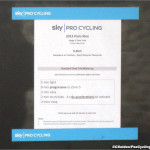
I found this at wattbike.com that shows Team Sky's preparation for last year's opening stage Time Trial for the Paris-Nice stage race. The completion of each rider's warm up is timed to coincide with their individual start time of the race.
Paris-Nice
Stage 1 Time Trial
Standard Time Trial Warm-Up
5 min light
8 min progressive to Zone 5
2 min easy
2 min to include – 3 x 6s accelerations to activate
3 mins easy
Notes:
Progressive means building to the power zone over the 8 minutes. Only in the last 1 min do you get to Z5
6 second accelerations are sprints & for a whole 6 seconds!
“Why is it an hour?” My perception is that most of our regulars could manage a 90 minute class – if we locked the doors and brought out the whips 🙂 So 30 mins + the Golden Hour = 90 minutes of achievable effort before fatigue sets in.
“But my class is only 45/60 minutes… how would this help?”
I use the Golden Hour to cultivate an abundance mentalitymindset in my class. Simply stated; you have a lot… so you can freely spend a lot. A common training technique,for time limited triathletes, is to limit your rides to just double your event distance. So on race day, when you're faced with a 20 mile bike leg, you're thinking; “I'm trained to ride 40 miles – so twenty's no big deal.” “I'll have a bunch left for the run.”
Contrast this with the scarcity mentality that many of our student's come to class with. They walk in thinking; “I need to pace myself, or I'll never be able to finish this class.” Which is the same as saying; I only have a little… so I need to be very careful when and how I spend it. You've no doubt experienced participants who appear to coast through most of class, only to give one big effort at the finish. They were “saving” some of their limited resources, so as not to “run out” before the end.
Here's a few ideas on how you can incorporate the Golden Hour into your classes.
Seek agreement
I talk frequently about the Golden Hour effect at the beginning of my classes, asking for my classes' agreement that they too feel stronger during the second half of class. Then at the 25 minute mark; ” do you feel it?” “Do you sense how you body is beginning to fire on all cylinders?” “Do you feel those early feelings of stiffness or limitations/distress in your breathing leaving you?” “Do you have new feelings of strength and confidence?” “Are you ready to take advantage of your Golden Hour?”
Make it a goal to reach the Golden Hour ASAP
It drives me crazy watching people come early to class, mount up and then spend ten or more minutes sitting there slowly turning the pedals. What are they waiting for? I make a point to commend all those making the most productive use of their time in class – and encourage the others who aren't to “get your money's worth” by independently beginning their warm up as soon as possible.
Your participants/students/riders come to your class with different objectives; burn fat, maintain/increase fitness, endorphin rush, etc… Success in any of these requires a commitment to do the work you intended for them. Coaching everyone to work at their potential is part of your role as an Instructor. Helping everyone understand that their capacity for work exceeds the length of available class time, can go a long way toward helping everyone reach their unique fitness goals.
This Podcast is was originally published on May 7, 2017, I have updated it with our new Podcast host information and I am representing it now. I hope you enjoy it, Joey
The latest issue of ACE Certified News features an article: Create Safe, Effective Indoor Cycling Classes. The author, health and fitness writer Karen Asp joins me to discuss what she describes as the "Five Common Mistakes" made by Indoor Cycling Instructors. Karen also explains what motivated the American Council on Exercise to contract her to write this story.
NOTE: I'm trying to get approval from ACE to reprint the article and will post it asap.
Listen to the Podcast below or subscribe for free using iTunes or Zune.