This question from a prospective ICI/PRO member got me thinking today, while out on my early AM training ride…
I'm interested in signing up for your programs, but I have a few questions about the information that is received. When you receive the classes, are there instructions included with how to teach each song; meaning what to do when?
Good question.
I answered her saying that the majority of our Audio Class Profiles are Intensity based – segments of time at a specific level of effort defined by RPE, HR Zone or Power/Watts.
After I hit send I started to reconsider my response – are our profiles mainly intensity based? So I took a one of our most popular profiles (Welcome to the Jungle from Krista Leopold) with a specific focus on how much movement/position/cadence change she had included.
It turns out not much… here's what I found in the PDF download.
Krista's introduction is all about intensity:
Welcome to the Jungle is a high-intensity class. For the student, the prescribed intensity gradually increases from below threshold to maximum effort, which is advisable only for students with previous experience and solid fitness levels. Just as in any class, new and deconditioned students will be coached to ride only where they feel comfortable. This ride is best taught to a group that you already know, and is not a ride to use on a day when you are subbing or just starting out in a new setting. Ideally, you would have announced it in advance so that they are prepared and rested for it. Instead of using heart rate numbers for this ride, we will rely on good ‘ole RPE. You and your students will benefit from having 1-10 scale RPE chart displayed. We will work through four rounds of intervals separated by a complete recovery. Each round will increase in intensity and the recovery time will decrease.
Page two includes this:
For all of the work efforts I recommend theSpinning® movement called “Running with Resistance,” but any movement can be substituted. Running with Resistance is particularly effective because it is a move that is specifically done for short periods. It allows you push a higher resistance at a higher intensity in a way that is different from a sprint. Done correctly, you can easily push your heart into the high end anaerobic zones.
In the description for song #2
Toward the end of the warm-up, we will accelerate as we leave the saddle, almost like jumping,
to finish raising our exertion to right around 6 on the RPE scale.
Then there are a few random suggestions:
It’ll be a fun, high-cadence climb that will be as easy or
as hard as they want it to be.
For this final effort you are mostly cheering them on, reminding them that their cheering squad is
cheering them on, and giving them their starts and stops. Be very clear with every start and stop (of the Tabata intervals) because you don’t want them to miss it. I find that a “3-2-1-Stop” countdown at the end of every
segment helps them by giving them a regular pattern to follow.
Krista's Welcome to the Jungle Quick PROfile only includes one reference to movement
Created by: Krista Leopold, aka GroupFitPower
Training Type: High-Intensity Intervals Working HR Zones: Zones 4-5c
Total Class Length: 60 minutes
Warm-up: 12 minutes Start with a long warm-up to help settle them in. After 8-9 minutes, bring them out of the saddle to get them energized.
1:3 Intervals Round: 11 minutes 30 seconds “Hard” (RPE 7) + 90 seconds “Moderate” repeated 4 times, followed by complete recovery of 2 minutes.
1:2 Intervals Round: 9 minutes 30 seconds “Very Hard” (RPE 8) + 60 seconds “Moderate” repeated 4 times, followed by a complete recovery of 3 minutes.
1:1 Intervals Round: 10 minutes 30 seconds “Very, Very Hard” (RPE 9) + 30 seconds “Moderate” repeated 4 times, followed by a complete recovery of 6 minutes.
2:1 Tabata Intervals: 4 minutes 20 seconds “All-Out Maximum” (RPE 10) + 10 seconds “Moderate” repeated 8 times.
Cool Down and Recovery
After reviewing a few more it appears that I was right, our profiles are primarily intensity (not movement) based. But is that a good thing?
Wasn't the original Johnny G programming nearly all movement based? Jim Karanas made some interesting points about movement based classes in his Non-Authentic Indoor Cycling post.
It won’t last. Silly trend. Dance parties on bikes with music videos can’t last. You can’t even call it training. It’s just physical movement, not sure it’s even considered exercise. It’s totally without direction.
And yet SoulCycle is packing them in and as near as I can tell they're using a whole lot of movement in their classes.
Jim ends his post with this:
If non-authentic IC is going to make a mark, why not embrace it for what it is — a way to train on the bike that makes (some) people fit and happy? Assuming it’s validated as safe and effective (ICG has already contacted the American Council on Exercise and proposed a study), then shouldn’t every indoor cycling education body offer a program on how to teach non-authentic indoor cycling? Why shouldn’t any and every indoor cycling program be taught by those who are truly qualified to teach indoor cycling? That would be the likes of us. We know indoor cycling best. We could create a program — inauthentic fluff, if you will — that’s still authentic in its safety, structure and cardiovascular benefit. Why not?
Could the solution, that many of us are looking for, be as simple as just sprinkling some fun movement into a solid profile that's intensity based?
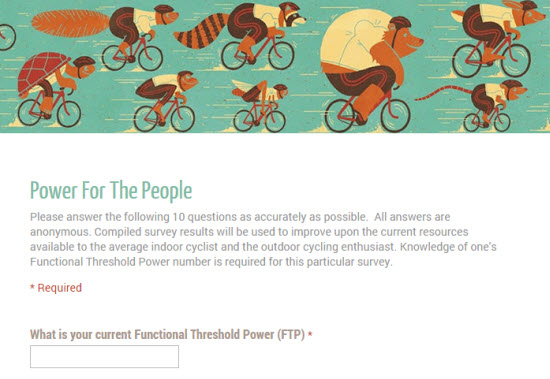
Cameron Chinatti from Stages Indoor Cycling is looking for Instructors and participants who know their FTP (Functional Threshold Power). I'm not sure exactly what she's doing with the results of this survey – but it only will take you two minutes to complete, so please click over and share your awesome wattage number.
It's anonymous if you choose and Cameron is looking for as many responses as possible – so feel free to share this survey with your class if you teach and/or train with power. It doesn't matter who's cycle you ride.
I haven't surveyed my regular participants, but I have asked a bunch over the past year or so if they have gotten a sense as to their PTP (Personal Threshold Power). I've stayed away from FTP as it designates the result of a formal assessment. The consensus is that most understand where they should be during the “Best Effort” intervals I do in nearly every class.
Feel free to use the FB share button to place this on your personal page if you have friends you feel would be interested.
This Podcast is was last published on Feb 7, 2010, I have updated it with our new Podcast host information and I am representing it now. I hope you enjoy it, Joey
Have you ever thought of creating a comprehensive training program for your members to help get them really fit? You want to
incorporate many areas of the gym, not just your indoor cycling class; you want to do the research to make sure the program follows a stepped approach using proper training principles; you want to provide the participants assessments and educational and motivational material along the way. But the amount of work to put it together is daunting so you just never get there!
What if you could take a self-funded, turn-key program that has been proven to work, that will bring profits, teamwork, excitement and success into your facility?
Jade Ng from Finish Strong Training Systems joins Jennifer and me to discuss her turnkey program for fitness clubs. To help ensure the success of the 6-phase, 12-week program, FSTS provides training videos for instructors and personal trainers on the focus of each phase and how to teach the suggested classes. Educational and motivational videos are provided for the participants to help them stay on track. Both Dr Haley Perlus and Jennifer were invited to create some of the videos and training information, and they are honored to be a part of the program.
Listen to the Podcast below or subscribe for free using iTunes
Beyond fitness and weight management, many of the people in my class are training for some event this summer. Most are tied to a charity fundraiser. The MS 150 is a popular ride here in Minnesota, that happens in July each year.
Could you ask your class two things and let me know the results?
What percentage of your class are planning to participate in a fund raising ride this year?
Does the fund raising become a bigger obstacle than the training?
Why am I asking?
I'm working on some ideas to help create some excitement in your class and at the same time assist riders with their fund raising. Please leave a comment below or send me an email john@indoorcycleinstructor.com