“Hello… My name is Karen and I stepped out of the box last year. I am also the self proclaimed spokesperson for KEEPING IT FUNâ„¢ Indoor Cycling. I’m committed to helping other indoor cycling instructors who aren't afraid to approach indoor cycling differently.”
I wrote it a little over a year ago.
I wrote it after making the commitment to add variety into my own studio's Indoor Cycling program.
I wrote it because in order for me to continue to transform lives through Indoor Cycling I recognized that my program needed to evolve.
If you are an Indoor Cycling studio owner/manager the brutal truth is… maintaining the integrity of the road may be the demise of your studio/program.
Soon after I opened my studio in November of 2012, I realized this NOT SO FUN fact.
So, I took an honest inventory of what our studio offers, what our customer wants, and what future projections were for the Indoor Cycling industry. I listened to our customers. I observed what classes they gravitated to and away from. I asked them what they found FUN.
I took into account my personal evolution as a GroupEx instructor, my observations of the Indoor Cycling industry, as well as input from other instructors and studio owners. And then … I charted my Indoor Cycling course and set sail by following my heart. I stayed true to my WHY. I honored both my vision and our Mission Statement of creating the ultimate Indoor Cycling customer experience. I added variety to our schedule.
In addition to traditional Indoor Cycling classes, our studio also offers
CB2 Rhythm
CB2 TotalBody
CB2 Performance IQ
CB2 Rhythm & TotalBody and
CB2 Revelation Revolution Christian Indoor Cycling … all of which we did not offer when we opened. It wasn't easy … but we did it … and it was worth it!
Is offering variety the key to success for future Indoor Cycling studios? ABSOLUTELY NOT
The key is recognizing that the Indoor Cycling industry is evolving and will continue to evolve.
Only you can figure out where you and your studio/program fit in. I suggest you start by revisiting your WHY.
Make decisions that maintain the integrity of your brand mission (which I hope you have) and honor your brand vision (which I also hope you have). Talk to your customers and look at it through their eyes. Look at it through the eyes of customers that ARE NOT customers. Talk to your peers. Ask for help.
Regardless of the path you choose… BELIEVE in it and be ALL IN
Words of Wisdom From An Outdoor & Indoor Cyclist “People need to realize clients have different goals, something your team is exceptionally respectful of. Those who say dance has no room in spin* need to check why they are in the business in my opinion. I love cycling, fitness and helping people improve and grow. I know that may violate an ideal that orbits the bottom line comes first mindset, but it is how I feel. If you want to have limited appeal to a small clientele offer nothing but high powered, intimidating classes that serve Tour de France, Ironman Kona specialists, otherwise open your mind and look at he every day folks that are interested in mixing it up and developing fitness via different methodologies.
I'm admittedly novice in your world and likely idealistic to a fault, but I have trouble dealing with folks that are close minded, dismissive and risk averse. Try things live and learn!” Phil
* “spin” has not been identified as Spin® to maintain the integrity of the customer's own words.
Click below to see (clearly amateur) video of Phil riding in a CB2 class taught for the purpose of media photos. The testimonial after class is unplanned and a beautiful testament to different being a good thing. How do you feel about Phil's testimonial?
As a training tool – running a PTP test/assessment is invaluable!
We had some excellent questions from Studio Owners this past weekend during our Full Psycle/PRO PIQ workshop. Paul Harmeling addressed these two related questions during the Q&A – I wanted to offer my thoughts on it here:
When, or how often, should we be using using the PTP (Personal Threshold Power) mode screen?
What exactly should we have our riders doing, during the PTP (Calc) test/assessment?
First, for those currently not using a Display System in your studio, let me explain what we're talking about. NOTE: I'll focus on Performance IQ because I know it much better – all of this has similar application with Spivi.
On a related note, I learned a little known trick that could potentially save a new studio enough money to pay for PIQ or Spivi – contact me if you're interested in learning more.
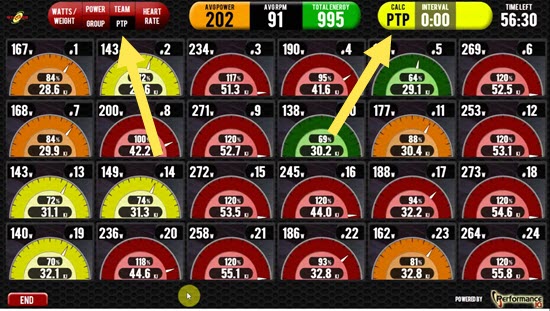
The PTP (Personal Threshold Power) mode screen in PIQ offers a quick (just three minutes) and simple tool to give your riders an approximate understanding of their maximum sustainable power wattage. Then through the wonders of technology, PIQ creates 5 power zones and displays them as different colors. The system calculates PTP as 90% of the highest sustainable power each rider can sustain for the length of the three minute test.
Is PTP as accurate as a 20 Threshold assessment? It doesn't matter to ~98.5% of your riders. What is important is that PTP answers the question that I've heard over and over the past 3 years I've been teaching with power: how hard should I be working… when you ask me to work hard?
So on to the questions:
When, or how often, should we be using using the PTP (Personal Threshold Power) mode screen?
Paul and I are in agreement here – we both feel you should be including PTP in most, if not all classes. There are of course exceptions. You may have a teams challenge scheduled or focus on a class that's directed toward handicapping everyone based on watts/pound.
What exactly should we have our riders doing, during the PTP (Calc) test/assessment?
Here's where Paul and I diverge in our thinking. I see this as a time for a focused effort in the saddle with a consistent cadence, where Paul was saying (and he demonstrated during the Master Class) that he's open to varying position and/or cadence. So who's right? I feel we both are 🙂
You see we each teach very different classes. Mine are typically focused efforts in the saddle = how I would run my PTP tests. Paul's classes are much more frenetic, with frequent changes = that's how he conducts his PTP segments.
Here's mine:
Running a PTP test isn't any different from the Best Effort intervals we suggest you use in a power class that doesn't have a Display Training system. Here's one I included in a recent Performance Cycle class.
Track #2 — the first PTP track is important. We’ll use this average wattage for each of the four PTP efforts to follow. Everyone seemed to enjoy Billy Idol — Rebel Yell — 1999 — Remaster — maybe suffered a bit as well. At 4:47 there’s plenty of time to explore PTP.
We use the Stage button to reset the averages at the beginning of what I describe as; Your Best Sustainable Effort. It’s normal for riders to miss-judge where they should be, so I’ll often have everyone make needed adjustments and hit the Stage button again to reset the averages.
My experience is that everyone will benefit from from a few mini (30-60 secs) PTP efforts to figure out where you should be. On any of the magnetic bikes I like to have find a reasonably challenging climb at around 65 RPM and then have riders accelerate to over 80RPM and observe what it feels like (RPE) and the wattage.
Two or three of these short intervals should give your peeps a watts window they can shoot for during the actual 3 minute PTP test.
I ask everyone to stand and walk, without touching the resistance, for a minute recovery.
To start the PTP test, I'll cue up a track like 83RPM Billy Idol — Rebel Yell and cue finding the cadence. Ten seconds to get everyone there and I will click Calc PTP. Encourage everyone to do whatever it takes to complete the assessment and let the technology work it's magic, figuring everyone's training zones.
As a nutritionist who coaches many clients with sugar addiction, I find myself talking about willpower frequently and thinking about it a lot.
I used to take a hard line against willpower — or rather, against people’s view of it. On behalf of my clients, I resented those who smirked when the clients reacted to sugary temptations with vulnerability and conflict. “You don’t have to eat it,” they would smirk. I’m not a fan of smirking.
Time and again, I remind my clients of how misguided that smirking view of willpower is.
Would we tell a smoker who’s trying to quit to carry a pack of cigarettes in her purse, and place a pack in the car, in the office and in every room of the house, just to prove she has willpower?
Would we tell someone who’s trying to stop drinking to get a job in a bar or hang out with his drinking buddies while they party, just to prove he has willpower?
So why do we expect someone going for weight loss to sit in a room full of brownies and jellybeans and not take a bite?
If your goal is to lose weight, the only thing you have to do is lose weight. You don’t have to show you’re a tower of strength. Keep tempting foods out of the house so they don’t challenge your willpower.
The tower-of-strength willpower view is misguided at best. It typically comes from people who don’t understand sugar addiction or why someone may have trouble resisting sugar that’s readily available.
But have you noticed a shift lately in the attitude toward willpower?
I remember motivating slogans. Things like, “Willpower is a muscle. The more you use it, the stronger it gets.” Things like, “Where there’s a will, there’s a won’t.”
The slogans seem inspiring — but they can make someone feel like a failure for not exerting willpower in certain situations.
Willpower 2015[wlm_private ‘PRO-Platinum|PRO-Monthly|PRO-Gratis|PRO-Seasonal|Platinum-trial|Monthly-trial|PRO-Military|30-Days-of-PRO|90 Day PRO|Stages-Instructor|Schwinn-Instructor|Instructor-Bonus|28 Day Challenge']
The new view of willpower is that it’s finite, and actually in short supply. It’s now considered a conscious state that’s strong early in the day but diminishes as the day wears on. Apparently, it’s not a muscle that strengthens with use. It runs out because of something called Decision-Making Fatigue.
The more decisions we have to make over the course of the day — choosing between a donut or egg whites for breakfast, skipping a muffin at the morning meeting, avoiding dessert at lunch, ignoring the tray of cookies in the snack room at 3:30 p.m. — the more difficult it becomes to say “no” when we get home at night.
So is willpower a lifestyle habit that can be developed and strengthened? Or is it a limited resource that has to be meted out and saved for the moments it really counts?
And I wonder whether the limited-willpower viewpoint reflects rising obesity rates. Is it an attempt to explain them?
I’ll boldly go where no one seems to be going. Could this new Law of Diminishing Daily Willpower have anything to do with the fact that sugar is everywhere, and in everything?
Because sugar is everywhere, it’s an external trigger, making us want the goodies we see or smell. Cinnabon, anyone?
Because sugar’s hidden in everything, it’s an internal trigger, changing brain chemistry and priming us to eat more.
If sugar didn’t run our food industry, maybe we’d have stuck with the old view of willpower. It was around for a long time. I recall hearing those “inspiring” sayings before the obesity epidemic.
Maybe sugar is the reason for diminishing willpower — and the change in viewpoint about it.
Maybe. But I still say you don’t have to prove you’re a tower of willpower to get your nutrition goals. Set things up so you can win and just get them.[/wlm_private]
I had an awesome phone call from the Better Business Bureau (BBB) today. The nice man told me that because of our sterling (we've never had a complaint) reputation, the BBB had upgraded our company's rating to A+… their highest rating 🙂
Like many other business, our actual name (Deep Breath In, LLC) is different from how we are known publicly – indoorcycleinstructor.com and ICI/PRO. The only place you'd see our name is on your credit card statement – which has to be listed as Deep Breath In, LLC vs. ICI/PRO. This has, at times, created some confusion; “honey, what's this charge on our credit card from Deep Breath In, LLC?”
Of course that wasn't the only reason why he called – the BBB offers a special “Accreditation” (which would remove the “This Business is not BBB Accredited” notification) for an annual fee of $490.00. I thanked him for recognising that we take very good care of our ICI/PRO members, but I would pass on the additional expense.
Is your business BBB Accredited? I don't know for sure, but I'll bet that it's more important for higher ticket products or services. I am curious to know if you feel it's worth the $500.00 a year cost.
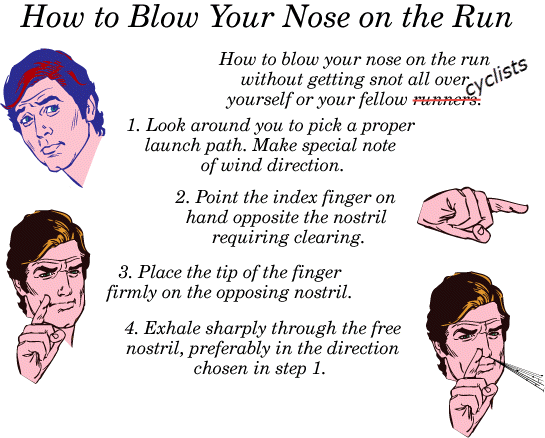
Disclaimer: this method may not be socially acceptable in your club or studio – but it works great out on the road riding solo – don't even think about trying this on a tandem!
The condition is called exercise-induced rhinitis > your nose runs when you exercise. Mine does, a lot and it always has. I don't normally give a second thought to how I go through two or three hand towels in a typical class, to keep my sinuses mucus free .
I hadn't, that is, until this interesting exchange after my class this morning…
“I appreciate how you use two towels.” The woman speaking was a long time regular and her comment came as I was thanking people at the door as they were leaving.
“Come again?” “I'm not sure what you're talking about.”
“You use two separate towels while you teach the class.” “One to wipe the sweat off your face… and the other to blow your nose.” “I appreciate that” she said with a big smile.
I didn't know how to respond. I stammered for a few moments until I could offer a sheepish (and slightly embarrassed); “Thank You!”
As she walked out I felt a bit guilty. Yes I had two towels on the bike, but I wasn't very particular which one I used and for what. You can bet I will be in the future 🙁
Exercise-induced rhinitis is one of those weird maladies. Some people are prone to getting a runny nose when they workout and some don't. I'd add it to the list that includes the sweat-ers and non-sweat-ers. I'm not sure > is sweat-er even a real word? You get the point… people who leave a big puddle under their bike and those who appear to no more than glow during a hard effort.
To the best of my knowledge, beyond taking an antihistamine before you teach, there's really nothing can do other than ensure you have a supply of towels or plenty of tissues.
Which brings up the issue of towel management
Found this at http://blog.rateyourburn.com/blog/post/2012/08/01/which-indoor-cyclist-are-you-16-types-of-spinners-i-always-see-in-class.aspx
Toweling off during class is an integral part of what we most of us do (those of you who just glow consider yourself lucky). So it surprised me to find we've never discussed proper Instructor “towel management” here at ICI/PRO – ever. In fact I did quick google search and found nothing beyond this graphic from rateyourburn.com poking fun at anal retentive particpants. Like everything else we do, you'd think there's a Best Practice. Here are my thoughts.
Towel(s) size and placement
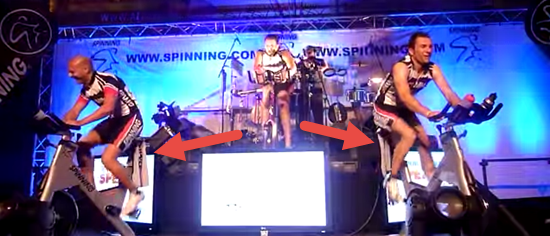
Having a towel hanging from your handlebars can look a little tatty – not to mention it obstructs the view of your legs like you see here.
The better place to hang your towel is on the seat slider that extends beyond the saddle on most indoor cycles. This Spinning® Master Class shows good towel placement.
With your towel behind you, it's always within reach, but partially hidden from your participants – and ready to whip around your head when you really want to stir things up!
At LifeTime we have two sizes of towels: big bath (not beach) size and hand-towels. My preference is to start the class with three hand towels; one on the handlebar (which is small so it doesn't impede rider's vision) and two spares on the stereo cabinet.
One of which I'll only use to blow my nose 🙂
What's your solution… or do you just plug one nostril and let-er-fly?
You need to have read part one of this series where I laid out two scenarios and asked the question;
Why do Breathless Betty and Chatty Cathy not behave the same way that you and Susan did at WSSC?
It's my worldly perspective that the major difference between those two situations boils down to respect. You and Susan show your respect for Josh Taylor by behaving correctly – riding in silence. Breathless Betty and Chatty Cathy aren't showing the instructor in scenario #1 any respect > make sense?
But why?
So if in one instance people are disrespecting you and the other's in your class by talking, but in a different situation they wouldn't, the obvious question to ask is WHY? Why do people act disrespectfully? The whole concept of why people do what they do is fascinating to me. Back in 2011 I introduced you to the concept of Start with WHY and that it's important to understand why you are doing what you do… and why some of your participants do what they do.
I see three possible reasons why:
They don't know they are acting disrespectfully…
They don't care they are acting disrespectfully…
They're disrespecting you on purpose…
I'm making the assumption that your goal is a quiet, focused class – where you're the only one doing the talking. If it's a yard-sale (neither quiet or focused) – with others talking (besides you), I feel it's super important to truly understand why (what's the real reason), before you can effectively address the problem.
Was there ever a time when you made an assumption about the motivations behind a person's actions, only to be horribly embarrassed when you discovered you had it completely wrong?
We don't want that to happen, so lets explore these three potential reasons a participant in your class would disrespect you. Then we'll know the right ways to address the issues.
OMG! I had no idea 🙁
In my little story about your participation in Josh Taylor's class, your friend Susan acts embarrassed when she realizes that attempting to start a conversation with you was completely inappropriate.
Most people care and wouldn't purposefully act disrespectfully toward you. So we can assume that the reason why the are talking… is because they don't understand that they shouldn't. Unfortunately there are a lot of Instructors who don't have control of their class. I've ridden in many classes where the Instructor has either given up, or are too afraid to do anything.
So there's a good chance that your talkers have experienced other classes where they felt free to talk, so they feel perfectly free to chat away in yours. This group will apologize to you, after you apply the solution you'll find in part three.
I'm special!
I teach at an “Athletic” (most expensive) level Life Time Fitness in an affluent suburb of Minneapolis. A trip through the parking lot will confirm that my typical participants are very well to do. It's common for me to reassuringly pet the dash of my humble Mazda3, as I park between $100k S Class Mercedes, 6 and 7 series BMW's, Lexus', Audi's, Land Rovers and Escalades on Thursday mornings.
Some people of “means” can act – how should I say it? – a bit entitled. I'm sure you've met a few people like this. They (if you ask them) feel that because they are spending a lot of money to be a member, they expect to be able to do pretty much whatever they damn well please. When you make general comments about riding quietly, these folks don't think it applies to them > does that sound familiar to you?
My experience is that these are the people who get mad if you confront them directly > “how dare you!” They are also the group who will pull rank and complain to management, if you don't correct them properly.
The concept of a democracy; social groups where everyone works together, contributes equally and respects the needs of others sounds good… but rarely works out well in the real world. I can’t think of better places to demonstrate this than in your class or on an outdoor group ride. Both these collections of people require a leader… or chaos ensues.
There are members who will purposefully challenge your authority as the leader of your class.
You may have experienced this at some point in your teaching career. Maybe it was some participant in the back row holding court with those sitting around him. The effect is disrupting to your class and it may have irritated, if not angered you.
I view a large part of this as simple disrespect, but sometimes it’s not. It may be helpful to look at it a different way; the disruptive student may be trying to assert themselves as leader of your class.
At the time I got some grief on Facebook about that post. So before you dismiss the possibility (“this never happens John!”) that there are members who are trying to take control away from you, I'd like you to think back and see if anything like this has ever happened to you…
That gal who talks endlessly with whoever is riding near her – while she looks straight at you? She maybe testing you, waiting for your response.
That guy who's in the front row defiantly doing his own thing? No question about it. You might catch him watching in the mirror to see if anyone will follow his movements, instead of yours.
That jerk who's always late. He strolls in and takes his sweet time getting set up front & center. He's trying to take control of your class by distracting everyone. The “LOOK AT ME!” narcissists of the world live to try and tear down others in authority.
“I hate this song!” Ever had some A**hole who complains or criticises you publicly? There are insecure people in the world who are intent on pulling you down, thinking it will elevate them in the eyes of others.
Your class isn't a democracy. Only you can be the sole leader in your class… if you don't protect your role as the leader, someone else could try to take it from you.
Now I hopefully have you thinking about the specific problem in your class.
Here's part three where I offer my strategies and methods for addressing/correcting each instance of when people act disrespectfully (talk) in your class.