Life Time Fitness is hiring! If you've always wanted to teach Indoor Cycling or Group Fitness, at one of their 100+ beautiful upper-end big box clubs, this is could be your big chance 🙂
They (LTF) are all about member experience. The equipment (awesome sound system/twin big-screens for video + FreeMotion S11.9 Indoor Cycles with power) and their studios are fantastic. Their pay is respectable and you aren't forced to use music that's provided for you like at LA Fitness.
What should you do?
First, so you know, I know LTF 🙂 I'm lucky to live smack dab in the middle of four Life Time locations – with regularly scheduled Indoor Cycling classes with them since 2008.
#1 Read through these articles. We've helped dozens of Instructors get hired by Life Time
Our Mission is to provide an Educational, Entertaining, Friendly and Inviting, Functional and Innovative experience of uncompromising quality that meets the health and fitness needs of the entire family.
Don't take knowing this mission statement lightly – it's not optional. YOU WILL BE ASKED TO RECITE IT AS PART OF ANY AUDITION.
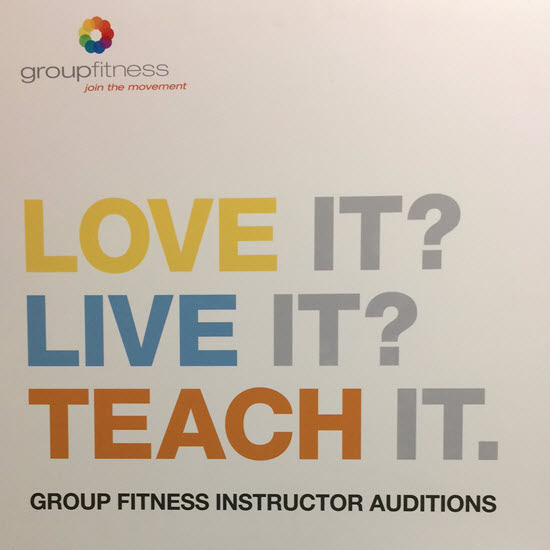
#3 Go to your local club location and find the the sign that looks like the image at the top of this page. It will include information about the audition schedule, name of the Dept Head running the auditions, etc…
NOTE: Some locations might not have immediate openings, but I wouldn't let that stop you from attending and showing your stuff!
#4 I'm big on taking bold action, so I'd recommend finding a way to meet with the Group Fitness Dept Head, before the audition day, in person > if at all possible. You might ask the front desk if he/she is available right now.
If yes, then introduce yourself and expressing your enthusiasm for being part of her/his Instructor team. Ask an open ended question like; “what can I do to prepare for the audition?” and then listen. Now isn't the time to sell yourself… unless you are asked a specific question. Be respectful of their time and say so; “I know you're a very busy person, my objective to let you know who I am and that I'm very excited for the audition on ___________ and look forward to seeing you again then.
That's it, unless she/he appears to have more time for you. Be very careful not to ask anything beyond advice.
If no, ask when would be the best time to call and what number. They work crazy hours, so I'd call at different times until they answer – I wouldn't suggest leaving a message or emailing. Call until you get through. Tell them about your interest in teaching for them (again, NO SELLING) and then ask if you could meet them for two minutes to introduce yourself in person. Give two very specific days & times – DO NOT ASK; “what would be a good time to meet?” Busy people hate it when they're asked that… but they love when you give them a solid time that they can easily say yes/no to. Then follow the above.
No worries > they'll train you! Life Time realises that they need to develop/train people passionate about fitness, to become Instructors, through their Life Time Academy.
Group Fitness Instructor Training Overview
The Life Time Academy Professional Fitness Specialist program provides a unique educational experience of on-line, in classroom and hands-on learning, integrated with practical experiences that prepare graduates to succeed as a Professional Fitness Specialist in their respective area of emphasis.
The emphasis of the Group Fitness Instructor Program provides a quality educational experience that prepares graduates to succeed in the area of group fitness instruction, whether they are new to the industry or expanding their skills.
Topics covered in the Life Time Academy Group Fitness Instructor Training (GFIT) 50-hour program meet or exceed all the required standards set forth by the American Council on Exercise to achieve certification as well as the practical skills to lead a best-in-class group fitness experience.
With an 8-week curriculum, totaling 50 contact hours, the instructor-led coursework consists of approximately 30 hours of online study (reading, videos, activities, assignments and quizzes), 16 hours of in-club lab class time and 4 hours of practicum.
Curriculum includes:
Exercise Science Foundations
Essentials of Group Fitness
If you don't have a certification, I would ask the GFDH during your intro meeting for their advice for getting your training. LTF has multiple workshops throughout the year where you can receive the training you need.
Good luck and let me know when you're successfully on the schedule!
There's an old saying that goes; “I've been at this so long… I've forgotten much of what I didn't know, when I first started.” I've taught Indoor Cycling classes since 1998ish. A long time ago for sure. Even back then I had an advantage over most new Instructors. I'm married to the “Senior Group Fitness Instructor” in my family. Amy began her fitness career in 1994 and Spinning® in 1995. She was there for many of my early classes to help guide and critique me and my classes. I had her positioned front-center in the class during my first audition at Life Time – yes, I passed 🙂
So a lot of time has passed between those first classes and today. It's hard for me to think back on the nervousness and insecurity that's common in most new instructors. What's needed is a newer Instructor who's willing to share their ideas and solutions. That sounds like my friend Lena Hershey 🙂
This page at leanlena.com has links to multiple articles writen by Lena > New Instructor Tips specifically for those of you just getting started in your teaching carreer 🙂
Was it just me, or did that last Instructor never make eye contact with you, either?
Amy and I were both participating at a teach-back assessment a few months ago, for Life Time's new Evolution Signature Indoor Cycling format. There was a handful of Instructors trying out and we all assumed the role as a “participant”, while we waited our turn on the Instructor bike.
It wasn't only you John, was Amy's response. That guy looked everywhere but directly at me… At first it was a little weird – his focus kept switching from the floor > ceiling and then at alternating walls on either side of the room. After a while I felt kind of dismissed,by how he seemed to purposefully avoid directly looking at me 🙁
Amy and I discussed our experiences with the guy, in the car on our way home. We both felt like he had all the right words = technically he sounded like he knew what he should be saying. But he had ZERO connection with his riders. Now I know this was probably an extreme example, but;
How effective are you at making eye contact with your riders?
If I came to your class, would you look at me?
Would I see you making eye contact with others in a meaningful way?
Take a moment and reflect back on your last class. How many people do you remember connecting with?[wlm_private ‘PRO-Platinum|PRO-Monthly|PRO-Gratis|PRO-Seasonal|Platinum-trial|Monthly-trial|PRO-Military|30-Days-of-PRO|90 Day PRO|Stages-Instructor|Schwinn-Instructor|Instructor-Bonus|28 Day Challenge']
Johnny G is a master at connecting with his audience of riders. Watch this short segment of him presenting. Pay particular attention to how he scans the faces in the room.
Make connections the objective of your class
I've featured presentation coach Alexa Fischer here in the past because she is a master communicator. She has a new blog post that expands on the video below, where she explains:
For me, winning over your audience has nothing to do with seeing everyone in their birthday suits. It has everything to do with making a genuine connection, in the exact same way you would when you meet a new friend in a cafe. In today’s video, I share my surefire strategies for keeping my audience engaged.
As the late, great Maya Angelou said, “I’ve learned that people will forget what you said, people will forget what you did, but people will never forget how you made them feel.”
The same is true for when you are on stage.
Click here to see Alexa's other video > and by all means, join her email list. She's sending out good stuff every week that I find very helpful.
Look up here at Me… not the video!
If you frequently play video in your classes, you're probably creating a connection problem with your participants. They are focused on the big screens, not you. For some of your members that will be OK for you to be an unseen narrator, while they watch what's happening on the video.
But many riders won't. They need you to make them feel important, if only for an instant, where you connect and flash them a quick smile or some other acknowledgment.
Random thought: does it make sense to whiten your teeth? Would your smile be more impactful, especially to those riding way in the back, if it was whiter/brighter?
So how do you get people to pay attention, so you can connect with them, when you're playing a video?
Check your lighting.
Maybe it was because I was a little self conscience, but early in my teaching career I wouldn't turn on the stage spotlights. I normally kept the studio lights down low. But over time (and watching other Instructors teach in the same room) I learned that I retained people's attention longer, if they could see me clearly. Having two focal points in the room, #1 the screen(s) and #2 YOU, should help direct your riders attention.
Make a change
Did you see how Johnny G maintained the room's attention, by asking them to sit up? How about suggesting in your next class, “this is a good time for a water break / toweling off.” Then watch what happens. Catch people following your lead and reaffirm those who do with a nod or a tip of your water bottle.
Ask questions
It's very natural for people to turn toward the person asking a question. Why? I think we instinctively do this to try and gather more information. I feel open ended questions (can't be a Yes/No response) work best. If you really want to get eyes up on you, ask a question that references something that needs to been seen to be understood and then point/demonstrate without giving any additional cues until you have their eyes-forward. Maybe something like; is your pedal stroke smooth like this? Then demonstrate the action while scanning the faces of the room for recognition.
Bring up the room lights
If you have a really dark studio, bring up the room lights for the cool down. It's here when you can really try to connect with each rider – or – try and develop a surrogate; have everyone turn, face each other and congratulate their neighbor!
March 31st is world backup day. Why not the day after, on 4/1? It certainly would be easier to remember. But it's on this day, not the next, because everyone would think they were joking if it was on April 1st, that's why.
All jokes aside, having a regular backup of your computer's files is critical and a Best Practice for Professional Indoor Cycling Instructors. I personally have experienced multiple hard drive failures. I make my living with a trusted friend, a Dell laptop. My entire business + all my music (although Spotify has reduced this particular risk) pictures, sponsor contracts, tax files… everything is dependent on a little disk spinning under my fingertips… and on a cloud Carbonite cloud server located who knows where. That's why they call it “the cloud” > nobody has a clue where that place really is.
I haven't lifted a finger to backup my files for about 7 years. Every morning at 2:00am, Carbonite checks my computer, identifies which files are new, or changed and makes an encrypted copy that's safely stored wherever. I don't care where, as long as I can easily restore all of my data, the next time I drop my Dell on it's head and I hear all those funny noises again.
If you don't have an automatic backup happening everyday > I implore you to correct that oversight and sign up today.
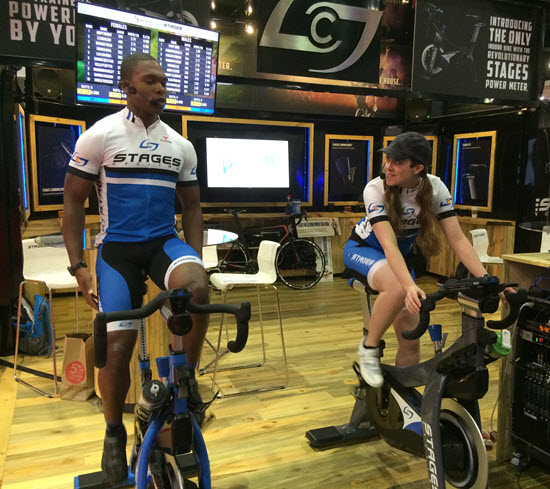
Stages Master Educators Dunte Hector and Cameron Chinatti leading the morning ride at IHRSA
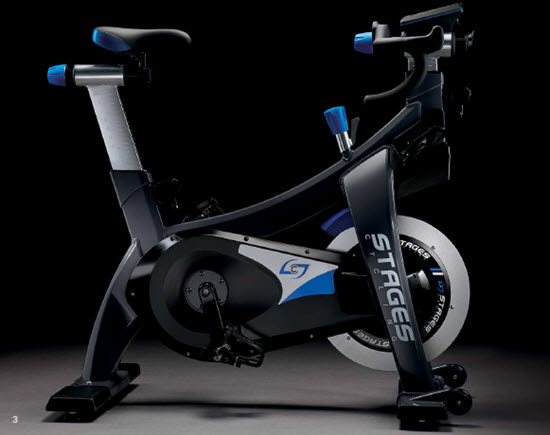
IHRSA 2015 was the first public appearance of the Stages Cycling SC3 Indoor Cycle. This was a total surprise to me and I have no idea how Stages Master Educator Dennis Mellon was able to keep his mouth shut for so long. We talk weekly and it must have been killing him not to be able to tell me about their latest project 🙂
Going forward, I feel it's important to disclosure that Stages Cycling sponsored (paid) my and Amy's travel to, and lodging in, Los Angeles to take part in the launch of their new Stages SC3 at IHRSA 2015.
If parts of the Stage SC3 look familiar, there's a good reason. The engineers who designed this Indoor Cycle have a long and storied history of product development with indoor cycles and power consoles. It was explained to me that the design criteria for the SC3 was; take all of the engineering team's collective experience and build the ultimate, commercial Indoor Cycle. Did they succeed? Let's find out…
The Basics
Frame – Aluminum… and lots of it. This is a very solid/substantial IC > perfect for studios with big, powerful riders – or – those offering unconventional classes with a lot of movement.
Drive – CarbonGlydeâ„¢ drive system. Yes, this is the same Gates belt as other manufacturers are using, but there are fundamental differences with the other components of the drive train, that give the SC3 a very different feel. Because they don't run the belt under tension (there's a tiny bit of slack you can feel as you move the pedals back and forth) the SC3 is noticeably quieter than the Schwinn AC and it's tensioned Gates belt. It also retains a slight, chain-like vibration, but doesn't buzz like the AC. Stages is so confident in their drive system that they offer a 10 year warranty on the CarbonGlydeâ„¢ belt. Correction: Stairmaster's engineer Travis Vaughan alerted me to my error describing the Schwinn AC's Gates belt as “tensioned” – which it's not. I didn't intend to infer that they used a tensioner like what's used with Poly “V” belts. Instead I should have described the differences as; the AC runs it's belt taut (zero slack) vs. the SC3 which, when properly tensioned, has a very small amount of slack.
Resistance – Magnetic > surrounding an aluminum flywheel. Screw style adjustment and includes the new Stages SprintShiftâ„¢ three position lever . More on that below.
Handlebars – Road Bike Style Drop Bars – there's a reason that handlebars on road bikes haven't changed over the last 100 years > these fit us (humans) the best. Please don't ask me; “butwhere is position #3 John?” It's standing, with your hands surrounding the brake hoods, exactly where your hands belong when you're out of the saddle 🙂 It's here where you have the most leverage to power through a steep climb and it eliminates the temptation to “over reach” while seated.
Saddle – nice. Not too narrow… and not to wide/fat. Forgive me for saying it this way, it's very close to (might be exactly the same as) the saddle on the Schwinn AC > we have one on the back of our Trek Tandem. Amy loves this saddle and it's been comfortable for her for thousands of miles. Trust me on this one… I'd have heard all about an uncomfortable saddle.
The Power Meter
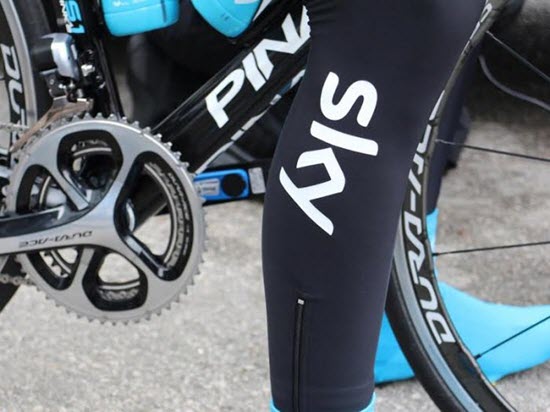
Good enough for TDF winning Team Sky Professional Racing Team
The heart of an Indoor Cycle that features power measurement is, of course, the power meter. The new SC3 is using the same technology used by Team Sky – winners of two Tour de France bicycle races and they're going to continue to use these power meters in 2015.
I could devote an entire article on just this topic and will have more as part of the ride portion of this review. In the interest of time I'll give you the important bits:
2,000 hours of battery life using two AA's – yes the display console is self-charging.
Same hardware, design, and accuracy found in the Stage Power® meter, which is used by professional cyclists’ and used in the world’s most famous cycling races, including the Tour de France.
ANT+â„¢ and Bluetooth – so it will connect with your iPhone or Android without any adapters.
Supposedly accurate to +/- 2.5%. I say “supposedly” because I have no way to verify their claims – but I bet Team Sky does 🙂
Display Console
It's important to separate the power meter, from the display console. Although most studios will choose to purchase their new SC3's with the new Stages EcoSCRNâ„¢ console, you don't have to. The Stages power meter will work with any Bluetooth or Ant+ device, like an iPhone or Garmin. You could also choose to wirelessly connect the Stages power meter directly to Display Training systems from Performance IQ or Spivi.
Here's a short video showing it in action during one of the 60 sec challenges.
The EcoSCRNâ„¢ console is self-powered = no batteries to replace ever… that's the Eco part 🙂
No exposed wires > I was told they've very neatly packaged the cable that connects the flywheel generator to the console = a long life of raising the handlebars up and down.
Constant backlight if you choose 🙂
Stage button to record intervals > there's also a nice feature that your averages remain displayed for 5 seconds after you end a stage.
Stages SprintShiftâ„¢ is a three position “shifter”, that provides course adjustments quickly. I want to describe it as a sort of cruise control, where you flick your finger and instantly resume your previous speed/resistance level.
Think of doing a repeating series of intervals. We cue everyone to add load, ride the segment and then recover. Now repeat it again. With SprintShift you can set your initial load with the lever full right. Move it left for recovery and then return back to the exact resistance instantly, by moving the lever all the way to the right.
There's some interesting physics at work here. If you use the SprintShift at lower resistance levels, the amount of change between each level remains relative & realistic. But start with a big gear and the changes are incrementally larger.
There are multiple ways you could incorporate this in your class and we'll find more over time. I'll describe a relay race we did in the ride part of the review where it was very helpful > we won! I'm sure Cameron and Co. will have some fun suggestions for using SprintShift when I interview her in the next few weeks.
If you've ever fought over a stubborn screw type seatpost of handlebar adjuster, you'll enjoy these new FitLoc cam style adjusters. Watch the video and you will see how quick and easy they are to operate. Also, they've kept the weight of the bars low, so it takes very little strength to raise them, using only one hand.
Several months ago, an author known for being a strong proponent of healthful eating wrote an article about a new line of “good” candy bars. You know: organic ingredients, no preservatives, that sort of thing.
The author took an if-you-can’t-beat-em-join-em approach. Candy isn’t going to go away, so let’s make better candy.
Who makes these healthy candy bars? A company aptly named UnReal. Their idea was to duplicate the top-selling candy bars, using different — better — ingredients.
What’s supposedly good about the candy?
[wlm_private ‘PRO-Platinum|PRO-Monthly|PRO-Gratis|PRO-Seasonal|Platinum-trial|Monthly-trial|PRO-Military|30-Days-of-PRO|90 Day PRO|Stages-Instructor|Schwinn-Instructor|Instructor-Bonus|28 Day Challenge']
Good taste, better ingredients, and improved nutritional value. That translates to being made without chemicals, artificial colors, artificial flavors, corn syrup, hydrogenated oils, or GMOs.
[Let me stop here to ask a dumb question: How would you get GMOs in a candy bar, anyway? Aren’t those typically found in agricultural products? So are we just talking about non-GMO peanuts?]
What else is supposedly good about these candy bars?
They apparently contain less sugar, more protein, more fiber, and — I’m as confused as I can get about this one — real food ingredients. Does it seem contradictory to anyone else to talk about “real food ingredients” and candy in the same sentence?
Please don’t say agave.
As a final benefit, the candy bars are sold in the same places and for the same prices as the standard junk versions. Because that was my primary concern: convenience.
Could you enumerate the health benefits of that list? They escape me, but maybe I missed something.
Readers weigh in
Several people commented on the article, including me. Here’s my comment, and please keep in mind that I was being polite:
“I saw a display of UnReal candy bars at Staples a couple of days ago. Curiosity made me read the label of one bar, and I couldn’t help laughing at the number of sugars in it. As a recovered sugar addict, I certainly didn’t have the guts to try one…. I honestly can’t see how these products could teach children, or anyone else, about the value of fresh, whole foods or steer them in that direction.”
If you’ve read my articles, that comment won’t surprise you, even a little. It’s just me doing my anti-sugar thing again.
The truly surprising thing was the enthusiasm a number of respondents had for the product: “Go, UnReal!” “Bravo!” “Great idea!” “Kudos to UnReal.” Others described their plans to give out the healthy candy bars on Halloween.
And many of the folks who commented positively seem to have kids.
Fortunately, others indicated disapproval of the candy bars and disappointment with the author (“Have you sold your soul to the devil?”).
That made me laugh. A seminar attendee once summed up my attitude as, “Sugar is the devil.”
Well, sugar can, and absolutely does, outweigh whatever benefits a so-called “healthy” candy bar can claim to have — even one with non-GMO peanuts.
My recommendation?
Stop looking for a sugar loophole. If there were one, I would have found it. No one looked harder than I did 🙂