
by John | Jul 24, 2020 | Best Practices, Engage Your Students, Instructor Training
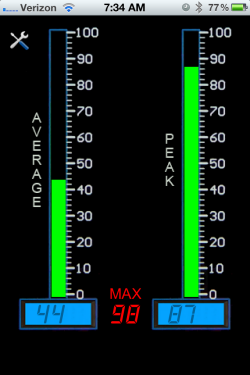
Click to download this App – I'm sure a search on your Droid phone will find something similar.
ICI/PRO member Kristin Krantzman makes an excellent point here in her comment, to my earlier post about sound levels.
I have one student that really complains about the loudness of the music. She has tried wearing special noise protectors.
She tells me that I am damaging my own hearing as well as that of my students if I do not reduce the volume.
BUT, when she is in my class and I reduce the volume to the level she wants, the rest of the class can barely hear the music. Students start cross-talking in class and they lose interest. What can I do? I agree that increasing the volume so high that the walls are shaking is not healthy. But, when the members cannot hear the music and they start talking to each other in class, that is not good either. Anyone have ideas about how to handle this sensitive problem???
Kristin you're making a great point about “subjective” vs. “objective” measurements. We all have different levels of hearing. I want to call it a “sensitivity” to sound that may have reader's nodding in agreement, if they've ever had an argument with their spouse about the sound level coming from the TV.
You and your student are having the time honored, back-and-forth of; “it's too loud”… “no it's not”… “yes it is”… “I like it this loud”… “it will damage your hearing”… “no it won't”… which goes on without resolution because there's no “objective” sound level you can point to as an authority. I know from 24 years of marriage that a subjective argument like this will never end in “Win – Win”. Amy get's mad and leaves the room or I begrudgingly turn down the volume. Either way only one of us “wins” and, more often than not, neither of us feels good about the outcome.
The same is true for you and your noise sensitive student. If you had a sound meter in your studio (or living room) you could point to it and say something like; “our sound levels don't exceed 85 dB, which is the maximum level recommended by The National Institute for Occupational Safety and Health (NIOSH).
Can you see how having this “objective” measurement could change everything [wlm_firstname]? Instead of your student arguing with you, her complaint is totally with some third party authority. She may still believe that the music is too loud, but her issue isn't with you or your club. You're following the recommendations of a highly authoritative government body.
She maybe frustrated by all of this, but none of it will be directed at you. Smile and say; “I'd really like it if you stayed for my class, but I will completely understand if you don't.” And then it's critical that you make a very direct disengagement from him or her. Physically turn your body, break eye contact or say hello to another student. If you give her the chance, she'll re-load and come at you with another complaint or a different spin on her original complaint.
Handled correctly, my guess is that she'll stay for your class because…
People frequently use non-specific complaints to advance their own self interests!
It's said, but true. Every day people are trying to manipulate you into doing… what they want you to do!
Kristin's comment included this:
She tells me that I am damaging my own hearing as well as that of my students if I do not reduce the volume.
Please tell me if I'm wrong here – This student's expressions of concern, for Kristin and the other students, maybe completely well-intentioned. But I've been around far too long not to think that at some level she's simply taking advantage of Kristin's concerns for the wellness of everyone in her class, with the intent to manipulate Kristin into doing what she wants.
If you've had sales or customer service training, you'll recognize customer comments such as “your music is too loud” as a classic objection or complaint without specificity. Sales people learn that when presented with a non-specific objection; “your price is too high” the only effective response is to make the objection specific; “compared to what?”
The same is true in a customer service situation; “your music is too loud” needs to be qualified and made specific “our classes don't exceed the recommended safe maximum of 85 dB” effectively neutralizing the complaint. “Next?” you say, as you smile and greet the next person in line.
Like it or not, as the Instructor you are also a front line Customer Service person for your club or studio. Be aware that complaints from students aren't always what they appear. Bringing clarity to a complaint, by identifying specifics, can go a long way toward peace and harmony in your class and a lot less frustration for you, the Instructor.
P.S – I've downloaded the free sound meter App for my iPhone shown in the screen shot above. I played around with it last night and plan to use it to establish an agreed sound level for the TV in our home. So the next time I hear; “it's too loud!” I can check and see who's right 🙂
P.S.S. You may want to forward this to your owner or Dept Head, so you're both on the same page if/when this student tries to escalate her complaint to management.
Originally posted 2012-08-30 07:53:36.
by John | Jul 21, 2020 | Engage Your Students, Your Fitness Business
My Monday morning (5:45 am) classes are always a JRA Endurance ride. My class looks forward to them as a foundational part of their weekly training. The combination of plenty of caffeine + a steady Aerobic effort gets the old brain cells working and the creative juices flowing. This past Monday was no exception and I found myself considering the state of Indoor Cycling and it's potential for the future. What started as an appreciation of the room and all my loyal students slowly morphed into a mental list of reasons Indoor Cycling is here to stay – and probably destined to continue to grow 🙂
I tried to come up with a top ten, but fell a few short. Perhaps you can suggest a few more?
- Winters (here in Minnesota and in many other parts of the world) are getting colder and longer, driving everyone inside and keeping them there.
- We've got the demographics on our side. My participants seem to be are getting older. Many tell me that Cycling is the only thing they can continue to do with the joint problems they deal with daily.
- These older participants are looking for two things from a class; help maintaining their body weight and hopefully stave off the aging effects of each new year. Vanity, in my opinion, is the number one motivator for many in your class. Are you speaking to it?
- You can't turn on the TV without seeing some Fitness Program like P90x being advertised. Our general population is obese, and getting more so. They don't like it (see #3) and many are looking for a fun way to get thinner, err… healthier 🙂
- Small Indoor Cycling Studios are popping up everywhere offering high quality, low financial commitment alternatives to traditional health clubs. I see these new studios following a parallel path that boutique Yoga/Pilates studios use. They appear to numerous and profitable.
- I see society contracting inward, with the Internet allowing for the creation of very specific communities of like minded people – like ours here at ICI/PRO 🙂 I'm watching Life Time Fitness attempt to adapt to this by offering “Clubs within a Club” like their Cycle Club, Run Club, Triathlon Club,etc…
- Indoor Cycling 2.0 is becoming a reality as more clubs invest in the new Indoor Cycles with Power from Keiser, Schwinn, Cycle Ops, FreeMotion and the new Spinner NXT with power.
- The introduction of Power measurement will dispel the “I burned 700 calories today” lie that so many in our industry continue to tell. I predict that many in your club will hate knowing the truth; that you can't sit in class and talk to your neighbor for an hour, while barely getting warm and burn a substantial amount of energy. But many will learn the truth and accept it. Sure at first they maybe angry, but that anger will subside … and possibly change to a renewed source of focused intensity that will have them achieving their goals (see #3) … maybe for the very first time. When that happens they will be back, and they will bring their friends.
Yep, the future looks bright.
John
Originally posted 2011-03-31 09:00:00.
by John | Jul 9, 2020 | Best Practices, Engage Your Students, KEEPING IT FUN, Master Instructor Blog, Your Fitness Business
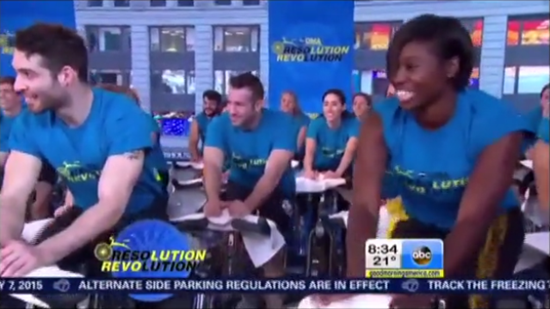
Five million viewers of ABC's “Good Morning America” TV program were treated to a wonderful promotion for Indoor Cycling this past week. As I watched I just couldn't help myself and began humming REM's Shiny Happy People. That was exactly what I was seeing > hundreds of shiny, happy people enjoying riding inside. I can't think of a better way to kick off 2015!
I'm of course describing the nationwide 2015 SoulCycle resolution ride that aired Jan 7th live on “Good Morning America.
What a way to jumpstart January! SoulCycle joined Good Morning America today for its Resolution Revolution. We tapped it back on SoulCycle bikes in their dressing rooms and hallways as well as in Times Square – while GMA showed live feeds from Soul classes happening in Bethesda, Chestnut Hill, Coral Gables, Short Hills and West Hollywood! Check out this video clip of all the action, including an interview with instructor ANGELA DAVIS on how to stay motivated as well as an update on our SoulScholarships Program. It was a good morning, indeed!
Here's the video of the event if you haven't seen it.
http://vimeo.com/116184911
Originally posted 2015-01-11 13:54:43.
by John | Jun 24, 2020 | Engage Your Students, Instructor Training

I had forgotten how challenging it is to teach a completely naked Indoor Cycling class!
I'm in Jamaica with Amy this week, teaching at Couples Tower Isle on a working fitness vacation. Jamaica is well know for sun, rum, Red Stripe beer, the clear blue ocean and a very carefree lifestyle. Jamaicans use the word Irie to describe the constant state of bliss you experience on this beautiful island.
My week-long teaching gig has me scheduled for two classes a day; 9:00am and 5:00pm and that presents a unique set of challenges for me:
- NO TECHNOLOGY – beyond a somewhat weak sound system, I've got nothing additional to work with here; no video, power meters, cadence… nothing.
- NO BLUETOOTH – I had no idea how dependent I had become on the Bluetooth receiver I use with my iPhone.
- NO REGULARS – Each class had a least one guest who had never experienced an indoor class.
- NO BIKE SHORTS – My classes typically involve a lot of Saddle Endurance. I needed to modify and give everyone plenty of time off the seat as no one (but me) had anything remotely resembling padded shorts.
It's actually been very refreshing to teach like we all did 10 years ago 🙂 Once I accepted the limitations I was working with, I went back to the basics of; terrain, cadence, intensity and imagery and we had a great time each class.
And yes, everyone was wearing clothes – what were you thinking I meant by naked?
Originally posted 2012-03-02 08:24:01.
by John | May 4, 2020 | Engage Your Students

I started writing this post with the idea of giving you some outside resources like this one:
Many of us have heard these words as part of the advertising campaign for the self-help book Verbal Advantage: 10 Steps to a Powerful Vocabulary and although I haven't read the book, as a long time salesperson I understand how powerful using the correct words can be.
And then it dawned on me that after 3 years we have resources buried within our 900+ pages that many of you may have never seen or heard. So I thought I would suggest some articles and Podcasts that speak directly (pun intended) to helping improve How You Sound to your class 🙂
Originally posted 2011-09-13 09:43:33.
by John | Mar 23, 2020 | Engage Your Students, Zone based Heart Rate Training
I need your help.
Beyond fitness and weight management, many of the people in my class are training for some event this summer. Most are tied to a charity fundraiser. The MS 150 is a popular ride here in Minnesota, that happens in July each year. 
Could you ask your class two things and let me know the results?
- What percentage of your class are planning to participate in a fund raising ride this year?
- Does the fund raising become a bigger obstacle than the training?
Why am I asking?
I'm working on some ideas to help create some excitement in your class and at the same time assist riders with their fund raising. Please leave a comment below or send me an email john@indoorcycleinstructor.com
Originally posted 2009-03-07 18:43:41.
