Meet Dave Goss – Graduate student and Indoor Cycling Instructor at the University of Florida!
While working on his music education graduate degree at U-Florida, Dave enrolled in the college's group fitness instructor development program. There he earned his AFAA Primary Group Fitness Certification and then completed his Schwinn Indoor Cycling Certification. Now Dave has scheduled classes at both the colleges rec centers 🙂
Dave originally responded to my request for Instructors who teach at both Big Box and Boutique Studios. He asked if I would be interested in learning more about what it's like to teach in a college – to college students, which of course I was.
My biggest surprise during the interview? When Dave explained how his early AM cycle class is very popular! My experience with college kids is they all (given the chance) will sleep to noon. Listen to the interview to learn who, exactly, he's riding with @ 6:15 in the morning.
Here's the to our free Podcast.
You can connect with Dave through his multiple social media platforms:
There's a recurring issue that keeps popping up on Facebook and Pedal-On forum:
Does anyone have a suggestion about to do about the consistent talkers in my classes? They're really disruptive, but I don't what to offend anyone. What should I do?
What follows are a series of well meaning suggestions from other Instructors; turn down the music, make a light joke – you don't want me to have to split you two up, do you?, stand between them, etc.
Others state something like; it's their ride, they're the paying customer, so I let them talk.
I don't feel any of these simple solutions are directed at the real problem or identify the real cause. In many cases there are no “simple” solutions. There will be a number of you won't be comfortable with the solutions I do plan to share. But before I go any further, I'd like your responses to what you see as the fundamental difference between these two scenarios:
Scenario #1
Breathless Betty and Chatty Cathy are long time fixtures at your club. They are inseparable and always ride the same two bikes (second row from the front, just off center) they have for years. They're talking as they come in and continue, non-stop, through your's (and everyone else's) class. Betty spends much of the class sitting up, soft pedaling, while looking and listening to Cathy. Cathy from a distance appears to be following the class, but never shuts up.
You've tried everything you can think of and have even asked them both privately to please stop talking in class. They don't. To make matters worse they've complained to the GM how they feel you've embarrassed them.
Despite your best efforts to ignore them, the negative affect these two have on you is wearing. Rather than being excited about teaching, you feel anxious, powerless and your class presentation suffers – resulting in fewer participants.
Scenario #1
You are super excited! You've staked out two great bikes (second row from the front, just off center) for Josh Taylor's Fighter Pilot ride at WSSC. Joining you for the ride is your dear friend Susan, who you only see once a year when you're together in Miami. You both laugh about how expensive this ride is, but agree that it will be so worth every penny. Josh mounts his custom Blade Ion. The lights come down. And with the start of the music, Josh launches into the ride.
Ten minutes in Susan looks over at you and asks; “so… how are your kids?” You're shocked in disbelief; doesn't she realize where we are? Without even thinking you turn to Susan and place your index finger across your closed lips > the universal sign for “Be Quiet”. Susan gets the hint immediately and you sense her embarrassment. The two of you ride in silence for the remaining time of the ride.
So what's the difference?
Why do Breathless Betty and Chatty Cathy not behave the same way that you and Susan did at WSSC?
In part two we'll explore what I feel is the answer to this and why, exactly, this happens.
Back to business this morning at the “Spa” (Minnetonka LifeTime Athletic Club & Spa) after the summer break. Everyone calls it the Spa because it's full name is just too much of a mouthful, especially in the early AM.
It's amazing how consistent (or maybe habitual is a better word) people tend to be. I zipped into the parking lot at 5:30 AM with a full 15 minutes to spare and pulled into the exact same slot, next to the exact same contractor's pickup, that I always use. Walked up to the front desk and was greeted; “good-morning John. Are you teaching again?” by that same friendly smile. I surprise myself by actually producing my membership card. “Yes, Monday's are back on the schedule” is my response as I turn toward the steps down to the locker room.
“Wait” I thought. I stopped, turned and walked back to the reception desk.
“Forgive me… I've forgotten your name.”
“Cathy”.
“It's nice to see you again Cathy” I said before turning back toward the steps. I walked away feeling much better about myself for having the courage to confront something that I frequently struggle with… forgetting (or never asking) co-worker's and member's names.
Dressed for class and on my way up the stairs, when I had my second chance. A very familiar face, smile, “good morning John!” “I was excited to see that they added your class back for Fall.”
It worked the first time. I'll try it again. “Good-morning, but forgive me… I've forgotten your name.”
“Oh it's Betsy, but you have so many people's names to remember. I don't expect you to remember mine.”
“Good-morning Betsy.” “I'm looking forward to seeing your smile in class again.” I said, seeing a mental image of her on her bike.
“Thank you for saying something to those two girls. I can't tell you how frustrating it is for me to have to sit and listen to their mindless chatter while I'm trying to focus on my workout.”
It was yesterday and I had just finished subbing a class at one of the high-end clubs where I have a regular endurance class during the winter.
I started to say “You're wel…” when she interrupted me with; “Not all the Instructors will say something. I don't have a lot of flexibility in my schedule and this is one of the few classes that works for me… so thank you.”
I wanted to ask her why, when she is in that situation, she didn't say anything to the people who were disrupting her time in class? But before I could, I answered my own question.
She respected my social rank or status in the class and was waiting for me to demonstrate the leadership she believed came with my position as the Instructor. I have some knowledge of this member. She is a very successful local attorney and when you see her in street clothes you know she means business. I'm going to guess that her Social Status hasn't come from a meek or non-confrontational personality.
But when she's in class, with her Lycra shorts and a bright yellow jersey, she has the same exact status of everyone in the room, except one – the Instructor, who yesterday was me.
It's actually kind of funny when I think about it. I've often described my students as people who you will regularly read about in the business section of the newspaper or see interviewed on TV. And here's little old me, the leader of a group of high power Lawyers, CEO's and business owners… hard to believe. But for one hour every Monday morning I am the Big Dog 🙂
And more importantly, they all expect me to be the leader.
Put yourself in your student's position. Whatever social status they have outside of class vanishes when they strip down in the locker room and squeeze into their bike shorts. Some go from a position of absolute authority to near social impotence in the three minutes it takes them to change. Imagine the frustration they must feel riding in your class, trying to focus on their workout, but forced to listen to a detailed recap of yesterday's Housewives of the O C or some other nonsense.
There's a good thread running about this over at Pedal-On Students who won't shut up that has a bunch of suggestions about how you can address this problem. My personal favorite is setting clear expectations at the beginning of your class. Master Instructor Kenji Freedman is phenomenal at setting these expectations in his class opening. You can hear it at the beginning of Podcast #143.
Do you understand your role as the leader in your class?
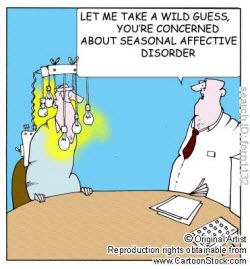
Seasonal affective disorder (also called SAD) is a type of depression that occurs at the same time every year. If you're like most people with seasonal affective disorder, your symptoms start in the fall and may continue into the winter months, sapping your energy and making you feel moody. Less often, seasonal affective disorder causes depression in the spring or early summer.
Treatment for seasonal affective disorder includes light therapy (phototherapy), psychotherapy and medications. Don't brush off that yearly feeling as simply a case of the “winter blues” or a seasonal funk that you have to tough out on your own. Take steps to keep your mood and motivation steady throughout the year.
I don't mean to make light of depression – my mother struggled with it for much of her life. But this morning a number of us decided that even jokes about how bad the weather is here, are depressing. Worst one I've heard was this morning; “John, I'm not sure I'm ready for winter to start again…” Not sure if it was intended as a joke, but it got a few chuckles from the other's who heard it.
There is treatment available.Bright light therapy is supposed to be effective. I'm all about finding solutions to problems. This morning I may have come up with a way we could introduce this much needed therapy, as part of a special class we could offer.
An Indoor Tanning Triathlon!
We could run it just like a regular indoor Tri, except participants would recover between each leg with a few minutes enjoying some rays in a tanning bed. Our club is always forming marketing partnerships with local business. Why not have the local tanning salon roll a bunch of beds in for an afternoon?
You'd come out of the pool, dry off and then spend 5 minutes in a turbo tan – we could even have special UV protective swim goggles made so you wouldn't need to change them. Then into the cycling class, which ends with another blast of vitamin D, before a short run on the treadmill.
Our Cycling Studio Owners will want to check this out ASAP…
For years we've promoted Working Fitness Vacations – where you, the Instructor, teache a few fitness classes in exchange for a very low cost, Caribbean vacation. Hundreds of Instructors have followed our recommendations and have really enjoyed their all inclusive vacations.
Now there's TripTribe.com. They specialize in assisting fitness professionals who want to take a group of clients (your tribe) on a fitness retreat. For leading these trips you, the Instructor, will be paid as the Trip Tribe Ambassador!
To learn the actual scoop on these trips, I asked the marketing representative at Trip Tribe if she'd connect me with an Ambassador that I could interview…
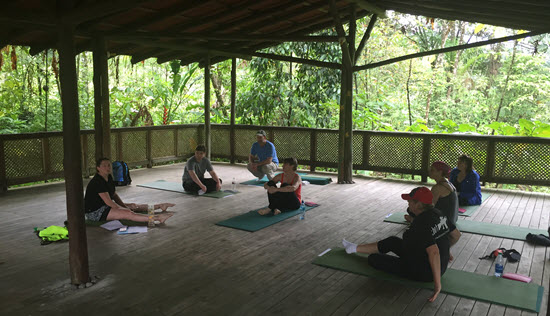
Coach Kelly McCormack owns Club Inhale Exhale in Billerica, Massachusetts. This past May she traveled with a group of her clients to a ranch in the mountains of Costa Rica. It sounds like everyone had a great time and best of all, the check TripTribe.com sent her at the conclusion of the trip paid all of her expenses🙂
Listen to my interview with Kelly to learn if this would be something you could do with your tribe.
TripTribe.com offers dozens of exotic locations across the world, in a wide range of pricing, including;
Go here and create a free profile. Spend some time working with their retreat planning wizard to get an understanding of the possibilities. Then I'd encourage you to call and discuss your ideas for a group trip with one of their advisors.