by Christine Nielsen | Oct 28, 2020 | Engage Your Students
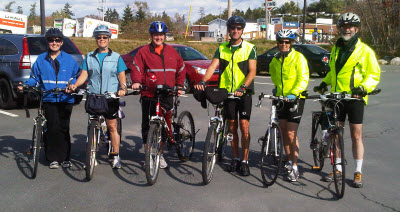
When a friend and I returned from a cycling trip in Croatia last June my IC classes were curious about the experience and I told them lots of stories. One day I mused “Now that we have done some hills in Europe I guess it’s time to do the hills here at home. We’ll be riding the Cabot Trail next.” http://www.mapmyride.com/s/routes/view/bike-ride-map/canada/nova-scotia/cape-breton/8895784
Follow that link to see just how big a challenge this will be 🙂
Within minutes the class had come up with a scheme to ride the trail as a group. Word of our plans has spread and new people have arrived in my classes to be part of this adventure. Most of them have never done any serious riding outdoors and several do not even own bicycles. We are aiming for a four to six day trip in late September 2012. Right now we are making plans for winter training and a spring reconnaissance ride for the ‘leaders’.
Yesterday, with temperatures in the mid-teens (℃) and under a sunny sky, a few of the group got together for their first ride. We did a safety check on the bikes and headed out with the promise that no one would be left behind. I placed experienced riders at lead and sweep and had a spare to accompany anyone who turned back. The most ambitious riders did 28 kilometers and realized after the fact that they could have done more. I was very supportive of their decision to ride within themselves. It will be time to test their limits after they have improved their form and bike handling skills.
Next time we do this route I will encourage them to do a 52 kilometer loop. They will all be amazed at how much farther and faster they will travel than they did on their first outing.
In anticipation of this weekend, I put together a profile for my classes which simulated parts of the ride and, in particular, highlighted how to avoid red-lining on the hills. Several people told me that they relied on that information when they found themselves in doubt during yesterday's efforts. As proof that they find real-time data useful — every one but me had on their heart rate monitor! I had an opportunity to ride with and coach each member of the group. One person stood out for me – her ability to receive verbal guidance and apply it was outstanding. Her skills improved dramatically and she was rewarded by being able to ride a hill she had had to walk on the way out. Another rider surprised us all – she was very strong even though she had previously only ridden on rail trails. She attributed her performance to her indoor experiences – improved endurance and better form.
Next up: a clinic on gears and shifting and a discussion about bike choice. Most of the group will be purchasing a new or new-to-them bike in the next few months.
Originally posted 2011-10-20 05:11:38.
by Joan Kent | Oct 25, 2020 | Engage Your Students, Master Instructor Blog
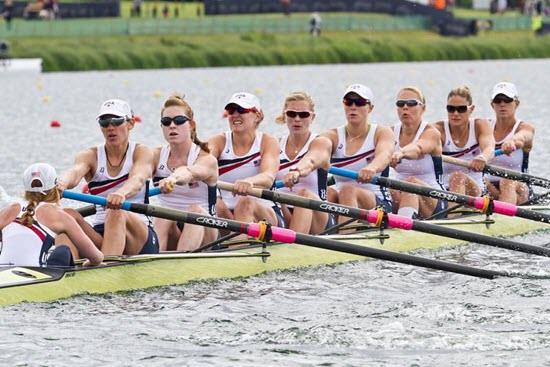
USA Women's Rowing Team – image credit boothbayregister.com/
If you’re about to start teaching a class that includes both cycling and rowing, here are a few tips.
Stay off the bike. To handle all the variables in a cycling/rowing class, you’ll need to be on your feet, moving around the room.
Will you warm up? On-bike stretches won’t work in a split class. Decide whether you’ll begin with a full-class stretch and warm-up, or have the participants take care of that on their own. Active Isolation Stretching is the most efficient in class — it warms the body as you stretch — but they all take up training time.
Pre-plan your trainings. You’ll need a specific and detailed rowing workout, along with your planned cycling workout. They don’t have to run parallel. That is, a 6:00 flat on the bike doesn’t have to run in sync with a 6:00 interval on the rowing ergometer (erg). They can if you prefer.
Feel the differences between the two workouts. Rowing workouts are often rigidly timed. That makes them effective and easy to cue. But some of the most unpleasant cycling workouts I’ve ever done were created by an instructor who was primarily a rower. His classes seemed to be created with a calculator and a slide rule (a what?). Instead, use cycling workouts that are similar to the ones you run now. Then you can mold your rowing workouts without alienating your riders.
Gear your music for the bikes. It’s less important to match music to a rowing drill, so keep handling your music the way you have been. There are exceptions — mostly performance-related — but generally this holds true.
Memorize the steps for setting the erg monitor. Concept 2 Models D and E use a complex procedure for setting time or distance. You’ll have to cue it every time. If you switch mid-workout from time to distance, be prepared to re-cue. Example: “Press Select Workout. Press New Workout. Press Intervals Time. DO NOT set the time yet! Use the Back Arrow to go back to the “tens” column. Set that for 1. Now use the Forward Arrow to get to the “ones” column. Change that to 0.” [At this point you have to cue setting the rest interval.] “Now press the check mark at the bottom of the screen.”
That lengthy description sets the timer for a 10-minute interval. If they set the “ones” column first to 0, it will default to an automatic “:20” (20 seconds). That messes up everything, and you’ll have to spend time changing it.
Note: The above cues are an illustration. You’re not done till you’ve set the rest interval (assuming you want repeating intervals). If you press the check mark midway through the process, you have to begin again. It will happen.
Don’t kill the Concept 2 people. All of the above is why the simple Model C was wonderful, but you’ll get used to the D/E. And you WILL remember the cues. I wrote the procedure from memory.
Always cue the rowers first. Let’s say you’ve decided to run the workouts in parallel format, which is easier for you. Separate the groups on their equipment. Cue the rowers while the riders roll their legs. Tell the rowers what to do during their warm-up (say it’s 10 minutes). Easy warm-up shortcut: Have them press “Just Row”. They row as instructed and stop when the computer clock reaches 10:00. While they row, you run a 10-minute bike warm-up. Once the warm-up is done, the riders roll and recover while you cue the rowing training — and setting the monitor.
This approach syncs the major changes for the two groups. The intervals will be of the same duration, but what the groups do during the intervals can be as similar or as different as you like.
Create a timeline. If you like multitasking, feel free to create workouts that don’t resemble each other at all. You may need some sort of timeline to track what’s happening. If you’re a spreadsheet geek, that approach will be fun for you. If you’re able to keep track of two different workouts mentally with no cheat-sheet, just go for it.
A timeline could be just a basic log with 3 to 4 columns. Minutes (0:00 to 30:00) go in the left column, rowing drills in the next, the cycling workout in the third column, and perhaps notes and prompts for you in the fourth column. Use a stopwatch. You’ll check your watch and know exactly what everyone should be doing at any given minute.
All of this planning makes improvising and modifying a lot easier. You have your plan, yet still feel ready to change whenever time or circumstances call for it.
At the 30-minute mark, switch equipment. The change will take a few minutes, so shorten the warm-up, but give everyone a chance to accustom the target muscles to the new activity for the second half of the class. Re-start your watch and repeat the body of the training.
If you can manage to do all of this AND deliver content — exercise physiology, technique, and training philosophy — your classes will be engaging and informative, and appeal to a broad base.
I hope these instructions are clear. I’d be happy to answer questions.
Originally posted 2014-07-14 10:24:52.
by John | Oct 16, 2020 | Engage Your Students, Instructor Training, Master Instructor Blog, Training With Power, Zone based Heart Rate Training
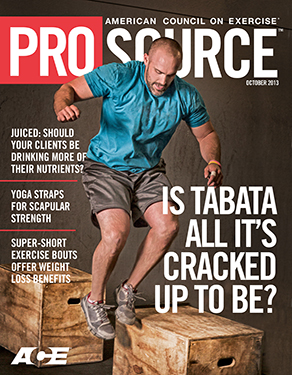
Image from http://www.acefitness.org/prosource/71/
I just read a press release and accompanying article from the ACE – The American Console on Exercise PRO SOURCE magazine about their study to gauge the effectiveness of High Intensity Training (HIT).
Is Tabata All It's Cracked Up To Be?
“It seems like everything high-intensity is now called Tabata Training,” says John Porcari, Ph.D., head of the Clinical Exercise Physiology Program at the University of Wisconsin, La Crosse. “The original Tabata study was done on a bicycle, but people are now doing that 20-second/10-second format with resistance training, plyometrics, calisthenics…with almost anything.”
Because of all of this recent interest in Tabata-style workouts, the American Council on Exercise enlisted Porcari and his research team to gauge just how effective a Tabata-style workout really is.
THE BOTTOM LINE
“The great thing about Tabata is it’s a short workout–only 20 minutes–and it incorporates your total body, so it’s working every muscle group that you possibly can,” says Embert, referring specifically to the Tabata-style workout she designed.
You can download the article for printing here.
But what to do during the remainder of your 60 minute class?
There was a trainer at Life Time who told me years ago something I've never forgotten; First give them (your class) what they WANT… and then give them what they NEED.
The WANT he was referring to are very intense/anaerobic intervals. There's no secret sauce IMO at SoulCycle > they're just teaching very intense classes because they know that's what people WANT.
The NEED is for solid aerobic training. Not necessarily base building, but solid work below threshold HR / FTP.
There are a lot of serendipity going on here at ICI/PRO. A quick check back to our latest Audio PROfile is another – Bad A*s Intervals Audio Class PROfile from Schwinn Master Trainer Rachel Buschert Vaziralli could be a perfect work set you could add to an existing profile.
Instructor Kathy Palkaninec was a past winner of our profile contest and her profile follows a similar WANT & NEED format.
You may want to announce your intentions to crush them (WANT) during a 20 minute Tabata round that will start fifteen minutes into class. Don't worry about telling them what follows. Keep everyone focused on doing their best effort during the Tabatas.
Give everyone a full 5 minutes or more of complete recovery. It's during this time that I talk about the “Golden Hour” and how most of us have 90 minutes where we can really perform well, before fatigue really limits our performance. The Golden Hour doesn't begin for most of us until ~30 minutes in. At the end of the recovery we're only @ the 40 minute mark of a 60 minute class and I explain how we're only 10 minutes into our Golden Hour – just now ready to perform. It's here where you can coach them through a 10 or more minute sub-threshold effort (NEED) to conclude the class. Here's where you can put that stage button to work if you have one – encourage everyone to ramp up to a big number, Stage Button, now maintain it by keeping your instantaneous wattage at or above the average 🙂
Make sense?
Originally posted 2013-10-10 08:28:16.
by John | Sep 22, 2020 | Engage Your Students, Instructor Training, KEEPING IT FUN, Your Fitness Business
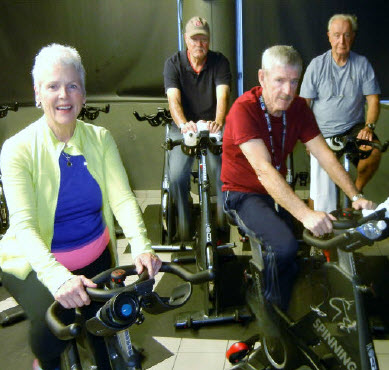
Guest post by Instructor & Studio Owner Pauline Geraci
According the Administration for Community Living (ACL), people 65-plus represented 12.4 percent of the population in the year 2000 but are expected to grow to be 19 percent of the population by 2030.
Let’s face it, we are not getting any younger. As we age, the more important it is for us to stay active. But the older we get, the harder it is activity becomes.
We start developing muscle and joint pains and other issues which we sometimes use as an excuse to become less physically active which in turn makes us more prone to injury and the aging process. What to do?
Indoor cycling meets many of our aging population’s needs. For starters, it is a great cardiovascular workout. The American College of Sports Medicine (ACSM) recommends that healthy adults ages 18-65 years old should participate in aerobic physical activity for a minimum of 30 minutes, five days per week or vigorous intensity, aerobic activity for a minimum of 20 minutes, three days per week.
An indoor cycling class will keep your heart rate up long enough to provide health benefits. A physical activity that includes continuous cardiovascular activity can help lower your risk of coronary artery disease, can help lower blood pressure and LDL cholesterol, and can help lower your overall resting heart rate.
As we age, we start to develop balance issues because of inactivity or inner ear problems. Maybe we have fallen once and now are afraid to do activities without relying on a walker or cane. You certainly don’t feel comfortable riding a bike outdoors. Indoor cycling eliminates your concerns with balance issues. Indoor cycling removes the element of risk and the fear of falling so you can experience its health benefits. A good cycling class allows you to go at your own pace and push yourself, yet feel safe and comfortable.
Another worry for seniors is finding a cardiovascular workout that is low to no impact. Indoor cycling offers a high intensity low impact workout. Many people who recently have recovered from orthopedic injuries turn to indoor cycling to help them get back on track.
Remember, as with all physical activity you are about to embark on, make sure you get clearance from your doctor. Indoor cycling, when done correctly, provides minimal impact on the hip, knee and ankle joints.
Because of the circular motion of riding a bike, your knees properly flex and extend, while avoiding the high impact pounding of other activities such as running or certain aerobic type classes.
Another issue of aging is age-related sarcopenia. People who are physically inactive can lose as much as 3-5 percent of their muscle mass per decade after age 30. Even if you are active, you still will experience some muscle loss.
A benefit of indoor cycling is increased muscular endurance. This refers to the ability of a muscle to continually and repeatedly exert force over an extended period of time. In an indoor cycling class, you pedal against resistance which increase the endurance of the leg muscles: legs, quadriceps, hamstrings, gluteus and even the calf muscles.
Working out these muscles also will help to strengthen the surrounding bones, tendons and ligaments which also help you with balance issues.
In turn, this increased strength means you’ll be able to perform your daily activities with greater ease.
Riding outdoors is great but there are safety and weather issues to contend with. You can’t make excuses about not working out because of the weather when you ride indoors. Indoor cycling also allows you to be free from concerns such as negligent motorists, narrow road shoulders, going downhill too fast and bike malfunctions (flat tires, loose chains, etc.).
It’s good to get outdoors and exercise whenever possible, but it’s also important to keep from putting yourself at unnecessary risk, especially at an age when each fall is a little harder to get up from than the last.
The ability to choose your own resistance also makes indoor cycling an ideal fitness class for seniors. On an outdoor ride, your resistance level is dependent on your surrounding terrain. On any given route in Sequim you will find inclines that you are not prepared to handle. You also may not feel challenged during an outdoor ride.
Indoor cycling will definitely challenge you! Indoor bikes come with resistance knobs. This allows you to raise or lower the intensity of the workout to meet your physical restraints and/or fitness goals.
Many people, not just seniors, would like to lose some weight. If your fitness goals include weight and/or fat loss, you’ve come to the right place.
According to spinning.com, you can burn anywhere between 400-600 calories per average 45-minute class.
Since it takes 3,500 calories to burn one pound of fat, just 5-8 indoor cycling classes, combined with a healthy diet can help you meet your New Year goals!
Unfortunately, it’s impossible to stop the aging process. But don’t let that excuse you from engaging in your favorite activities. Come and enjoy a safe and exhilarating workout experience at indoor cycling classes nearest to you!
Pauline Geraci is owner of Fit4Life Studio, 1245 W. Washington St., Sequim. See www.fit4lifesequim.com.
This article first appeared at www.sequimgazette.com
Originally posted 2015-03-04 16:19:10.
by Jennifer Lintz | Sep 22, 2020 | Engage Your Students, ICI/PRO Team Member Articles, Mental Toughness
By Jennifer Lintz, Registered Dietitian Nutritionist and ICI/PRO Contributor
Have you ever not done something because you weren’t sure you could?
As instructors, I have a feeling many of us talk quite a bit about comfort zones (specifically, getting out of them) in our classes, but I often wonder … do we take our own advice?
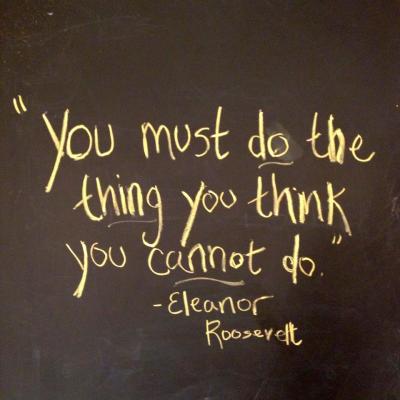
I have seen Eleanor Roosevelt’s quotes on this topic numerous times, but I will admit, I never fully appreciated her words until I actually took them out for a test drive.
Two years ago, a dietetic intern of mine, Amanda, who is now a very close friend, asked me to do something with her called RAGNAR®. Ever heard of it? She told me a little bit about it, but all I processed was:
“You have to run a lot over two days. You will be in a van with 11 other people when you aren’t running. You probably will not sleep.”
I immediately thought “Why would anyone choose to do this?”
I told her I would pass, and thought “Whew. I’m off the hook.”
That was, of course, until she asked me to join her team again the next year.
She assured me it would be “life changing” and “the most fun I’ll ever have.” While I was not convinced it would be either of those things, I begrudgingly agreed to do it.
Our team of 12 – all women – was formed by the early part of 2014, and because many of us live in southeast Minnesota, we chose to do RAGNAR® Great River which starts in Winona, MN, and ends in Minneapolis, MN. Over August 13th and 14th, we would run just over 200 miles as a team. Each runner was assigned 3 legs of the route that ranged anywhere from 3 to 10 miles. Some of us ran during the day, others overnight. I was runner #2, which meant my first leg was 6.2 miles, the second 5.1, and the third 5.6.
Knowing we would be running in the dog days of August, I made sure to get plenty of training under my belt in the months leading up to RAGNAR®, sometimes running a few miles in the morning and later a few more at night. I did everything from steady state runs, to hill-repeats, speed work, tempo runs, cross training, and weight lifting to prepare.
As the event neared, I was feeling fairly confident about my ability to do the running part. My apprehension, I realized, stemmed mainly from knowing I would get virtually no sleep and have very little time to myself. I have long considered myself an introvert who requires plenty of rest, so both of these aspects of RAGNAR® made me nervous. I fully expected to be tired and grumpy when it was over.
Without sharing all of the details, I will tell you that I couldn't have been more wrong. Doing RAGNAR® was an incredible experience and just plain fun … and it wasn't because of the running. Sure, it was exciting to get a couple PRs, but the real value of RAGNAR®, for me, came down to the people and the camaraderie. Needless to say, we are already preparing for next year.
So, how does this tie into teaching indoor cycling? For starters, my self-talk during the training process and the weekend itself gave me fresh ideas for coaching in cycling classes. But, perhaps most importantly, it helped me truly understand what it means to get uncomfortable and why stretching our personal limits can be a beautiful thing. As someone who regularly encourages students to challenge themselves, I found it very valuable to practice what I preach off the bike.
For me, RAGNAR® was just the tip of the iceberg. I now have the beginnings of what I'm calling a “To Try” list; first up is Zumba (let's just say dancing is not one of my strengths). In all seriousness, it reminded me how important it is to be the student and get a taste of what it feels like to be a little nervous.
What would you do if you weren't apprehensive about it? Please feel free to share your experience.
A big THANK YOU to John and ICI/PRO who sponsored our team. Below are a few pictures from the weekend.

The start line at 6:00 a.m. Friday morning.

Community nap time at one of the big exchanges on Saturday afternoon.

I was just finishing my last leg of the race. Felt good!

The full “Ragdolls” team!
Originally posted 2014-11-22 04:33:43.
by Jim Karanas | Aug 17, 2020 | Engage Your Students, Indoor Cycling Group - Team ICG, Master Instructor Blog

Susan? or Bob?
It’s a given that different people come into our classes with different expectations, needs and goals. How can we as instructors/trainers accommodate their individual needs without alienating any single group?
Let’s take two hypothetical participants — Susan and Bob. They’re the same age, but Susan is interested primarily in weight management, arguably the most common fitness goal, while Bob is interested in getting stronger, fitter and faster on the bike because he rides outdoors frequently and races regularly. Can these two find happiness in the same indoor cycling class?
I’ve resolved this with a reasoning that works for me. First, I needed to define my professional role as I see it, which may differ from how the fitness industry sees it. As an instructor/trainer, my job is to create a situation and an environment in which members can experience the benefits of physical exercise, and nothing more. Which benefits these are will vary with the individual, and it’s important that I never assume what they could or should be.
Even though Susan tells me she wants to lose weight and Bob says he wants to race bicycles, I know from experience that what the members want is often far removed from what they need, regarding the benefits that training has to offer. Here’s an easy trap, though: I have to be careful not to presume to know what they need.
The goal-oriented approach to training has a built-in limitation. I have known many members who, after 10 years of trying to “get something” out of exercise (e.g., weight loss), were frustrated and disheartened. Maybe they had some limited success from time to time (that I even helped them achieve), but it didn’t last.
If a workout session has to produce a result, you have a paradigm for unhappiness. Instead, my current approach is to create a training session that allows a person to get whatever he/she needs from the workout without interference on my part. I keep in mind that the average member will not understand this approach right away, so the training has to be about something they can understand and offer them some fundamentals of training.
So I teach indoor cycling. This is because the bike has brought balance to my life. It has been a source of both hardship and delight, but the practice of cycling has made me happier. I look forward to riding my bike, whether indoors or out, every day.
I explain early on that I will ask them to ride as if they were riding a real bike outdoors because there are excellent reasons for everyone to train that way, no matter who they are: greater enjoyment of the class, for example, and good technique that will prevent them from wasting energy, so they can apply the energy to creating power. (The last point will clearly help Bob, but it helps Susan as well. The stronger the trainings make her, the more power she can generate, and the more calories she’ll burn.)
Now my job in class is simple: Teach the bike. Completely. Offer my students structured trainings that have helped me and never assume what they need. If it’s in my heart to lead a training on riding big gears in the hills, that’s what I do. What the students get, they get, and I don’t over- or underestimate my influence on it.
Sure, a student with a specific goal may need individual attention. If Susan really wants to lose weight, I can make recommendations and/or referrals. The same goes for Bob. My job as an educator is to show them how to modify what I teach — which is a valuable skill they can use in any class they may take in the future. I offer suggestions but recognize that this is their path. I can’t overshadow it with what I think they should do with, or gain from, their training. That’s not my job and would be a misuse of the trainer role.
Originally posted 2018-11-14 06:00:01.