Ever notice how, if you teach on multiple brands of Indoor Cycle, your class presentation changes a little from one to the other? From the distance all the IC's from FreeMotion, Keiser, Schwinn and Star Trac, look pretty much the same. But you know better if you're teaching at more than one location. Each brand's bikes have their own unique characteristics:
The resistance systems react differently and the method for adding and subtracting load is different.
The consoles are all different in what information they display during and after class.
Is there a lap/stage button? How do you use it?
Hand locations & positions vary.
So why not help our ICI/PRO members learn the differences?
Do you spend any time practicing your classes? I realize that few of us have a lot of extra time. If you do – why not spend an hour of “ME” time, riding along with Dennis leading your ride. This may be the best 60 minutes you'll spend this week 🙂
Our membership really grows this time of year. So if you've been contemplating joining us here at ICI/PRO, you won't be alone.
Start your PRO/Monthly subscription $9.95 – no minimum. [wlm_paypalps_btn name=”Monthly-trial Product” sku=”E90D58D12B” btn=”pp_pay:s”]
This is interesting to me. Why choose to study this?
Talk about opening “Pandora's Box” – this is bound to get a few conversations going…
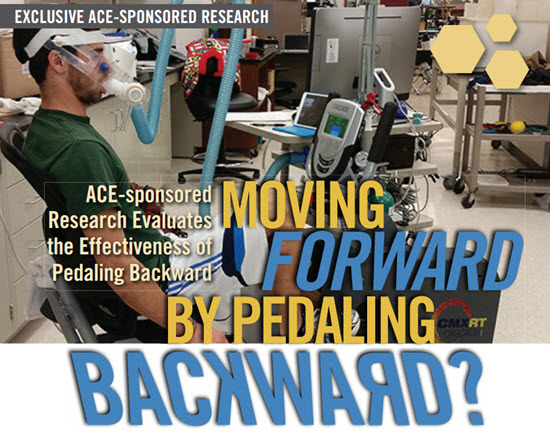
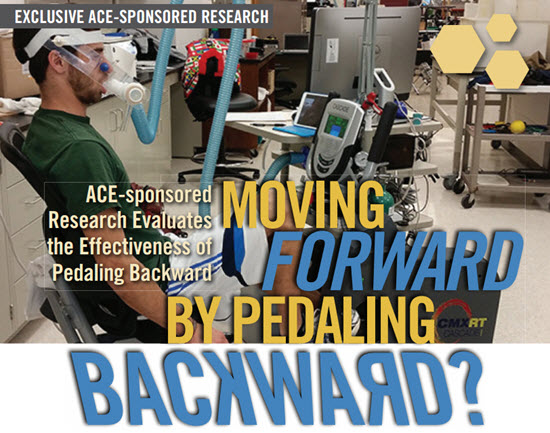
Cameron Chinatti from Stages Indoor Cycling alerted me to this. ACE (American Council on Exercise) published a scientific study that looked at the effectiveness of pedaling backwards. Please download the PDF and read it in it's entirety, so you have a complete understanding of the purpose and results of the study.
That ACE chose to study this at all is very interesting (and a bit confusing) to me. We've all been taught that we should always pedal forward and never backwards. So what's the point looking into this activity? The intro talks about the potential cross-training effects. Oh, and there's a quick bit about how variety can help prevent boredom…
Discussing this topic, I felt I needed to break it down to these three questions:
Is backwards pedaling beneficial?
Is backwards pedaling safe?
Should you consider adding backwards pedaling to your classes?
#1 Is pedaling backwards beneficial?
In the conclusion of the study, ACE says:
The Bottom Line
This study showed that pedaling backward on the Cascade cycle elicited higher heart-rate and energycost values than pedaling at identical workloads in the forward direction. The increase in physiological response was reflected by higher muscle activation of the quadriceps muscles (vastus medialis, vastus lateralis and rectus femoris), which is consistent with the subjects’ descriptions of feeling like they had to “pull” the pedals when cycling backward. “The concept of specificity tells us that pedaling forward should still make up the vast majority of a cyclist’s training,” explains Dr. Porcari, “but the subtle differences in muscle activation seen when pedaling backward can be very beneficial.” Dr. Porcari recommends treating backward pedaling as a change of pace and a form of cross-training that better targets the quads. Maria Cress, a member of the research team for this study, points out that by improving quadriceps strength by pedaling in the backward direction, cyclists will experience improved strength for regular cycling. “They will be able to work at a higher workload at a lower RPE and heart rate,” says Cress, “which means that incorporating backward pedaling into your routine will eventually make pedaling forward mentally and physically easier.”
So the researchers are saying backwards pedaling is beneficial. These folks from UWL are exercise scientists after all and include Dr. Carl Foster. Dr. Foster's research has validated most of the zone based heart rate training you've learned – regardless of the source.
#2 Is backwards pedaling safe?
Let's start with this. All of the Indoor Cycling certifications recommend against pedaling backwards. But here's where my confusion comes in… why would ACE even consider studying and publishing this? They have to know that there will be many Instructors who will read this and think; “ACE isn't concerned about pedaling backwards, so I don't need to be either!”
I can already see the responses on Facebook; “ACE doesn't know what they're talking about… they don't understand cycling like Spinning®/Schwinn/Keiser/Stages/etc..
So why wasn't ACE concerned?
ACE quotes the manufacturer of this recumbent:
The Cascade CMXRT recumbent exercise bike is designed to mimic the real road feel of cycling outdoors. Its website says that the bike offers “quiet bi-directional resistance [that] lets you pedal forward and backward throughout the whole 360-degree pedal stroke for a more effective workout.”
I'm guessing that ACE saw this and thought; “you can pedal their bike both directions. Let's use it to see if backwards pedaling is beneficial.” Except…
ACE is mistaken about this part.
The Cascade recumbent is fixed gear drive
In the sidebar included in the study, ACE makes this comment:
Of course, bike safety is another issue entirely. Before telling participants in a group exercise class or a personal-training client to start pedaling backward, be sure that the bike you are using is designed to do so. It is important to note that this research was not conducted on a fixed-gear cycle, but rather on a specifically designed recumbent bike that provides resistance in both directions.
As you can see in the above screenshot from Cascade's website that their recumbent does have a fixed gear drive system, just like every other Indoor Cycle – the one exception being CycleOps which uses a freewheel.
What ACE should have highlighted is this recumbent uses magnetic resistance, combined with an aluminum flywheel. The eddy currents that create the magnetic resistance don't care which direction the flywheel spins = that's where the provides resistance in both directions comes from. The aluminum flywheel is light enough that it doesn't create the huge rotational momentum (and resulting “run-away flywheel” effect) experienced with a friction resistance system that uses a heavily weighted flywheel.
There isn't anything special/unique in use here. All of the Indoor Cycling brands (FreeMotion/ICG/Keiser/Schwinn/Stages offer a similar magnetic resistance. So it's my view that this experiment could have been conducted on any ICs with magnetic resistance and ACE would have seen similar results.
Quick side note: I jumped on my personal indoor cycle that has magnetic resistance and a Stages Power Meter, to try backwards pedaling. Believe it or not, I'd never, ever tried this before. The Stages Power Meter did display cadence, but the watts stayed at zero. So no backwards pedaling, power training for me 🙁
What struck me was how I felt everything flipped; where I could add the most force was lifting my lead foot, as it came forward and up. Pushing down seemed very awkward and I didn't feel I could apply much pressure.
#4 Should you consider adding backwards pedaling to your classes?
I wouldn't. There doesn't appear to be enough positive benefits, in contrast with the possible injury. Not to mention pedaling backwards just looks wrong/goofy, So I can't see including it in my class.
If you are thinking; “My class is super experienced and we'd like to try this”. I'd love to know your experiences.
One more note: I briefly rode this recumbent cycle when I was at IHRSA. The manufacturer, Cascade Health and Fitness, and ICI/PRO are currently conducting a small study of our own. We have two clubs who are using recumbents, along with conventional indoor cycles, to see if they can be successfully integrated together in a group class. Our objective is to see if adding a few recumbents can make classes more accessible, to people who have physical limitations that prevent them from riding a stationary bike.
I woke up one morning thinking; the appeal of SoulCycle to women is eerily similar to golf's appeal to men.
Amy and I rode a class at SoulCycle in Santa Monica, CA. I was working on a few posts about our experiences that I hope to have finished by tomorrow. But this observation needed to be in a post all its own… and begins with this question?
Why is SoulCycle so appealing to women?
[wlm_private ‘PRO-Platinum|PRO-Monthly|PRO-Gratis|PRO-Seasonal|Platinum-trial|Monthly-trial|PRO-Military|30-Days-of-PRO|90 Day PRO|Stages-Instructor|Schwinn-Instructor|Instructor-Bonus|28 Day Challenge']
The class I took yesterday had about 60 people in it – I forgot to count the exact number of bikes. I was one of two men (lucky us!) and the age spread of the women there was 18 – 50, heavily biased to 30 and under. Now I get how the demographics of all group fitness classes are primarily women, but there is obviously some extra special attraction between SoulCycle and the women who flock to these classes.
I'm not a “golfer” in the same sense that I am a “cyclist”, but I have played enough to understand the game and the appeal it has with men. I'm also not a women. So please let me know if any of what follows sounds plausible – or if I'm totally out in left field.
SoulCycle is challenging… just like golf.
I was asked a question on Facebook about “did you do all the moves John?” I certainly tried, but keeping my cadence in time with the tempo of the music, while doing 4 & 8 count jumps was really challenging. I left the class thinking; “I can do better than that”… and then considered coming back later in the week to try again.
Golf is exactly the same. If you're not so frustrated by the end of the game that you commit to quitting for life, you are very motivated to return to prove to yourself (and the people you play with) that you can do better.
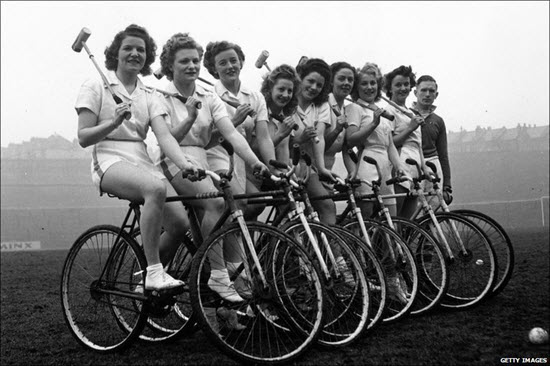
Said differently: How popular would golf be, if every swing resulted in a hole-in-one? That would be pretty boring, right? Who would bother to play a game where you're always successful? I suppose you could make the game more challenging by racing your foursome between the holes, or only play on hilly courses, or walk taking slow really big (or quick super small) steps to add variety. Maybe you could turn the game into something more like polo, using bicycles instead of horses.
Does any of that sound familiar? Part of SoulCycle's appeal is that the class itself is challenging to perform well. It's my guess that mastering all the movements is very gratifying – just as learning to hit and place a golf ball exactly where you want it.
SoulCycle is social… just like golf.
This is obvious.
SoulCycle is exclusive… just like golf.
‘Where are you playing this weekend?” I hear that asked frequently in the locker room where I teach. It's an exclusive club and many of our members are quite well to do. I'm not thinking that any of them would want to respond with; “we're playing the town course”, but rather stand up straight and tall, smile and respond with the name of one of the private golf courses in our area.
SoulCycle is a form of exercise… just like golf.
Play an 18 hole round of golf and you'll walk 4-6 miles. Is walking that far a good form of exercise? Sure it is. Is it the best form of exercise? No/maybe/yes/who's to judge. How about swinging the clubs 100 or more times during a round… will that help you increase your strength? Yes – and the muscle stiffness you feel over the next few days is an indication of the training effect. But is that the best way to increase strength? Again no/maybe/yes/who's to judge?
Is a SoulCycle class exercise? Yes. Do those exercises you do with the little hand weights increase strength? Maybe. Certainly they're not the best way to gain strength, but are they really any different from swinging a 9 iron – for the man whose only form of exercise is his week golf game?
SoulCycle is expensive… just like golf – see where I'm going with this?
SoulCycle classes at $34.00 a pop, are a bargain compared to many exclusive golf courses who charge $200 – $1,000 a round. People like to treat themselves to nice things – especially those people who work hard and can afford either of these two forms of exercise.
Golf has all kinds of expensive gear and clothing – and a quick check of the clothing displayed showed me SoulCycle does too.[/wlm_private]
Amy and I met Shirley (a former homecoming queen) after class. She told us how she had lost 65 lbs in advance of her reunion by taking 5 -6 SoulCycle classes each week. I didn't ask, but got the sense that she was a professional of some type and wasn't financially challenged by the cost of classes there. Shirley said she will normally do a triple on Sundays and based on how hard I saw her work in class – the girl could be an animal on the road.
That isn't a normal SoulCycle Indoor Cycle she's riding!
I'd heard some rumors that this was in the works > Stages Indoor Cycles appears to be supplying SoulCycle with Indoor Cycles.
This would be a HUGE safety improvement to their classes. Why? Because the combination of a lighter aluminum flywheel + magnetic resistance greatly reduces the crazy pedal speedsseen in many classes using heavy flywheels and friction resistance.
Does this mean SoulCycle will be introducing Power based classes?
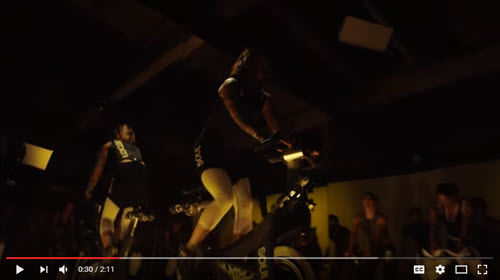
Check out this new, promotional video to catch a few glimpses of their custom branded Stages SC3s.In
Looking at this silhouette, there doesn't appear to be a computer or the Sprint Shift lever found on the original SC3.
Today is World Backup Day! Having a daily, scheduled, backup of all of your data is supercritical for everyone with a computer… especially Instructors who depend on iTunes to deliver their class music.
Here's a fun info-graphic that explains more > Courtesy of: Cloudwards.net
3/1/17 UPDATE – Amazon has solved their problems and everything appears to be working now!
ICI/PRO uses Amazon's SC servers to “serve” our podcasts, video files and some of our images. We've used Amazon since 2009 and this is the first time they've failed us. Until they get this corrected there's nothing I can do 🙁
We're not alone – some of the biggest websites on the Internet who use Amazon are down too.
Amazon’s S3 web-based storage service is experiencing widespread issues, leading to service that’s either partially or fully broken on websites, apps and devices upon which it relies. The AWS offering provides hosting for images for a lot of sites, and also hosts entire websites, and app backends including Nest.
The S3 outage is due to “high error rates with S3 in US-EAST-1,” according to Amazon’s AWS service health dashboard, which is where the company also says it’s working on “remediating the issue,” without initially revealing any further details.
Affected websites and services include Quora, newsletter provider Sailthru, Business Insider, Giphy, image hosting at a number of publisher websites, filesharing in Slack, and many more. Connected lightbulbs, thermostats and other IoT hardware is also being impacted, with many unable to control these devices as a result of the outage.
Amazon S3 is used by around 148,213 websites, and 121,761 unique domains, according to data tracked by SimilarTech, and its popularity as a content host concentrates specifically in the U.S. It’s used by 0.8 percent of the top 1 million websites, which is actually quite a bit smaller than CloudFlare, which is used by 6.2 percent of the top 1 million websites globally — and yet it’s still having this much of an effect.
Amazon’s web hosting services are among the most widely used out there, which means that when Amazon’s servers goes down, a lot of things go down with them. That appears to be happening today, with Amazon reporting “high error rates” in one region of its S3 web services, and a number of services going offline because of it.
Trello, Quora, IFTTT, and Splitwise all appear to be offline, as are websites built with the site-creation service Wix; GroupMe seems to be unable to load assets (The Verge’s own image system, which relies on Amazon, is also down); and Alexa is struggling to stay online, too. Nest’s app was unable to connect to thermostats and other devices for a period of time as well.