Running a successful fitness studio takes a lot of passion, experience and hard work. The husband and wife team of Xavier and Nadia McClinton who run Body By X Skill Development & Training Center in Marin County California sound like they have all three covered… and more!
Together they have developed a unique fitness offering that combines strength training, along with Indoor cycling and includes the MyRide+ virtual ride video system. Body By X's experiences with MyRide+ were covered in more detail in this case study we published back in February.
Listen to my interview with Xavier and Nadia to get an understanding of how they are able to succeed by creating a real sense of community at their studio and a simple idea you can use to retain members who (for whatever reason) decide not to show up.
You can subscribe to our free Podcast in iTunes by clicking here.
John,
Greetings from Korea… I would just like to let you know my current situation. At this time, I am not able to continue my membership with ICI/PRO due to financial reasons. As you may not remember, I am in the US Army over here in Korea and someone in the States (most likely Washington) decided that we were getting paid too much and cut the BAH (Basic Allowance for Housing) and COLA (Cost of Living Allowance)… so, I lost over $500 this month, and have to pay for more out of pocket expenses. I would like to know if it is possible for you to keep me as a member and I pay at a later date? I will keep you informed of when and I will put some aside to make the payment. If this is not possible, please let me know.
Respectfully,
Tim [redacted]
SFC, US Army Korea
Yes Tim, I do remember you and how last year you requested that we host a conference in Taegu, Korea – Boston was a little too far for you to travel.
I don't know about you, but I feel very blessed by those who serve as Active Duty Military. It also brings me a lot of joy to know we have ICI/PRO members serving in Korea and the Middle East who are using our resources to keep their base personnel fit and ready for duty.
I'm also glad that I could help former Spinning MI Debbie Miller promote Sweat for a Vet – where 51 clubs, with hundreds of riders, will participate next Saturday 11/12 to raise money to help wounded warriors become fitness instructors.
I also feel very blessed by the support of the ICI/PRO community and felt compelled to do my part and give something back…
So I responded to Tim explaining that I had him covered and his subscription would continue. Not wanting to limit this to just Tim, I decided that new and renewing ICI/PRO members on active duty (any country) will qualify for a 6 month Gratis level membership = FREE 🙂
Please forward this information on to anyone you feel would qualify. If you are aware of any Military Fitness Instructor social media groups or email lists, I would appreciate you posting this information.
Just a few trends I've seen in 2012 that are moving smartly into 2013.
– Dual fitness offerings – boutique cycling studios are now combining TRX, Pilates, personal training, yoga, etc. The ideal studio space required to provide these amenities is running 3000 sq ft. and above.
– Ambient features are now included in the start up budget…no longer an option but a must have on opening day. Even the big box gyms are installing LED lighting and promoting the entire mind/body ride concept. If the corporate giants are starting to figure it out, boutique studios must stay ahead of the game and keep adding more….video, performance tracking, etc.
– Benefit rides are all the rage. If your studio doesn't offer yearly at least ONE cancer/special olympics, etc. ride with proceeds going to a local charity, you're missing a HUGE opportunity to recruit new members and establish yourself as a forward thinking fitness organization. My studio hosts 2-3 benefit rides per year….I have tons of resources if anyone is interested.
– SPD's required…no longer an option in many studios. The shift has been strong in 2012 for clips only. As you know, I'm working with Pearl and others to provide dealer status to studios. Stocking rental shoes is the accepted norm now.
– Studio Logo/Names – The swoosh image on a bike has seen its day and new designs for studios are clean, more Euro, and less nosiy…..very clean. simple.
– Websites – look impressive. No longer are GoDaddy “do it yourself” websites cutting it. Clients are sinking tons of money into edgy website experiences….check out my latest project: kor180.com
And puh-leeeese, studio owners! Hire a consultant to check your site for grammatical errors, incorrect usage of cycling terms, and red flags that shout “little details don't matter” to your customers. I've found so many spelling/punctuation/redundancy/inaccurate info on cycling sites. Studio owners are cutting back funds and creating the text themselves…or worse, they're plagiarizing from other sites.
– Studio names. Guys, if your don't trademark, anyone can use your studio name…it's up to you to protect it. I'm aware studios in different cities with the same name. I asked one why she had not trademarked for protection, and her reply was, “haven't gotten around to it….” Please Include legal fees in your startup budget.
– Branding…..it's the name of the game. Everything from clothing to bumper stickers…studios are blowing it up with marketing and creating a buzz with super cool gear with a logo recognized immediately. Friday night wine tasting after a ride, guest celebrity chefs, fitness lectures…etc. We are creating a community, not just a cycling studio. See me for more info.
Want to use your iPhone or Android based device to schedule your next Indoor Cycling class?
There's an App for that® 🙂
I added the ® because Apple has trademarked that phrase.
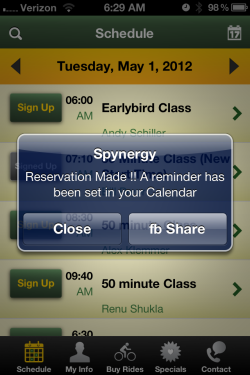
Studio owner Bill Pryor has created an App for his customers at Spynergy Wellesley, Bill's Indoor Cycling Studio outside of Boston Mass. Spynergy customers can download the App for free, quickly review the class schedule and easily signup for a future class. The part I love most is how it adds the event your calendar, so there's no excuse for missing the class.
The App is made by TempoXSports and they can build a custom App for your Club or Studio if you're using MINDBODY Online to manage registrations – which is about everyone as far as I can tell.
Here's more about it:
The app your clients see will be similar in feel to what they are used to from booking through their browser-based systems. Your app will let clients easily perform the following critical tasks from their phones
Sign-in to their MINDBODY existing account
Set up an account if they are new
View your schedule
Sign-up / reserve spots (reservations auto-posted to calendar / ical)
Read teacher and class descriptions
Check their account (visits, schedule, attendance, purchases)
Purchase any packages you are selling through MINDBODY
Seasonal affective disorder (also called SAD) is a type of depression that occurs at the same time every year. If you're like most people with seasonal affective disorder, your symptoms start in the fall and may continue into the winter months, sapping your energy and making you feel moody. Less often, seasonal affective disorder causes depression in the spring or early summer.
Treatment for seasonal affective disorder includes light therapy (phototherapy), psychotherapy and medications. Don't brush off that yearly feeling as simply a case of the “winter blues” or a seasonal funk that you have to tough out on your own. Take steps to keep your mood and motivation steady throughout the year.
I don't mean to make light of depression – my mother struggled with it for much of her life. But this morning a number of us decided that even jokes about how bad the weather is here, are depressing. Worst one I've heard was this morning; “John, I'm not sure I'm ready for winter to start again…” Not sure if it was intended as a joke, but it got a few chuckles from the other's who heard it.
There is treatment available.Bright light therapy is supposed to be effective. I'm all about finding solutions to problems. This morning I may have come up with a way we could introduce this much needed therapy, as part of a special class we could offer.
An Indoor Tanning Triathlon!
We could run it just like a regular indoor Tri, except participants would recover between each leg with a few minutes enjoying some rays in a tanning bed. Our club is always forming marketing partnerships with local business. Why not have the local tanning salon roll a bunch of beds in for an afternoon?
You'd come out of the pool, dry off and then spend 5 minutes in a turbo tan – we could even have special UV protective swim goggles made so you wouldn't need to change them. Then into the cycling class, which ends with another blast of vitamin D, before a short run on the treadmill.
Our Cycling Studio Owners will want to check this out ASAP…
For years we've promoted Working Fitness Vacations – where you, the Instructor, teache a few fitness classes in exchange for a very low cost, Caribbean vacation. Hundreds of Instructors have followed our recommendations and have really enjoyed their all inclusive vacations.
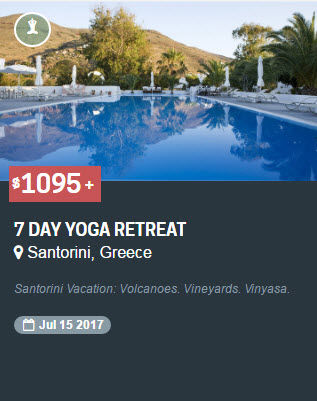
Now there's TripTribe.com. They specialize in assisting fitness professionals who want to take a group of clients (your tribe) on a fitness retreat. For leading these trips you, the Instructor, will be paid as the Trip Tribe Ambassador!
To learn the actual scoop on these trips, I asked the marketing representative at Trip Tribe if she'd connect me with an Ambassador that I could interview…
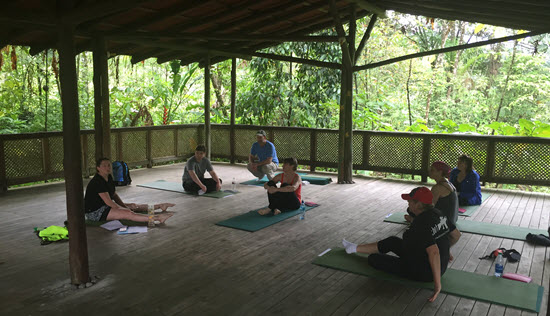
Coach Kelly McCormack owns Club Inhale Exhale in Billerica, Massachusetts. This past May she traveled with a group of her clients to a ranch in the mountains of Costa Rica. It sounds like everyone had a great time and best of all, the check TripTribe.com sent her at the conclusion of the trip paid all of her expenses🙂
Listen to my interview with Kelly to learn if this would be something you could do with your tribe.
TripTribe.com offers dozens of exotic locations across the world, in a wide range of pricing, including;
Go here and create a free profile. Spend some time working with their retreat planning wizard to get an understanding of the possibilities. Then I'd encourage you to call and discuss your ideas for a group trip with one of their advisors.