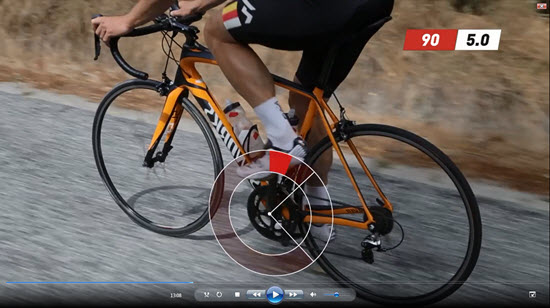
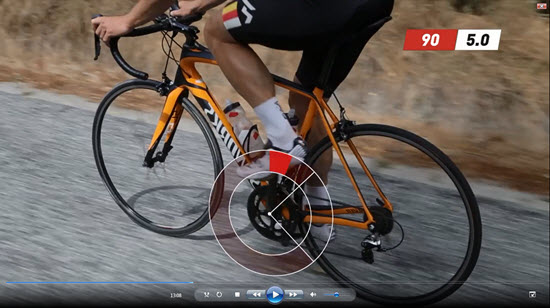
This Indoor Cycling training video will help you learn the Elements of Style
Did anyone teach you how to pedal correctly?
I was lucky to have a mentor when I first started riding outdoors. My friend Eddy not only gently coached me on the finer points of cycling style as we rode together, he demonstrated an impeccable pedaling form. He was so smooth and powerful, that I desperately wanted to emulate how Eddy looked on his bicycle. So over hundreds of miles I watched and listened. Now I'll get an occasional comment about how smooth I am on a bike. I owe it all to Eddy!
So how do you learn if you don't have a friend or mentor with the experience and patience needed? Might I suggest this 40 minute video from the folks at Sufferfest: The Elements of Style – Efficiency and Awareness
https://vimeo.com/thesufferfest/elementsofstyle
I have an interview planned with David McQuillen the creator/producer of these excellent quality HD training videos tomorrow. So for show prep, I checked out what was new and downloaded The Elements of Style. NOTE: Sufferfest videos are only digital downloads > they don't offer DVDS.
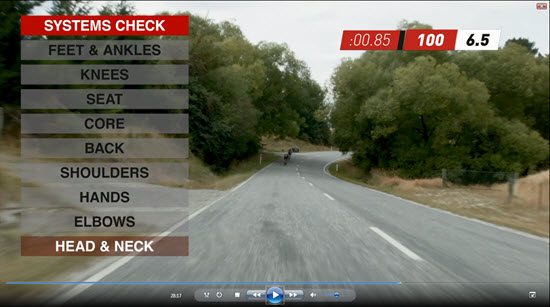
Includes a nice “Systems Check” for proper riding position.
Learn to ride with style
I rode along and completed all of the drills included in this video today – fantastic. The recommendations are solid – although they just might conflict with what you've been told by others.
New Instructors should consider using this training to fine tune how they ride an Indoor Cycle. Maybe setting up with a mirror so you can see yourself from the side.
I know, as part of your training you were told a bunch of things about proper pedal technique and position… but have you ever practiced improving how you ride? More importantly, how do you look – when you're up there on the Instructor bike? Are you demonstrating a cycling style that your participants will want to copy?
Can you ride? Really ride? Can you Suffer with style? Make profound Suffering look effortless?
Although it has very little Suffering in it, Elements of Style may just be our most important video ever. Developed together with the expert team at CyclingTips and shot on location in Wanaka, New Zealand, this 39 minute video provides the very foundation upon which all your Suffering must rest.
Over the course of six specific drills, you’ll learn and practice:
An exclusive 9-point ‘Systems Check’ you can use on any ride to get into your optimal position.
A 4-step process for standing up on a climb and generating more power.
How to engage your core, including your glutes, for more stability and power.
The components of a smooth pedal stroke and how to bring them together at both low and high cadences.
How to stay relaxed and efficient under pressure.
Narrated by one of the best cycling commentators in the world, Eurosport’s Carlton Kirby, you’ll get clear instructions about exactly what to do, when and why. We guarantee it will change the way you think about your riding style after doing it JUST ONCE. Do it five times and you’ll automatically adjust your position while out on rides. Do it 10 times and Sufferlandrian angels will burst into tears at the sheer epic beauty of you kicking the crap out of your competition all the while making it look effortless.
*** Download includes a FREE PDF from CyclingTips with further style tips. Look in the .zip folder after download. ***
We were waiting for a long traffic light to change yesterday, when one of our group asked me a question; why do you unclip your left foot? I always unclip my right… personal preference, or is one way better/more correct?
The women who asked this question is a relatively new rider. This is her second year road riding with our outdoor group. Like many who've become passionate cyclists, she has become a student of all the little details involved in cycling. So she's often curious, questioning us about things we do on the road. I remember her asking last year why I would always stop in the center of the righthand lane, rather than staying on the shoulder. She quickly understood when I explained that by claiming the lane, it would hopefully prevent a car from squeezing us into the right hand curb, as we cross the intersection 🙂
Seeing that there are a bunch of Instructors riding outdoors, I thought I would share this with you. For your benefit, and possibly some new rider you have the opportunity to mentor someday.
My view is that unclipping should always be done with your left foot, regardless of which footed you are, because it's safer.
Regular or Goofy Foot?
Lead foot choice on board sports like; Slalom Water Skiing, Wakeboarding, Skateboarding and Snowboarding are designated as;
Left foot forward = Regular Footed
Right foot forward = Goofy Footed
I have no idea when I first heard the term Goofy Foot, but I do know it was waterskiing. I always had my right (Goofy) foot in the forward binding of the ski. I just felt more natural for me, even though all my friends did the opposite. With these sports it's a matter of personal preference.
Why does it matter which foot on a bicycle?
Here are a few reasons I feel it's safer unclipping your left foot during a controlled stop. NOTE: road cyclists should be comfortable unclipping either foot in case of emergency.
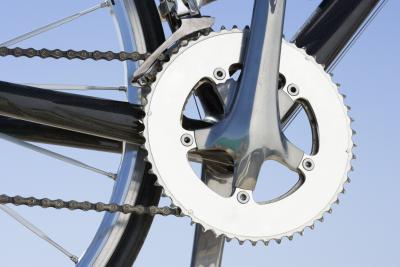
#1 That front chain ring is really sharp!
Like a stationary saw blade… ready to slice open your calf!
I didn't want to post the actual picture, but this link shows what can happen when your foot slips off the pedal when you aren't successful clipping in and you're in your small chainring. Ride long enough with slippery road pedals and there'll be a time when you put pressure on an unclipped pedal. Your body weight quickly carries your sliding foot across, and then off, the front of the pedal. Do it with your left foot and you'll just be embarrassed. With your right and there's a chance you'll need stitches from your right calf scraping across those sharp teeth and a tetanus shot – those teeth are not only like little razor blades, they're also really dirty.
This actually happened to my buddy Randy Erwin a few years ago. He had been following Amy and me on our tandem. Amy looked back and saw him stopped, hunched over his bike. Once we rode back we saw all the blood – he did too and nearly passed out from it.
#2 Your right leg is probably stronger
Watch a child or new rider leave from a stop and you'll normally see them repeatedly pushing/pawing off with the unclipped foot – often with the clipped-in pedal in it's lowest position.
Experienced riders start with the clipped in pedal positioned around 2 o'clock. This allows you to power away by driving the clipped foot down, using a normal pedaling motion. The unclipped foot can help push off a little, but it's mainly for balance. This first pedal stroke needs to be powerful – so use your strongest leg! With 90%+ people being righthand dominate, your right leg is typically stronger.
You might need to complete multiple rotations with just one leg, before pausing long enough to get the second foot secured. Another reason you need as much strength as possible.
NOTE: for you “lefties” I still feel the potential danger listed in #1 should have you unclipping your left foot.
#3 Keep your down foot on the high side
This might not apply where you live – and it will be contraindicated (a new use for that term) for our friends in the UK, Oz and other British territories. Roads are often constructed with a “crown” = the center of the road is higher than the shoulders. They do this to speed rainwater runoff and it will naturally cause an initiative/sleeping driver to steer away from oncoming traffic. So for us who drive on the right/correct side, your left foot will be on the “high side” = you may have better balance than reaching down to the low side.
NOTE: for you who drive on the left/wrong side, I still feel the potential danger listed in #1 should have you unclipping your left foot.
#4 Don't get confused
Err… not sure?
After leading group rides for 20 years, it's not uncommon to see a rider who appears confused at a stop – they aren't sure which foot to unclip. As you know, confusion can lead to indecision and indecision on a stopped bicycle frequently leads to someone tipping over. Embarrassing and often painful 🙁 Not to mention any names, but I have a guy… Lee, in the “C” group I lead (my community service) with this problem. More than once a ride I'm seeing him jump out of both pedals and then slide on both feet until he stops!
Decide what you're going to do in advance. Make a conscience decision; “I'm going to go Goofy and unclip my left foot!” as you roll to the stop with your right foot at the bottom.
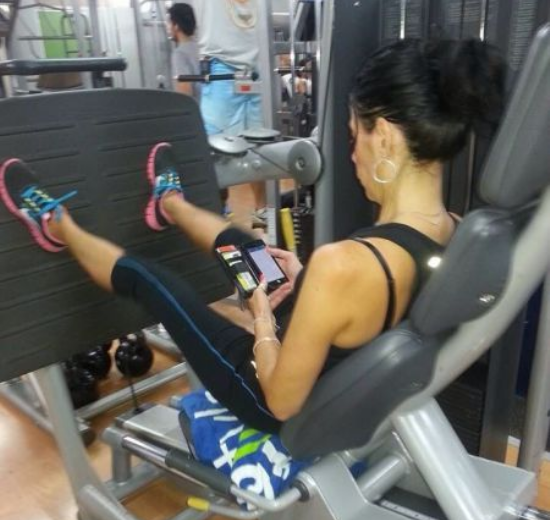
Texting during exercise could prevent weight loss: Study
Kent State University researchers Jacob Barkley, Ph.D., and Andrew Lepp, Ph.D., as well as Kent State alumni Michael Rebold, Ph.D., and Gabe Sanders, Ph.D., assessed how common smartphone uses — texting and talking — interfere with treadmill exercise.
The researchers, from Kent State’s College of Education, Health and Human Services, found that when individuals use their smartphones during exercise for texting or talking, it causes a reduction in exercise intensity.
“Exercising at a lower intensity has been found to reduce the health benefits of exercise and fitness improvements over time,” Barkley said.
The results of the study and the widespread use of smartphones during exercise help explain the results of a previous study conducted at Kent State by the same researchers, which found a negative relationship between smartphone use and cardiorespiratory fitness.
“These findings are important because poor cardiorespiratory fitness is associated with an increased prevalence of cardiovascular disease risk factors, such as higher cholesterol and blood pressure levels, which could potentially lead to premature mortality,” said Rebold, who worked on the study while at Kent State and now serves as an assistant professor of exercise science at Bloomsburg University of Pennsylvania.
Of course you already knew this – nice to know it's supported by science.
You need to exhale all those fat calories away! Image credit www.wikihow.com/
I'm constantly on the hunt for clever ways to encourage my class to focus (a polite way of saying SHUT UP) and work hard. Over the years my best success has come from equating the work we're doing to weight loss. After all, interest in burning calories is universal – doesn't matter who it is (cyclist, club athlete, new mother, etc..) everyone in my class is interested in either reducing or maintaining their body fat percentage.
I've learned a new one today and can't wait to give it a try:
OK – you two talking in the back. Do you realise you're preventing fat from escaping your body?
It might sound crazy, but it's true. Science has shown that when you burn body fat, after giving up it's energy, fat is converted to CO2 (carbon dioxide) and H2O (Water) and leaves your body when you exhale.
We talk a lot about dieting and burning off fat, but we actually have a lot of misconceptions about weight loss. Some people think fat is converted into energy or heat–a violation of the law of conservation of mass–while others think that the fat is somehow excreted or even converted to muscle. I was told early on that you can never lose your fat cells (adipose) once you gain them…they just shrink if you work it off.
Well, according to Andrew Brown from the University of New South Wales and Australian TV personality (slash former physicist) Ruben Meerman, when you lose weight, you exhale your fat. Their new calculations, based on existing knowledge about biochemistry, were published in the British Medical Journal this week.
A little research on the subject lead me to this excellent video from ABC.net.AU that describes the process of converting Fat to energy in a way that you'll be able to share with your class.
So I might be taking some technical liberties here, by saying that talking is preventing fat calories from escaping. I'm willing to distort the science a little if it gets the larger point across… which is:
If you're talking you're not working as hard as you should and not burning the calories you could!
There was an interesting question asked at one of the Facebook groups;
If you were to tell a New Instructor to master one thing as an Indoor cycling instructor . What would it be ?
There were a plenty of great responses that included; learn musicality, cuing, be prepared, be yourself, project confidence/control your class (very important) and other suggestions that focused on education. All important for sure. Mine was short – Smile. Pretty simplistic I'll agree – but when you consider that your ability to connect with the riders in your class is crucial for building and maintaining a full class, regularly smiling at people can really add to your overall presentation.
My response was directed at a long running frustration I have. Over hundreds of classes I've taken or observed, I've seen very few smiling Instructors. Lot's of serious Instructors. Instructors who scowl, grimace and a few who look bored… but not many who offer a genuine smile. Sure you'll find pictures of smiling Instructors posted on Facebook or instagram > they're smiling because that's the natural response most people have when having their picture taken. On the count of three I want everyone to Smile. One, Two, Three…
You can make me feel good [wlm_private ‘PRO-Platinum|PRO-Monthly|PRO-Gratis|PRO-Seasonal|Platinum-trial|Monthly-trial|PRO-Military|30-Days-of-PRO|90 Day PRO|Stages-Instructor|Schwinn-Instructor|Instructor-Bonus|28 Day Challenge']
I like it when someone smiles at me. Do you? Dumb question, of course you and everyone else I know enjoys a smile. A warm/real smile communicates an enormous amount of goodwill, acceptance and affirmation between two people. Who can forget a smile from someone of great importance? Maybe it was a crush you had in highschool. When he/she smiled at you it validated you as important to someone else. Or maybe you received a smile from a person in authority that said “well done” and boosted your self confidence in a way words never could?
Why so serious?
I do tend to see Instructors with super serious faces. You know, that stern face that conveys concern as they scan across the room. Realising many of us take our role as that of a concerned watchdog, I get how it's important to be watchful of everyone.
I few years back Cycling Fusion ran a contest to find great Instructors. There were quite a few videos submitted, each demonstrating different/unique Instructor styles. Watch a few minutes of the video below to see if you have the same reaction I had > Keith's “persona” is very intense – nothing wrong with that. Can you see how his class presentation could be improved if he just smiled occasionally?
Consider for a moment you're a participant. Better yet, you are a brand new rider – this is your very first class. So there you are, riding along and feeling pretty good about your success so far. Then you happen to raise your head and see the Instructor looking directly at you with a super serious face…
Why is she looking at me like that? Crap. Am I doing something wrong? I mustn't be pedaling right… are my hand in the wrong place? Sit up straighter… yeah that's it, I need to sit up straighter. Oh good, she's looking at someone else now. She can tell I'm not very good at this…
The goal is to mask your concern/focus/intensity with a friendly & inviting smile.
Pick someone to smile at, using your eyes
In this article about eye contact, I described an Instructor who looked at everything in the studio, but never at me. Or it at least felt that way. He would get close to looking at me; above my head, to the left, right and at the floor. Never once did he make eye contact with me… and it was kind of creepy.
Notice in the video where Kevin looks while he's teaching? Straight ahead and somewhat down, at a place just in front of him, right? It doesn't appear to me that he's looking directly at the riders… and he's certainly not making eye contact with anyone. How do I know that? Because most people's expression will change when they connect with another person who's across the room. There are riders facing him, but I don't see any reaction that shows he's connecting with any of them.
What to do?
We've encouraged Instructors to record the audio of their classes. So they can hear exactly what their class hears.
Are my cues clear?
Am I talking over and/or competing with the lyrics?
Do I talk too much?
Not enough?
What tone do I use?
Does it communicate energy and various emotions – or am I monotone, without any vocal inflection?
Listening to your class presentation can identify any issues/weaknesses. Just like improving your fitness (if you can measure it… you can improve it) being aware of small things that detract from your presentation is the launching pad for improving your presentation skills.
Moving beyond audio, I'm thinking your class presentation could be improved if you were to film yourself. Then you'd see;
Am I smiling?
What's my expression when I'm not smiling?
Am I making eye contact?
Does my face show a reaction of connecting with others?
Do I scan the room? Or focus in just one place?
It doesn't need to be anything fancy – only you will be watching this. Most phones have excellent video capabilities. You could probably craft a simple stand using a chair and a folded up towel. Get there early, set up you camera, turn it on and then hopefully you'll forget it's running – remember everyone smiles when they know they're being filmed. You want a candid video of the real/natural you.
Important note: try to resist the natural self-criticism that comes from watching yourself in a video. You're only looking for signs of connecting with riders and projecting positive vibes. Unless the class you teach is filled with experienced cyclists, your participants aren't nit-picking how you're ride the bike.
Sleep difficulties can take several different forms. Let’s look at one.
If you have trouble falling asleep at night, one easy solution is to eat a small portion of carbohydrate, preferably starch, about an hour or so before bed. Starch examples include quinoa, potato, rice, sweet potato, pumpkin, oats, even pasta.
What Starches Do[wlm_private ‘PRO-Platinum|PRO-Monthly|PRO-Gratis|PRO-Seasonal|Platinum-trial|Monthly-trial|PRO-Military|30-Days-of-PRO|90 Day PRO|Stages-Instructor|Schwinn-Instructor|Instructor-Bonus|28 Day Challenge']
Starches stimulate insulin, and insulin allows a specific amino acid (tryptophan) to reach the brain. When tryptophan reaches the brain, it’s used to make serotonin.
Serotonin relaxes us and allows us to fall asleep. It’s also converted to melatonin, the sleep hormone. Melatonin has the additional benefit of anti-inflammatory action, which is one reason sleep is so good for us.
When Starch Doesn’t Work, Add Turkey
If you try starch and still can’t fall asleep, another suggestion is to start your pre-bed food ritual with a little bit of turkey, which contains a relatively high amount of tryptophan. Eating carb together with turkey will have the same effect that you may have experienced after a Thanksgiving dinner — feeling sleepy after the meal.
Although turkey is usually blamed for that sleepiness, the tryptophan wouldn’t reach the brain readily if we didn’t eat carbs with it. Several larger and more abundant amino acids compete with tryptophan for brain entry. In effect, they block tryptophan and prevent it from reaching the brain.
Those competing amino acids are used to form dopamine and norepinephrine, which make us alert.
How Carbs Help
When carbs trigger insulin release, the insulin transports amino acids throughout the body. They can then be used for the various functions that aminos are used for: formation of antibodies, hormones, receptor sites, enzymes, and more.
At that point, tryptophan — smaller in size and less plentiful — can reach the brain. It can then be converted to serotonin.
Why Starches? Why Not Sugar?
Some people tend to crave sugar before bed, but eating it can backfire for a couple of reasons.
Sugar triggers the release of endorphins and dopamine. As mentioned above, dopamine is a brain alertness chemical, so it could wake us up, rather than allowing us to fall asleep. Some people are more sensitive to the dopamine effect of sugar and might find themselves “wired” after eating sugar.
Starches, in contrast, tend to produce relaxation without that wired feeling.
Another Problem With Sugar
Another way sugar can backfire has to do with glucose. This could wake us up in the middle of the night.
Sugar tends to trigger high insulin secretion. That effect is much more pronounced in some people than in others. (Those people are called “carbohydrate sensitive”, but don’t be confused by the name. We’re still talking about sugar before bed, rather than starch.)
In someone who is sensitive to sugar in this way, the extra insulin might cause glucose levels to drop very low. It might seem as if the low glucose would make someone so tired that they’d stay asleep all night and even having trouble waking in the morning.
Instead, the drop in glucose tends to cause us to wake up in the middle of the night and have difficulty going back asleep, even if we feel tired.
So starch again seems to be a better solution.
Bottom line
Eat protein throughout the day, and eat less protein with your dinner. Eat a small portion of starch about an hour or so before bedtime. Add turkey if it doesn’t work. Avoid late-night sugar.[/wlm_private]
————————————————————————————-
Note from John: Last Thursday a participant asked me; “John, where do you find all of these helpful tidbits about eating? I'm a sugar addict like you (I share my own personal struggles with my class) and appreciate your helpful reminders.” I responded by telling her that Dr. Joan Kent, our resident nutritionist at my website ICI/PRO, publishes these weekly. I simply copy down a few notes or print the article and share the info during recoveries.