
by John | Jun 14, 2013 | Class DVDS & Videos, Latest News
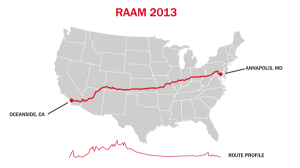
3,000 miles with 170,000 feet of climbing 🙁
That's RAAM or Race Across America and it starts this Saturday June 15th.
RAAM begins in Oceanside, CA and travels 3,000 miles, 170,000 feet of elevation change and the the film crew from epicPLANET.tv will be filming the riders all the way to the end in Annapolis, MD!
For this year's event starting in mid-June, epicPLANET.tv has embedded it's film crew with
Team Break the Cycle from Bentonville, Arkansas. This four-person team is riding in support of the
Northwest Arkansas Children's Shelter, a private, non-profit organization that provides 24-hour emergency residential care to children who are victims of family violence, neglect and physical and sexual abuse. So far, they've raised over $200,000. WOW!
Team cyclists, Mike Brady, Chip Gibbons, Randy Johnson, and Lori O'Connor will be riding around the clock for approximately seven days supported by a team of 14 dedicated volunteers led by Crew Chief Mark Burson. It's a cyclists dream come true!
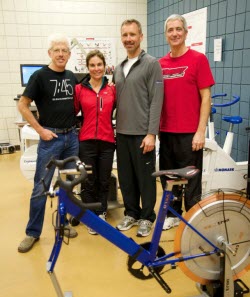
Team Break the Cycle
EpicPlanet's producer, Allen Jones, is planning to create short videos from RAMM that we will be displaying here to track their progress.
Later this fall epicPLANET plans to produce a number of Indoor Cycling videos & DVDs that chronicle Team Break the Cycle's journey across the USA. I can't wait to show them to my classes, especially the parts where they climb across the Rocky Mountains 🙂
Lots more about RAAM here.
by John | Jun 2, 2013 | Latest News
ICI/PRO members are not affected by this – if you have subscribed using your Super Secret Feed.
We're having issues communicating with the iTunes music store. Currently iTunes is showing everything but the actual Podcast episodes – which of course in not good!
I'll let you know when we have successfully corrected this.
by Amy Macgowan | May 29, 2013 | Engage Your Students, Instructor Training
I won't ride at all….
John was talking with a neighbor friend after returning from a challenging group ride and invited him to ride along the following week. His response was, “I used to lead the A ride. I won't do it now, because I can't sit up front anymore.”
Andrew* was recently diagnosed with Multiple Myeloma. Thanks to many years of riding, racing, much training and knowing his body really well, he knew something was wrong. He had been training hard, riding a lot, and yet his performance was diminishing. He FINALLY (after much prompting from his wife) went to the doctor and blood tests revealed MM. Prognosis is “squiffy”…my term for not terminal, but not definitive. Andrew and his wife are taking it day by day.
I need to give you a bit of history… Andrew has been a significant force and influence in John's cycling ‘career'. As John timidly set out to gain some fitness 18 years ago, Andrew supported him wholeheartedly. First he brought over Power Bars, then a jersey, then some new bike shorts he, “would never use”… Andrew encouraged and helped John at every turn. (Plus, Andrew is a ‘Gear Head'. I am sure it pained him to see John riding in sweats, tennis shoes and a sweatshirt back in the old days!). As John progressed, Andrew would encourage him and ride with him. John would strategize as to how to overtake Andrew just once a season!!!! I will be forever thankful to Andrew for his passion for riding and encouragement for John as he started out.
As neighbors, we have watched each others children grow up and move on and continue in our quest to remain fit and healthful. I consider Andrew to be fit and healthful to this day, despite his diagnosis. I wish he felt the same.
Andrew has always been an example to me and John. He has been diligent in his eating and fitness routines. He did not ask for cancer and he is not keeping his MM diagnosis a secret. He is maintaining phenomenal fitness despite his diagnosis. I personally consider him a great example of what cancer and fitness can look like in co-existence. I only wish he saw it this way and would lead whatever ‘alphabet' ride he chose with confidence and courage, because he is, and has always been, a cycling hero in his own rite.
I think this begs us to ask ourselves, “What would I do if I were still healthy enough to ride, but not in the capacity I used to?” Would we be courageous enough to ride the ride we are able and be thankful? Would we take the opportunity to step up and be an example in lesser settings? Pride is a strong and wicked opponent.
We are all leaders. Sometimes ‘A' leaders and sometimes leaders in other ways. I pray I will see the difference and be willing to lead wherever I am destined to.
I believe Andrew is missing a huge opportunity to give and receive. It's not always about being the leader of the “A” group. The “B” and “C” group need leaders, motivators and examples too.
*Our neighbor and friend's name has been changed to protect his privacy
by Chuck Cali | May 20, 2013 | Engage Your Students, Master Instructor Blog

by Team ICG® Master Trainer Chuck Cali
As I prepared to support ICG at IHRSA 2013, I considered the ICG tenet that learning is about removing resistance.
I had just gotten back from a bit of Vegas shopping. A nice saleslady asked me what I was doing in Vegas and told me about the time she and her friends first tried indoor cycling. She loved it and was hooked, but her friends ran away and never came back. She explained that their initial reluctance to try something with a reputation for being hard had unfortunately been validated.
The cycling class tradition is steeped in that reputation — it’s crazy hard and the people doing it are crazier still. The reputation makes it difficult to get new riders. There’s built-in resistance to the classes. Regrettably, many instructors deliver indiscriminately on the reputation.
Yet we know that doesn’t need to be the case. How an instructor begins a class can go a long way toward removing resistance for first-timers. So I’ve developed a list. I’m not sure if they’re “Dos and Don’ts” or “Pros and Cons”, but certainly following these tenets during every class will help improve the reputation of indoor cycling.
YOU MUST GET THERE AT LEAST 15 MINUTES EARLY!!
This seemingly simple, yet consistently underemployed, strategy will put you in a calmer place. Your riders can feel your tension. Moreover, it gives you a chance to get ready without stress and bond a bit with your riders. Especially first-timers.
BE ATTENTIVE TO FIRST-TIME RIDERS
Many first-time riders will not approach you with that information. They tend to wander in, head to the back of the room, and look for a bike that fits. If you’re in discussion with your roadie friend, picking videos, lacing up your bike shoes, emailing or texting, you could easily miss them. Be on the lookout.
PERFORM A BIKE FIT TO GET TO KNOW THEM AND LET THEM KNOW YOU
I’m often made fun of for the amount of time I take doing bike fits for my riders. Well, LOL, for first-timers, the key is the time you give them, rather than how precisely you fit them. While doing the bike fit, I ask their name, talk about the console (if applicable), show them how to change resistance, define some terms I’ll use, explain the order of tasks (fun, cadence, resistance), and most importantly, explain how to modify anything I ask. Make your first connection here.
START CLASS BY WELCOMING THE NEW PEOPLE
I may catch some flak here because some people don’t like to be called out. But rather than calling them out, I simply state that we have a first-timer and have everyone clap. Then we get to it.
MAKE EYE CONTACT AND GIVE POSITIVE REINFORCEMENT
During class, check in on your first-timer. It’s simple. Watch. Make eye contact. Smile and nod reassuringly. If they’re struggling, find an opportune moment to get off the bike, turn off the mic, and give some help. Help other riders along the way.
TALK TO THEM AFTER CLASS
As much as practical, get right to your first-timers and talk to them. How did it feel? What did you like? What didn’t you like? Did you get the workout you expected? Where to buy cycling shorts and shoes. Welcome them into the community.
FINAL WORDS ON EDUCATION
Innovation has been the cornerstone of the ICG mission. Our approach to education — learning is a process of removing resistance — is a giant leap forward for indoor cycling. As an instructor, you have the opportunity to remove resistance and educate both your regular riders and beginners. The longevity of our craft depends on bringing in, educating and motivating new riders. Removing resistance is the first step. Take it.
At IHRSA, I worked the ICG booth and was fortunate — in some bizarre way — to be cornered by two club owners after my second of three demo rides. Both used the same language.
“You’re very good at teaching to video. But, of course, that’s why your company brought you here. How can we get our instructors to do as well as you and make their classes just as compelling?”
I explained that the best programs are those where the synergy between club management and employees is high. When management works closely with the group exercise teams to educate, promote, nurture and applaud, good things happen. The corollary is that management first needs to go in search of “the best of the best (and) make them better”. (Yes, I stole that line from “Top Gun.”)
They were surprised to hear that ICG's online continuing education is free for everyone, not just those who buy our widgets. I explained our concept of educating by removing resistance. Our online modules are there for all — and you don’t have to start at the top. Nor do the instructors, who have learned a thing or two over the years, have to read all the chapters before taking the quiz at the end of each module.
As instructors, we can’t lose sight of the fact that, if we’re not working on improving our craft, then it could be better.
by John | May 18, 2013 | Engage Your Students, Instructor Training, Master Instructor Blog
I saw this last Tuesday and forgot to share it with you. Our club ride begins at the Minnetonka Lifetime Athletic Club. Better known as The Spa, this is a unique LTF facility. Definitely not a Big Box, this club began as a women only club before being purchased by Lifetime.

When I got there Tuesday night they were setting up for an outdoor ride. How fun is that? We rolled before they got started and I heard later that they (Manager and Instructors) did a very nice job making this outdoor class an event, rather than just a class.
The area behind the fence is a small patio. After the class participants enjoyed Hors d'oeuvres and a cash bar – this is an adults only club. They even had live entertainment from a local duet. Is that something you could do at your club or studio?
Could I keep up in a group ride?
With Amy visiting her family in Phoenix, I become the de facto sub for her Saturday AM class. Which was fine – 55 and rain this morning = no outdoor ride for John. After class a regular member asked me if I felt she could keep up in a group ride. I dislike giving answers beginning with; “well that depends” – except in this situation it really does. Riding with a group depends on a number of factors. So I asked her the following:
- Do you have a suitable road bike?
- Are you comfortable riding close to others?
- Are you OK riding on the road?
- How far (miles) can you typically ride at a consistent pace?
It surprised (and delighted) me a little when she quickly answered positively to each question and then clarified what she was asking:
How many Watts do I have to make, to keep up in a group ride?
She's been listening and wanted to equate the power/watts she seeing in class to riding outdoors 🙂
I had to think about it for a few minutes, before I could answer her. I explained that most organised group rides have multiple “levels”:
- “A” groups are normally drop rides. If you can't keep up you get dropped, and ride home by yourself. Based on my purely anecdotal experience, “A” groupers can sustain 1.5 or more watts per pound of body weight for the entire ride.
- “B” groups, depending on the organization and/or leaders, are partial drop rides = we may wait for you or there maybe someone who will come back to help you catch up. To hang with the “Bs” you should be comfortable producing your body weight in watts > and be able to climb at around 1.5 watts per pound.
- “C” groups are no drop rides. Everyone stays together and ride at the pace of the slowest rider.
But I don't want to slow everyone up – so what's the minimum watts I need to make?
I told her that there's no way to know that number. I encouraged her to show up one night and see what happens…
by John | May 12, 2013 | Instructor Training, Latest News

Confirmation of a job well done!
Moms are awesome – I realise that although raising kids can be a thankless job at times… there are moments that make it all worthwhile 🙂
This is college graduation weekend for older daughter Abby. Amy and I are very proud of how she has grown into a self sufficient, hard working young women.
It's not a surprise to me. Abby had a fantastic role model growing up.
While watching this very confident graduate receiving her diploma, I couldn't help but think; I'll bet Amy's parents watched a near replica of this and felt exactly the same way as I do now. There's no mistaking Abby and Amy as anything other than mother / daughter.
Abby and her housemates hosted a big after-party at their favorite tavern. The place was packed and I must of heard 50 times – YOU MUST BE AMY, ABBY'S MOM!
Amy and I will be heading out on the “Bus” (our Trek Tandem) later today after it warms up. My plan for the ride has me doing more than my share of the work – but I'm not sure Amy will be soft pedaling for very long. When there's work to be done, Amy has the tendency to step up and hammer whenever and wherever she's needed. And I appreciate that.
