Great music, incredible feats of strength and concentration plus some very funny physical comedy. What more could you want to entertain your class during a long endurance ride? Cirque du Soleil are by far my favorite for a long ride indoors.
What I like best about the music is most of it falls in the E – C Training Rate Ranges. (86 – 94 RPM) Perfect for the cyclists in your class learning to maintain an effective cadence, while developing their aerobic engine.
The crew at epicplanet.tv have produced a new DVD you can show in your Indoor Cycling classes. The Virtual Race Across America is a 60 minute (there's also a 45 minute option) DVD or Video that was created using footage shot during the 2013 RAAM Race Across America.
Ride the entire length of the U.S. in one training ride with the Virtual Race Across America (RAAM)!
Based on the actual RAAM race route, The Virtual Race Across America gives you a broad sample of this amazing race with 7 selected segments of the course including:
– Start and San Diego Mountains
– The “Glass Elevator” mammoth descent
– The hot, low desert of Southern California
– The climb into Sedona, Arizona
– Monument Valley in Utah
– Wolf Creek Pass, Colorado – the race's highest point!
– The plains of Kansas
– The killer hills of West Virginia
Both DVD and now Download customers will have three versions of the ride to use: A full version, and Just the Ride 60 minute and 45 minute versions.
PLUS BONUS CONTENT! – This purchase includes our 30 minute documentary “EPIC – One Team's Story of the Race Across America,” A $9.95!
Judging from the ride profile shown above, this video appears to be my kind of class – close to 30 minutes of climbing in the red zone!
I've watched the bonus video you get for free – the cyclists in your class will appreciate seeing how much effort goes into participating in the most grueling bike race in North America.
Two things prompted this post. One was John’s post showing video as one more distraction in a distraction-filled studio (see “Virtual Engagement or Virtual Distraction?”, 7/22/12). The other was my concern about what might happen if instructors and students learned about cycling with video under such poor circumstances — and the entire cycling-with-video concept ended before it even began.
Cycling with video has too much potential to allow it to fall victim to that fate. The obvious question is how to prevent that and present video in a way that showcases it as the amazing asset it is, with great potential for increasing ROI. The cycling-with-video concept hinges on immersion, the sense that the scene is real. It just doesn’t work without it. Here’s what needs to happen to create immersion.
First, there’s lighting. If you want the students engaged in the video, the image must be as bright as possible and dominate the room. If distracting sources of light can be minimized or eliminated, so much the better.
There’s also screen size. Bigger is definitely better for purposes of creating immersion and making it seem real. If the screen can’t be big (say, if a TV monitor is used), there are specific ways to maximize presentation of the footage.
Positioning of the screen is critical. It’s important not to place the front row of bikes too close to the screen. It’s important not to place the screen too high or too low on the wall. The actual distances will change, depending on the size of the screen, but precise guidelines should be followed. Finally, the screen should be centered, taking into account the width of the studio and where the instructor will be.
Managing the mirrors is also critical. The photo in John’s post shows mirror reflections coming from several directions and sources. Those reflections will distort, even destroy, the illusion of forward motion and the possibility of immersion. The solution is either to use a non-mirrored wall in that studio — preferably one painted black, gray or white — or to use a large pull-down screen to cover the mirrors on the forward wall completely.
There’s also the matter of where to place the instructor and the A-V equipment. We’re used to being center-stage. ICI-Pro posts have mentioned our enjoyment of that. With video, though, we need to move to one side and let the video get most of the attention.
Last, and maybe most importantly, the video, the projector (or TV), and the screen (or video wall) need to be of high quality.
When all of these things are put together in a professional studio prep, the result is completely different from the chaos John showed us in the photo with his post last week. But it’s not always that easy.
So what’s standing in the way? In a word, expectations.
Understandably, the club owner hopes to make the studio video-ready for the lowest initial cost possible. What’s true is that the above preparations can cost thousands of dollars, if done right. But the inexpensive way leads to what John showed us. If the equipment costs relatively little, that leads to an expectation that the entire set-up should also cost relatively little.
It’s a profound understatement to say that a poorly prepared studio limits the students’ experience — and that it clearly limits future ROI.
Here’s where I’ll stir up trouble and state that, in this regard, DVD is actually pushing things in the wrong direction. It’s a halfway measure that’s not impactful enough to create immersion. This “halfway” aspect of it is why club owners resist spending the money necessary to make cycling-to-video happen on an impressive scale.
To get club owners to make the leap to spectacular video, they need to be exposed to a true immersion experience. Then it becomes obvious that there’s no substitute.
Seriously, if you bought a fake “jewel” for a few dollars at a street fair, would you buy an expensive platinum ring setting for it? For a beautifully cut diamond, your willingness to invest in platinum would increase. Please note that I’m talking here not about budget per se, but about the willingness to invest big money to showcase something mediocre versus something spectacular.
DVD is a mediocre medium with respect to cycling videos and creating immersion. As such, DVD may be keeping the new concept of cycling-with-video from moving forward and becoming the fullest experience it can be. Again, immersion is key and happens best when video is done right.
I know these are controversial statements, but they’re true even when the instructor leading the class does a great job with it. John is a superior instructor who does a great job with it. But who or what could compete with the distractions in that studio? It’s simply not set up for … well, what could and would happen if the video were done right.
For one example of “done right”, please click here
This 45 minute free video could make a splash in your next endurance class – especially if you have a large number of women participants. With so much of the sport dominated by men, I found this video featuring professional cyclist Liz Hatch refreshing. Yes guys, that Liz Hatch 🙂
This video is a production of Cyclefilm and they have a number of full length videos, that feature some of the best professional women cyclists in the world.
Liz Hatch – Come Ride with Me includes this awesome track; Recorder 2:09 (83 RPM) from the Gasoline Brothers. It's not on Spotify but you can download it for free here.
Here's a tip for using YouTube in your class without interruptions by the commercials that are inserted. Play the video from this page > click the Full Screen button bottom right corner of the player and enjoy uninterrupted play.
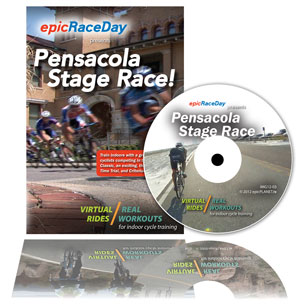
If you've ever asked yourself; “when will there be a video that we could use as part of a Spinning® Class Race Day profile?” The answer is now! Epic Planet has just released Pensacola Stage Race which I see as perfect for a Race Day class or to use during an FTP or AT/LT Heart Rate assessment day. This 60 minute video includes:
5 minute warmup
10 minute Road Race
10 minute Time Trial
30 Criterium
5 minute cool-down
Here's the part I'm most excited about 🙂 Producer Allen Jones had sent me a rough cut version of Pensacola Stage Race earlier this Summer asking for input. I was instantly transported back to my days racing local criteriums, by the on-bike footage showing the riders jostling for position, over-taking, the steep angle of cornering, all of the scary things for you to run into on each lap and even a few crashes. But what really did it for me were the sounds of the race; shifting gears, the buzz of a coasting freewheel, communication between the racers, shouts of encouragement from the crowds and most importantly the ringing of the bell – signalling one lap to go!!!!! Fantastic! But I really dislike the canned music included on most DVDs. Where I teach (and most I'm aware of) the sound system will combine the sounds from multiple sources – I can play the sound track from a video along with the music from my iPhone or a CD. So I asked Allen if he could include the option to play just the actual sounds of the race, with no music. Being the very accommodating person that he is, Allen has included what he calls an option for just SFX – Sound Effects that you can play along with your personal playlist. Here's the trailer and you can order Pensacola Stage Race as either a DVD or Digital Download.
I love a fun contest where I get to give away something cool to our members 🙂
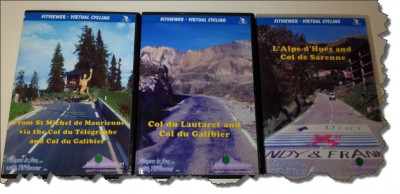
TeleAnimation – the company in Bavaria that produces FitViewer Indoor Cycling training videos asked if we would promote their comprehensive catalog of virtual cycling videos that include some of the famous Tour de France climbs like; Alpe d'Huez, Col d´Izoard, Col de la Madeleine, Col du Telegraphe,Col du Galibier and many others.
FitViewer's DVD selection includes 83 HD videos and include these locations:
These are very “pure” HD virtual ride videos. There are no riders (except for those randomly passed), no metrics (profiles or other training information) and no music; you would use your own anyways.
Many of these videos running 90 minutes to two hours – Alpe d'Huez is just under 3 hours at 175 minutes – which will make for an awesome endurance class next winter!
Entering the contest is as easy as leaving a comment below. Tell us where you teach and a short – fun/interesting story or fact about your class, studio or club.
That's it.
We'll pick three Instructor comments at random on June 30th. They'll all be able to lead their classes over the long, punishing Tour de France climbs in July.


 Great music, incredible feats of strength and concentration plus some very funny physical comedy. What more could you want to entertain your class during a long endurance ride? Cirque du Soleil are by far my favorite for a long ride indoors.


 If you've ever asked yourself; “when will there be a video that we could use as part of a Spinning® Class Race Day profile?” The answer is now! Epic Planet has just released