If you hate how you look in pictures, or wonder if you appear confident on the bike, I suggest watching the video below.
If you–or the people you take photographs of–always look bad in images, then help is at hand. Professional portrait photographer Peter Hurley suggests you squinch next time you have your picture taken.
If you're unaware what squinching is, join the club! Merriam Webster defines it as:
SQUINCH
transitive verb 1: to screw up (the eyes or face); squint 2: to make more compact.
But in fact Hurley has taken the word and used it to describe the “action of squinting your eyes in such a way as to portray confidence and self-assurance as opposed to the fear and uncertainty that you project when you stare wide-eyed at the camera.” Crucially, it's a little different to squinting, which leaves you looking a bit… odd. Instead, you lift and tighten your lower eyelids, and let the top ones come down just a fraction.
The results are actually quite impressive. Indeed, this video shows how you can get your squinch on, and the benefits it will have–as do the images below, pre- and post-squinching. And you just know that even the least vain of us are gonna give it at least a little try.
… I'm giving this to you as a gift, you can look awesome!
If you haven't yet, I would encourage you to listen to our latest Podcast that features 26 year old Cycling Studio owner Jessica Bashelor. If you're short on time, you really only need to hear the lead in where she describes her vision for her studio.
I knew that I wanted to have a really strong brand, that was based on; work and fun and music. And those are things that I sort of live by myself as a 26 year old.
Something about this interview has been bugging me until this morning. While riding in Amy's class it hit me. Jessica's brand doesn't include anything about education – zero. Just work/fun/music. Oh, and she throws in; taking life a little less seriously 🙂
Aren't studios supposed to be all about; coaching and purpose and threshold heart rate training and power training and weight loss and healthful living and fitness knowledge and, and, and?
Obviously not for Jessica or the rider's (I'd guess she'd never consider calling them “Students”) who pack her studio.
My generation wasn't any different.
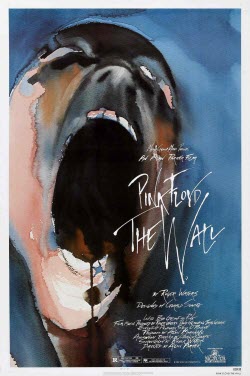
I was 18 years old in 1979 when Pink Floyd — The Wall dominated the the charts and captivated me and many of my friends. The album's most popular track Another Brick In The Wall, Pt. 2 spoke to me as a teenager; we don't need no education… we don't want no thought control…
http://youtu.be/zcevYuG3j7M
I didn't want anyone, telling me anything… I wanted to be heard and understood at 18, and this hasn't changed much now that I'm 52.
The Wall is a story about how we build metaphorical/emotional walls around ourselves. As a young person, or old for that matter, one way we build walls is we learn to tune-out people like our parents/spouses/bosses or teachers, when they talk at us, instead of communicate with us. As the father of two daughters, I know all about how ineffective it can be to try and “educate” them about what I wanted them to know and accept. It almost never worked. Often it had the opposite reaction and it wasn't hard to see them constructing their own wall to shut me out.
Sometimes the walls we create are small.
Have you ever had someone tell you; “I just answered that ten minutes ago” ? Chances are you created your own “wall” and it prevented you from hearing what could be plainly heard by others.
I was in a class last week where the Instructor talked nearly nonstop. While he rattled on about mitochondria and slow twitch muscle fibers, I found myself in my own little world – missing many of his cues. I'd come back to reality and find myself down when everyone was up or surprised when he announced the end of an interval, that I hadn't even realized we were doing. As I watched the rest of the class in the mirror it was obvious I wasn't the only one with a wall around me and my bike 🙁
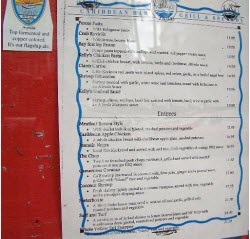
The Senior Group Fitness Instructor and I spent a weekend in Door County WI last month. Lots of quaint little towns to explore along the shores of Lake Michigan. We did what most tourists do as we walked along all the shops and restaurants… we stopped to check out the menus posted along the sidewalk, with the intent of finding the place where we would have dinner that evening.
I hadn't considered it at the time, but if one of the restaurants we passed didn't have a menu posted near the sidewalk, we wouldn't have considered eating there. Without some of the basic information (type of food, pricing, ambiance, entertainment, etc…) we'd never know if they had the best food in town or not.
We weren't looking for anything specific in a place to eat – the best I can tell you we were just looking for some place that fit us. Does that make sense? I guess it follows the; “I don't know what I want… but I'll know it, once I find it!”
So, is your class “menu” displayed somewhere prospective participants can find/learn more about you and your class? Or classes if you're a studio owner/manager?
I'm thinking this menu needs to be more than; “Indoor Cycling with John” which really doesn't tell you anything about me or my class. Maybe I could improve my menu by adding a picture of me and something all flowery and word-smithy like; “Experience outdoor cycling… indoors. Take a virtual training ride with John. Blah, blah, blah” which may or may not be effective. What else could you include?
Beyond your; charming / energetic personality, comprehensive knowledge of exercise physiology and dazzling smile, what else (if they could know more in advance) would be of interest to potential participants to our classes? Or your regulars for that matter?
How about your music!
Consider what primarily gets shared between members about your class:
How hard/easy is her class?She killed us this morning!
Was his music good?We rocked this morning! or What was he thinking with that playlist?
Technology from Spotify and Deezer now gives us the ability to easily share our playlists. Surge Cycle is a studio near me. On their Meet our Instructors page (Internet menu of sorts) studio owner Zion Anderson has posted a sample Spotify playlist of each instructor's class music. Here is Zion's playlist.
Now I think that's an awesome idea… now if I could get Life Time to do something similar.
Who was it that decided climbing songs should be slow?
If I tried to stay with the group I ride with on a long climb, grinding along at 60 RPM, I'd be off the back (and on my own) in no time flat.
Sure a climb should make you struggle to turn the pedals – but to replicate an actual climb outdoors, might I suggest having everyone maintain their cadence in the 80s? Or at least the high 70s?
I've been keeping track of rider's cadences during our group rides, especially when the grade turns positive. Anyone who appears strong is spinning smoothly at 75 RPM or more. The grinders hang on for a little while… just a little, before their leg muscles fatigue and someone ends up waiting at the top – to help them catch back on.
Bicycles have gears for a reason. My new VeloVie has 20 to choose from. How I decide which gear to be in is simple…
I select the gear that allows me to maintain my prefered cadence of ~85 to 95 RPM.
Going up, down or on a flat I'm continuously shifting to keep my pedals in this RPM range. The one exception would be on a long downhill where I will have shifted down to the point where I'm pushing a huge gear at ~ 60 RPM. The exact opposite of conventional thinking.
The typical rookie mistake on the road is to wait to shift until the road literally forces you to do something. They're pedalling merrily along during the beginning of the climb, with their cadence slowly decaying and forward momentum slowing. That is until someone stuck behind them (that would be me) yells SHIFT. By that point the damage is done and they've lost touch with the wheel they were following. Riders behind (again me) are forced to pass them and fight to close the gap before we (once more me) get dropped as well.
A more experienced cyclist will respond instantly to the feel of the road pushing back against their pedals and shift gears. Same with any feeling that their legs are tiring and starting to slow. Shifting to maintain or increase cadence moves the production of work from fatigued legs, up to your (hopefully) less stressed cardiovascular system.
Todays free track is at a very powerful 85 RPM – but it's not a flat. Try coaching this as a climb. If you're riding a magnet cycle have everyone add load at 70 RPM until they feel the need to stand > then accelerate to the music's 85 RPM.
Friction folks will have participants find the tempo and then add the hill while staying with the music.
In either case, cuing everyone; “if you're feeling a burning in your legs > you're doing it right :)” “No burning? Then you're not keeping up, slipping off the back and you will be riding home alone!”
Now I'm not talking about lying to you in a malicious/manipulative way, I have this awesome bridge in Brooklyn I can sell you really cheap – or – she's a real peach, only driven to church and back by the gentlest 80 year old grandmother you've ever met.
What I'm talking about is how people will/do lie to you… if they think telling you the truth could or would hurt your feelings.
Friends can be the worst. And I count a lot of long time members at our club, as friends.
“The truth is always an insult or a joke, lies are generally tastier. We love them. The nature of lies is to please. Truth has no concern for anyones comfort” – Arturo Binewski.”
― Katherine Dunn
Here's a recent example.
Two weeks ago I took over a class for another Instructor. 6:00 am Thursday mornings. The previous Instructor is very solid and she teaches a cycling specific class – I've taken and subbed it multiple times, so I was a good choice to take over her class. Everyone there knows me by name and most I've known for years.
The first week was Spring break = only about 1/2 the normal attendance. It was an endurance day and I thought; “why not run them though some Effortless Exercise intervals?” I lead everyone through a series of ladders where the challenge was to keep your mouth closed (staying aerobic) – while maximising power output. I had them experimenting with different cadences to observe where they each were most efficient.
After class I asked a few participants their thoughts (I try to always ask for questions/comments) and each was positive. But as it turned out, they were lying to me 🙁
This past week was an ugly snowstorm, so again a small class. Wanting to build on the theme we did a bunch of climbing, but stayed down around VT1 = aerobic. I needed to get on the road quickly that morning, so I didn't hang around very long.
Walking to to Amy's class Saturday morning, a member approached me with; “John, you've really got to step it up!” And she proceeded to tell me how such and such's class on Tuesday is really hard and how a number of other members were disappointed by how “easy” my class was.
Finally someone willing to tell me the truth!
I can do hard and these members know it. In fact I'll bet I disappointed most of them. Beyond their (misguided) belief that a hard class always equals a good class, my reputation is that John teaches hard classes. When I didn't meet their “expectations” for hard, they probably felt cheated at some level.
In Krista Leopold's Dear Instructor post, she shared the honest disappointment of Patrick, a frustrated member. He had an expectation that wasn't met that was based on his perspective; the scheduled Instructor is totally capable of coming come to class prepared. I found the very specific honesty refreshing and I'm hoping that this Instructor will appreciate Patrick. He could very well be the only participant in his class that believes enough in him, to tell him the truth.
As a think back through this, I'm realizing that my mistake was not considering that these members would have an expectation based on their previous experiences with me and my class. I had walked in thinking; “these folks need aerobic base training… so that's what I'm going to give them.” When I should have thought; “these folks are probably thinking I'm going to walk in and crush them… so I need to meet that expectation first and then slowly work in the base training I feel they need.” As I type this I'm also realizing that ME, deciding what THEY need, was about ME and not THEM 🙁
This week I'm planning a class that will bracket a long aerobic climb, with two very long/intense FTPish intervals. I'm also going to have everyone fill out this Instructor Evaluation Form that Dr. Haley Perlus had created for us for us a while back.
Gary Hawkins from Ride Fit contacted me last week about a new virtual cycling training video he had produced. Except this video doesn't feature typical cyclists – it's designed for people who train indoors on an ElliptiGO.
If you've never heard of an ElliptiGO you can join the club – it was completely news to me. But they are supposedly getting popular and they even have their own World Championships.
Now why am I asking if this could be the next big thing?
When I first watch the video I have to admit I thought they looked a little goofy to me. An elliptical for the road? Who would want that?
I called Gary and asked him; “who's buying these ElliptiGO things?”
“Mainly runners.” “They really like how low impact they are to ride.”
The indoor/outdoor cyclist in me started to say something snarky about people who choose to punish their bodies because they aren't smart enough to use the wheel… but I caught myself and asked Gary; do you know how many runners there are, compared with cyclists?
“Not sure, probably a lot more.”
So I checked and after a quick search it looks like committed runners out number committed cyclists by something like and an order of magnitude = 10 times as many runners.
Many of us are trying to build our classes by attracting cyclists. What would happen if we offered a group class that appealed to all those runners?