
by Barbara | Jul 5, 2011 | Barbara Hoots, Promote and Build Your Class

The dog days of summer are here with a vengeance, and your classes may be showing the wear and tear of hot weather. But there is no reason why your studio can’t be a riot of activity in spite of the heat. Consider these six easy perk-ups to generate new energy and unstoppable momentum.
“Featured Artists” Spin® Off
ICI/PRO Member Nina Israel asked me to create a mixtape featuring music by Prince and Michael Jackson to help launch a new studio. Because her idea was so awesome, I offered the same ride at my own facility and even included classic YouTube video performances prior to the ride. Who can forget Michael Jackson’s Moon Walk? A few creative posters promoted the event, and many students arrived an hour before class to secure a bike. Not a fan of Michael or Prince? Select your own artist showdown: Zeppelin vs. Rolling Stones, 70’s vs. 90s’, Akon vs. Usher, Divas vs. Degenerates, etc.
Cycle 101
Promote weekly intro classes to recruit new students. Bonding with other newbies creates a fraternity, and students feel comfortable knowing they have a buddy system for encouragement and accountability. Offer a “graduation” incentive after attending six Cycle 101 classes: a logo water bottle, towel, bumper sticker or tee shirt.
Spruce Up Your Studio
Let’s be honest. Does your facility look the same as it did last summer? No wonder your class attendance has slumped! Momentum must be created and sustained continually in order to foster growth. You’ve talked for years about updating your studio — now is the time.
Guest Instructors
In a rut? When was the last time your club brought in a guest instructor to motivate and inspire both students and teachers? Generate a buzz and create excitement when you hype up a guest appearance. Reach beyond your comfort zone and invite a motivating instructor to teach a few rides at your studio. Works like a charm.
Monday Night Lights
Beg, borrow, rent or purchase some nightclub-quality LED lights. Just plug them in around the room to create a visually stimulating light show every Monday night during the summer. You can easily transform an average class into a spectacle of lights and sound. American DJ lights are affordable and simple to install.
We’re Going Out!
Teens and college kids home for summer are an enormous untapped market. My studio added a Friday evening “We’re Going Out” ride with music and instruction designed for the “Under-25 Crowd.” Instructors invited their friends to attend using Facebook and free passes. Those friends soon became members, and now they are an integral part of our cycling family.
What idea would you like to share?
by John | Jul 1, 2011 | Instructor Tips and Tricks, Instructor Training, Music
As far as I'm concerned Bill Gates, Steve Jobs, Larry Page and Sergey Brin all deserve a big hug! Without their fantastic companies; Microsoft, Apple and Google none of what we do here at www.indoorcycleinstructor.com would be possible 🙂
That's not to say that these services aren't without their problems… Much of the Free and ICI/PRO Premimum content we produce here is delivered automatically to you via an RSS feed to iTunes. So when I get an email stating that “My Podcasts aren't updating in iTunes” I'm always quick to respond.
But I've learned that not everyone feels comfortable asking for help*, so here is a quick; I can help tutorial – Forcing iTunes to refresh. *Your questions are always welcome – I'm here to help you 🙂
If you see this in the Podcast section of your iTunes.

I don't know why this happens... but here is how to fix it.
And the Refresh button in the bottom RH corner doesn't update all your Podcasts. Right Click on the Podcast Header Title (it has the little horizontal triangle next to it) and you will get this dialog box.

Click on the Update Podcast link. You should see the podcast update and if there are any new episodes you will see the orange status icon.

If not I'm here to help you trouble-shoot the problem. Click here for the support request form.
by John | Jun 19, 2011 | Instructor Tips and Tricks, Latest News

Forget to sync your iPhone or Droid and don't have the latest episodes of your favorite Podcast? Like they say in Jamaica, No Problem – Mon 🙂
Go and get the Stitcher SmartRadio App that streams Podcasts directly to your Smart Phone. It's completely FREE and is one of the few Apps that I see using more than once or twice.
Here's why.
I'm very excited to announce that The Indoor Cycle Instructor Podcast has been selected to be part of this exclusive network. We join a number of other excellent Fitness Podcasts like; Keith Burnage's Cadence Revolution, The Get Fit Guy Ben Greenfield, The Fred Cast + all the big name news outlets like CNN and the Wall Street Journal.
Currently only the free version of the Podcast is available. The way their system is setup only new episodes, starting with #157, are available. I see that Stitcher supports a number of Premium (paid) services and I have contacted them to see if ICI/PRO members will be able to stream Audio PROfiles in the future.
Those of you who don't regularly update your device will find this very helpful.
You can download the Stitcher App for iPhone/iPad – Droids – Blackberrys & Palms here.
Then simply search for Indoor Cycling to start streaming today.
by John | Apr 10, 2011 | Engage Your Students, Instructor Tips and Tricks

ICI/PRO Member Chris Nielsen contributes today's guest post and the picture was taken by one of Chris's friends.
How many of you read the ‘Tri-ing to be Athletic’ and ‘Revenge of the Friend’ posts here on ICI/PRO and quietly cringed or even got a little steamed at the behavior of the instructors in the stories? What did you do about it?
How many of you have endured the “My friend took one of those spin® classes. It was brutal – she never went back.” stories while in line at the grocery store? What was your reply?
John has invited me to write this post because I spoke up about the pieces on ICI/PRO in private emails to him. My thoughts were as follows.
We ignore descriptions of IC such as those above at our peril. The naive reader/listener may believe that they are accurate descriptions of the classes that are available to them. As I told John, I was particularly alarmed that those posts appeared on a site devoted to enhancing the professionalism of IC instructors – without comment a reader might believe that we endorse the instructors’ decisions. We need to speak up to change that impression.
How we speak up will say volumes. As instructors we ARE indoor cycling – we are its public face and we are its future as a safe, enjoyable and productive exercise alternative. We must approach public interactions carefully as a representation of our respect for the activity, our students and our fellow instructors.
What is the best way to deal with stories such as those that appeared here recently? Picking at those elements that we perceive to be ‘wrong’ just plays into the stereotype of the tough, punishing IC instructor. As an alternative, can I suggest selecting a core concept in each story and initiating a discussion about ways in which we, as IC instructors, might constructively deal with a challenge in our classes. For example, the Revenge story raises the question: “How do we deal with personal bias when dealing with our students?” I am sure that many of you have strategies which help you get through some awkward moments. Personally, I try to redirect my bias into reinforcement. I have a ‘target’ number of reinforcers which I try to deliver to each student in each class. I double that number for the student who I find challenging. The effort of finding positives (however small) in his/her form, performance, attitude distracts me from my ‘negative’ thoughts. How do you handle similar situations?
What about the interactions you have as you are out and about in the community? It’s tempting to tell that person in the grocery store that their friend’s class was bad and unsafe. Believe me, I sometimes want to stamp my foot and say NEVER ever go to a class like that. Instead I say “There are other ways to learn about indoor cycling. Here’s what we do when someone new arrives at my class.” I then give them a two or three sentence description of what we focus on and how I want someone to feel at the end of their first class. It’s not a sales pitch – it is a calm and reasonable statement of fact packaged in normal conversational style. What words do you choose in a similar situation? Whatever you do – please speak up for respectful, reflective and responsible instructors and their classes.
Moving this conversation forward – what else can we do to offset the stereotypes about IC that circulate in the general and fitness communities? I’d love to see a list developed that can be used as tools by other instructors. Here’s something that I do – I realize that it’s not feasible for everyone. I insist that facilities where I teach offer half hour introductory classes. I have made a financial arrangement which means that I do not take payment for those classes unless the fees paid by the participants meets or exceeds my wages for that half hour. The intro classes ensure that I can do the best possible job of introducing new people to IC with a focus on technique and measured effort. The unique nature of my arrangement makes the half hour classes stand out to the people who do the marketing.
The move to indoor cycling 2.0 provides us with exciting opportunities for education and outreach. I look forward to learning more about those here on ICI/PRO.
by John | Mar 22, 2011 | Instructor Tips and Tricks, Music
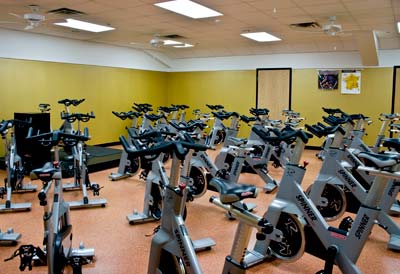
Music is such an important part of our classes and yet I can find very little information available about what can be done to improve the quality of the sound in the studios where we teach.
That scarcity of info ends starting today with this article, which is cross posted over at www.cyclingstudio.org
Intro from Barbara Hoots —spinroomdesign.com
As an indoor cycling studio designer, I’m often asked how to prevent class music from pumping through the walls and disturbing businesses next door. After interviewing many reputable sound control companies, Ryan Gibbons with Auralex wowed me with his brilliance and agreed to submit an article that would outline acoustical treatment options that studio owners can implement to ensure a happy environment for all. If you’re considering opening a studio, read this first!
Total Sound Control
By Ryan Gibbons, Sound Applications Specialist
As we all know, indoor cycling classrooms can present an array of acoustical issues for both studio owners and customers alike. Loud music levels and equipment noise can translate to a harsh acoustical environment inside the studio and can disturb neighboring businesses which ultimately leads to lower profits. Obviously, having happy customers and neighbors is essential to a successful business.
A question we often hear at Auralex is, “If I put some of your foam on the walls, will it keep my neighbors from hearing my music?” The answer is unfortunately a qualified “No.” We refer to the limiting of transmission of sound between structures as “isolation.” Properly isolating a space requires construction materials and would likely require a remodel of an existing space. This can be a time-consuming and sometimes expensive process; however, if done correctly it can be well worth the effort.
From our experience, the most efficient way to eliminate room-to-room sound transmission is to build what we call a “room within a room.” This involves two steps. First, decoupling (acoustically separating) the new structure from the existing structure is important to eliminate structure-borne vibrations. Generally these vibrations are caused by low-frequencies travelling through the walls, ceiling, and floor. This can translate to your attached neighbors as “boomy.” Decoupling the structure can help control those vibrations, thus reducing the amount of noise people in the other structures hear. Next, we suggest placing mass (drywall/sheetrock and insulation) between the existing structures to help control higher frequencies from travelling through the existing walls. Accomplishing these two steps should help improve your relationship with your neighbors considerably.
Auralex has a publication on the web called “Acoustics 101.” This is a great resource that can help guide you or your general contractor through the proper construction to isolate your space. It provides detailed drawings on the topics discussed, and is easy to read and understand. You can find this publication on the web at www.acoustics101.com. Also see our page, Bothering Your Neighbors? for helpful diagrams and audio clips.
When it comes to interior acoustics, there are many solutions for these dilemmas and a wide array of products designed to help you reach a comfortable acoustic environment. The two most commonly-used sound absorption materials are high-quality acoustic foam and specialized acoustic fiberglass (no, not the stuff you buy at the hardware store). For brevity, at times we’ll generically call acoustic foam just plain “foam,” although there are very dramatic differences in cell structure and density between acoustic foam and the thousands of other types we could manufacture. (This is why you can’t just run down to the local SuperMart and buy mattress pads with which to acoustically treat your studio.)
In addition to the two most popular types of acoustic absorption materials, a Class A, fire resistant, natural fiber panel called SonoFiber. SonoFiber acoustic panels are the perfect solution for those budget-conscious projects requiring a Class A fire rating without the aesthetic demands of designer treatments such as fabric-covered panels.
Acoustic sound absorption foam is well-suited to alleviate slap and flutter echo, the two most common problems in rooms not specifically designed for music recording and performance. In fact, foam can turn even the most cavernous warehouse or gymnasium into a suitable acoustic environment.
Feel free to contact me if you have any specific questions about your studio, and I’ll be happy to provide any assistance, suggestions, or solutions. You can contact me at Aurale via email at auralexinfo@auralex.com or by calling 1.800.959.3343.
I have an interview scheduled with Ryan on Thursday March 24th. If you have a question you would like me to ask him send it to john@indoorcycleinstructor.com by the end of Wednesday the 23rd.
by John | Mar 9, 2011 | Instructor Tips and Tricks, Instructor Training
 As an indoor cycling instructor, you’re going to find a large percentage of your students dabble in triathlon, or engage in it as a serious sport. Either way, you don’t want to be embarrassed by using the wrong triathlon-related words or terms in your class when talking to them about triathlon (including the ever-popular pronunciation of triathlon as “triath-a-lon”).
So to help you look better and converse intelligently and confidently with your indoor cycling students who are triathletes, this is Part 4 of a five part series called “Tri-Lingo 101” that will teach you how to use the correct triathlon terms. In this article, you’ll learn common triathlon transition terms. Without further ado, let’s dive in!
Bike In — Coming off the bike leg of the triathlon, there is typically an arch, gate or area into which you push your bike.
Bike Out — When you head out on the bike leg of the triathlon, there is typically an arch, gate or area out of which you push your bike.
Bodyglide — Various forms of lotion or lubricant materials exist, with Bodyglide being one popular brand. This can be used on arms, legs, hands and feet to enter and exit wetsuits more quickly, and also in shoes to get feet to slide into shoes more quickly.
Change Tent — In Ironman (and some Half-Ironman) events, this is a tent to run into after the swim to change into your cycling gear.
Elastic Laces — These are placed on running shoes to increase speed of transition and reduce the length of time it takes to tie a shoe.
Mat — Timing mats are placed throughout the course and in the transition areas to sense the chip on your ankle and keep track of your swim, bike, run and transition times.
Run Out – When you head out on the run leg of the triathlon, there is typically an arch, gate or area out of which you push your bike (there is no “Run In”…that’s the finish line!)
Swim In — As you come out of the water and run up to the transition area, you’ll typically go through an arch, gate or area marked “Swim In”.
T1 — The first transition from swim-to-bike.
T2 — The second transition from bike-to-run.
Transition Bags — In many events, you’ll be given separate bags in which you place things like running shoes, wetsuit and goggles, or special needs. Be sure to pay attention to what goes where!
Wetsuit Stripper — A volunteer who is there at the end of the swim to help you out of your wetsuit.
Bio:
Ben is a fitness business coach, triathlon author, and sports nutritionist. If you want more videos, aricles and audios about swimming and other triathlon related topics, visit Ben’s free blog and podcast at http://www.bengreenfieldfitness.com . Also be sure to check out Ben’s endurance sports website Endurance Planet, at http://www.enduranceplanet.com and his Rock Star Triathlete Academy, at http://www.rockstartriathlete.com . Finally, if you want to learn how to grow your fitness business and make more money, visit Ben’s fitness business advice website at http://www.trainfortopdollar.com .
