
by John | Aug 23, 2018 | Best Practices, Instructor Training, KEEPING IT FUN, Learn Leadership Skills, Master Instructor Blog, Promote and Build Your Class

In part two we identified how the talkers act the way they do because of; cluelessness, a lack of respect for you and your class or they're challenging your position as the leader.
Much of this could also apply to the texters/bring their own music/do their own thing people.
I defined the three possible reasons WHY people act disrespectfully as:
- They don't know they are acting disrespectfully…
- They don't care they are acting disrespectfully…
- They're disrespecting you on purpose…
Because you've made it here to part three, I'm guessing you'd like to know my ideas on how to solve these problems. But first, a few words of caution.
My recommendations below will be difficult for many Instructors, especially for those of you with a short amount of teaching experience. They require you to be the Leader your class expects you to be – not just one of their friends who happens to be on the bike in the front.*
I realise that this will be difficult for many Instructors who would prefer everyone just get along… but they won't > that's why they need you!
These suggestions may conflict with your natural instincts to protect the feelings of others. Attempting to implement these solutions may make you feel uncomfortable. I've heard it expressed dozens of time; I really wish I could get these people to stop disrupting my class… but I don't want to offend anyone 🙁
That's why I broke this up into a series and spent so much time on explaining WHY people are acting the way they do. My hope is that through this process you would already be coming up with these solutions yourself, or at least understand that at times being the leader is hard and not always pleasant.
Your class participants and manager/owner are expecting you to be the leader of your class.
So ICI/PRO Members let's end these Talker problems today!
First – Set your microphone volume level correctly
I can't tell you how many classes I've been in, where I wanted to run up and turn the Instructors mic level up… way up. Your voice must be the most dominant sound in the room!” IDEA recommends a mic level 10 decibels over the music. Your amplified voice should be clearly heard and easily understood, over the music.
Many new Instructors (and some not so new) are not comfortable hearing themselves through an amplified sound system, so they keep their mic level low. Do whatever you need to correct this – today! If you're a manager/owner please offer to audit sound levels for your Instructors > many rooms end up with a cone of silence, shielding the Instructor from accurately hearing their voice/music ballance – ultimately what the class is hearing.

Get help to properly set your voice/music levels.
Your class needs & wants to hear your big strong, confident voice > weak, quiet voices are very easy to talk over and this alone may solve many of your problems.
Second – don't talk over the lyrics
If two people are talking at the same time, which one is the leader?
Neither
You are diminishing who you are as a fitness professional and what you're trying to communicate, by competing with the voices of Bono, Pit Bull, Nicki Manaj, Ellie Goulding or whoever else you're playing. Talking over them forces your riders to have to choose between listening to you or their favorite singer. You'll lose with some and they'll potentially tune you out. Others, who can't understand what you are saying, just might decide to start a conversation that they can hear – with the person next to them.
Third – keep your cues short and actionable
Ever been at a party where you were stuck talking with “that person” who never seems to run out of words? What do you do? When I'm in that situation, I'll listen respectfully for a few moments and then I'm looking around for someone to rescue me.
I'm convinced that Instructors lose control of their classes for the same reason. I've seen it happen. She/he drones on and on to the point where riders just shut them out. Too much talking = you lose people. Once they've lost interest in what you have to say, it's natural to turn and engage with the person next to them. That is until there's a “SQUIRREL” moment that catches their attention.
Are you with me so far?
Excelent. Suggest trying these in order and you'll soon be teaching to the quiet, focused class you dream of having. …
#4 Solving – They don't know they are acting disrespectfully…
This one should cut out 60% or more of the talking > if you do it consistently in every class. You must firmly and clearly explaining that conversations are not allowed after the initial warmup.
Say it with me with a bib smile: We run our studio like a movie theater. Now that our class has started, talking and other distractions should stop. Please, no further conversations until after class has ended.
PERIOD… END OF SENTENCE!
I know this sounds really simple and it is. Your class isn't (and can't be) a democracy where everyone gets a voice. It should be a dictatorship with only one voice – YOURS!
If you don't set clear expectations, how can you expect people to behave properly? You can't. If you have a talker problem (and I listened to a recording your class) I'll bet you don't say anything, or at best you mumble something unintelligible that no one listens to.
If after your warm up you still have talkers, I want you to clearly tell them how it makes you feel. Remember, this group of talkers just doesn't realize the negative affect their talking has on you and the class. I've personally found this to very effective. A man, talking about his feelings? I better listen.
Turn the music way down (almost off) and say along with me: Can I get your help here? Pause long enough to get the attention of the talkers. Look directly at the talkers and say; It's really hard for me to teach this class when when I'm competing with the two of you talking. Can you understand how this can be difficult for me?
The temptation is to address the whole class (there's that fear of offending someone) rather than communicate directly toward the talkers. Is that fair to the rest of the class? No. Demonstrate your leadership here by confidently addressing the actual people who are causing the problem.
For the next two (#5 and #6) you'll need the full support of your owner or manager because both of these could get ugly**. Which means you should have already discussed this problem with them and they agreed that the issue needs to be corrected.
#5 Solving – They don't care they are acting disrespectfully…
Members who feel entitled and don't care might not respect you, but they will care if you shame them (just a little) in front of other members. I used this method a few weeks ago at a class I subbed. The aftermath was overheard by another member who's email to me is part of this post; It’s a good thing I don’t teach in New Jersey .
After making specific requests for people to stay quiet and focus on the ride, I turned down the music – which makes my voice seem even louder – and I pointed directly at the people located around the two talkers. I asked them; are you all OK with those two talking? This resulted in a bunch of frowning faces vigorously shaking side-to-side. NO! Then sitting up, with both hands extended, palms forward, I made a meek, squinty face and said; I'm sorry, but they don't want you talking during class. And then got right back to my cuing as if nothing ever happened.
Both women looked at each other with stunned looks on their faces and we enjoyed complete silence for the rest of class. I do hope the regular Instructor will carry this policy forward > so I don't have to repeat this exercise again.
Why does this work, when making general statements to the whole class doesn't? The first is probably obvious; no one likes being shamed in front of their peers. These rich members might not respect you, but they do care about the opinions of those riding around them.
The second reason this works is that you are supporting all the non-talkers who are too polite to say something. Don't be surprised if you are thanked multiple times after you give them the chance to show their disgust for the Chatty Cathys who are disrupting your class.
#6 Solving – They're disrespecting you on purpose…
When nothing else works, then you're left with two choices and neither is easy:
- Confront them directly and they stay
- Confront them directly, they leave and never come back
You and your manager need to be OK with either result.
You've probably figure out that I have a very low tolerance for nonsense or disruptions in my classes. As a result my participants are all very well behaved 🙂 I've learned that people who are challenging your authority need to be confronted quickly and directly. The longer you tolerate their negative behavior, the harder it will ultimately be to address this successfully.
In my entire career, I've only had to ask two people to leave the room – they were together and it wasn't even my class. If you can believe it, this couple had removed their seatposts in the middle of a class I was attending. There were two loud BANGs as the aluminum posts hit the floor, scaring everyone. I saw that the Instructor had frozen in place, unable to comprehend what had happened. I hopped off and in a very loud voice I said: YOU BOTH NEED TO LEAVE NOW! And I stood there in front of them until they did. As you can imagine, there were a few angry phone calls to our GM. Because my GFDH was very understanding after talking with the Instructor, she backed me up and nothing became of it.
If I remember right, another two I asked on separate occasions not to come back. None of these confrontations were pleasant and part of me is sad that it got to the point where I would need to exclude someone from my classes.
In both instances I had decided during the class I would confront the person privately as soon as possible after the class.
Start with a question
Do you realise how disruptive it is when you; talk/criticise me/do your own thing/etc…? You've established the specific behavior you don't want in your class. My experience is they will get defensive at this point > be ready for “I've been a member here for 20 years!” but don't let it deflect where you're going.
You are welcome in this class, but not if you continue to; talk/criticise me/do your own thing/etc… If you come again and continue to; talk/criticise me/do your own thing/etc… I will ask you to leave immediately.
Is that clear? To confirm what you are expecting. And then quickly turn and walk away. You don't want to get into a debate here. Just set your clear boundary and leave.
Then I would document the exchange in an email to your GFDH/owner ASAP – so they aren't blindsided by an angry phone call. I would ask the GFDH/owner to contact the member and reinforce the requirements for her/his attending your class in the future.
My experience is that you'll never see the person in your class again. If they do (and behave) it's all good.
What if they return and continue to disrupt your class? You've done everything you can. Now it's time for your owner/manager to step in – so no I wouldn't publicly confront them… unless you feel it would be appropriate.
I truly hope this will help and I'd love to hear what happens in your quest for a quiet & focused class!
*I'm not suggesting you aren't supposed to be friendly with your class. Just as parents need to be Parents to their children and not their children's friend – Instructors need to be Leaders in the studio.
**There are some who dismiss what I'm writing here as overly dramatic and hyperbolic. They obviously have never had a regularly scheduled class, at a Big Box club, in an affluent part of town.
by John | May 21, 2018 | Featured Instructor, KEEPING IT FUN, Latest News, Learn Leadership Skills
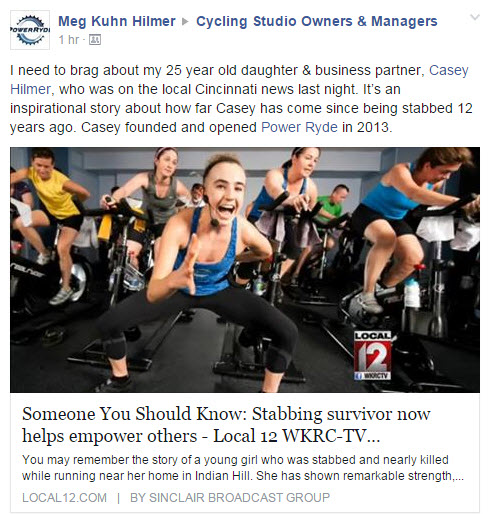
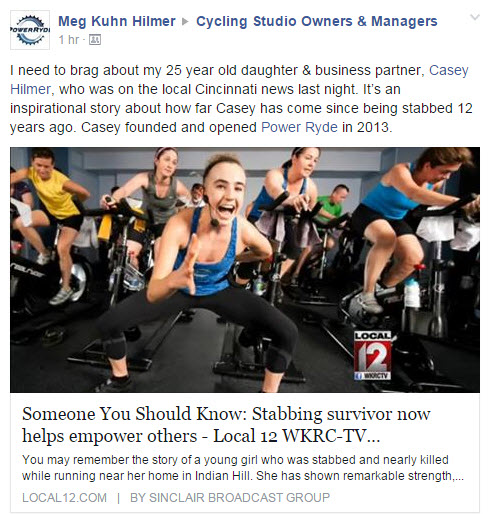
Power Ride Studio Owner Meg Kuhn Hilmer shared this remarkable story about her daughter/business partner in the Studio Owners Facebook group. I was so inspired by it I had to share it here for everyone to see 🙂
When she was 13-years old, Casey was running near her home in Indian Hill when she was dragged into the woods and stabbed in the face, neck and side by her troubled 17-year-old neighbor, Benjamin White. Casey was able to fight him off. Physically, she healed rather quickly. Her emotional wounds would take a lot longer. “I couldn't sleep alone,” said Casey. “Couldn't be in the house alone, second floor alone… I remember the first night I came home and had to take a shower I had to have my mom in the bathroom sitting on the toilet because i was just too scared to be alone” “I probably slept in my parents room until I was 16,” said Casey.
Diagnosed with severe PTSD, Casey has slowly made her way back with the support of her family and Children's Hospital's Trauma Department. “There are highs and lows and new problems,” said Casey’s father Steve Hilmer. “You come home and the roof's fallen in and you rebuild the roof, but you keep going and there's no easy answer. You just don't quit.” “No matter what happens, you have to keep fighting,” said Casey. “You can't give up on yourself or your family. You have to fight for yourself.” Sports, like running, lacrosse, and indoor cycling, helped Casey to keep moving forward.
After graduating from the University of Michigan and being turned down for medical school, Casey turned her passion for fitness into a career. “Sometimes you fail, and that helps you find what you're meant to do,” said Casey. “You have to keep an open mind and be persistent and the right thing will come to you.” Casey and her mom opened “Power Ryde” in Loveland. Casey motivates everyone in class with her enthusiasm and spirit. “I really try in 45 minutes to get people's minds off what's going on in their daily lives and make their day better in that 45 minutes,” said Casey.
Read More Here
by John | Jan 12, 2018 | Best Practices, Engage Your Students, Learn Leadership Skills

Take it away Tom >>>>
Great post and well detailed. I appreciate all the great articles you post.
The challenges you described are all too familiar to me. I’ve found a simple solution that works for my indoor cycling classes, and is based on my experience running a small business that provides software training classes. In that capacity, we teach software productivity courses (1, 2 and up to 5 day workshops) where there could be 20, 50 or even 100 participants. The distractions are numerous: participants checking their emails, texting, talking to their colleagues, etc. It is unfortunate because they have to bring their laptops and mobile devices to class. So, in order to deliver a more effective training session, we first had to understand the causes of distraction:
1. People use training classes, and for that matter, indoor cycling classes as a social venue, a “catch-up” of sorts. They meet friends, colleagues and chit chat about their families, work or other issues.
2. We are all wired, 24/7. The availability of mobile devices and the need to have them tends to add another layer of distraction. There is nothing more frustrating than being asked to repeat a key topic during a training class only because the person who asked was checking their email.
We found the solution to be tricky. The effectiveness of the solution, however, was in its simplicity.
1. Establish a basic ground rule and make them promise to respect it.
At the beginning of each software training class and also at the beginning of each indoor cycling class I teach, I ask all participants to silence their phones, avoid chatting, and in the case of software training classes, I ask them to not check their email, instant messaging or texts until break time. Then, and this is key, I request that they promise to respect this rule. I know we are all adults here, but sometimes, you have to go back to basics.
2. Make them commit to the belief that the class is their time, their investment and thus, their reward.
Again, at the start of each class, I define the objectives of why we are here and what we are trying to accomplish. For indoor cycling classes, I simply state that for next 60minutes, this will be “your time” where you focus on your health and mental well-being. I ask all participants to take a moment to empty their minds of all distractions, worries and anxiety and leave those outside the studio (to be collected later of course). Then I ask that we all respect our collective time by not creating distractions. [I love this line!]
With these two basic rules, I have found greater success in creating an experience for riders that extends beyond the social gathering aspects. In fact, I hear frequent feedback from riders that in that one hour, they have found a way to re-focus and re-recommit; to re-balance and de-escalate; and, to have fun and enjoy the workout at the same time.
In closing, the important of establishing these ground rules will define you as an instructor who places a high priority on the participants’ time and commitment. They will respond in kind.
Ride on!!
by Dr. Shannon | Nov 22, 2017 | Engage Your Students, Learn Leadership Skills

Are you still as deeply passionate and in love with instructing as you used to be? If the answer is yes, good for you! If it is not, then good for you! You are about to be reminded of some things that perhaps you have forgotten.
It was the spring of 1985 and I will never forget the first time I saw someone teaching an “aerobics class”. Yes, that’s what we used to call what is known today as a “Group Fitness” class. It was absolutely intriguing. So much energy, rhythm and sweat! The music was playing (yes, sweatin’ with the 80’s) and my body starting moving. I was a junior in high school, and even though I was an athlete I had never done (or seen) this type of workout. I asked the owner of the gym how I could “do that”? She told me I could join the gym and start taking classes. To which I replied, “No, I don’t want to take the class, I want to teach the class.” She smiled, as she asked me if I had ever taken a class before. I told her no, but that I wanted to learn how to teach like the instructor that I was watching. She responded by telling me that the first place to start was by taking classes. I signed up and started training. Several weeks later I became certified and the rest is history. That was 32 years ago, and it seems like just yesterday that I put on my red unitard (yes, that’s what we called them), and white leg warmers as I began a journey that has never lost its passion for me!
When you are truly passionate about something, not only will you keep coming back for me…year after year. But your followers will do the same.
What is passion? Although I use this word a lot, I decided to find out what my trusty pocket dictionary had to say about it. (Thank you “Dictionary App”) “Any powerful or compelling emotion or feeling…” “The state of being acted upon or affected by something external, especially something alien to one’s nature or one’s customary behavior…”
That led me to the words, powerful and compelling. What do they really mean?
Powerful: “physically strong…producing great physical effects…having great effectiveness…having great power, authority or influence…”
Compelling: “having a powerful and irresistible effect; requiring acute admiration, attention or respect…”
Wow…by nature, when you are genuinely passionate about what you are doing, you will have the capacity to do something alien to your previous nature or customary behavior.
Naturally, you will also become physically strong(er), produce great physical effects (in yourself and others), have great effectiveness, and great power (previously mentioned), authority and influence! Would you like a little (or a lot) of that?
Passion equates to power. Being passionate equals being powerful. This leads to you being compelling, which ultimately will draw others (your students) to you. This is magnetic and multiplicable (Is that a word? Well, if it’s not…it is now. And it means that your magnetism will lead to exponential multiplicity. J) That means that you and those around you will experience expansion that comes from a rare and organic source deep within you. Thus, gaining you the “acute” (not “a-ugly J) admiration, attention or respect that you deserve (and let’s face it, quite possibly “DESIRE”).
Don’t you just love the power of words? I do too!
But these are far more than just words; they are a representation of the value (your core) that resides inside of you and every passionate leader. If it’s just “lip service”, then it really isn’t passion and therefore you will continue to seek something that seems distant and unattainable.
So let’s talk about this for a moment. What if you had passion for being a fabulous instructor, but somehow you seem to have misplaced it? Perhaps it’s hidden somewhere with your thong leotard and headband? OMG…has it been that long?
Thank God we don’t have to go back to move forward, but sometimes we need to go within so we do not have to go without. What do I mean by this?
Sometimes when it seems as though we have lost something that we thought we once had, we long for what some may refer to as “the good ole’ days”. It’s something we may long for, but is not possible to attain. Come on, would you really want to go back to using tapes, choreography, thong leotards, and leg warmers? O.K., maybe the thong leotards…they really did make our butts look smaller, don’t you think? JK! J Do you really want to go back to the stationary Air-Dyne bike that pumped your arms as you pedaled with your legs?
If you want to long for something and fully attain it, long for discovering your true passion. What compelled you to become an instructor in the first place? Do you remember it like it was yesterday? (I do!) Do you remember how excited (and nervous) you were to teach your first class? Do you remember the first time a student told you what a huge difference you had made in their life? Do you remember how great it felt to proudly tell your friends and family that YOU had become a fitness instructor (or perhaps an aerobics instructor…or cycling instructor)? You had a goal and you accomplished it. Why?
It’s time to tap into the reason you started in the first place, and give thanks for a dream fulfilled and a goal accomplished. It’s time for you to awaken the passion within you, and move ahead as you “make love” with what you are doing every time you do it. Let the sizzle inside you penetrate those around you. Then you, my friend, will be the instructor that your students cannot wait to see again!
Experts say that “sex sells”…well true LOVE not only sells, but it also pays…and it pays big! Pay yourself what you’re worth by investing your heart and soul into every class that you instruct, and watch what happens to not only your class…but also your own personal CLASS!
When you do what you love and love what you do…you will love YOU, and so will everyone around you! This is exactly how to be the Instructor (Inspirer) that your students can’t wait to see. It begins with being the instructor (Inspirer) that YOU can’t wait to see!
Thanks for allowing me to share what I see…
Dr. Shannon
Dr. Shannon Subramaniam
chiropractor | coach | speaker | author
http://www.drshannonknows.com
Like me on facebook
Follow me on twitter
Save
Save
by Christine Nielsen | Aug 12, 2017 | Engage Your Students, Learn Leadership Skills

OK [wlm_firstname], What's holding you back?
I had an ‘aha' moment after last week's Sunday morning ride with the group which is going to tackle the Cabot Trail. All of these people started their cycling in my indoor classes so I have had an opportunity to observe their strengths and limitations. I can work on the same issues indoors and then outdoors, and then take the outdoors experience indoors to help people bring greater refinement to their form and understanding of their bodies.
About a year ago a 50ish year old woman arrived in my class. My questions about other physical activity revealed that she did a lot of Pilates. That was clear from the moment she got on the bike – good core and balance. On the other hand, she didn't seem familiar with the sensations of cardiovascular exercise. Over the next few weeks I had an opportunity to teach her the value of a a heart rate monitor. I saw a gradual change in her willingness to work hard. Her greatest limitation became her seeming inability to raise her cadence, even a little bit, under any circumstances.
Fast forward to this year. Her cadence indoors has increased dramatically but as soon as she got on a bike outdoors she reverted. I knew that she was well-prepared in terms of fitness and strength so that wasn't the reason for the change. I spent a lot of time riding with her or leaving her to the sweep with specific instructions for coaching. She was consistently the slowest rider but never complained and didn't seem discouraged about her progress. This seemed odd. In her ‘real' life she is an accomplished and driven university administrator.
I struggled to identify what I could do to help her. Two weeks ago I rode with her and observed that when road conditions would allow her to speed up she didn't. Speed was not the problem – she is a confident and fast descender. I began to give her speed checks, encouraging her to find the sweet spot that would let her move a little faster with a high cadence while keeping her effort in check. Halfway through that day I left her with the sweep and rode on to work with other riders. When I checked the sweep's GPS the next day, I noticed that Michelle's average speed was painfully slow even though that part of the route was not challenging.
Last Sunday I saw that Michelle had purchased a bike computer. She reported that the speed checks I had given her were very instructive. At that point I asked her how fast she was going at the end of the previous week. Her response was a number that was more than twice the actual. She was genuinely shocked when I told her what I had seen on the GPS record. Michelle had a great ride that day, with an average speed about twice what it has been. She finished only five minutes behind the biggest part of the group.
Over lunch after the ride she told us a story. As a girl of ten, she had an asthma attack while playing outside and was hospitalized. Her asthma disappeared shortly after but the effect on her behavior did not. The process of training for the trail helped her to recognize that she has been holding back ever since that first attack. Once she allowed herself to let go of the fear, the skills and knowledge she has acquired both indoors and outdoors let her perform to her potential.
As a coach I had my own epiphany that day. I realized that everyone has a story like that. Mine dates back to a second grade teacher who told me I couldn't draw. I didn't put pencil to paper for four decades. Now I make a part of my living as an artist. Recognizing that we all have a similar ‘story' will encourage me to keep gently exploring around the edges, reinforcing progress when I see it and keeping my students aware of the mental aspects of their performance.
Originally posted 2012-08-02 06:42:01.
by John | Jul 15, 2017 | Instructor Training, Learn Leadership Skills

It's not what or how, but WHY
In a previous post Be the Leader they expect, I expressed that our students are expecting us to be the Leader in our classes.
Some of you might be thinking; OK John; this is easier said, then done.
Maybe you haven't seen yourself as the “Leader” of your class, instead you have considered yourself as part of the group. Or perhaps you are a bit new at the teaching game and are questioning your ability to assert your position as a leader. There's no shortage of big egos out there and being a leader can take a lot of energy to maintain… so it's not surprising that some of us may have let our leadership skills slip a bit due to simple fatigue.
But what if there was a different way to becoming a leader? One that doesn't require a huge amount of confidence, knowledge, effort or charisma?
Start with WHY
If you truly would like to be the Leader of your class I suggest watching this video presentation from author Simon Sinek: How great leaders inspire action. The concept is that people will follow you based on a shared belief… you just need to communicate it! I will be expanding on this concept in future posts.


Originally posted 2011-07-12 05:07:35.
