
by Jim Karanas | Apr 28, 2021 | Master Instructor Blog
Update from John: This post was originally published in June of last year, shortly before we lost Jim. I thought Jim's wisdom could add to our current conversation about SoulCycle, so I'm re-publishing this today.
By Team ICG® Master Trainer Jim Karanas
Why would anyone want to do it? It’s crazy. What about the bike? Connecting with it. Feeling the road. How can anyone NOT want to feel the road? Rhythm, timing, breathing. It’s in our DNA.
It won’t last. Silly trend. Dance parties on bikes with music videos can’t last. You can’t even call it training. It’s just physical movement, not sure it’s even considered exercise. It’s totally without direction.
There are some heavy hitters out there who will slam Non-Authentic Indoor Cycling and talk about it with contempt. Read the blogs and forums. It’s important to have beliefs — something you stand for that defines you as a professional.
Am I sure? Absolutely not. Is Non-Authentic Indoor Cycling bad for Indoor Cycling? That’s a good question and the topic of this post.
I teach Authentic Indoor Cycling. I ride bikes outdoors and always seek to bring to my students what the road and trail teach me. The bike has taught me many lessons that I’ll share with anyone who wants to attend my classes and has the patience to listen to my rhetoric.
Fitness reached a pinnacle with indoor cycling. Finally, we had a way to communicate fitness concepts that were not based on hype or adrenalin. Eclectic music. Quality training. Depth. Achievement. Millions of dollars in revenue!
It wasn’t only about the money, but do you really believe that indoor cycling would be here today if it didn’t make money? Fitness is a $12.5-billion industry, and indoor cycling helped it get there. Whatever makes money will drive fitness.
Zumba is a classic example and should be a lesson to everyone. It’s simple choreography, not unlike what I used to teach as an aerobics instructor back in the ‘80s, with the addition of a little Latin dance and hip-hop. The instructors don’t even cue. Yet Zumba is a half-billion-dollar-a-year company. Which shows you what dazzling branding, marketing, and a single-minded focus on building a culture can do for a fitness program.
Do you think Zumba is a fad? Not with those revenues.
What about non-authentic indoor cycling? How about SoulCycle? It hurts; it really does. But if you believe that SoulCycle is going to fade away because it’s not authentic, then I believe you’re misguided. The SoulCycle brand is strong, their marketing is incredibly strong, AND they now have strong financial support after having been purchased by Equinox.
Something else: they’re building one hell of a culture. Friends of mine who have never taken my class come up and say with wide-eyed enthusiasm, “Do you know that SoulCycle is coming to San Francisco?” I ask, “Why would you take a class there when you haven’t yet come to mine?” No response.
I believe that non-authentic indoor cycling will become a significant trend in the Fitness Industry. ICG® is an authentic indoor cycling company. We believe in proper training principles and we all ride bikes, yet we’re not blind.
If non-authentic IC is going to make a mark, why not embrace it for what it is — a way to train on the bike that makes (some) people fit and happy? Assuming it’s validated as safe and effective (ICG has already contacted the American Council on Exercise and proposed a study), then shouldn't every indoor cycling education body offer a program on how to teach non-authentic indoor cycling? Why shouldn’t any and every indoor cycling program be taught by those who are truly qualified to teach indoor cycling? That would be the likes of us. We know indoor cycling best. We could create a program — inauthentic fluff, if you will — that’s still authentic in its safety, structure and cardiovascular benefit. Why not?
It need not (and would not) diminish our authentic style of teaching, and it just might make all of us some money.
Originally posted 2014-10-23 04:51:49.
by Jim Karanas | Apr 19, 2021 | Best Practices, Class DVDS & Videos, Instructor Training, Master Instructor Blog

By Team ICG® Master Trainer Jim Karanas
Two things prompted this post. One was John’s post showing video as one more distraction in a distraction-filled studio (see “Virtual Engagement or Virtual Distraction?”, 7/22/12). The other was my concern about what might happen if instructors and students learned about cycling with video under such poor circumstances — and the entire cycling-with-video concept ended before it even began.
Cycling with video has too much potential to allow it to fall victim to that fate. The obvious question is how to prevent that and present video in a way that showcases it as the amazing asset it is, with great potential for increasing ROI. The cycling-with-video concept hinges on immersion, the sense that the scene is real. It just doesn’t work without it. Here’s what needs to happen to create immersion.
First, there’s lighting. If you want the students engaged in the video, the image must be as bright as possible and dominate the room. If distracting sources of light can be minimized or eliminated, so much the better.
There’s also screen size. Bigger is definitely better for purposes of creating immersion and making it seem real. If the screen can’t be big (say, if a TV monitor is used), there are specific ways to maximize presentation of the footage.
Positioning of the screen is critical. It’s important not to place the front row of bikes too close to the screen. It’s important not to place the screen too high or too low on the wall. The actual distances will change, depending on the size of the screen, but precise guidelines should be followed. Finally, the screen should be centered, taking into account the width of the studio and where the instructor will be.
Managing the mirrors is also critical. The photo in John’s post shows mirror reflections coming from several directions and sources. Those reflections will distort, even destroy, the illusion of forward motion and the possibility of immersion. The solution is either to use a non-mirrored wall in that studio — preferably one painted black, gray or white — or to use a large pull-down screen to cover the mirrors on the forward wall completely.
There’s also the matter of where to place the instructor and the A-V equipment. We’re used to being center-stage. ICI-Pro posts have mentioned our enjoyment of that. With video, though, we need to move to one side and let the video get most of the attention.
Last, and maybe most importantly, the video, the projector (or TV), and the screen (or video wall) need to be of high quality.
(For details and specifics on these guidelines, please click here: www.myrideplus.com/Guidelines).
When all of these things are put together in a professional studio prep, the result is completely different from the chaos John showed us in the photo with his post last week. But it’s not always that easy.
So what’s standing in the way? In a word, expectations.
Understandably, the club owner hopes to make the studio video-ready for the lowest initial cost possible. What’s true is that the above preparations can cost thousands of dollars, if done right. But the inexpensive way leads to what John showed us. If the equipment costs relatively little, that leads to an expectation that the entire set-up should also cost relatively little.
It’s a profound understatement to say that a poorly prepared studio limits the students’ experience — and that it clearly limits future ROI.
Here’s where I’ll stir up trouble and state that, in this regard, DVD is actually pushing things in the wrong direction. It’s a halfway measure that’s not impactful enough to create immersion. This “halfway” aspect of it is why club owners resist spending the money necessary to make cycling-to-video happen on an impressive scale.
To get club owners to make the leap to spectacular video, they need to be exposed to a true immersion experience. Then it becomes obvious that there’s no substitute.
Seriously, if you bought a fake “jewel” for a few dollars at a street fair, would you buy an expensive platinum ring setting for it? For a beautifully cut diamond, your willingness to invest in platinum would increase. Please note that I’m talking here not about budget per se, but about the willingness to invest big money to showcase something mediocre versus something spectacular.
DVD is a mediocre medium with respect to cycling videos and creating immersion. As such, DVD may be keeping the new concept of cycling-with-video from moving forward and becoming the fullest experience it can be. Again, immersion is key and happens best when video is done right.
I know these are controversial statements, but they’re true even when the instructor leading the class does a great job with it. John is a superior instructor who does a great job with it. But who or what could compete with the distractions in that studio? It’s simply not set up for … well, what could and would happen if the video were done right.
For one example of “done right”, please click here
Originally posted 2012-07-30 15:05:12.
by Joey Stabile | Apr 10, 2021 | Audio PROfiles, Best Practices, Class Work-Sets, Creativity Indoor Classes, Instructor Training, KEEPING IT FUN, Master Instructor Blog, PRO/Playlists, Training With Power
Welcome to the The Weekly Ride by Cycling Fusion
Welcome to our new era of The Weekly Ride, you get:
- Full Ride PDF
- Apple Music Playlist
- Spotify Playlist
- File to Download the Ride directly into My Fitness DJ (Yes, no Programming)
- The Ride will be available for purchase in the iClass Builder Store (No Programming)
- A Podcast of the ride being delivered by a master instructor.
(more…)
Originally posted 2018-11-05 08:33:43.
by John | Apr 7, 2021 | Best Practices, Instructor Training, Master Instructor Blog

They aren't kidding about the power of oxygen.
You didn't notice it getting dressed and it wasn't there early in class, it just kind of snuck up on you. One minute you're JRA (Just Riding Along) and the next you begin to catch little whiffs of an odor, not pleasant, that makes you appreciate your position up front and away from anyone else.
What is that smell? Where is it coming from and how come I'm just noticing this now?
It didn't take me long to discover the cause of the foul odor, my trusty old Sidi Mega Cycling Shoes were rank.
But I wash my shoes (somewhat) regularly and they smelt fine when I put them on… why do they stink now?
The culprit are bacteria and odor causing microbes that love warm, humid places. In fact they thrive on it, eating, growing and multiplying at an astonishing rate once they are in the right environment – my warm, sweaty shoes must have been about as perfect an environment for bacterial growth as possible 🙁 The by-products of all this multiplying are toxins and toxic gases that our noses identify as stink. I don't even want to think about what all those little buggers are eating in my shoes. All these nasty critters are sitting dormant in your cool, dry shoes. Add some moisture and warmth and they come to life, with a potentially embarrassing affect.
What can I do to fix it?
I tried on multiple occasions to wash and dry my shoes using just clothes soap/detergent/vinegar/baking soda without success. If your shoes are old don't waste your time with these methods. The only thing I found that worked was a three day (I forgot them in the tub) soak in Oxi Clean. If you have white shoes you could try a small amount of bleach, but I can't vouch for this method, so I'd stick with Oxi Clean .
Billy Blanks Mays was telling you the truth when he would say; “the power of oxygen!” Oxygen is a powerful disinfectant and has the power to actually kill bacteria and odor causing microbes, rather than simply surround them and wash them away with the surfactants that make soap, err… soap.
It's a chemistry thing. Oxygen exists in nature as a component of the air we breath as a pair O² and in stable compounds like water as in H²O. Whenever an Oxygen atom finds itself alone (free ) it gets ugly, looks for something to attach to and in the process converts whatever it attaches to into another compound. Many of the products you use to clean with contain a free Oxygen atom; Hydrogen Peroxide, Bleach, Vinegar and household Ammonia are a few.
The free Oxygen atoms found in Oxi Clean are as deadly to bacteria as sunlight is to a vampire. So the next time your shoes get warm and sweaty there are fewer (you'll never get rid of them all) little friends to cause a stink – if you'll forgive the pun.
How can I prevent the stink it in the first place or prevent it from coming back?
Wear clean socks in your shoes! I'm guilty of trying to pull off the Triathlete look by riding sans socks – or sometimes it's just that I forgot to pack a pair. OK, I'll say it; they're eating the dead skin off your feet. Socks keep their source of food away from surfaces that are harder to clean, like the inside of your shoes.
After washing and drying your shoes, I suggest the regular use of an antibacterial foot spray.
The same goes for your Instructor Mic and windscreen if you use one.
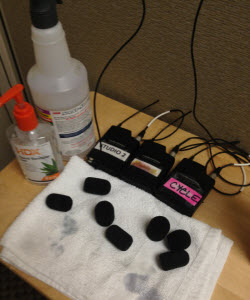
Does your club have a microphone sanitising station like this?
You need to kill all the bacteria, viruses and other icky stuff that you've introduced after each class, with no exceptions. This is doubly important if you share a mic with other Instructors.
The solution here is much easier. All it takes is a quick dollop of hand sanitiser that you can work through the windscreen, wipe over the headset and let dry for the next class.
Originally posted 2013-07-09 09:46:52.
by Joey Stabile | Mar 26, 2021 | Best Practices, Class Work-Sets, Creativity Indoor Classes, Instructor Training, KEEPING IT FUN, Master Instructor Blog, Training With Power
Welcome to the The Weekly Ride by Cycling Fusion
No more hunting for new music or counting out cues to develop your ride profile. Here is your ready to ride profile for a fully choreographed ride, that can be displayed from your phone, or printed out onto cue cards for your class. This ride is timed out, down to the second, to make your life as easy as possible!
(more…)
Originally posted 2018-05-31 23:40:19.
by Tom Scotto | Mar 26, 2021 | Master Instructor Blog
 If you are one of those instructors who loves to bring the experience of riding outdoors to your indoor riders, now is the time to get them excited. Give them a taste of the Tour de France and introduce them to some of the fun we enjoy during this special time of year. Maybe we want to learn more about all of that tour lingo so we can share more with our classes. Here are some recommendations I have to wrap your mind and riders around one of the greatest sporting events of all time.
This year is the 98th edition of the Tour de France (twitter: #TDF). With it’s 21 Stages (days) of racing over the next 3 weeks. The riders will cover an astounding 3,430.5 kilometers (2132 miles) which is even more amazing considering the speed at which they are traveling (stages can average over 25 mph for 6+ hours of riding — Yikes!). Now there are all kinds of tidbits we can share, but I like to give my riders homework to help them better understand how to ride during class. Here are a few of my homework assignments:
(1) Watch just 1 complete Stage of the TDF (YouTube is OK for partial credit)
(2) Notice how riders stand (out of the saddle) and move their bikes back and forth when climbing — Let’s imitate that!
(3) Look at how balanced riders are between the handlebars and seat when they are standing. They are not leaning back over the seat or hanging forward over the bars.
(4) Try to catch a glimpse of a rider’s stomach from the side. Notice how it balloons out? One minute they look pregnant and the next not. This is how our stomachs should look during class — relaxed and moving in and out as we breathe.
(5) Notice how relaxed they appear on the bike (shoulders, arms and hands).
(6) Watch how smooth their pedal stroke is. A gentle waving (ankling) movement where the heel of the foot is not forced down. Let’s imitate that!
Just listening to the voices of the Tour de France, the announcers, Phil Liggett and Paul Sherwen will give you enough knowledge of the race to fill a set of encyclopedias, but if you are craving more, I recommend the following:
(1) Boy Racer : My Journey to Tour de France Record-Breaker (Book)
This is a great book that will not only get you to fall in love with Mark Cavendish, the Max-Missile from the “Isle of Man”, but will teach you a great deal about the TDF. Mark not only mentions 100s of aspects of the race, but takes the time to explain each one in laymen's terms.
Amazon: http://www.amazon.com/Boy-Racer-Journey-France-Record-Breaker/dp/1934030643/ref=sr_1_1?ie=UTF8&qid=1309973467&sr=8-1
(2) Chasing Legends (DVD)
This is 2 DVD set that follows the team HTC Highroads through the TDF. You will get a unique perspective of what happens amongst the riders, in the team cars and when the riders are off the bike.
Amazon: http://www.amazon.com/Chasing-Legends-DVD-Mark-Cavendish/dp/B004DR4VHE/ref=sr_1_1?ie=UTF8&qid=1309973282&sr=8-1
There is no greater time than the present to enjoy/learn about the Tour de France and share it with those in your classes. They will feed off your energy, so if you are excited — they will be excited!
Originally posted 2011-07-06 05:30:00.
