This cute kid found something good – image from http://www.kingarthurflour.com/blog/2012/09/24/gluten-free-apple-crisp-fall-away-from-tradition/
The posts with more than a couple of comments always catch my attention. It shows a hit on a subject that interests people enough to share their thoughts. I have always considered this forum's primary objective to do just that. Light a fire so-to-speak.
That said, the post on Single Leg Pedal Drills got me thinking. They are a staple of my classes. I teach on both magnetic as well as friction resistance bikes. Like Doug (Yo Doug good to hear from you) I cue the riders to “let one leg go along for the ride.
The term ‘contraindicated' has – over the years — been associated with these drills when the rider has been instructed to ‘unclip'. And I agree though I see the risk as minimal. Even on bikes using MR we have a few ‘bouncers' — those that will just never put the kinds of resistance we instructors are trying cue — and as such are at risk for getting a pedal in the back of their leg. So I just don't do it.
Yet, what I liked most about John's post is that he has come back around to an important issue. It clearly got us talking with our fingers which means — hopefully — we gave it some thought. We don't always need to be finding something new so much as reinforcing something good. And that got me thinking.
As I have moved from beginner to journeyman to experienced to grizzled veteran, I've learned a few things.
Embrace and learn from those that take the time to compliment you/your class. Lately there have been many more of my riders — some regulars some new — that have taken the time after class to come to me with an acknowledgement of well delivered class. “Your best yet” said one just yesterday. The irony was that I'm doing nothing really new. In fact I used a playlist favorite of mine that has been collecting dust in my iPad for a while. When I think about it I've not really put anything new together in quite some time. Oh, I've got a pile of audio podcasts printed out waiting for me to take action. But I believe the truth is that the riders in my regular classes are enjoying my growth as an instructor far more than hearing Katy Perry's new tune. Or another way to climb.
People resist change. We already know we cannot please everyone in class every time. So if you are committed to bringing new everything to your class, every class, you may be setting yourself up for failure. Your regulars have an expectation of what you're going to deliver before they walk into the studio. Try your new stuff out when you sub.
You are who you are. If you have been teaching well attended, prime time classes then it is very likely that your success has more to do with you, than what you play and cue. While I don't recommend getting stale I do strongly urge you to stay true to your style.
I will use John as an example of what I mean. Recently he posted about a technology, Harmonic mixing, that blends tracks of the same musical key. His frustration was that others could put together better mixes than he. Ok, I guess. First, that is his opinion of his playlists and probably not an issue for his riders.
Next, while his integration of harmonic mixing may have a subtle effect (positive or negative) on what the riders hear, John is teaching to full room because he is John. A great smile, always happy to see his riders, has a plan for the workout and best of all, his voice over the mic during his cues are about the best I've heard. Right up there with the late Jim Karanas. Which segues nicely to.
Know your strengths and play to them. Maybe wife Amy and Chris Hawthorne put together mixes that he thinks flow better. Good for them, that is their strength, among many others, 🙂 not his. We all chose to get to the front of the room. On stage is what I call it. So face it, you like the affirmation. What gets you applauds is what your strengths are. If you are a new instructor then you may still be searching for key performance parameters. I use the word performance intentionally because that is what we do. It's not just about the workout but how you deliver it. Your performance.
One last thought on strengths. The best of the best are quite adept at getting their riders attention and holding it. I cannot stress this enough, go watch them. How? Maybe at your club there is the one instructor that ‘packs em in'. Attend conferences. IDEA here on the left coast is dedicated to instructor continuing education. SCW has monthly conferences around the country. Find one near you.
Know when to say when. If you are teaching more than an average of a class a day it will be very difficult to keep the fire burning hot. Motivating ain't easy. If you are teaching your third class of the day it will soon become obvious to your riders that you are not feeling the love. Teaching indoor cycling for living is tough and — in my opinion — not sustainable at pro levels. Unless teaching that many classes is standing between you and the street, consider what your optimum number is per day as well as per week.
Do continuing education. You can always get better. Our craft is one of caring, connecting, nurturing, prodding and sweating. But none of that is possible if you don't base it on sound fundamentals. Indoor cycling is about doing cardio vascular training on an indoor cycle. Knowing as much as you can about training both, will never hurt. Add your personality, a touch of some stuff you picked up from the pros and you've got a winning recipe.
We don't always need to be finding something new, so much as reinforcing something good.
“Why do I make less power (fewer watts) standing, then when I'm seated?”
This a a great question that we get often. I loved John's answer, and so I have done a few edits and present it here….. Joey
A great questions from one of the riders in a Performance Cycle class. An observation that shows he's paying attention plus it gives me the chance to clear this up, so you can properly explain this anomaly to your participants.
The short answer is you don't* If resistance and cadence remains the same, in or out of the saddle doesn't matter. The amount of power/watts you are creating doesn't change… because it can't.
The bike decides the right amount of power
You know that Power = Force x Cadence. So let's assume this participant is riding seated and pedaling @80RPM. Their resistance is set to a level that results in the console display showing 150 watts.
Our legs create the perfect amount of force required to get the job done, which in this instance is overcoming the resistance to pedal @ 80RPM. If your resistance setting on the cycle requires “X” amount of force to push down the pedal, your muscles will create exactly “X” – no extra force is created and no less. The combination of that force, multiplied by a cadence of 80 RPM results in the power meter showing 150 watts.
In fact there's an actual law of physics that says that it's impossible to get the same amount of power out of a machine with a reduced amount of power added into it – which is why I'm saying the amount of power/watts you are creating stays exactly the same, if you make no change other than to stand and ride out of the saddle.
“But then why does the power meter show my watts lower, when I'm standing.”
My response was; “you're right it does and there's a simple answer why…
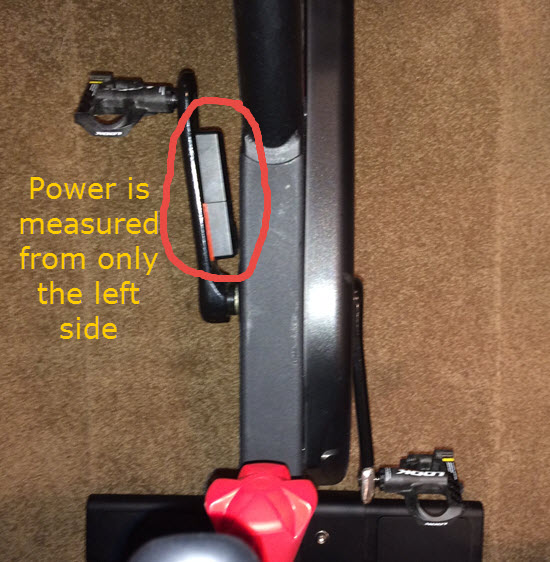
Let me begin with the basics. I teach at a Life Time Fitness Athletic Club and we ride FreeMotion S11.9 with the Carbon Drive belts. FreeMotion's measure power only through the left crankarm as you can see here.
This is my personal S11.0 (the home version) which is why it's black and not the normal silver color. The electronics are identical across all models.
Yes, the meter shows a drop in power…
Many of us who teach or ride on this Indoor Cycle have noticed that the power meter will show a lower wattage number when you transition out of the saddle, without giving any thought as to why. As I explained above, it shouldn't > the wattage number should remain the same. Again; Power is equal to force times cadence. If you didn't change the resistance setting, and you're maintaining the same cadence, the power meter should continue to show the same wattage… but it doesn't because >>>> your legs aren't the same strength.
Your dominate (stronger) leg does more work
The force required to pedal is divided between your two legs – but not equally. Because many (if not all) of us have one leg that's stronger than the other, our brains automatically proportion the amount of force from each. Remember: our legs only create exactly what's needed. Unless you consciously choose otherwise > more force is unconsciously asked from the stronger leg and the opposite leg adds what's left, equaling the total required.
Some quick research showed me that it's very common for one leg to be stronger in most people. Your dominant/stronger leg is typically the same as your writing hand. Since ~90% of people are right handed, the majority of your class will be seeing lower wattages when the come out of the saddle > because they are doing more work with their right leg. The FreeMotion's left hand power meter sensors are seeing a lower amount, of the total amount of work, as coming from your left leg.
Because this IC can only sense force on the left side, when you stand your stronger leg carries a greater percentage of your body weight = the wattages appear lower.
So standing or seated at the same cadence, you continue to create the exact same amount of power. It's just that the power meter doesn't see all of it and displays the reduced amount = the misperception that we create less power standing… which you now understand isn't true 🙂
Make this a feature (not a bug) in your class
Since the Freemotion can show leg strength disparity, why not use it as a training tool?
Novel idea, right?
Start by teaching everyone which leg is their stronger/dominate leg. The simplest way I know is by doing Step-Ups on a box or step raised to the proper level as shown in this short video.
This exercise was eye opening to me, when we did them in Boot Camp. Learning that my right leg is considerably stronger, I'm now really focusing on making my left leg do more work. Hopefully over time, a stronger left leg will result in me having a higher FTP and greater overall muscular endurance.
I suggest having your riders do this as an after class activity > or you could bring a box into your studio and have everyone take a turn.
Using a pair of reasonably sized dumbbells, perform 8-12 reps all on one side and then the other. It should be quickly apparent which (or if) they have a leg strength disparity.
We'll explore drills to exploit this feature and help riders train their weaker leg in future posts! [/wlm_private]
* I'm not referring to pedaling efficiency here, which is a completely different subject.
** Please let me know if this isn't clear, if I've confused you or you have an alternate method of explaining this.
Working off of the buzz of last week’s tirade on Tabata training in indoor cycling, I thought I’d touch on a related cousin that also carries some confusion and thus misuse — High Intensity Interval Training (HIIT).
The main contributor to misuse in indoor cycling with training methods like Tabata and HIIT has more to do with how it is interpreted and embraced and not that the methods are invalid. Many people are busy and also frustrated with lack of results (or the speed of results) in their fitness. The pendulum swingers arrive on the scene and claim that this NEW way of training is the end-all. So the pendulum swings to the other side implying that this new way is the only “right” way.
Tom Goes Off-Road
Let me take this opportunity to help you understand why it has been a hard sell to get outdoor cyclists and competitive riders into indoor cycling classes (or the gym for that matter). Going back to our pendulum swingers; the groups of people they affect most are the fitness crowd and those stuck in between fitness and athletics (for example those branching out to attempt their first century ride, event, etc.). In a few weeks I’m going to write an entire article on the topic of the Fitness Enthusiast vs. the Athlete, but let me share one of the biggest differences between these two types of individuals and how this has impacted who attends our indoor cycling classes.
It can be summed up in one word — Performance. The athlete actually has to perform on a high level, and further, is required to measure their performance. In general, fitness enthusiasts wants to condition their body to improve their overall health. This can include weight loss, gaining strength and body sculpting. I’m not trying to bash the fitness enthusiast in the least, but rather want to encourage everyone to continue taking care of their body and staying healthy. What I am saying, is the proof whether a training method like HIIT actually works is on the road.
So where am I going with this? When the fitness world gets swayed by yet another “new” way of training, we often don’t get to see if this is really effective, because we are not truly putting it to the test. We just see some super fit guy or girl touting how great it is (and “hey, look at me”). The athlete looks in on the latest thing the fitness world (and indoor cycling) is hanging their hat on and says (with some arrogance) “they don’t know what they are doing or how to really train”. All arrogance aside, in most cases they are correct. In many ways, this is how outdoor and competitive cyclists view indoor cycling.
There's an App for That
As we reel this baby back into HIIT and indoor cycling and we find another case of “here we go again”. The problem is not indoor cycling or HIIT, but rather the contagious blanket statements that lead indoor cycling instructors astray. Research studies claim better fat utilization, higher VO2max, increase in stroke volume, left-ventricle heart mass and cardiac contractibility to name a few. Are these all good things? Yes. Are these research studies wrong or lying? No. So what’s the problem? The problem is application.
First, they are often comparing HIIT to endurance training which they inaccurately define as 30 to 60 minutes of continuous running or cycling. 30 to 60 minutes is NOT the definition of endurance training for everyone. I’ve been on “recreational” outdoor group rides with cyclists all around the country. I’ve yet to get home in an hour. Just to clarify, I’m not only riding with racers, but those who motor along at 12-14mph and just like to ride. So if one ONLY trains using HIIT which consists of 5-second to 8-minute intense efforts followed by 3-4 minutes of active recovery, how effective will the training be if the person has to endure 2+ hours in the saddle at close to 75-80% of their perceived effort? This is where the studies are misleading.
That’s A Lot of Science Stuff
HIIT studies claim increases in oxidative enzymes such as citrate synthase, malate dehydrogenase and succinate dehydrogenase, and increases in mitochondrial density and more effective signaling through the AMPK pathway (Jennifer Klau…HELP!). I’m not debating this (…I have a hard time pronouncing these words). However, when a 4-hour bike race is concluded, scientists don’t go and start measuring oxidative enzymes — “The winner is…. Number 354 with the highest level of citrate synthase!” No the winner is the one who has endured the challenges of the terrain and distance and came across the finish line first.
So, when a Tour de France team trains solely with HIIT and wins….no forget that….completes the first week, OR a HIIT-only marathon runner OR a HIIT-only triathlete wins, then HIIT will have our attention and will have proven something.
As Usual — We Need Both…But….
It is usually no big surprise to find out that when the dust clears and the emotions subside, both types of training are necessary to produce well-rounded fitness for both the enthusiast and athlete. However, I’ll leave you with two things to consider when applying all of this to your indoor cycling classes:
(1) HIIT (like Tabata) is not a license to justify blood-snorting intervals in all of one’s classes. High intensity intervals (usually defined as 80-100% of max effort) should be greatly limited in the early part of the year in our classes and always sprinkled with caution depending on our demographic.
(2) Endurance training should also be limited during indoor cycling classes (WHAT!?). Yes, you heard me right. 45-60 minute classes are not the best format for performing extended low-intensity (60-70% max efforts). Classes that are 90 minutes or greater are more ideal for these long steady efforts. There is still plenty of highly effective and appropriate training to do during indoor cycling classes in the early season (base building) such as muscular endurance, steady-state tempo (Zone 3), muscular strength and leg speed work to name a few.
Remember: Real Training. Real Cycling. Real Results. All beautifully packaged in a fun-wrapper.
“For all intents and purposes, your body works exactly like the engine in the car that brought you to the studio today.” I like to use that line, especially when I sense I have a bunch of gear heads in the class. First to get their attention by saying something profound and secondly, because it's (grant me a little leeway here) technically true; your body powers a bicycle exactly like an internal combustion engine powers a car.
Now at the risk of one of my daughters admonishing me with “Dad, your class doesn't want another science lesson”, let me explain;[wlm_private ‘PRO-Platinum|PRO-Monthly|PRO-Gratis|PRO-Seasonal|Platinum-trial|Monthly-trial|PRO-Military|30-Days-of-PRO|90 Day PRO|Stages-Instructor|Schwinn-Instructor|Instructor-Bonus|28 Day Challenge']
Your students and their cars use a Carbon based fuel sources that contain essentially “Stored Sun Light” derived from plant photosynthesis.
Both have a system to ingest air (more importantly the Oxygen it contains)
Both have a process to chemically combine fuel and Oxygen which creates heat and pressure
Both use this pressure to create linear motion
Both use an offset crankshaft to convert linear motion to rotary motion.
Both have a system to expel the waste byproducts of combustion
What brought this to mind was last night in my class I had a number of students who rode most of the class looking straight down, instead of the “Head up – Look at your self in the mirror and smile :)” posture we all want. But why do we want it?
I remember listening to the commentators during the China Olympics talking about how you could tell who was strong and who wasn't on the big climbs by how each rider held their head.
Head up = Strong … Head dropped = weak. But beyond the body language, why is head position indicative of performance?
And then I thought of this:
Modern engine designers understand that best power and efficiency is dependent on moving the maximum amount of air into and out of the engine. For that to occur the path the air takes, as it flows into the engine, needs to be as straight as possible.
Here is a diagram of the Intake Track in an older, much less efficient engine, circa; 1940
Now compare that to the Intake Track of one of your students.
Here is a cyclist demonstrating good form with “Head Up – Eyes Forward” posture. Notice how the Intake Track becomes straighter?
Does it then follow that;
Head up = Efficient Breathing (Strong) … Head dropped = Inefficient Breathing (Weak)[/wlm_private]
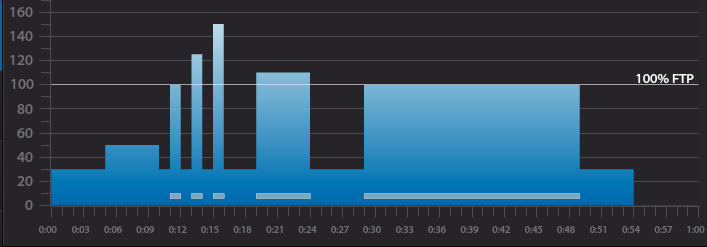
Over the last 2 years I've been performing a FTP (Functional Threshold Power) test on the first Thursday and Friday of every month in every facility I teach in that has bikes with power. I have yet to have anyone complain or comment that I test too often or that the 20 minute FTP effort is too hard. What I have been told is how much people like knowing their threshold numbers and how much they enjoy the challenge of the test.
Last week I was involved in a conversation on Facebook where some indoor cycling instructors were discussing various ways to estimate FTP with their class. My response was “Why estimate it when you can perform a REAL test and get some REAL FTP numbers?”. Some of the responses I got back were that the test is “too hard”, “too long”, “too complicated”, “newbies might get scared away”, or “some people just want to ride and not focus on numbers”. I was, quite frankly, shocked by the lack of confidence these instructors had in their class participants. If we, as instructors, don't have the confidence that our riders are strong, tough and smart enough to handle and understand the benefits of a FTP test, this doubt will quickly turn into a self-fullfiliing prophecy and class participants will never reach their full potential.
I believe the best instructors don't only know the science of exercise physiology but are also masters of physicology and expert motivators. It is our job to show each and every rider the respect they deserve by having the faith that they are capable of completing any physical task we ask of them. I am in constant awe of what my riders are capable of, they impress me every day, but amaze me on FTP days.
Bikes with power are becoming the norm in most indoor cycling facilities. This new technology will keep riding a bike that goes nowhere in the forefront of group exercise for years to come. If your facility is going to invest in these state of the art bikes, instructors and facility mangers should program regular FTP tests so they can be used to their fullest capabilities and riders can be aware of their current fitness levels, set up proper training zones and track improvement over time. The use of power can be a bit confusing at first, but after performing a FTP test most riders quickly gain an understanding of their maximum sustainable intensity or threshold wattage.
Believe in your students and they will surprise you, doubt your students and they will affirm you.
Here are some links to articles I have written about FTP and Threshold over the years. My testing profile may have changed slightly but the science is still the same.
Full articles are only available to ICI/Pro members.
NOTE: I'll be publishing what I believe are the 10 Myths of Indoor Cycle Rider Setup / Bike Fit on Wednesdays each week, starting today with:
Myth #1 – It's proper, for you the instructor, to cue people to draw in their knees.
I cringe whenever I hear; “OK people, now I want everyone to bring in your knees!” because, for most of the riders in class, everyone's knees are already where they need to be. Please note that I didn't say where they should be, but where they need to be based on a number of different factors. Some are based on how the rider is fitted to the cycle and some are because…
Indoor Cycles are perfectly symmetrical – Humans, not so much…
You can find dozens of books and multiple business who focus on the art of fitting an imperfect cyclist to a perfect bicycle. Discussions of Leg Length Discrepancies, Feet Pronation, Q Factor and Cycling Shoe Cleat Wedges are beyond the scope of an Indoor Cycle Instructor helping a student with setup.
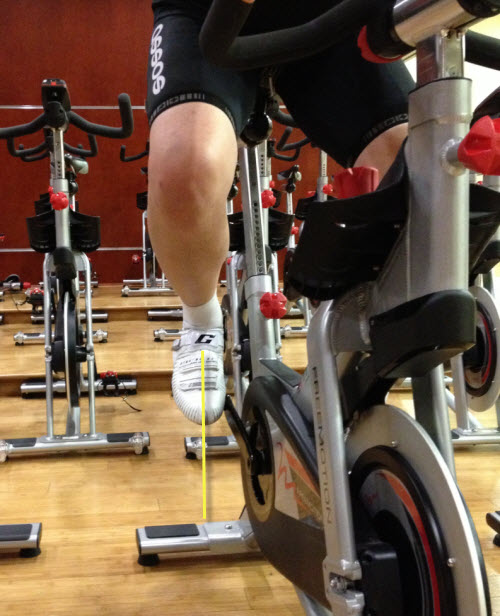
But there is one aspect of Indoor Cycle setup that has a huge influence on knee position, and yet is universally ignored*- foot alignment.
Take a minute and try his test on yourself: Stand on a smooth floor wearing your socks. Feet shoulder width apart, with a soft bend in your knees (like you should have on the bike). Now transfer the majority of your weight to the balls of your feet (like you're standing on the pedals) and rotate your heels inward. Notice where your knees go?
For most of us they move out, did they for you [wlm_firstname]?
Now let's see what happens when you arbitrarily decide; “my knees are sticking out, I need to bring them in.” Go to the same position as before; soft bend, heels in, but now bring some of your weight back to your heels which will prevent your feet from moving (similar to how the pedal cages or cleats fix the position of your feet) and try to bring your knees in. What happened?
Because everything is connected (you remember the song; foot bone's connected to the ankle bone, the ankle bone's connected to the thigh bone, the thigh bone's connected to the knee bone, etc…) the position of your knee is exactly where it needs to be, based on your position on the cycle. If you have a student with improperly adjusted shoe cleats (or too low a saddle) and you tell them in your BIG INSTRUCTOR VOICE; “I want everyone to bring in your knees during this crushing 11 minute climb!” you could potentially hurt them over time. Worse, cause them to ignore the true reason their knees are out which for many people is simply having their heels rotated inward – like my buddy Randy demonstrates below.
Heels rotated in forces knees out
Feet aligned forward bring knees over pedal 🙂
There's actually a Sub- Myth here; the objective of proper bike fit isn't to just “bring in your knees”. The objective is to get your knee pushing directly down on your pedal = the most efficient transfer of power with the least amount of stress on the most vulnerable joint in the system – your knees. We live in a three dimensional world, not two 🙁 So when while helping a student get set up, be sure to observe them from the front, as well as from the side.
So what to do and/or cue as the Instructor?
Jim Karanas gave us a beautiful cue during a class I took last week in San Francisco. He had us down in the drops (I realize your cycle may not have drops – Spinning Instructors can read this as comfortably in position 2) and asked that we look down and we should see our knees in the space between our arms. Nothing more. He was simply suggesting that we observe what was happening.
You haven't heard it yet, but I will be publishing an interview with Jay Blahnik in December where he makes a similar point about suggesting your students observe something and then let them act on it.
You may also pay attention to what you see in your students and identify excessive foot rotation. But be careful – some people are naturally very duck footed (or whatever the opposite of pigeon toed is where you live) so my suggestion is to ask “did you have someone set up your cleats? This may give you a clue to if they put any thought or care into attaching their cleats. You could also have them stand naturally in their socks on a smooth floor to see if there's anything weird and refer them to your local bike fit expert if necessary.
*There are 100's of YouTube videos explaining a multitude of different ways to properly fit someone to an Indoor Cycle, but not one that I'm aware of makes any comment or suggestions as to foot position and it's effect on knee position / alignment. Even the Spinning® Fit System ignores this topic beyond “… the cleats must be adjusted properly on the shoe. A good bike shop or bike fit specialist can help with this if needed.” What “adjusted properly” means remains a mystery.