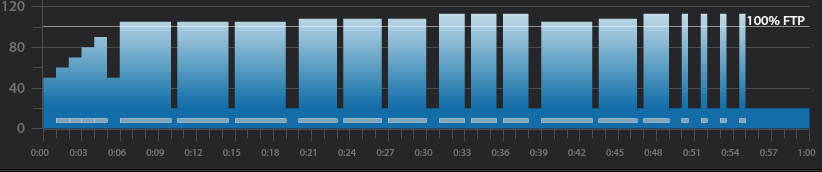
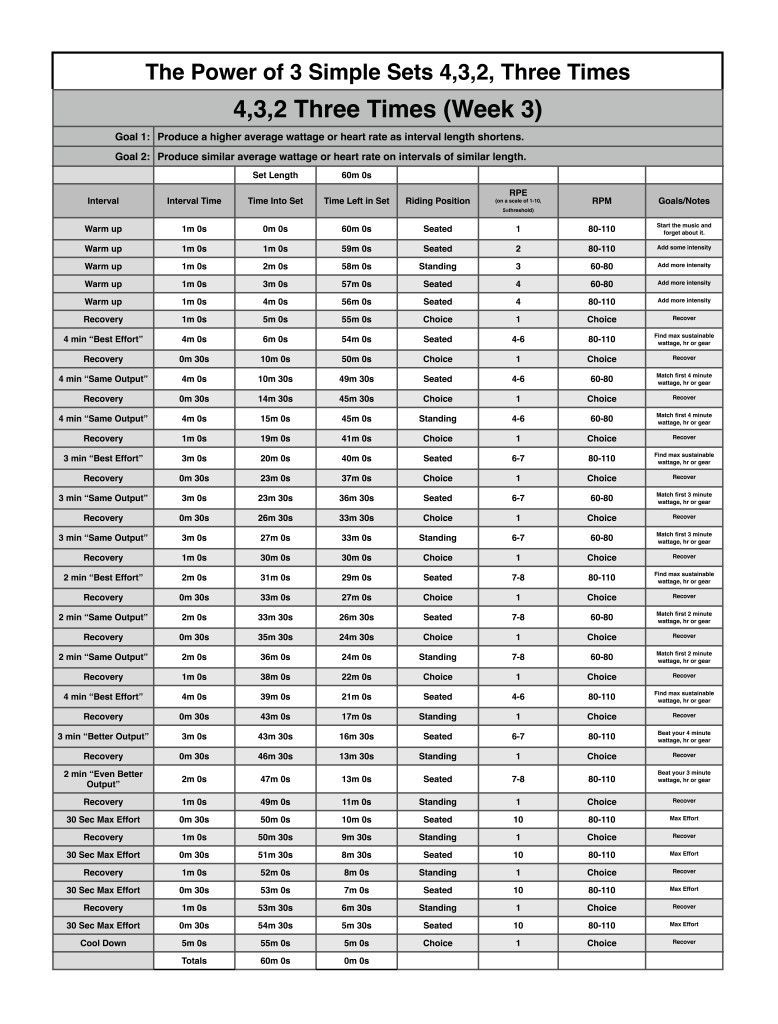
Below you'll find Week 3 of July's Keep it Simple and Progress indoor cycling profile.
Workout Basics:
5 minute warmup
3 x 4 minute intervals with 30 seconds recovery after each
1 minute recovery after the third 4 minute interval
3 x 3 minute intervals with 30 seconds recovery after each
1 minute recovery after the third 3 minute interval
3 x 2 minute intervals with 30 seconds recovery after each
1 minute recovery after the third 2 minute interval
4,3,2 minute intervals with 30 seconds recovery after each
1 minute recovery after the 2 minute interval
4 x 30 second intervals with 1 minute recovery after each
5 minute cool down
3 x 4 minute interval goals and specifics:
1st 4 minute intervals should be ridden seated at 80-110 rpm at Threshold wattage, HR or RPE
30 second recovery or reset
2nd 4 minute interval should be ridden seated at 60-80 rpm at the same wattage, HR or RPE as the 1st.
30 second recovery or reset
3rd 4 minute interval should ridden standing at 60-70 rpm at the same wattage, HR or RPE as 2nd.
1 minute recovery or reset
3 x 3 minute interval goals and specifics:
1st 3 minute intervals should be ridden seated at 80-110 rpm a wattage, HR or RPE that is higher than the last 4 minute interval
30 second recovery or reset
2nd 3 minute interval should be ridden seated at 60-80 rpm at the same wattage, HR or RPE as the 1st 3 minute interval
30 second recovery or reset
3rd 3 minute interval should ridden standing at 60-70 rpm at the same wattage, HR or RPE as 2nd 3 minute interval
1 minute recovery or reset
3 x 2 minute interval goals and specifics:
1st 2 minute intervals should be ridden seated at 80-110 rpm a wattage, HR or RPE that is higher than the last 3 minute interval
30 second recovery or reset
2nd 2 minute interval should be ridden seated at 60-80 rpm at the same wattage, HR or RPE as the 1st 2 minute interval
30 second recovery or reset
3rd 2 minute interval should ridden standing at 60-70 rpm at the same wattage, HR or RPE as 2nd 2 minute interval
1 minute recovery or reset
4,3,2 minute interval goals and specifics:
4 minute intervals should be ridden seated at 80-110 rpm at Threshold wattage, HR or RPE
30 second recovery or reset
3 minute intervals should be ridden seated at 60-80 rpm at a wattage, HR or RPE that is higher than the last 4 minute interval
30 second recovery or reset
2 minute interval should ridden standing at 60-70 rpm at a wattage, HR or RPE that is higher than the last 3 minute interval
1 minute recovery or reset
3 x 30 second interval goals and specifics:
The 4 x 30 second intervals should be ridden at the riders choice RPM or position and should be ridden at maximum effort followed by a 1 minute recovery.
[wlm_private ‘PRO-Platinum|PRO-Monthly|PRO-Gratis|PRO-Seasonal|Platinum-trial|Monthly-trial|PRO-Military|30-Days-of-PRO|90 Day PRO|Stages-Instructor|Schwinn-Instructor|Instructor-Bonus|28 Day Challenge'].
Trainer Road Profile (If you're Trainer Road Member join my Team to get this and all profiles)
Part 1 covered getting participants to stop eating foods they hate and also avoid stress-driven, high-calorie blowouts or using food as entertainment.
Here are two more things you might wish your participants would stop.[wlm_private ‘PRO-Platinum|PRO-Monthly|PRO-Gratis|PRO-Seasonal|Platinum-trial|Monthly-trial|PRO-Military|30-Days-of-PRO|90 Day PRO|Stages-Instructor|Schwinn-Instructor|Instructor-Bonus|28 Day Challenge']
Thinking Only About Calories, Not Food Quality
I don’t think food (or weight) is only about calories in/calories out. I’ve even written articles and a book chapter on it because it’s an important subject — one that has raised angry reactions.
Some nutritionists and dietitians do think that a calorie is a calorie is a calorie.
As the lead nutritionist in a weight-loss program, I worked with a registered dietitian. One participant had typed “HELP!” next to the brownie listed in her food log.
Here was the dietitian’s reply: “This is only X calories, so I’m not worried about it.”
The dietitian didn’t seem to realize that the brownie might have consequences. My specialty — psychoactive nutrition — keeps me aware of those consequences. They might include increased appetite, the onset of cravings, or bingeing — any of which could last for several days.
The dietitian also seemed unaware that the brownie might have been a result of something the participant had eaten earlier that day or the day before.
Or that “HELP!” revealed the lack of control the participant was experiencing.
I have never told a client that all calories are equal — or that it’s okay to eat a certain amount of sugar if you stay within your calorie limits. When you recognize sugar as a psychoactive drug, calories are less important than that.
And this isn’t just about sugar. Even though we now know that saturated fats aren’t as bad as we were told, most of my clients do realize that fried pork rinds are not a healthful option in a daily food plan. Some foods we should just avoid.
At a recent presentation, a man asked about a non-caloric butter replacement. He started using it to save calories, but the junky chemicals in it made it a poor substitute. Coconut oil, raw almond butter, even butter would be better. They have calories but also offer nutrition benefits.
Thinking about calories alone leads to eating without focus or mindful attention.
Cleaning the House Before Housekeeping Gets There
This is something my clients do frequently. I suppose they expect me to reprimand them for the “bad” stuff they’ve been eating. (That never happens!)
They cancel, then reschedule appointments for later on, so they can get themselves together to eat well for a week or so — and keep a food log that shows how well they’re doing.
I’ve also had clients cancel follow-up appointments. Follow-ups are arguably the most important appointments. They give us a chance to discuss what has been working and what hasn’t.
The clients reschedule because they weren’t implementing the first appointment recommendations.
Yet the reasons they’re not implementing could reveal the moments that throw them off-track. Postponing till they’re sure they’ll get a gold star misses those valuable discovery points.
And occasionally, unfortunately, I never hear from them, even though they’ve already paid for their follow-up appointment — and have serious health problems that I specialize in and have studied in depth.
A final issue might be “too many cooks.” A new client came in after meeting with her physical therapist. She presented a week’s worth of food logs, based on her PT’s recommendations. She had already “cleaned house.”
My review of her logs indicated that this woman needed to make several nutrition changes. She was reluctant to do so, though, because the PT had suggested something else.
When it comes to nutrition, your cycling participants are free to do whatever they choose. They can wing it. They can follow steps they’ve found on websites — there’s more nutrition stuff online now than ever before.
They can combine different plans and follow a Paleo diet 2 days a week, the Mediterranean Diet on 2 different days, a vegan diet for 2 days, and a pepperoni pizza and beer binge the last day. Whatever they want.
But they might be eating too much of some things and too little of others, missing vital nutrients. They might skip over key brain chemical info that could make life easier if they knew it. They might find their appetite out of control and not know why. They might have intense cravings and not know why.[/wlm_private]
Food isn't as casual as we sometimes assume it is. You probably wish your participants would stop treating it as if it were. I know I do.
I'm a big fan of controlling the energy of a class or set through music. I often look for high energy fast beats per minute songs to help push my riders to higher and higher intensities, but sometimes I like to use lower energy, yet powerful, slower beats per minute songs to force participants to slow down, focus on pedaling technique and power production at slower revolutions per minute.
I live in Denver Colorado and there are some long climbs here, it's not uncommon for a climb to last over an hour. When on these climbs it's important to maintain a “doable” intensity and find a sustainable rhythm. In the great INDOORS we often climb to max effort then recover a few times per class, but in the great OUTDOORS it's important to control the intensity so riders can make it to the top of the climb. I like to bring this controlled rhythmic type of hill simulation indoors from time to time.
This 3 song mix can be used to simulate a slow and steady climb. During the first song I like to stay seated and find a steady rhythm around my threshold wattage or HR. For the second song I like to mix between sitting and standing, I usually sit for 45 seconds and stand for 15 seconds. The third song has a few energy spikes that I like to use as surges to the top of the hill.
Give it a try and let me know if your class likes it.
[wlm_private ‘PRO-Platinum|PRO-Monthly|PRO-Gratis|PRO-Seasonal|Platinum-trial|Monthly-trial|PRO-Military|30-Days-of-PRO|90 Day PRO|Stages-Instructor|Schwinn-Instructor|Instructor-Bonus|28 Day Challenge']
Understanding WHY something “is” the way it “is” is fascinating to me. Outdoor road riders tend to be predominantly men… and Indoor Cycling participants are far and away women. So why is that?
OK, I already know why – outdoor cycling has an element of risk that's more acceptable to men, than women. My wife Amy is much more comfortable at speed on the back of our tandem, than she would be piloting her own bike. And it's not just me who's figured this out. Citi Bike has too.
When Citi Bike arrived here, it promised to spread the benefits of biking to the masses, an uphill push in a city where large potholes, heedless yellow cabs and darting pedestrians can make riding on busy streets seem like an activity best left for daring messengers.
But two years in, Citi Bike’s inroads have been decidedly uneven, with men far outnumbering women in using the bike-sharing system. A little time on Eighth Avenue on a recent morning, watching the stream of Citi Bike riders heading north past Pennsylvania Station and toward Times Square, was instructive. Man after man pedaled by, some in suits, others in jeans. From time to time, a woman on a Citi Bike rode by.
Reasonable (and observant) people already understood this, so I'm not sure why this is even a question. Men are by nature more reckless and more tolerant/accepting of risk than women.
“Women are early indicators of a successful bike system,” said Sarah M. Kaufman, the assistant director for technology programming at the Rudin Center for Transportation at New York University and an author of a new report on Citi Bike. “If you have more women riders, that means it’s convenient and safe.”
Officials at Citi Bike say they are attracting a greater share of women than the citywide rate of female cyclists – about 21 percent, according to a study from Hunter College. The bike-sharing service is looking at more than just the safety concerns that seem to nag more at women than men, who insurance actuaries long ago concluded are more likely to engage in risky behavior, such as not wearing a bike helmet.
Anyone who's insured young drivers (like me), are thankful they had daughters – not sons – when they get their insurance bill. Young women are less likely to do stupid/risky stuff in a car = they crash less often = they're less of an insurance risk.
This isn't rocket science here people. And yet I'm continuously seeing instructors and studios focusing their marketing at men… who ride outside… and will probably never set foot in your class. While successful (read profitable) fitness businesses like SoulCycle cater almost exclusively to women.
My advice to Citi Bike is to accept the reality here (women don't feel safe riding in traffic) and quit coming up with stupid non issues like not having a place for their kids.
And there are other perceived obstacles, not unique to women but more commonly cited by them: They cannot ride with small children. They think the cost – $149 for an annual membership or $9.95 for a day pass – is too steep, especially on top of a subway pass. And they worry about arriving at work sweaty.
“I wouldn’t want to be gross the whole day,” said Maeve McCarthy, 21, an intern at an interior design firm in Manhattan, who has not tried Citi Bike but said she would consider taking a nice ride through Central Park, if not commuting to work from Brooklyn.
Ms. McCarthy just doesn't want to smell sweaty the rest of the day… and I don't want to sit next to her if she does 🙁
There's an old saying; “you can't fight city hall”. It points to the futility of trying to change something that just ain't going to change… no matter how hard you wish it to change.
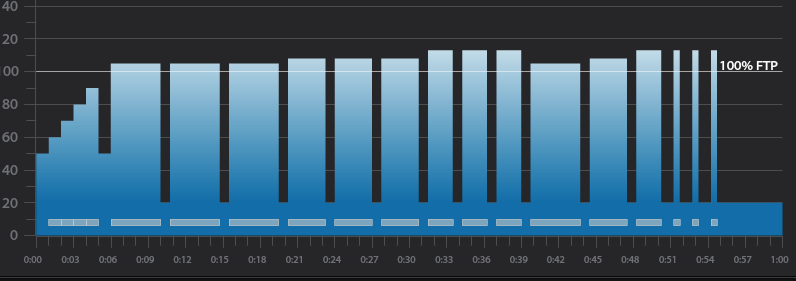
Below you'll find Week 2 of July's Keep it Simple and Progress indoor cycling profile.
In order to keep it simple and progress I have kept the same series of intervals as last week but reduced the rest to just 45 seconds. Due to the reduced rest there's extra time, so I added three 30 second maximum effort intervals at the end of the workout.
Workout Basics:
5 minute warmup
3 x 4 minute intervals with 45 seconds recovery after each
3 x 3 minute intervals with 45 seconds recovery after each
3 x 2 minute intervals with 45 seconds recovery after each
4,3,2 minute intervals with 45 seconds recovery after each
3 x 30 second intervals with 1 minute recovery after each
5 minute cool down
3 x 4 minute interval goals and specifics:
1st 4 minute intervals should be ridden seated at 80-110 rpm at Threshold wattage, HR or RPE
45 second recovery or reset
2nd 4 minute interval should be ridden seated at 60-80 rpm at the same wattage, HR or RPE as the 1st.
45 second recovery or reset
3rd 4 minute interval should ridden standing at 60-70 rpm at the same wattage, HR or RPE as 2nd.
45 second recovery or reset
3 x 3 minute interval goals and specifics:
1st 3 minute intervals should be ridden seated at 80-110 rpm a wattage, HR or RPE that is higher than the last 4 minute interval
45 second recovery or reset
2nd 3 minute interval should be ridden seated at 60-80 rpm at the same wattage, HR or RPE as the 1st 3 minute interval
45 second recovery or reset
3rd 3 minute interval should ridden standing at 60-70 rpm at the same wattage, HR or RPE as 2nd 3 minute interval
45 second recovery or reset
3 x 2 minute interval goals and specifics:
1st 2 minute intervals should be ridden seated at 80-110 rpm a wattage, HR or RPE that is higher than the last 3 minute interval
45 second recovery or reset
2nd 2 minute interval should be ridden seated at 60-80 rpm at the same wattage, HR or RPE as the 1st 2 minute interval
45 second recovery or reset
3rd 2 minute interval should ridden standing at 60-70 rpm at the same wattage, HR or RPE as 2nd 2 minute interval
45 second recovery or reset
4,3,2 minute interval goals and specifics:
4 minute intervals should be ridden seated at 80-110 rpm at Threshold wattage, HR or RPE
45 second recovery or reset
3 minute intervals should be ridden seated at 60-80 rpm at a wattage, HR or RPE that is higher than the last 4 minute interval
45 second recovery or reset
2 minute interval should ridden standing at 60-70 rpm at a wattage, HR or RPE that is higher than the last 3 minute interval
60 second recovery or reset
3 x 30 second interval goals and specifics:
The 3 x 30 second intervals should be ridden at the riders choice RPM or position and should be ridden at maximum effort followed by a 1 minute recovery.
[wlm_private ‘PRO-Platinum|PRO-Monthly|PRO-Gratis|PRO-Seasonal|Platinum-trial|Monthly-trial|PRO-Military|30-Days-of-PRO|90 Day PRO|Stages-Instructor|Schwinn-Instructor|Instructor-Bonus|28 Day Challenge']
Trainer Road Profile (If you're Trainer Road Member join my Team to get this and all profiles)
Most IC instructors have the client’s best interest at heart. We may not all agree on every point, but we do want our participants to do well, get the results they seek, and feel great. That probably goes not just for how they work out, but for what they eat, as well.
It’s a safe guess that most instructors wouldn’t mind at all if their class participants stopped doing the following things — immediately and forever.[wlm_private ‘PRO-Platinum|PRO-Monthly|PRO-Gratis|PRO-Seasonal|Platinum-trial|Monthly-trial|PRO-Military|30-Days-of-PRO|90 Day PRO|Stages-Instructor|Schwinn-Instructor|Instructor-Bonus|28 Day Challenge']
1. Eating “Good For You” Foods They Hate
The feeling of deprivation can make us do strange things with food. Feeling deprived can result from eating so little food that they’re always hungry, always thinking about food, always ready to gnaw the legs off the furniture.
We know it’s a binge waiting to happen. But there’s more to it.
Several years ago, during an appointment, a frustrated client stomped her foot at me and demanded, “Joan, do you ever enjoy eating?!”
My answer was an enthusiastic, “Yes, of course.” It’s true that we might need to give up certain foods — including some of our favorites — to get the results we want.
But let’s look at the good news. There are always foods we can and do enjoy that will fit into our food plan — even if we stop eating sugar, for example. Plenty of delicious foods are out there that don’t contain sugar.
The main point of this, however, is to get your participants to avoid eating foods they hate. Please. They shouldn’t eat them because they heard how “healthy” they are. They shouldn’t eat them because they read about the antioxidants they contain.
They shouldn’t keep eating them because they’re worried about their health. Chances are you can find a different food for them that contains the same healthful nutrients as that hated food. In a food they won’t hate.
Most importantly, if they don’t like what they’re eating, they’ll feel deprived — as surely as if they were skimping on quantities and semi-starving throughout the day.
Eating foods they hate is just another binge waiting to happen.
2. Using Food As Their Entertainment Or Reward
How do we use food for entertainment or reward? We eat when we’re bored. We eat to procrastinate on that work project we dread starting. We eat to take a break from that work project we started but aren’t enjoying. We eat because we got through a killer cycling class that morning. We eat because we had a great day. We eat to celebrate hitting our weight loss goal that week.
Feel free to fill in other favorite entertainment or reward uses of food.
In the early days of an athletic training program for which I was the nutritionist, a participant refused to follow the nutrition guidelines for the program. Her rationale was simple: She worked out hard and was entitled to eat whatever foods she wanted. Who could argue with that? We all get to make our own decisions.
When her training coach took weight and measurements at the end of the program, though, it was disappointing for her. Hers had all increased. It was a shame, too, because she probably would have performed better athletically if she had followed the food plan.
It seems unusual that we’d eat more food — or eat junk — when things go well. But, to use just one example, endorphins (beta-endorphin) may be released when mood is “up” and positive.
Beta-endorphin affects the brain’s satiety center. It makes us want to eat more. It doesn’t matter whether the original trigger was positive or negative.
When we’re ‘up,’ it’s not surprising that we want more of that up feeling. And we may end up eating foods that trigger the release of more endorphins.
More sugar, please.
3. Using Food As Their Primary Stress Reliever
What does it look like when we eat to relieve stress? We eat when we’re frustrated. We eat at the end of a bad day. We eat in the middle of the bad day. We’re much more likely to go for junk food when we’re stressed.
Eating when we’re stressed might seem like a minor issue, but any stressed-out moment is a bad time to eat. The digestive system basically shuts down — reduced production of saliva, lack of peristaltic contractions throughout the digestive tract, and other stress changes. It all means the body isn’t ready for food.
Because foods change brain chemistry, they can change our mental/emotional state. When our moods are low, it’s almost an instinct to look for something that will lift us out of that low mood state.
Even animals do it. Researchers have said that animals don’t eat for calories or nutrition per se, but for “optimal arousal.”
That’s why food choices when we’re stressed go in the direction of big brain-chem changes. Sugar is often used as a stress reliever because it triggers changes in brain chemicals that are felt readily.
But other comfort foods are used — frequently in large quantities: mashed potatoes, mac & cheese, spaghetti, biscuits, grilled cheese sandwiches, chips.
If your participant’s favorite comfort food isn’t on this list, it’s probably still a state-changer.
State changing is the key. They won’t binge on broccoli when they’re stressed — unless it’s smothered in cheese or sauce. That’s because broccoli doesn’t change brain chem, but those toppings will.
You’d probably prefer that they avoid these stress-driven, high-calorie blowouts.[/wlm_private]