It's finally Friday! It's been an incredibly long week for me, lots of classes not enough sleep. I'm so looking forward to sleeping in tomorrow morning, like to maybe 7:00am. Most weekday mornings my alarm goes off at 4:30am. On Monday, Tuesday, Thursday and Friday I teach an early morning indoor cycling class at 5:30 or 6:00am and on Wednesday morning in I have personal training client at 6:00am, so the only way I can get 8 hours of sleep is if I go to bed at 8:30pm. Getting to bed at 8:30pm in the summer with two 15 year old boys playing sports and needing rides everywhere is nearly impossible, so starting Monday night my sleep deficit becomes greater and greater throughout the week. By Friday I can hardly remember my name. Yesterday, for example, was Thursday, but my sleep deprived self thought it was Friday so I got all my cycling gear together and started driving to teach my Friday morning class. Then I heard the DJ on the radio mention that it was Thursday July 9th, lucky I hadn't driven too far out of my way, turned the car around and drove to a different club to teach my Thursday morning class. I shared this story with my class and we all had a big laugh.
After the workout I had a participant approach me and say how happy she was that I realized my mistake and made it to this class. She told me how she had had a difficult week and really needed a great workout and escape for her crazy week. She said “All the group exercise instructors at this club do such a great job and really make a difference in the lives of it's members”. That was probably one of the best compliments I had ever received. Sure, I love hearing “awesome class”, “great music”, “so much fun” but hearing that you REALLY make a difference in someone's life is so much more.
So today I dedicate the song Difference Maker by NEEDTOBREATH to all the instructors out there, we really do make a difference in people's lives, one workout at a time.
On July 3rd my family and I were lucky enough to see the very first concert at Coors Field in Denver Colorado. The headliner was the Zac Brown Band and the warmup band was a Big Head Todd and the Monsters. Big Head Todd and the Monsters is a local band and have a huge local following, it was great to see these local boys be the first play Coors Field. Zac Brown was AWESOME! If you have not listened to their new album, Jekyll and Hyde, I would suggest you give it a listen. It really shows the bands versatility as musicians. You may think of them as a country band but this album hits many different genre, there's something for everyone!
When leading a class I feel one of my most important jobs is to control the energy of the room. Too mellow and riders get bored and never come back, too intense and riders burn out before they reach the finish line. Whenever I go to a concert I pay close attention to how the band controls the energy of the crowd. At most shows the band usually starts a few of their most popular songs to elevate the energy of the crowd then they usually transition into some of their more mellow or lesser known music and finish with their most popular tracks while whipping the crowd into a frenzy.
When using music to control the energy in an indoor cycling class I follow this same technique. Always start strong with a high energy song you know the class will enjoy, you can back off the energy or try some new music in the middle of class, but ALWAYS finish with your best stuff so everyone wants to come back.
If this approach works for Rock Stars it most certainly will work for you.
[wlm_private ‘PRO-Platinum|PRO-Monthly|PRO-Gratis|PRO-Seasonal|Platinum-trial|Monthly-trial|PRO-Military|30-Days-of-PRO|90 Day PRO|Stages-Instructor|Schwinn-Instructor|Instructor-Bonus|28 Day Challenge']If you use video I also mixed together the videos of these three songs.This week's mix includes:
Both of these questions have pretty much the same solution…
Spotify is jumping in Apple's face with this and I find it kind of funny 🙂 Turns out that if you're paying your monthly Spotify subscription through iTunes, you are paying an extra $3.00 a month. Why? Because iTunes charges an extra 30% on top of recurrent subscriptions.
Spotify is trying to raise awareness around the fact that it's cheaper to subscribe on the web instead of through Apple's App Store. The leading subscription music service plans to email iPhone customers the below note encouraging them, if they haven't already, to start paying at Spotify.com and save a few dollars. “In case you didn’t know, the normal Premium price is only $9.99, but Apple charges 30 percent on all payments made through iTunes,” the email blast reads. “You can get the exact same Spotify for only $9.99/month, and it’s super simple.”
The message is followed with a step-by-step tutorial that explains how to shut off auto-renew through iTunes (so Apple won't keep charging you the higher $12.99-per-month rate) and transfer your account to the web – something that can only be done once your current subscription lapses. “Pardon us if you can't do this immediately. Your current plan needs to end first,” Spotify says.
This will only apply if you downloaded and subscribed to Spotify using your iDevice. Most of us (me included) used our computers and subscribed directly with Spotify.
But this got me thinking; how do I cancel my free trial to Apple Music?
Turns out it's easy to cancel any monthly subscriptions.[wlm_private ‘PRO-Platinum|PRO-Monthly|PRO-Gratis|PRO-Seasonal|Platinum-trial|Monthly-trial|PRO-Military|30-Days-of-PRO|90 Day PRO|Stages-Instructor|Schwinn-Instructor|Instructor-Bonus|28 Day Challenge']
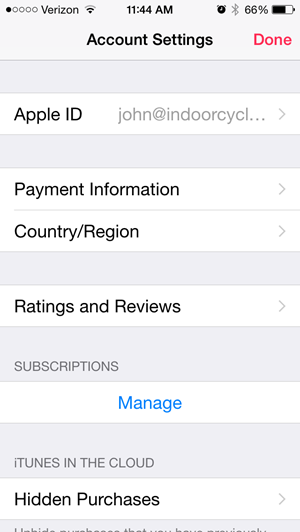
Open the Music App on your phone and click the silhouette icon in the top-left corner.
Next choose View Apple ID and Log In.
Then under Subscriptions > Manage
This screen will show your Apple Music and other auto-pay subscriptions, including Spotify if that's how you're subscribed.
NOTE: cancelling won't end your trial early.
Please let me know if you have additional questions. [/wlm_private]
It's common to have a little “chit-chat” warmup with Podcast guests. This time is for catching up with past contributors (or to calm first timers) before we record the actual Audio Profile or dive into the episode's topic. I'll occasionally have the recorder running during this time and for fun, I thought you'd enjoy hearing a segment of my conversation with Instructor Christine Hawthorne – AKA blogger Chrispins – where we discuss our initial thoughts on Apple Music and Chris shares a bit about her life beyond teaching.
I'll be publishing Chris's latest Audio Profile for our ICI/PRO members later today.
The USA Women won the World Cup finals in soccer yesterday!
The US team coaches are using heart rate training, aka Heart Zones Training, extensively in their preparation for what lead to this victory.
I wanted to share with you an article released yesterday about how that training is accomplished using training load points and player position specificity – and comments that I made in that regard in the article. You can read it here.
While members of the U.S. team will no doubt play their hearts out during the Women's World Cup final against Japan, a coach on the sideline will be receiving real-time data about their actual hearts.
Credit forward-thinking coaches who embraced sport science to improve performance: Each U.S. player wears a heart rate monitor — not unlike one you'd find at your local sporting goods store — when she trains and plays games.
But what makes these special is where the information goes and how it's used. Whereas a commercial monitor (or “wearable”) is designed for information to go to a wrist unit, an iPhone or iPad, and be used by the individual, for the U.S. women, there is a receiver that simultaneously collects the heart rates of 28 athletes to be analyzed by a coach.
[That “receiver” is the same as what's used to connect participants to the Display Training systems in cycling studios – John]
“What evolved [with the technology] was the ability for coaches to not only record the data, but be able to see it live,” says Josh Simonsen, a training specialist for Polar, the company that supplies the U.S. team with its heart rate system.
The data shows how hard a player is working, and can help a fitness coach determine everything from individualized training programs to deciding how much rest a player needs after a tough game. “If you take the women's national team, they're all fit. But it comes down to what type of fitness each player has,” Simonsen says.
What type of position an athlete plays also makes a difference, explains Sally Edwards, a heart rate expert and founder and CEO of Heart Zones, a fitness technology company. “In team sports, each player's position has unique physiological requirements, so the forward on a soccer team has to have different training than a defender,” says Edwards. “Some positions might need quick acceleration. Others might need endurance late in the game.”
With the use of sensor technology, a training program can be tailored to each player to make the fit even fitter.
If you'd like to learn more about this technology and how it could improve your team's performance, Use this contact form to request more information.
Sally
Sally Edwards, Founder and Head Heart
Heart Zones, Inc.
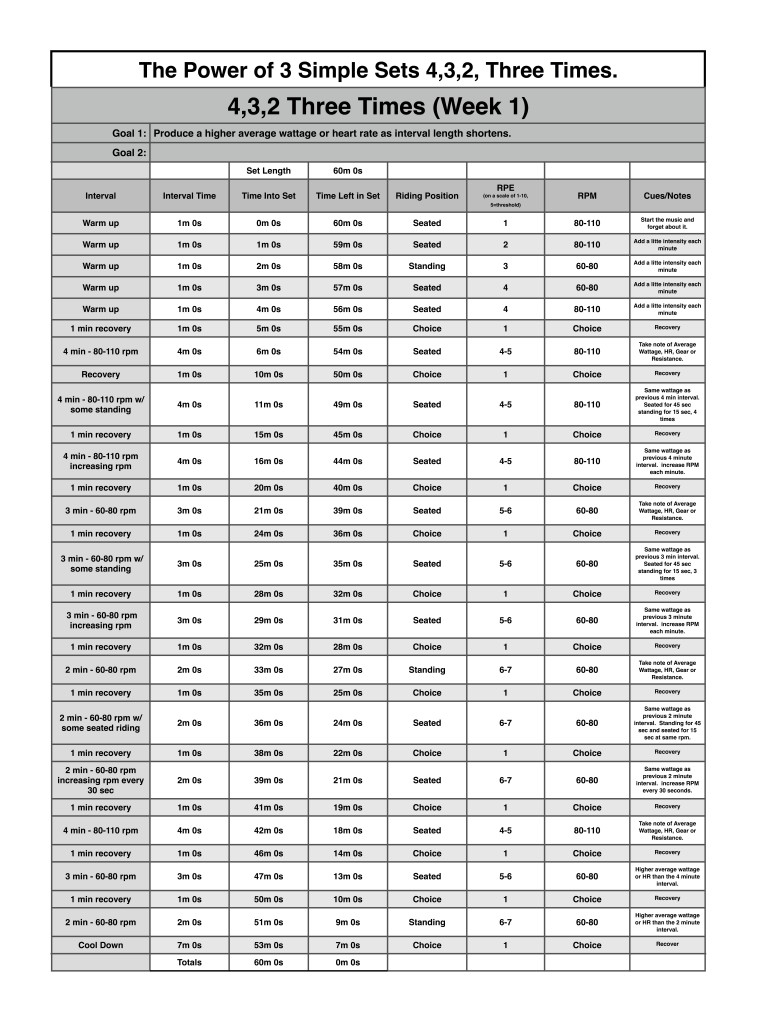
Last month I started this “Keep it Simple and Progress” profile post. In my classes this has been a huge success! Many riders have excitedly shared with me their wattage and/or resistance improvements. It's so rewarding to see and hear how we, as instructors, are changing lives through health and fitness everyday.
I've been using this 3 week progressive training technique, with great success, for many years as a coach, personal trainer, athlete and group exercise instructor. When I'm in a coaching situation I'll have my athletes work through a 3 week progression then take a week for recovery so they can “unload” all the accumulated training stress. In a group exercise setting, where you don't know the exercise consistency of your participants, a recovery week my be frowned upon. To incorporate this sound and proven training techniques in my indoor cycling world I'll set up progressive profiles for 3 weeks and on the 4th week I'll do something completely different. This 4th week is where I'll experiment with new music or video or use an old profile, maybe I'll even have my class cover their consoles and we go “Old School” and ride by perceived exertion only. I tell the riders that have been very consistent with their training the previous 3 weeks that it is time to take it easier and let the body recover and rebound from the straining stress of the previous 3 weeks. This is the time for them to enjoy their fitness level and have fun in class and not to worry about their metrics because we are going to get back to serious training very soon.
In order to provide the members of ICI/Pro with my class recordings, I'm always teaching one week ahead of these posts. This allows me time to experiment and perfect the profiles before I provide them to you. It also lets me hear the feedback and reaction of my class. I'm still amazed at the adaptive ability of the body. In week 1 of most progressions I usually hear how difficult the workout was. This makes sense because the body has not experienced these exact training stresses before. Then in week 2 after the body has had some time to adapt to week 1 the workout is not such a “shock” to the body, but I make some subtile changes to the workout so that the body still needs to adapt as we progress to week 3. Week 3 is, by far, the most difficult of the progression, but since we have taken “baby steps” from week to week this workout is doable. Progression is the only scientifically proven method to safely and effectively improve fitness. There has been a lot of talk in the media about “Muscle Confusion”. To be frank, “Muscle Confusion” is BULLSHIT and I challenge you to find one scientific study the proves it effectiveness. I'm working on another post on “The Myth of Muscle Confusion”, I'll let you all know when it's completed.
As many of you know I am a Master Educator for Stages Indoor Cycling and at our Stages University workshops one of our topics is the creation of “Simple Sets”. Next week I'm going to discuss using the technique of “Lather, Rinse and Repeat” on a micro and macro scale to help make you an even better instructor.
[wlm_private ‘PRO-Platinum|PRO-Monthly|PRO-Gratis|PRO-Seasonal|Platinum-trial|Monthly-trial|PRO-Military|30-Days-of-PRO|90 Day PRO|Stages-Instructor|Schwinn-Instructor|Instructor-Bonus|28 Day Challenge']
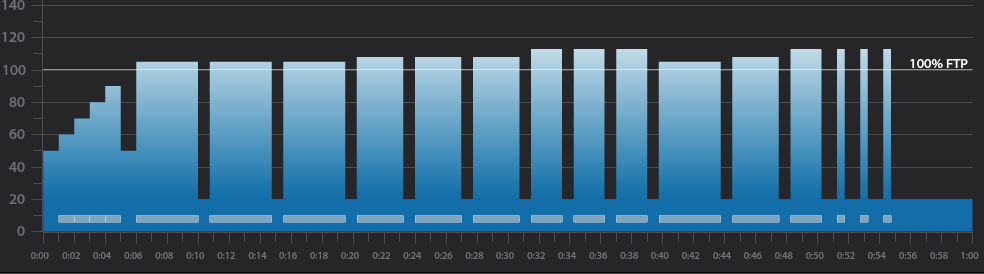
Below I have provided a snapshot of this new profile provided by Trainer Road.
Trainer Road Profile (If you're Trainer Road Member join my Team to get this and all profiles)