In Jennifer Lintz's last post; Use YOUR Workout as Inspiration for your Next Class , Jennifer talked about using your personal workouts and build a class around them. Makes sense to me… because I've experienced something, I can more accurately describe the feelings, intensity, frustration, etc…
I follow communication expert Alexa Fischer (she was featured on Podcast #296) and she's frequently sending out short videos that seem to always get me thinking. This week's email was on using thought bubbles vs. a script, when presenting:
When you are giving a speech or filming a video, I can appreciate the desire to communicate exactly what you want to say through a carefully crafted script. But let me ask you… Do you prefer watching a person reading a script or sharing their thoughts from their heart?
I used this technique in my class yesterday. Here are the thought bubbles I used to bring last Saturday's century ride inside:
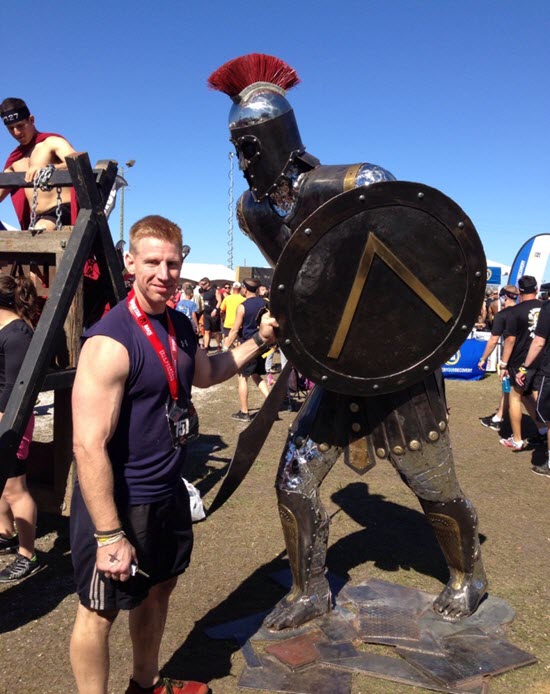
Tour de Tonka – that's what the ride is named. I asked if anyone else participated (there were 6,000+ riders) or, if they were driving, were they forced to sit and wait while the mass of riders rode past. I told this personal story during the warm up:
Two years ago I offered to sub a Saturday 8:00 AM class on the day of this event. I wasn't running late, but let's just say I hadn't left myself much extra time. The last stoplight I hit is the corner where the club is located. It's also an intersection where the Tour de Tonka riders cross. So at about 7:50 I'm first in line at the stoplight, waiting while the cop is waiving hundreds of riders through. Light turns green, cop's still waving. I can see the club from where I'm sitting – cop's still waving. At around 7:55 I'm panicking – there appears to be no end of riders and the cop seems content to keep us waiting at the light, as he waves the cyclists through. So out of desperation I go through a very awkward series of multi-point turns to get pointed the opposite direction. I found a place to park two blocks away and with just minutes until the class was supposed to start, I'm running down the street barefoot (I'm one to eschew shoes in the summer) with my gym bag, the cop yelling at me as I dart through the line of bikes, on my way to the club's parking lot.
Distance's – you can ride as short as 15 miles… all the way up to 100 miles, a full (not metric) century.
As a (somewhat proud) cyclist, there's only one response you want to give when asked; “did you ride the Tour de Tonka?” “Yep (standing a little taller) – the century. Reporting any other distance tends to feel like a disappointment, and your body language will normally reflect this. I added this as a bit of foreshadowing, which you'll understand in a few minutes.
Matt and the rollers – That's Matt as in Matt Finnesgard, one of the riders in our group. He's in his mid 30's and a very strong. Oh, and he rides with no technology… not even a speedometer.
Our normal position in the pace-line is front and center. Tandems are best up front. Besides making a nice hole in the air, for the riders behind, all of our mass makes it difficult to react to changes in speed easily. 100 miles can make for a long pull. After the 30 mile rest stop, Matt offered to pull us. A nice gesture on the face of it, as long as the roads are relatively flat. They're not. The next section we rode was pretty much continuous rollers. I know he wasn't doing it on purpose, but Matt didn't slow from his steady 23 mph when the grade became positive. He just keeps a steady cadence and it was killing us to keep up. Here's where I had everyone doing 30 second intervals; just below PTP and then above. Some were load based with steady cadence… and some where accelerations from 80 rpm to 100 rpm and back again.
Old Market – a long, two section climb at the 98.5 mile point in the century.
The Tour de Tonka begins at the Minnetonka High School, which is only one mile from our home. The route goes right past our neighborhood – Old Market is only a few blocks from our house. It turned out to be a pretty hot day, 93° and Amy and I were pretty much toast as we approached the turn, that if we took it, would have us home and quickly in the shower and a nap. It would also have us about a mile and a half short of the full distance. It's hard to describe how tempted we were and we quickly discussed ending our ride then and there. “Who would know if we bailed early?” I asked. We were alone at this point. “We would.” was Amy's response. “You're right.” “We can't honestly tell someone; we did the century – if we really didn't 🙁
So up Old Market we went. Amy and I can did the whole thing + they had some fantastic pizza at the finish. My class got to replicate the two sections as 45 secs climbing above threshold, and the final 45 secs of the class with an all out effort, out of the saddle struggling to make it to the top.
There was of course more to the story that filled the hour.
Do you have a similar story you could present to your class?
Turning the tables a little bit this week. The owners of the cycle studio where I teach on Monday's and Friday's: http://cyclequeststudio.com/ are awesome! Patti (Joe's wife) pops into my class whenever she can and loves rock music. In an effort to ‘keep the boss happy' I try to incorporate a couple rock tunes into each of my profiles.
I'm starting to like ‘grunge' rock a bit myself.
This week's tune is not new, but it's really good- from a Seattle based American rock band founded in 1984.
It's a hard driving flat (heavy on the bass) at 93 rpm's and 4:07.
Stage races span the duration spectrum. Shorter stage races that are done over a weekend might feature a time trial and road race on Day 1, for example, then a criterium on Day 2. These points on fueling for stage races are culled from several sources — cycling books, cycling magazines, websites, and my coach.
Ideal fueling starts with Body Recalibration — not my term, just a fancy name for conditioning your body for recovery. Recovery should begin at least 6 weeks before race season. (An even better practice is to eat well year-round, but we have to start somewhere — and I’m well aware that this post is late in the season).
Start by eliminating junk — assuming any of you ever indulge in such stuff! Junk includes alcohol, sugar, caffeine, high-fat chips, and such. If you’re in the habit of fueling with sugar before and during trainings, it’s a good idea to eliminate that as part of this process.
My coach always said that endurance athletes never mind expending energy, but don’t want to waste it. Wasted energy refers to anything without a performance payoff. Having to detox from chemicals and junk like sugar wastes energy.
Next, add the good stuff. Eat foods in a natural state whenever possible (whole foods, rather than processed). Stress vegetables (3-6 cups a day), rather than fruit. Fructose is associated with lots of health issues and isn’t good fuel for training.
If it’s possible to eat organic, do. That’s less important if we don’t eat the skin. So organic nuts matter less, but organic apples are a big deal. At least stay away from The Dirty Dozen — the foods with the highest pesticide levels: apples, strawberries, grapes, celery, peaches, spinach, bell peppers, imported nectarines, cucumbers, cherry tomatoes, imported snap peas, potatoes. Three foods recently added to the list are kale, collards and hot peppers, so it’s a Dirty 15.
Eat the same types of foods that you eat during your training. Race day is not the time for nutritional surprises. Believe it or not, if you’ve been junking out all the way up to race day, you might as well eat that way for the races.
Don’t deplete carbs or skip meals, especially race-day breakfast. Eat some extra starches 1-2 days before the event.
The primary nutrition concerns in training and racing are:
– Replacing water. Dehydration reduces blood volume; increases heart rate and perceived exertion; impairs thermoregulation, mental performance, and endurance.
– Replacing sodium. Low sodium can result in disorientation, nausea, fatigue, seizures, or collapse. Salt your food instead of using salt supplements.
– Saving glycogen during the race so it’s there at the end when you need it. (This may be a good place for Dr. Joan’s Potato Goo…)
– Replacing glycogen after the race so you can perform well in the next stage. High GI starch and protein in a 3:1 or 4:1 ratio replace glycogen better than sugar, including fruit. Don’t eat fats right after the race. They slow carb absorption.
Eat 3 hours or more before the start of the race. If you’re not adapted to that, consider it part of Body Recalibration. Avoid eating 30-60 minutes before the start, which may be too close to the effort. Find a food combination that works for you, but avoid all-carb (especially all-sugar) meals. They can lead to reactive hypoglycemia in some athletes and cause bonking. Instead, include protein and fat.
Refuel within 30 minutes after your race. Always. Be fanatical about it. Glycogen replacement is maximized during that 30 minutes because glycogen synthetase is in its active form and facilitates peak storage. Eating within 30 minutes counteracts cortisol’s breakdown of muscle protein for energy and will reduce soreness — very important for the next stage. If you miss the 30-minute window, your muscles may be temporarily insulin resistant for several hours. That prevents best glycogen replacement and may interfere with your performance in the next stage.
Eat again 2 hours later and 4 hours later — or 3 hours prior to the next stage. If you race twice that day, stay aware of how many calories you’re expending and consuming. Many convenient devices are available that are worn on your wrist and provide this information.
Racing at over 20 mph while drafting may burn roughly 12 kcal/kg/hr. Without drafting, that could increase to 15 kcal/kg/hr. Gender, size, and muscle mass all affect those values. Cycling efficiency (good technique) can lower them. The more you ride overall, the less you may burn.
The goal during racing is to postpone fatigue, not replace all of the calories you’ve burned. Full calorie replacement should occur during recovery.
Refuel within 30 minutes after the last race of the day, especially if you have to race again the next day!
And keep in mind that these points may also help on days that you teach several classes.
Have you ever considered giving up control of your class music to a DJ? I'm thinking it would be scary for some of us, those who enjoy the predictability of knowing exactly what track is next on their playlist.
Instructor Timothy Brumm says that fear can also be exciting and it will really challenge your improvisational skills as an Indoor Cycling Instructor!
Tim teaches at the Life Time Fitness in Boca Raton, Florida, where he's taught multiple special event classes with the assistance of a DJ. Seeing this as a trend, I looked for someone with experience and posted a request on Facebook. Tim responded and was nice enough to share his insights and experiences on successfully leading Indoor Cycling classes, where a DJ is providing the music.
John emailed me yesterday and said, ‘What about this song????' and I replied, ‘I love it….been using it in my profile for the last 3 months!' and he said, ‘Of course you have..'
It's a great climb at 62 rpm's with a feel good background rhythm from this unsuspecting Norwegian songwriting duo. I've been using it early on in the ride, as we head into our first threshold and establish that as our base for riding and commit to never dropping below it for the rest of our ride together.
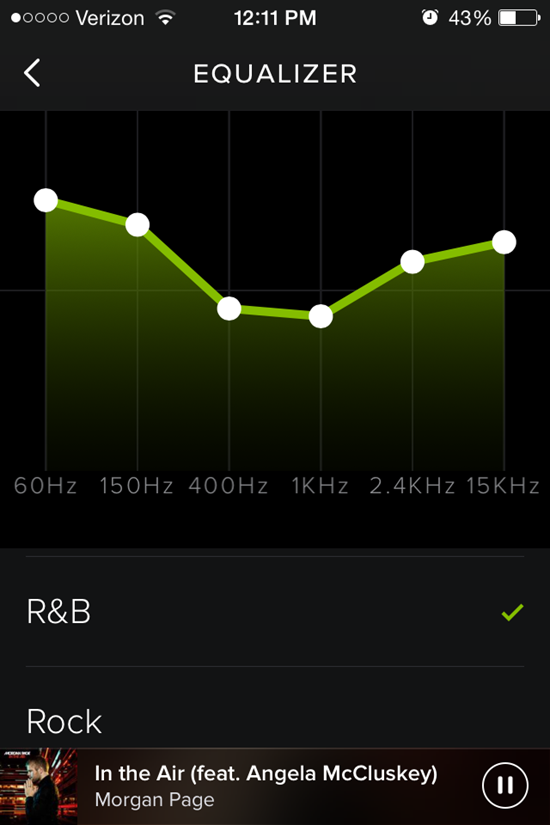
Spotify has added an Equalizer to their iPhone App in the latest update. NOTE: Spotify triggers software upgrades progressively, to groups of users over time. If you're not seeing the notification (pictured above) – you will soon.
This morning I saw the new notice, while I was checking that I had my playlist set to off-line mode and that it would play. This is cool, I thought and I had the chance to acquaint myself with how it worked, before my 6:00 am class. Wearing my ear buds, I found that the Electronic preset sounded the best… turns out I was wrong.
You'll find the new Equalizer in; Settings > Playback > (Scroll down) Equalizer toggle to turn it on/off. Spotify gives you 22 pre-set EQ settings or you can drag any of the six frequency ranges up/down to create you own personal settings.
I'm not sure why, but it seemed like I had to adjust both the sound system's and my iPhone's to a much higher volume level than normal. Please let me know if you experience something similar.
Class sounded OK – well actually I couldn't hear any difference where I sit. After class I connected my bluetooth receiver, so I could stand in the middle of the room to hear what my class hears – while changing the EQ settings.
Now I realise that this is completely subjective; what sounds good to me, may or may not be your preference and every studio's acoustics is different. The R&B setting sounded best, using Morgan Page — In the Air (feat. Angela McCluskey) as my demo track.
That track was part of today's playlist – 45 minutes. I built it from a larger playlist I followed from Instructor Gregg Pitts who teaches at Zengo Cycle in Washington DC – Gregg Pitts Cycle July Tunes. Gregg was featured in this Active Life DC fitness instructor profile. Here's my playlist.