by Joan Kent | Mar 3, 2014 | Master Instructor Blog

Image from http://adkjerseygirl.wordpress.com/2012/05/01/what-is-going-raw/
By Joan Kent
I’m often asked for my opinion about raw food diets, so I've done some research on them. Here’s what I think.
On the surface, it seems reasonable that raw foods would be better for us. After all, every process we put our food through, from start to finish, detracts at least a little from the nutrition. Raw foods would undergo the least processing, so they’d be more nutritious. Perhaps because of that, many raw foodies say they feel more energetic on a raw diet.
A couple of problems may occur with raw diets, though. One has to do with substances called goitrogens that some foods contain. These goitrogens can interfere with thyroid function, making it wise to limit or even avoid foods that contain them.
So which foods contain goitrogens? The list includes cabbage, peanuts, pine nuts, broccoli, Brussels sprouts, kale, spinach, bok choy, cauliflower, soy, mustard greens, collards, radishes, turnips, and more. As you know, some of these foods have a well-deserved reputation for being nutrition-packed all-stars, so we don’t necessarily want to eliminate them.
The good news is that heat from cooking can effectively destroy goitrogens, so these very healthful foods can still be part of your diet — as long as you let go of the raw rule where they’re concerned. I was in the habit of juicing several of these raw foods and stopped when I learned this information. Now I always steam or saute them. In the case of soy, fermentation (miso, tempeh) will do the trick.
Another problem I’ve seen has to do with which “track” the individual chooses. It actually appears to be quite clear-cut: Some raw foodies go in the vegetable direction, some in the fruit direction. It’s the fruit direction that concerns me. Fructose, the sugar in fruit, is nasty stuff.
Health-wise, fructose can induce insulin resistance, decrease glucose tolerance (both may lead to diabetes); increase blood pressure; increase LDL (bad) cholesterol or make it smaller, denser and more likely to form arterial plaque; raise triglycerides and risk for heart disease; rapidly convert to body fat; increase clotting; interfere with copper absorption, which is necessary for hemoglobin; and cause cavities. It doesn’t stimulate leptin and or suppress ghrelin, leading to increased appetite. It’s addictive, may stimulate sugar cravings, and can cause malabsorption and gastro-intestinal disturbances.
Fructose is also a relatively ineffective training fuel, either pre- or post-training. It absorbs less rapidly than glucose during exercise, promotes less water uptake, leading to dehydration, blocks sodium absorption, and replaces glycogen poorly.
Raw foodies who favor fruit tell me how great it is to “eat raw” because they “can have pie for breakfast”, and it’s perfectly fine because it’s raw. The pie shell is typically made from crumbled nuts, while the pie filling is fruit puree. Variations on this theme can be found in stores. Whole Foods, for example, sells cookies resembling Oreos, with a cookie made of crumbled nuts and filled with a paste-like fruit puree.
The advantages of raw food diets would seem to lie in the consumption of lots of vegetables, as well as the elimination of many unwholesome foods. Someone who goes from eating lots of bread, cakes, desserts, and other sugar- or gluten-containing foods to eating plenty of raw vegetables will undoubtedly experience a noticeable shift in health, weight, energy, and symptom management.
But if you’ve already made healthful changes in your diet and don’t eat much junk of any kind, you’ll probably notice a less dramatic change when switching to raw foods. Even a subtle change may feel worth it to you, however, so make your own decision.
If you decide to switch to a raw diet, please do yourself a big health favor and lean toward adding more vegetables to your meals, rather than fruit. My suggestions here are simple: Cook any foods that contain goitrogens, and get on the raw vegetable track, rather than the fruit track.
Fructose is sugar, no mistake. And in quantity, fruit and fructose can pack quite a mean punch. The fact that they’re raw won’t change that.
by John | Mar 1, 2014 | Instructor Training

Future Stages Master Trainer Doug Rusho hard at work during our last ICI/PRO conference.
The FreeMotion S11.9 Indoor Cycle and Stages Indoor Cycling education were a relative unknown to many of us before our 2011 ICI/PRO conference. Since then they've really gained a foothold in this market, becoming a solid choice for any club or studio looking to invest in power.
The S11.X series featured the first Indoor Cycle offering measured power/watts through an innovative strain gauge located in the left-hand crank-arm. The early bikes featured a conventional chain drive – which is a bit noisy compared to other brands. Now FreeMotion offers an optional belt drive (Gates Carbon) that eliminates 90% of any gear train noise, while still communicating the familiar feel of a standard bicycle chain.
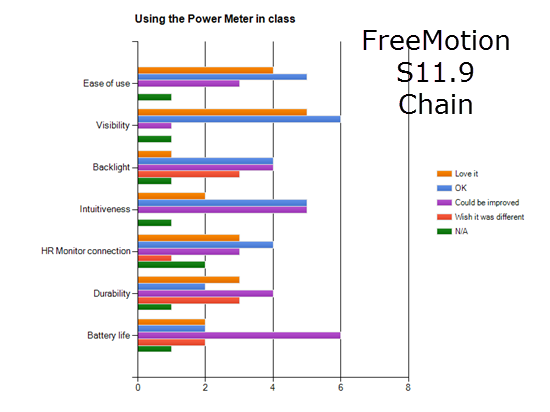
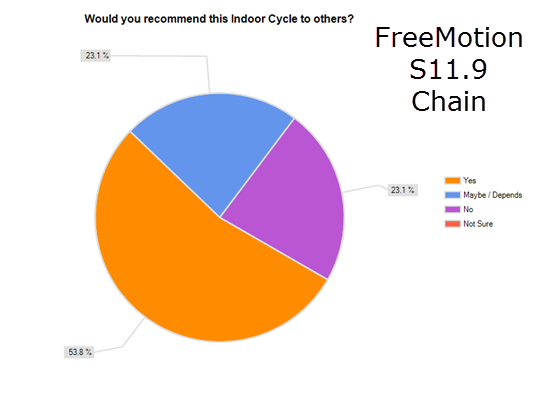
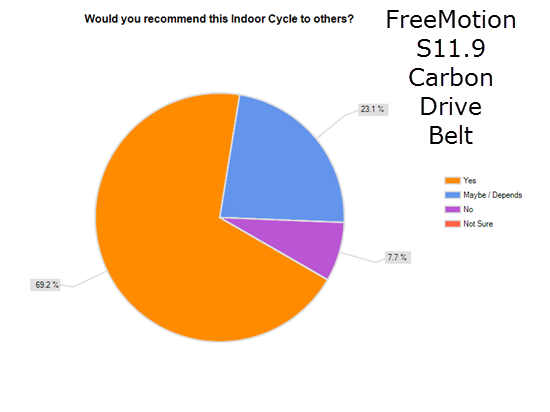
So how do Instructors like them? Let's take a look…

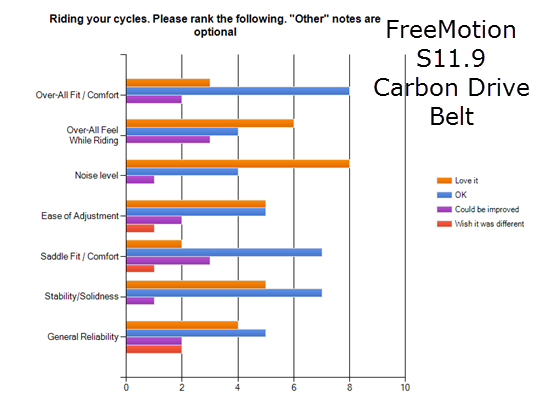
Surveys are funny things – both bikes use the exact same power meter, and yet we're seeing different results.



by John | Feb 28, 2014 | Instructor Training, Music
Some profiles call for a slow, powerful song to really encourage everyone to crank on a bunch of gears. I love to transition to some some strength work in the middle of class, before everyone is fatigued. There's a nice place about 2:30 in where you can cue focused pedal technique.
If you really want to challenge your power class you might try this for fun. Have everyone dial up their FTP / PTP watts – at this very slow 60 RPM and then maintain it for the duration – or – if you're feeling frisky, you might throw in a few, short accelerations and then recover back to this slow grind. Here's where you might consider turning down the music so you can hear the breathing of their struggle.
AWOLNATION — Sail
http://youtu.be/PPtSKimbjOU
This track AWOLNATION — Sail – Unlimited Gravity Remix and the free track are a bit faster @ 74 RPM – still both feature that very powerful downbeat that will have even your most rhythmic challenged pounding along with the song.
by John | Feb 26, 2014 | Instructor Training
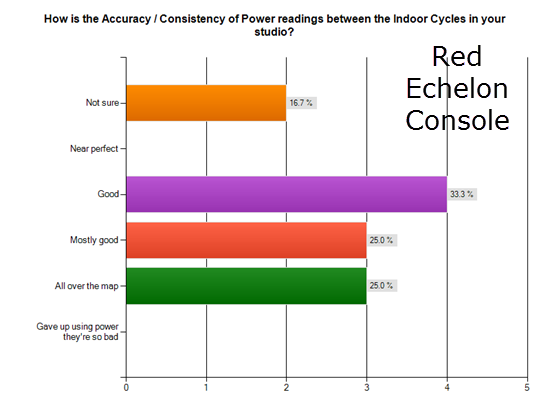
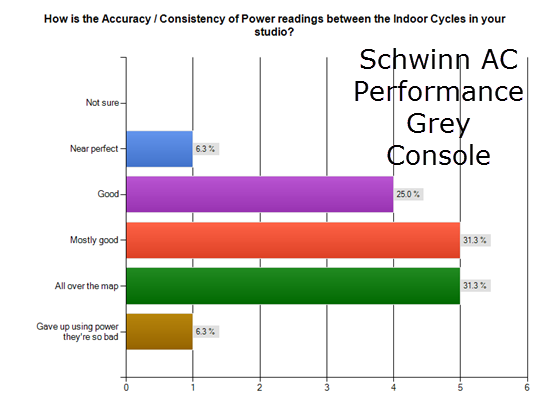
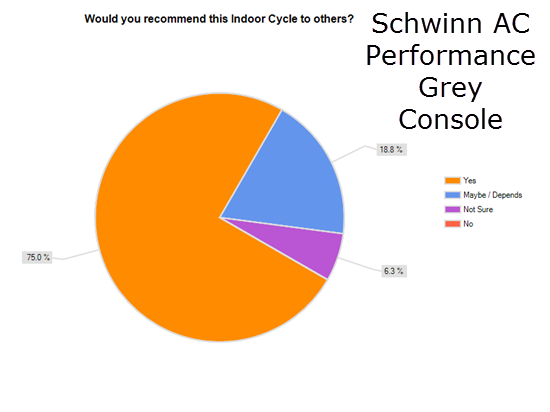
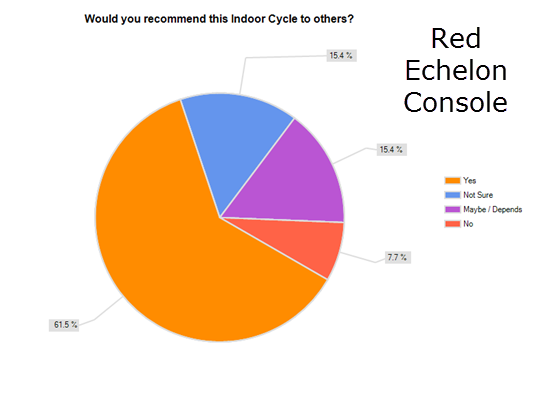
 My first exposure to the Schwinn AC Performance Indoor Cycle was back in the Fall of 2009. Since then I've seen them make a number of improvements > specifically to the console display with the intent of simplifying the calibration, improving the accuracy/consistency of wattage displayed and reduce the number of additional sensor batteries. I informed each manufacturer when I was preparing this survey, asking for direction that I hoped would improve the final results. Schwinn explained to me that their new red Echelon console is substantially improved over earlier versions and asked that I separate responses; older grey vs. newer red consoles – which you'll see that I did below.
Schwinn is now offering an updated AC Performance Plus using a conventional chain drive and an optional belt driven version (they call Carbon Blue) but this survey doesn't differentiate between the different cycle versions or include responses from owners of the belt drive.
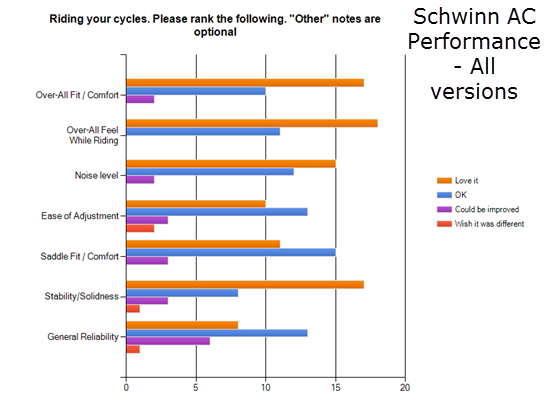
What follows appears to show that Schwinn's new Red Echelon console is an improvement.

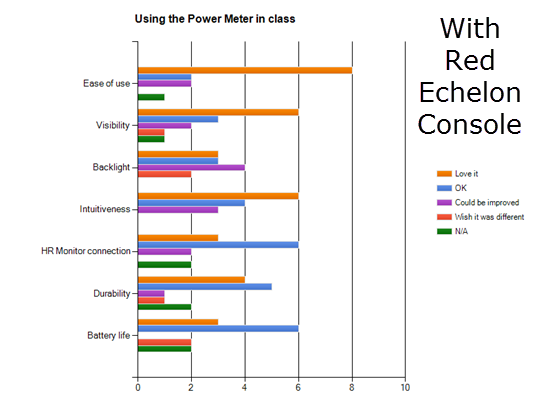
And the Echelon console is scoring higher on accuracy and consistency.
by John | Feb 25, 2014 | Instructor Tips and Tricks, Leading Group Rides

10+ years of shifting has left its mark on my gloves.
My buddy Randy is convinced that we'll be riding outdoors by March 15th. As it was -9° F this morning, I'm thinking he's a bit optimistic. But can you blame him for wishing winter will be over soon?
We've had cold/winter here since Halloween. That followed a summer that didn't really begin until mid June. Day two of our annual MS150 ride on June 9th blessed us with a light, consistent rain and hypothermia inducing temps in the early 40's. Amy and I were shivering so convulsively at the half way point, that we could barely ride our tandem. Then we did the unthinkable; we abandoned the ride at the lunch stop 🙁
So when March 15th rolls around, and if the roads are dry, me, Randy and a few others will attempt a short ride… for no reason other than breaking the depression many of us are feeling. That's not the only reason. You see Randy is the regional Life Time Cycle Lead = he manages all of the outdoor group rides and he's picked me as the ride leader for our home club in Eden Prairie.
The realist in me says I had better be prepared to stay warm.
I enjoyed winter riding on my MTB for years, mostly alone – I never didn't have much luck finding anyone to ride with. As long as my hands and feet stayed warm, I would ride for hours. I have some very ugly shoe covers that do a great job keeping my toes from going numb. The Pearl iZumi Lobster Glove pictured above must be 15 years old and did a great job (when they were a bit newer) keeping all ten fingers functioning. I burned out completely on winter a few years ago – more recently they're only used for shoveling snow.
Thinking I'm going to try these as the lobsters don't work as well with the SRAM shifters on my VeloVie road bike.
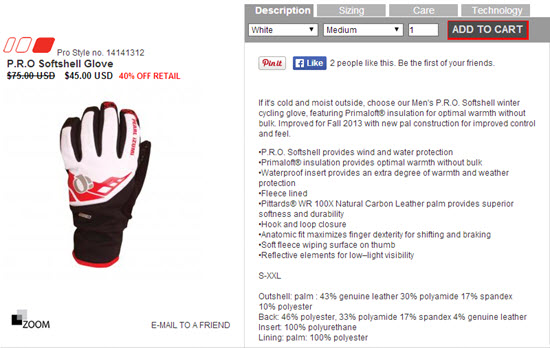
Annual ICI/PRO Platinum members get access to this 40% discount PRO purchase program. Everything Pearl makes and sells for women & men is available. Learn program details here at shop.pearlizumi.com/icipro/
If you'd like to join you can .

by Gino | Feb 25, 2014 | Instructor Training, Master Instructor Blog, Training With Power
Different Methods Same Skewed Results

A different approach with a professional researcher still produced mixed results
Let’s start with the good news. I’m sorry, I was completely pulling your leg. I really don’t have any good news. I know, that’s terrible — you can throw pencils and small farm animals at me next time you see me. I was really looking for the good news in these results and I just can’t find any. This last series of retesting the same three bikes to see if we could garner the same or similar results each time we measure the bike has led to 2 out of the 3 bikes demonstrating a “skewed distribution” of data. In other words, data that you could not and should not try to predict with because they are in a word, unreliable. That means my hope for creating a “handicap” for each bike to render them even and fair for comparisons and competitions is not possible.
Statistical measurements often use Standard Deviation to determine how much variation there is in the individual readings or occurrences of data (in our cases — the differences between the actual power and the measured power). There is something called the “Emperical Rule” (http://www.pmean.com/08/SdTooBig.html) “…it says that approximately 95% of the data lies between plus and minus two standard deviations of the mean.” This 95% rule is for data with a “normal distribution”. This is what we were hoping for when we measured the same bike several times.
Please remember, this stage of the research was RE-measuring the same bikes, not measuring the differences in power between bike computer and actual power of the power pedals. We knew all along the pure accuracy would not be there, we were simply hoping that the amount or degree to which it was “off” would be consistent.
So getting back to our “Empirical Rule”. There is a corollary to that principle, and that is “If a non-negative set of data (which we have with our power numbers study) has a standard deviation that is more than half of the mean, it is an indication that the data deviates substantially from a bell shaped curve. Almost always this is an indication of a skewed distribution.” The second column to the end (right side) indicates if the distribution of repeat, same bike readings has a skewed distribution or not.

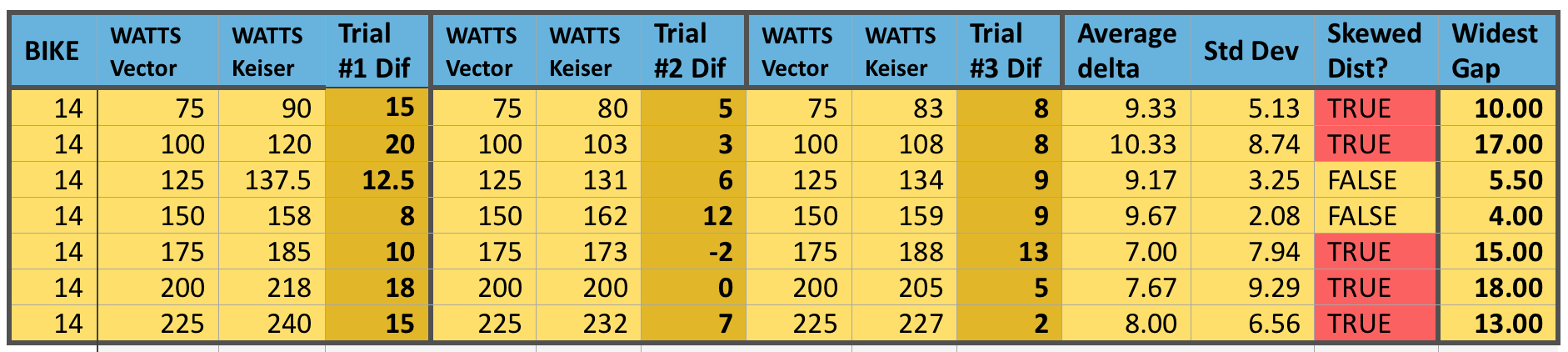
Bike 14 tested 3 separate times, looking for consistency between tests, for reliability to set bike handicaps.
With bike #14, it is notable that Trial #2 and #3 area actually fairly close except for at the 175 Watt stage. However, when we add our first set of numbers to the analysis, all but two wattage levels are skewed. If we just consider 1 bike, we might make a case that if we were to do 5 to 10 repeat trials, we might see these better numbers continue. This was something Sarah (our statistician) suggested as a next possible phase of the research; to conduct a much higher number of trials to see if we begin to see greater consistency or normalcy to the data.
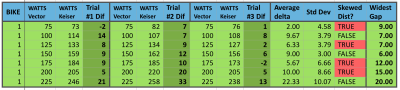
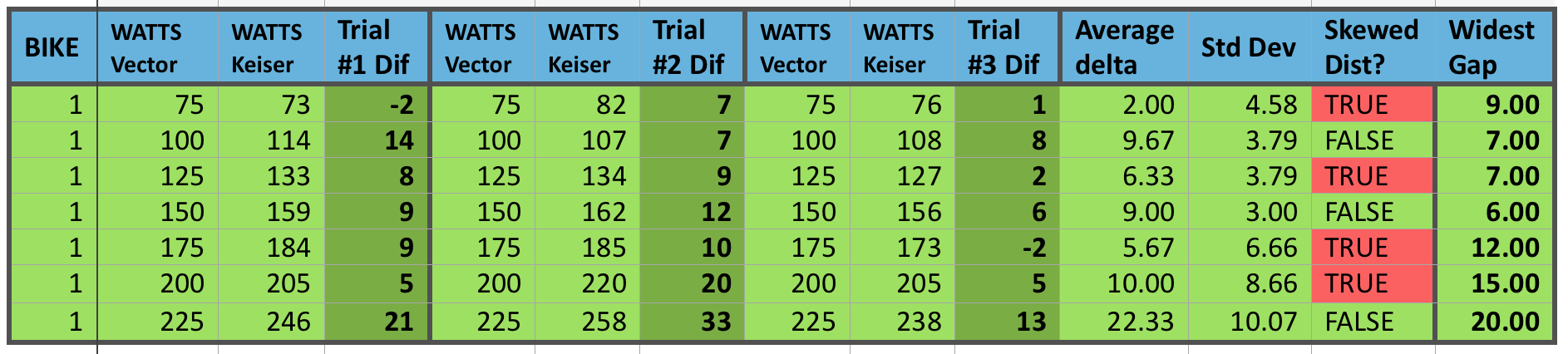
Bike 1 tested 3 separate times, looking for consistency between tests, for reliability to set bike handicaps.
Again, with bike #1 we have only 2 out of 7 different wattage stages that are not demonstrating a skewed distribution of data. At a “gut feel” level, I was hoping to see less than 5 watts difference between measurements of power when it was the same stage. I was willing to accept a difference of 10 watts since accuracy was still not the main driver here. However, again we must remember this is not the power difference, but just the repeating values on the same bike — how reliable it is for a consistent representation of power. Unfortunately, 30% of all the individual stages rendered differences greater than 10 watts and statistically 4 out of the 7 stages were considered skewed.
A Glimmer of Hope?
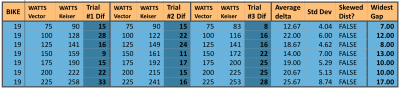
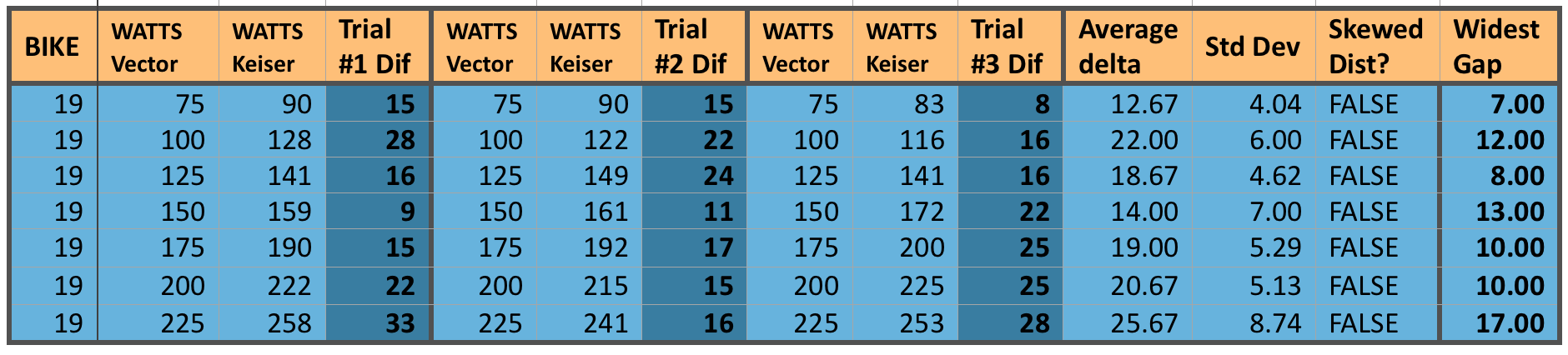
Bike 19 tested 3 separate times, looking for consistency between tests, for reliability to set bike handicaps.
Our last bike does seem to show a glimmer of hope though. While this specific bike had some of the largest differences in actual to measure power differences (in the 15 to 25 watt range), at least it showed those big swings fairly consistently. Notice how small the Standard Deviation is compared to the average delta (simply means the difference) among all three trials. This thus demonstrates a more “normal” distribution and could indeed support a type of “Power Handicap”.
So perhaps I have saved the good news for last. Maybe… just maybe, this means that some bikes would be amenable to a type of handicap while others may not. Picking up on Sarah’s suggestion, a lot more research (translate that — time spent repeating tests on the same bikes, many bikes) might lead to a set of bikes that are “good to go” with a handicap, and a set that are not. Naturally, being the proverbial curious cat, I would want to find out if there is some reason the unreliable bikes are that way. We might even be able to take those bikes through a preventive maintenance routine, recalibrate them to the furthest extent, and repeat the same retests. If we come up with a majority of the bikes being statistically solid and reliable, then we have not only created a handicap system, but we’ve validated the calibration method.
However, having spent as many hours as I have so far on this project, I’ve hung my lab coat up for now, so you won’t be blinded by science from me or a while. If I were Keiser corporation though, I believe I would have a vested interest in picking up where this research left off. I have moved this conundrum past the “blank page” and created a possible path that they could very well negotiate to a workable solution for their clients. Perhaps many clients don't care. I get that – not everyone even uses the training tools. Yet they were bold enough to lead the industry with power and have played a major role in seeing this industry change for the good. I believe Joe Public is becoming increasingly more savvy when it comes to training, and this is rapidly becoming a more educated marketplace. Especially if they consider just their own clients, such an undertaking should be received very well, supporting their image as a company that takes training seriously enough to put in the time and energy to make it right.