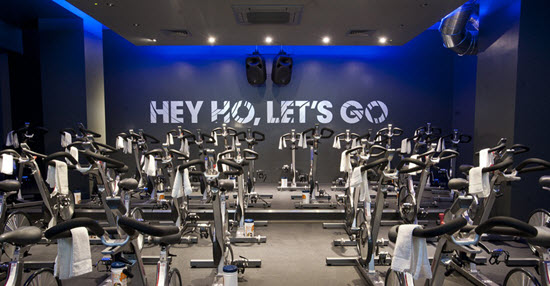
Cyclebeat is a beautiful Indoor Cycle Studio located in what was an old English pub in the commercial district of London. I couldn't decide which of these pictures to use, so here's the view as you walk in – fantastic… unless you're actually after a pint 🙂
Cyclebeat studio owner Greg Allon joins me to celebrate their first completed year in business! During the interview we discuss their “mixed membership model” (combination of monthly and per-ride payments) and the problems that occur when monthly members book a bike, but then don't show for the scheduled class – which prevents them from selling the reserved seat to someone else.
There's typically a “surprise” in every interview – something that catches me and gets my fully attention. When Greg describes the age demographic he sees in his classes (21 to 30), it's easy to understand why Performance IQ has been so helpful to making his studio a success. So successful that they're planning a Cyclebeat #2 for the near future!
Greg is also having success promoting a corporate discount rate… not by soliciting local business directly, but by encouraging the employees of those businesses to bring the information back to where they work. Effectively creating a little army of sales people to promote his studio – very clever!
Listen to the interview below – or you'll find this episode in our.
It's a fact of teaching Indoor Cycling classes using power… not every meter shows consistent – repeatable watts indication, no matter which brand you're riding. Faced with this (often times frustrating) inconsistency you have two choices:
Throw your hands up as if to say; “what's the use?” and ignore the power meter.
Accept the problem and offer your class a simple solution.
My hope is that you choose the later 🙂
As far as I know, there's only one solution you can offer the athletes riding in front of you to understand their power, today, on that cycle. Conduct a short PTP (Personal Threshold Power) assessment as part of every class you teach. If you have a different/better solution I'm all ears – please share it below.
These PTP assessments work great as the first real effort, after you've taken everyone through you initial warmup and a series of openers. Every class of mine begins the same:
5 minute warmup where we gradually increase intensity @ 90-100 RPM
3-4 30 second opener accelerations. We begin in a climbing gear @ 70 RPM, accelerate to and maintain 100 ish RPM for 30 seconds. Recover for 30 sec, rinse and repeat.
2 minute recovery (now we're calling this a “reset”)
3 or 4 minute “Best Effort” where we learn our PTP for this day, on this cycle. I tend to vary how I conduct these; some days are high cadence tempo flats @ 90-100 RPM and others are fast climbs @ 70 RPM
No matter what you decide, you need a great song for your “Best Effort” PTP assessment. For our free track this week I thought I would share one of my current favorites, the Lie To Me opening theme song Brand New Day from Ryan Star. This 93 RPM track is a little short at 3:14 – so you need everyone to quickly ramp up their effort, punch the STAGE button in unison and attack this 3 min Best Effort from GO!
The resulting average watts becomes the PTP for this class, on this bike.
I found this powder way back in the cupboard of our master bathroom.
I remember buying it l-o-n-g ago when the kids were little. They had terrible diaper rash and none of the standard gooey ointments were doing the trick. I called my mom, a nurse from the 50's, and asked her what I should do. She recommended heading over to Walgreen's and picking up some Caldesene Powder. You can't miss it- it comes in a round pink container with blue writing.
I popped that on their cute little booties and they miraculously healed up in no time!
I didn't throw the Caldesene Powder away, mostly for nostalgic reasons. I'm glad I didn't! This little powder has given me relief after long days in the saddle and after teaching back to back classes.
The zinc oxide and talc do a great job of relieving:
Prickly Heat/Heat Rash
Prickly heat is a heat rash that can develop when sweat gets trapped in the skin
This trapping of sweat can cause inflammation and itching
A dusting of Caldesene® Protecting Powder can absorb sweat and help the rash heal faster
Chafing
Chafing can occur as a result of sweat plus friction from clothing or body parts rubbing together
Chafing is common in areas such as the inner thigh, groin area or armpits
By using Caldesene® Protecting Powder, you can help keep these areas dry and protect against chafing
Caldesene® is gentler on chafed, irritated skin than messy creams
Dryness
Caldesene® can be used to help relieve dry, itchy skin
The zinc oxide in Caldesene® serves as a barrier between skin and surrounding air or clothing, helping to soothe skin and prevent further irritation
Sunburn
Use Caldesene® Protecting Powder to help keep clothes from rubbing against sensitive, sunburned skin
Cuts and Scrapes
Caldesene® Protecting Powder can also be used to treat minor cuts and scrapes
The zinc oxide in Caldesene® protects minor scrape and cut wounds from infection and helps them heal faster
Sand Removal
After a day at the beach, rub Caldesene® Protecting Powder onto skin and hair
Caldesene® will quickly absorb the moisture on your skin and the sand will fall away
Caldesene® can also be sprinkled on beach towels and clothing for easy sand removal
For under $5.00, I'm always keeping this pink and blue bottle stocked in my cupboard!
Have any good tips? Please share them with us.
Contact me: amyjo@groupfitnessradio.com. I'd love to hear from you.
*I receive no compensation for writing PRO/STYLE. If I do, I'll let you know!
Happy Valentine's Day- and for you today a climb that builds and builds at 66 rpm. It can be used many different ways. Currently I'm using it to qualify PTP- personal threshold power, approximatey 12 minutes into my profile. The tune is 3:52 long, and I like a PTP qualification to last about 3 minutes, so there's a little time in front to coach and cue.
Enjoy ‘Sweet Disposition' by the Australian band Temper Trap:
Time To Dig In
So we’ve painstakingly done everything possible to setup and prepare our methods for a solid research project — at least as solid as any “non-university” research setting can hope for. We’ve not only established a consistent protocol for conducting the tests, but we’ve also made sure to not do too many in any one day, nor to use different testers to eliminate potential influences to our results.
Once we executed these tests on about a dozen bikes, I wanted to start to analyze the data, and that’s when it occurred to me that we needed to make sure that the numbers I was about to analyze were reliable and repeatable from bike to bike. My last post demonstrated the process of re-testing to insure that very thing. After doing retests on about 6 of the 12 bikes, it is now finally time to review the data and see just what is what.
Let’s Start With The First 2 Bikes
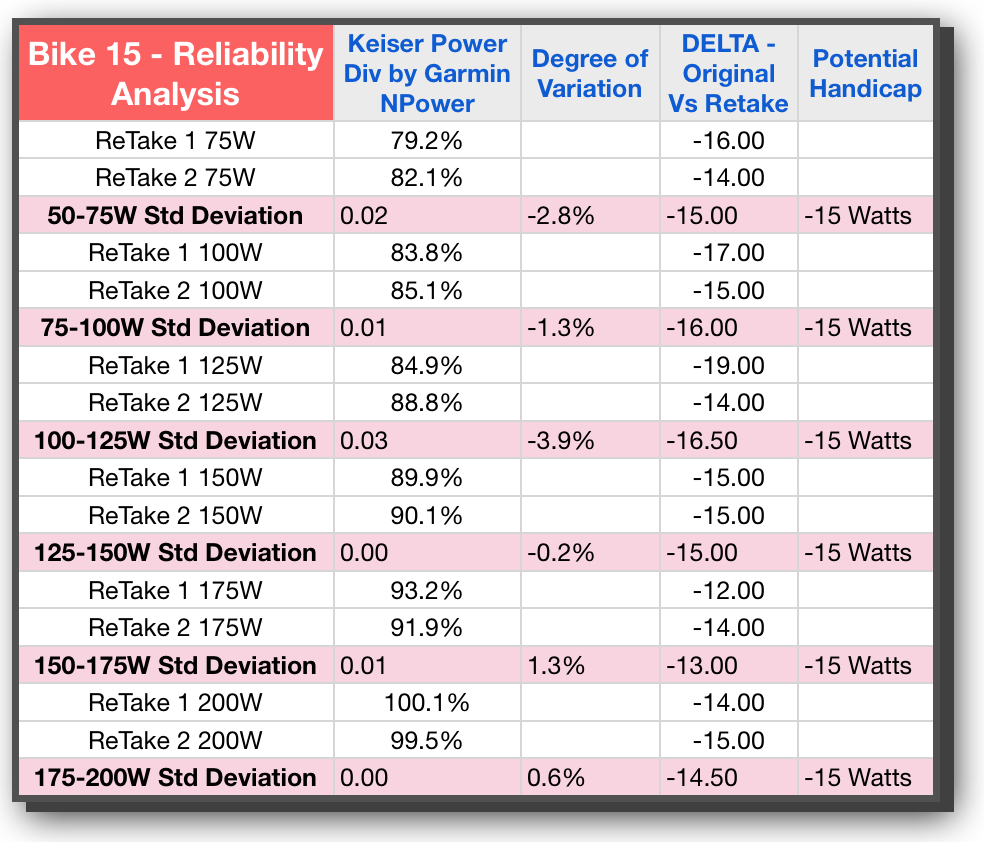
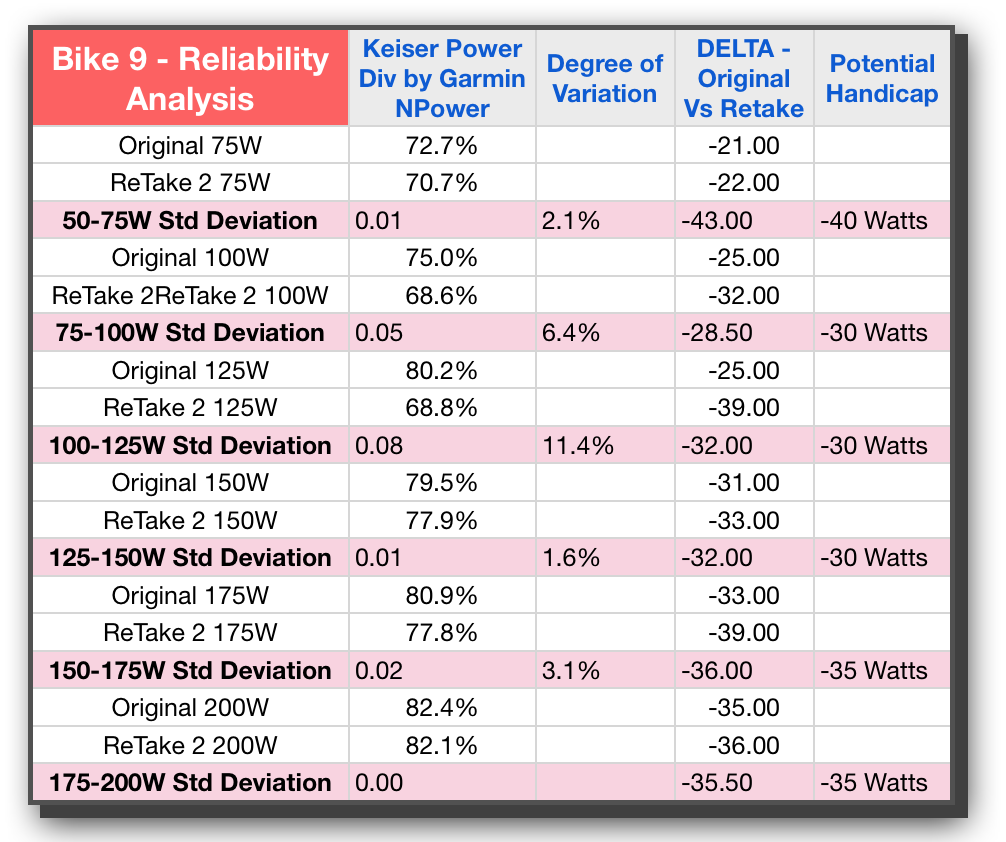
Each day I tested only 2 bikes — to make sure I was fresh each time. So naturally, my first peak at the numbers (and I try not to look at them until I am well into the research so that initial impressions do not subconsciously alter my performance as more tests are conducted) came after these first 2 retests. Remember, I’m into the research project a couple of months now without letting myself “have a taste” — that’s pretty tough for a data-geek like me ☺. So below you will see the first two bikes retested. Let’s go over the columns so we can understand what we are looking at.
1st Keiser m3 Indoor Cycling bike with power to be tested & retested.
2nd Keiser m3 Indoor Cycling Power bike tested with the Garmin Vector Pedals
The first column represents the 25 Watt stages that were used to get the average power numbers from. These were “settled into” for 2 to 3 minutes at each of these stages. More specifically I used the Keiser console to establish a steady wattage level during each stage, and then once the 2.5 minutes were up, I stopped the keiser to get the true average (which typically was within 5 watts of the target) and we also lapped the Garmin so it would later give us the average or “Normalized Power” (NPower is how I have referred to it on the table) from the Garmin Vector Power Pedals.
Column: Keiser Power Div by Garmin NPower
By dividing the calculated power of the bike by the measured power from the Vector power pedals, we will see by percentage just how close they are to each other. Remember, we are not concerned about pure accuracy per se — we know the calculated power is going to be inaccurate by its nature — we simply want to know how much it is off, and if that amount is reliable every time re ride that bike. Each percentage is a reflection of both bikes at a specific wattage on one test.
Column: Degree of Variation
If we now take the difference between the first test and the next, we can get at how reliable the bike is between test sessions. This is the KEY metric for our purposes during this phase of the study; validating that each bike within itself is reliable. From a practical standpoint, we need the difference between tests to be low if our handicaps are going to be valid and useful from one class to the next. In looking at both Bike 15 and Bike 9 we see that these are indeed fairly low — an initial good sign — and there is only one instance where the difference is over 10%. That’s actually a lot less than I expected.
Column: DELTA Original vs Retake
This is a “pre-handicap” column — showing the exact wattage differences at each stage of power averages. While this will produce precise numbers with decimals, we know that a practical application of handicaps would likely need to be in increments of 5 so that the math is easier when performing that handicapping in ones head. We could also use this to send to an automated system if one was ever created that could account for bike variations in the software (an insightful feature I would create if I were the purveyor of such software).
we use this column to evaluate the exact differences and averages before we designate a specific handicap number.
This column is the one that also really shows the amount of variation from one bike to the next. On Bike 15 we are averaging in the teens with wattage differences, whereas Bike 9 is averaging in the 20s and 30s. That’s quite a spread.
Column: Potential Handicap
This column would represent the entire motivation and impetus for all of the time and energy being spent on this research. We want to handicap the bikes! If you’ve read my eBook on Power (if not, no worries an updated iBook is due out soon — shameless plug apologies ☺ ), you will know that Power is not linear in its progression. As such we can not just use one number as the handicap and apply that to all wattage levels. If you look at all 4 bikes, you will see, with the exception of Bike 15, the differences get bigger and bigger as the wattage level increases. This is the exponential nature of power and the reason why I propose a handicap value for every 25 or 50 watts.
How About Some Analysis
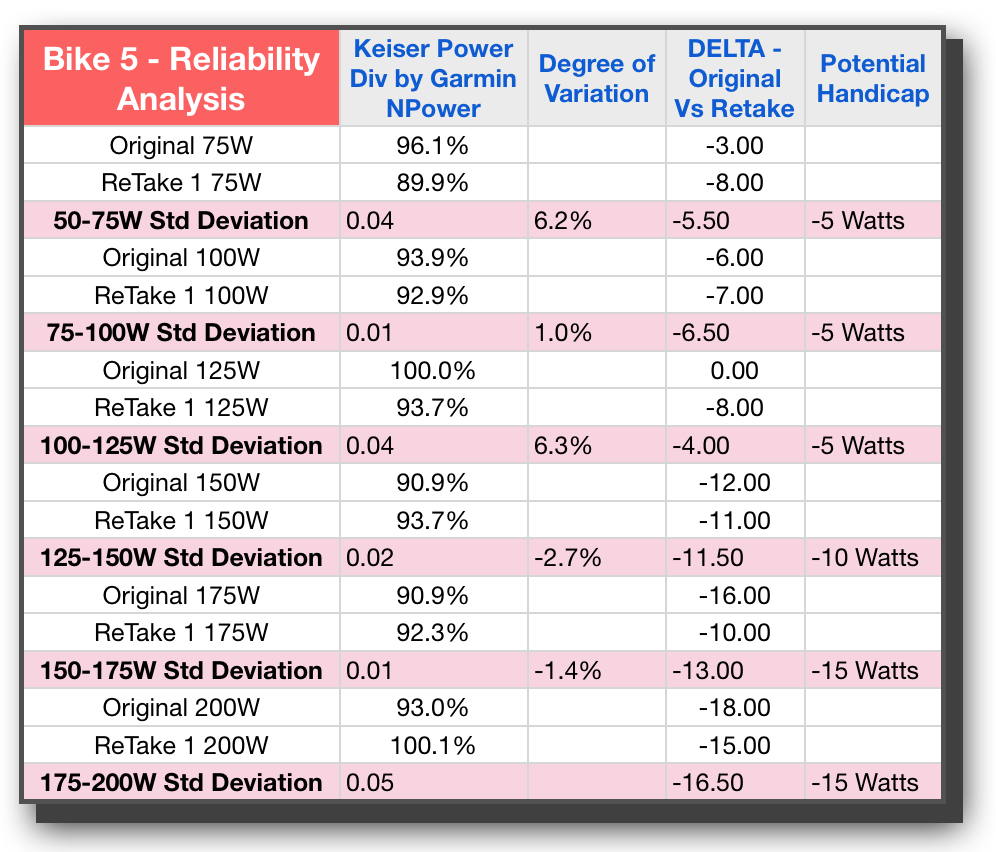
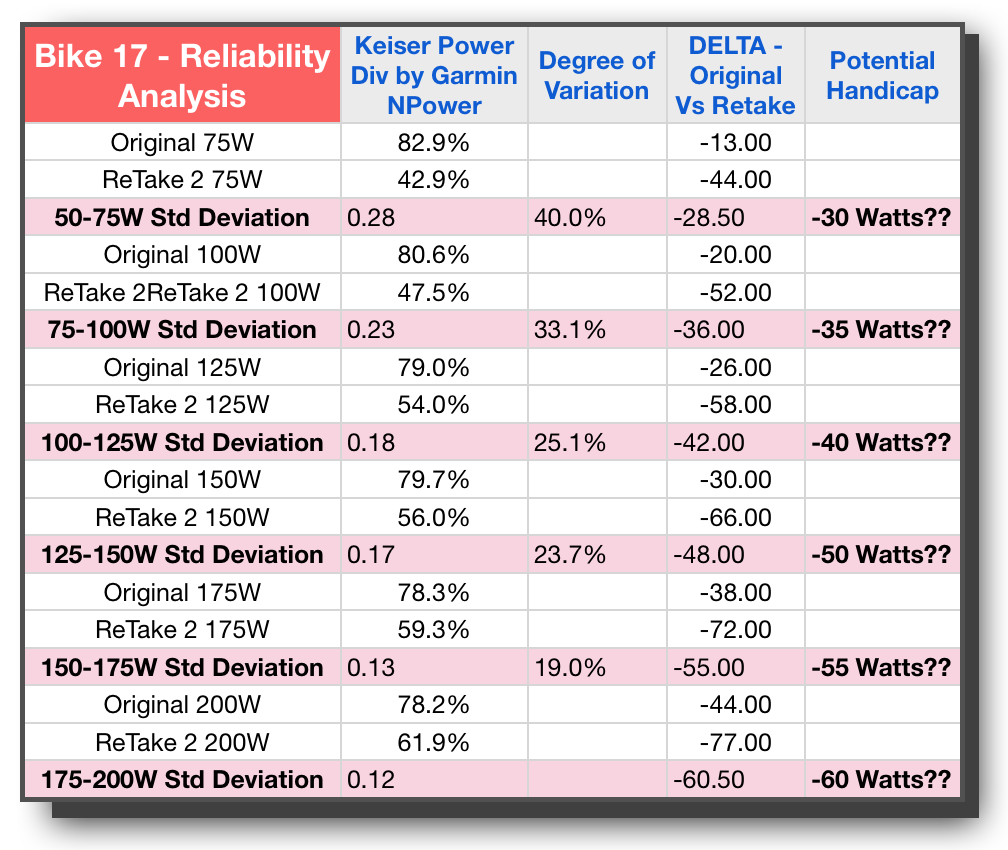
Up to now, we’ve only sprinkled the analysis or possible conclusions as I’ve described each column. However, in order to even think about drawing conclusions, we will need more data points than just 2. Lets’ show four more bikes so we can see if there are some patterns emerging when we have 6 total bikes and their retests — giving us a total of 12 tests or sets of data points to consider.
Looking at Bike 5 I’m feeling pretty good that it’s similar to #9, this time with all variation under 10% and the good power-like escalation of Potential Handicap wattage going up as a power curve would reflect. Taking a look at Bike #17 though, and I had to do a double take — WHAT?? or should I say “WAATTT!” The degree of variation is crazy. Not only that, even looking at it from a practical perspective, the Potential Handicap, aside from being huge in the 30 to 60 watt range, is simply not close to either of the trials in this study. While 30 Watts may indeed be the average between the two tests, with one being 13 and the other being 44, who knows if 30 will be too much or too little. In fact all of the stages are reflected as pretty wild for Bike 17.
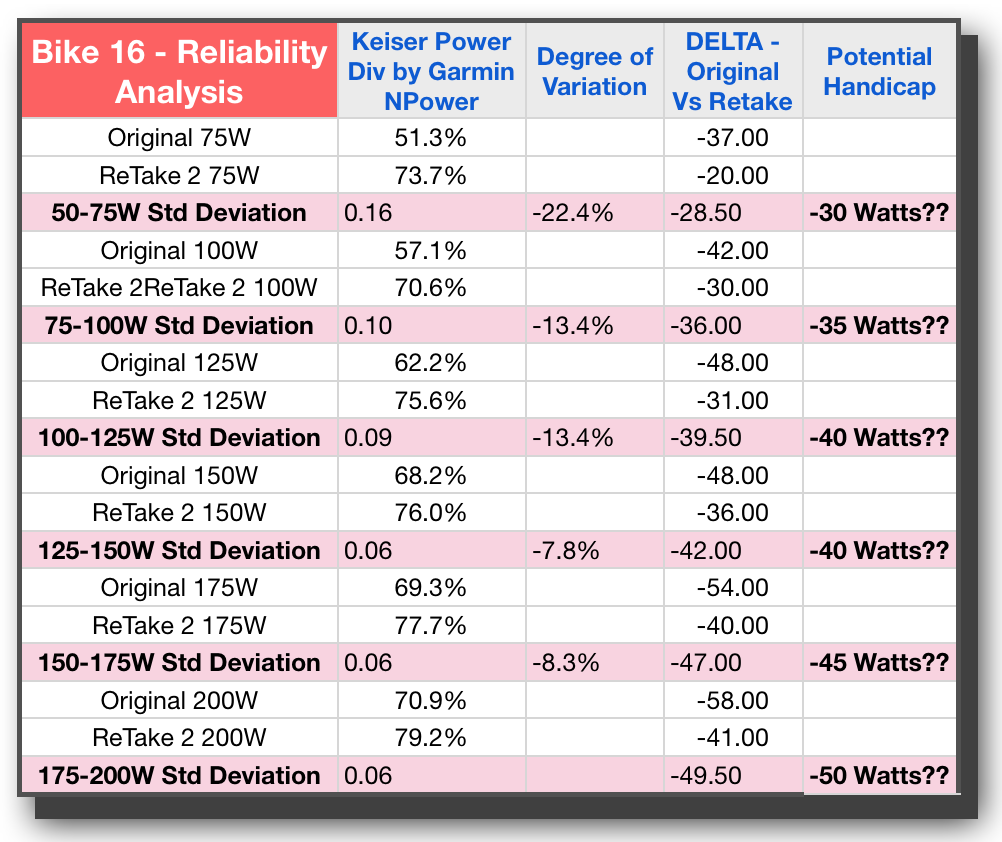
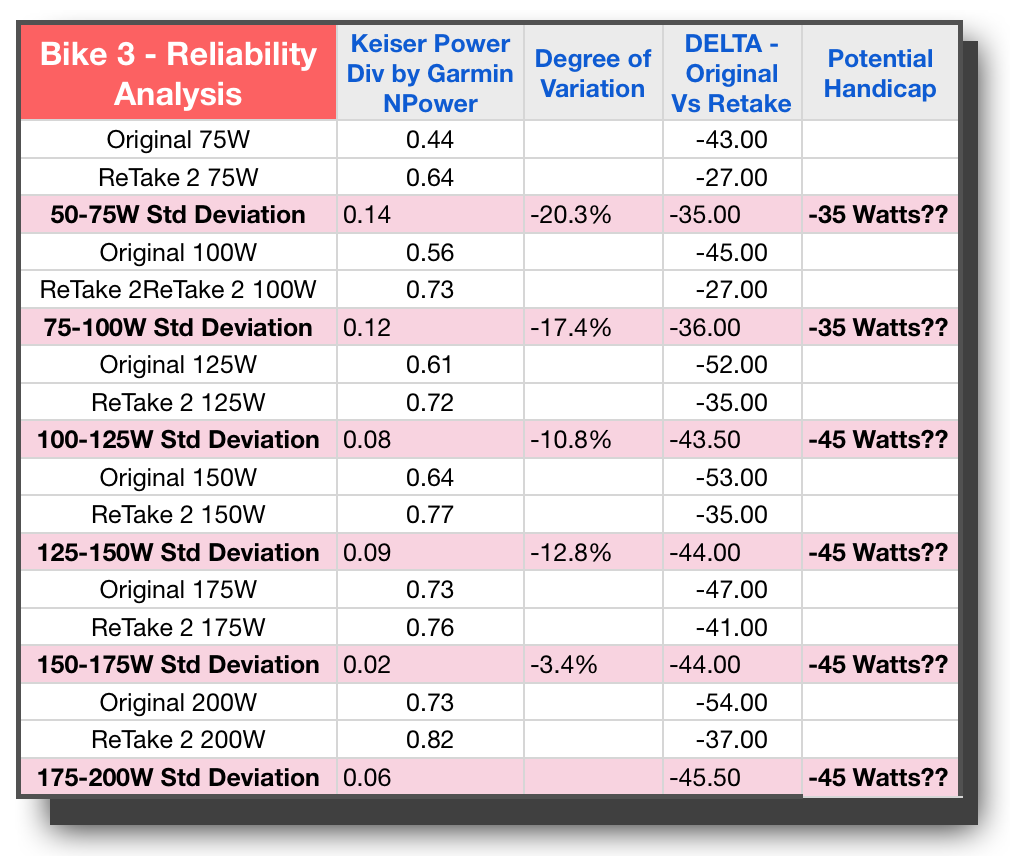
Unfortunately the bad news continues with Bike 16 and Bike 3. Both of these bikes have variations well above 10% and similar wide swings in Watts for the original delta between tests. In addition, we have bike #3 not demonstrating the proper power curve through the last 4 stages, but instead settling into one consistent difference in wattage.
Looking again specifically at these last 3 bikes, and there is no way I would be comfortable handicapping these bikes and expect it to be consistent. So all in all, we have 3 bikes that look like they would lend themselves to reliable handicaps, and three that do not. With a split decision like that, we are all but a hung jury here.
Since I recognized that I might be the problem — I am the only one conducting the tests – and while it stands to reason I would get better and more consistent over time not less, I did not want to rule that out. This data left me scratching my head more than anything else — more questions that need to be anwered. It was time to bring in bigger guns than I have.
The next blog will have another video where we brought in a professional statistician to help us get to the bottom of this.
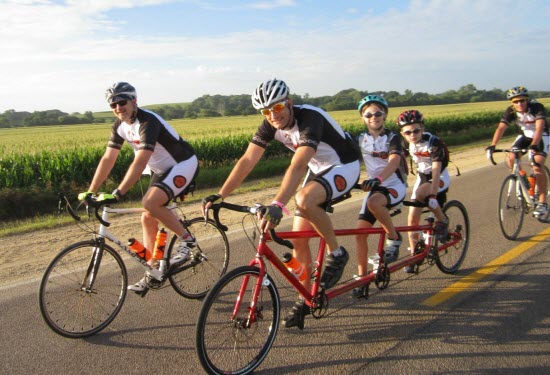
Dr Jay Alberts discovered the value of cycling as a relief of symptoms for people who suffer with Parkinson's disease, while riding a tandem bicycle in Iowa during the RAGBRAI – the ride across the state of Iowa. Based on his observations of the reduction in symptoms he saw in his tandem partner Cathy Frazier, he began clinical trials to study the affects of what he describes as “forced exercise” on someone suffering from a neurological diseases like Parkinson's.
UPDATE September 2014:
We are now offering an ACE approved Parkinson’s Cycling Coach training program. To learn if you qualify click here.
Jay Alberts is a native of Sanborn, Iowa and earned a Bachelor of Science Degree in Exercise Science from Iowa State University in 1994. He completed his neuroscience doctoral training in 2000 at Arizona State University where he worked under Drs. George E. Stelmach and James R. Bloedel in his studies investigating the effects of Parkinson’s disease on motor performance and learning.
Dr. Alberts is currently an Assistant Staff in the Department of Biomedical Engineering, within the Lerner Research Institute and the Center for Neurological Restoration , Cleveland Clinic , in Cleveland, OH. For more information on his research visit: http://www.lerner.ccf.org/bme/alberts/ . He has more than 25 peer-reviewed scientific publications in journals such as Brain, Experimental Brain Research and other prominent medical journals. Dr. Alberts serves as a reviewer for a number of scientific journals and funding agencies and his professional affiliations include, American Academy of Neurology, Society of Neuroscience and International Graphonomics Society. Dr. Alberts has had continual extramural funding for his research since 1997 in the form of grants from the National Institutes of Health, American Parkinson’s disease Association and Achievement Rewards for College Scientists Foundation.
Dr. Alberts is married to Janelle and they have two children. Dr. Alberts and his wife are tandem enthusiasts.
Listen to our discussion below to get a more complete understanding of this fascinating topic – or subscribe to our free Podcast in iTunes.
Interested in offering Parkinson's Cycling Classes at your location?
Click here for more information about our ACE approved training for Coaches.




 I found this powder way back in the cupboard of our master bathroom.