This is a great flat-road tune by a Panamanian-American singer/songwriter/rapper and musician born in 1979. I love that it builds continuously throughout the entire 4:16.
I was riding downstairs, alone with the music blasting, and John commented on how much he liked this song. (He also made mention of how loud I had the music!)
It's very versatile throughout any profile. I've particularly liked using it as a driving flat at the finish of a time trial.
It's Aloe Blacc and his single release, “I'm the Man”:
Making sure this process is repeatable with each bike tested is essential to our objectives.
Let’s recap what we’ve done so far in our video blog series:
1. We have introduced the whys and wherefores of this Indoor Cycling Power research project
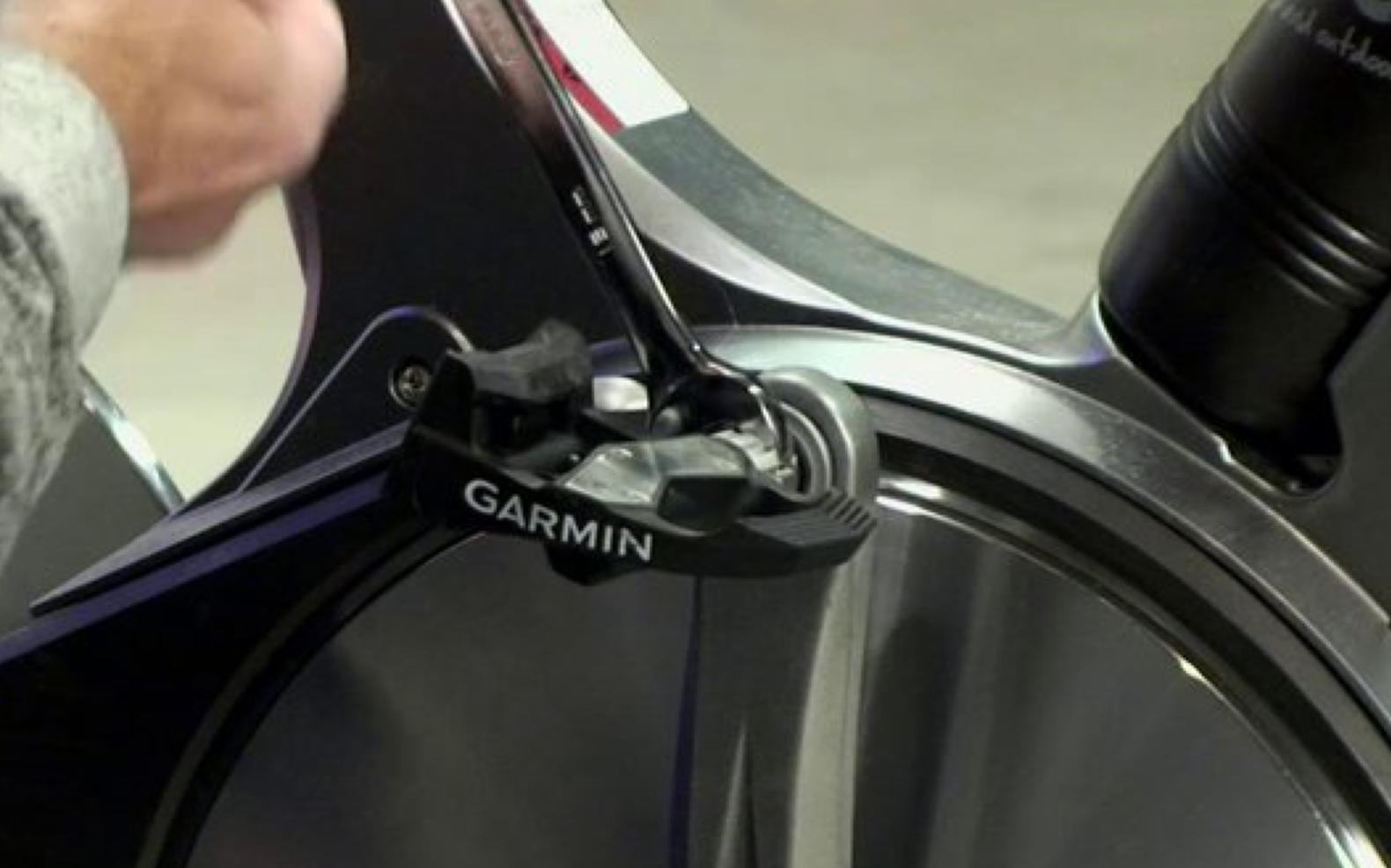
2. We’ve shown exactly how the Garmin Vector pedals get mounted to the Keiser m3 indoor cycle bike
3. We’ve demonstrated from start to finish, the precise protocol used in conducting repeatable tests on each bike
4. Last week we stepped through the process for getting the data from both the Garmin bike computer and the Keiser m3 console (manually recorded) put into the a consolidated spread sheet.
Accuracy & Reliability Are Two Different Things
This week we move into the steps required to begin validating the reliability of our equipment and/or our process. This is as crucial a consideration as the pure accuracy of the data. If we can’t confirm that our process of measuring power is consistent on any one given bike from one day to the next, how can we expect to handicap the bike for accuracy with a number or even series of numbers for different wattage levels since an unrepeatable test would mean this handicap would not be valid from one day to the next.
Consider the frustration of weighing yourself each day on a scale that can not show you 50 lbs from a 50lb weight from day to day. On some days you’ll be depressed while others you’ll be “woo hooing” all the while your weight has stayed the same. It’s an absolute critical component of our findings; to know what we are doing is repeatable and reliable. If it isn’t, we need to consider if the process is changing and causing the inconsistencies, or if the equipment is doing so. While I have tried to be more than methodical about every aspect of this process from pedal calibration to bike test execution, I will not rule out tester error or inconsistency for the moment. Let’s just first see how our numbers turn out before we decide which factor to consider (test process, or equipment variability).
Coach Gino Explains Why Validation & Reliability Are Important
The 2 video segments that make up this post are both quite short. The first one describes in detail how to unmounts the Vector Power pedals in order to use them on a second bike. It is important that we don’t just leave the pedals on and do multiple tests on the same bike. This would not tell us if that bike will be reliable one day to the next. We must first test other bikes, and then come back to bikes we’ve tested.
The second video segment is showing one complete test again (like our 2nd video), only this time on one of the bikes already tested from a previous session.
I've been experiencing low back and knee pain for over a year. When it got to the point when I couldn't climb stairs one-footed anymore, I finally consulted my OB/GYN at my annual appointment (it just so happens he takes John's and my classes and is a pretty darn good athlete).
I asked him for a physical therapy recommendation and he looked at me like I had horns. He referred me directly back to a Personal Trainer I'd recommended to him awhile ago when he was having hip and knee trouble. Duh!!!!
I've had two, TWO(!) sessions with Doug- my Personal Trainer, and I'm already at 50% improvement. Just a couple more, along with putting into practice what I've learned from him, and I should be good to go.
So, why am I writing about hip and knee pain in PRO/STYLE? Because I think we often know the answers to our troubles- in whatever realm we're dealing (fitness, style, beauty, etc.) we just don't realize it. Are you like me? I often problem solve (for myself/ family/ friends)…. think, “Phew” and move on so quickly I forget about it. Out of sight, out of mind!!!!
Whatever's going on- cold weather/ dry itchy skin/ rashes/ break-outs…the list goes on…ask yourself- have I, or anyone I know, experienced this before? How did I handle it then? Take a look in your drawers, cupboards, medicine cabinet and see if you have a solution sitting right there. You may not need to spend a dime, or any additional time. I LOVE THAT!
Not practicing the hand-off – but what comes next…
One of the many benefits of riding and training indoors, is not worrying about crashing and ending up on your head. So we practice our; pedaling technique, or Sprint form or whatever, without thinking about balancing or where we're going.
Now if we were riding our road bikes on trainers we could also practice reaching down, grabbing a bottle, taking a drink and then returning it safely into the cage. Not an easy task for many new (and a few old) outdoor cyclists.
Bicycle Safety Tip
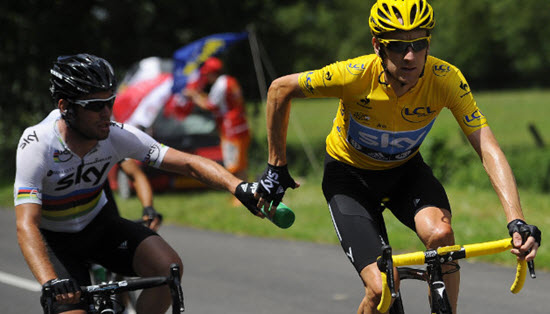
2012 Tour de France winner Bradley Wiggins pictured above/right may be an awesome cyclist with phenomenal bike handling skills. But he's not demonstrating proper hand position with one hand off the bars. The correct (safe) position for his left hand is on the cross bar, very close to the center / stem. Why not out at the end where he has it in the picture?
It's a matter of leverage. The further you hand is, away from the center/pivot, the easier it is to turn the bars. Without your other hand to counteract the force, riders with just one hand, on the outer end of the bars, tend to ride erratically = not in a straight line = dangerous.
Speaking of proper hand positions > I discovered this video while researching this article. Nothing to do with cycling, but it will get your heart rate up when you watch it 🙂
In celebration of today being the Super Bowl (the biggest sporting event in North America) we played drinking games. Not the typical; take a shot whenever an announcer uses some predictable cliche – that comes later today.
In class we played a different type of drinking game.
Although we're not on real bicycles, there's still a valuable technique we can safely practice during class; drinking at a high level of effort > @ or over FTP/Threshold/AT/Lt whatever you call it. More specifically; learning to regulate your breathing so you don't choke, launch into a coughing fit, swerve over and ultimately take down your riding buddy – or end up in the ditch.
NOT drinking enough during a long ride is the sure path to early fatigue. During a hard group ride there may not be a lot of breaks where you can recover and hydrate easily. So today we only drank during hard efforts, not during the recoveries when you would normally towel off and take a sip.
The first Sunday of each month is an FTP Assessment. Here's my class.
Class length 75 minutes + Cool Down
Warm Up — 10 minutes. 5 minutes of gradual increases in wattage. During the second 5 mins. we’re finding the wattage where everyone is first noticing a change in breathing; VT1 / Aerobic Threshold = the top of the Recover Zone. This establishes a rough understanding of a base wattage that we use throughout the rest of class.
3 x 30 sec. Hard / 30 sec. Easy – Openers to AT/LT. I cue these by first having everyone find the amount of load @ 70 RPM that has them feeling they should (not just could) come out of the saddle. The 30 sec. Hard is then simply accelerating to 90+ RPM which results in some pretty impressive power numbers. The 30 sec. Easy is back to 70 RPM — many will stand during the Easy portion.
1 minute rest – I encourage riders to focus on their recovery. Once they feel calm in their breathing, bring back the Base level work wattage.
3 min. Hard Effort — Here’s a “Best Effort” to establish a benchmark PTP Personal Threshold Power (top of the Perform Zone) or ride at 110% of FTP if known. It’s very helpful to riders to have that understanding of their personal upper wattage number. The “Best Effort” Threshold # + the Base Threshold # we found earlier form the three Power working zones I use in class.
2 min. Rest
3 x 1 min. Hard Effort x 1 min. Rest. These should be above the 3 minute average wattage.
3 min. Rest
20 min. TT / FTP Assessment effort – Quickly establish the average wattage at or near the 3 min. Interval. > Stage Button and then maintain. You may want to offer slight changes in cadence & load, while keeping wattage = to the initially established watts #. I was off the bike at the 10 min. to go, coaching, encouraging and then just watching them with a big smile on my face. This is a great group and they looked incredible — I’m so in my element with these classes
5 min. Rest
Base Wattage (aerobic) flat road to finish — use these time to congratulate everyone and give tell them a bit about what you have planned for them next week.
A slow and grinding climb of familiar origins (with a twist) is today's Free Music Friday.
Mash ups are great, but I also enjoy when older(ish) and newer artists, leave the tune alone and combine their unique talents. It achieves a really cool result.
Do you have people in your class that love to climb hard??? Me too! This one's for them! (And then I ask…beg…them to pedal at a flat road cadence later on).
The original version of “Sunshine of Your Love” is, of course, by Cream. And John also pointed out- it's one of the first guitar riffs learned by the wanna be future guitar players of the world!
The version I give you today via Spotify is by Santana and Rob Thomas- it's pretty darn fantastic. Coming in at 57 rpm's- remember, it's a grinding and demanding climb, and 4:43, it should leave your class wanting a bit of a recovery.
Enjoy! If you're in the “Polar Vortex”…I empathize…stay warm!
The difference between something good and something great is attention to detail. — Charles Swindoll
Do you do any writing in your work — blogs, website copy, ads, emails, posts, salesletters? Do you have lots to say, but no confidence in your ability to write it?
Writing intimidates many people. As a result, they avoid it or feel a sense of dread whenever they’re stuck writing something. The result could be missed deadlines, or a stilted, awkward article, post, letter, whatever the occasion requires. It doesn’t have to be that way.
Investing in a good developmental editor and/or copywriter is as important for your business as any other expense you see fit to justify as essential.
Writing style, grammar, sentence structure, parallel structure. The very words sound quaint as I write them. Some people couldn’t even define that last phrase. But their absence simply reeks of slovenliness.
As we know, professionalism is a matter of details. Just think of how many details go into the teaching of a single indoor cycling class: room management, music selection and recording, video selection and use, your workout plan, your training concept, any exercise science you plan to teach, any philosophy of training that matches the day’s workout, personal anecdotes that illustrate the point behind the day’s class, creating the right atmosphere, motivational messages, and more.
If you took a class taught by an instructor who neglected these important details, what would you conclude? ‘Professionalism’ wouldn’t be in your description.
So why would written work be any less important? The written word lasts. If only for that reason, the details of written messaging should be given the time and attention they require. William Feather said, “Beware of the person who can’t be bothered by details.”
There are many reasons to pay attention to our writing. Making sure our meaning is clear comes first. That’s made possible by using the appropriate tone, whether it’s formal, academic, or casual and conversational. The first two are not the only ones that matter.
The power of any message also hinges on both clarity and brevity. Avoid rambling. Unless you’re writing your own blog and hunting daily for material, don’t waste time in your posts describing the clouds in the sky as you sip your coffee while thinking about the topic you’re about to cover for Cyclotronic Cecil’s Cyclo-sation website. Get to the content and make it clear.
Another important element is grammar. Sure, I’m dating myself, but I insist that good grammar matters. Don’t kid yourself. Your readers — and not just the old ones like me — are, in fact, cringing as they read those embarrassing mistakes.
My tip on this is to avoid language trends. They always go in the direction of worsening illiteracy. Just because everyone around you says, “I could care less,” doesn’t make it right. If you don’t care, it’s correct to say you “couldn’t care less.” Think about it for a moment.
But I digress.
The point of this post is that a good editor/copywriter is a wise investment. He or she can polish stale prose, make you sound even smarter than you feel(!) when putting your ideas in writing, and leave you with the confidence that you’ve done the job well.
The attention to detail will show in your growing reputation for professionalism. You deserve that. You spend that kind of time on your teaching. Don’t neglect your writing when help is easy to find.
Give attention to the details and excellence will come. — Perry Paxton