
by Dennis Mellon | Feb 11, 2021 | Dennis Mellon, Thoughts from the Instructor Bike

I love group display systems. I mean I really really really love group display systems. Systems like Performance IQ and My Zone make classes so much more interactive and they magically make participants work so much harder AND smarter.
I teach at multiple locations in the Denver area and two of them use group display systems. One, just recently, launched Stages IQ which is Stages Indoor Cycling's version of Performance IQ and the other has been using My Zone for about 6 months. Stages IQ uses the power meter that is on every bike in the cycling studio. My Zone picks up the heart rate that is transmitted from the proprietary My Zone chest strap. When I teach a class with Stages IQ EVERYONE in the class can be part of the group display system. When I teach a My Zone class ONLY those who have purchased the MY Zone chest strap can enjoy the group display system.
The energy felt in the studio using Stages IQ is infectious as EVERYONE is working for a common goal and can see if they are successfully achieving that goal. The energy in the My Zone studio is not the same because, on a good day, only 25% of the participants may have the necessary MY Zone chest strap to see their heart rate on the group display system.
I have been working in the fitness industry for 25 years and heart rate based group exercise classes have NEVER been successful because the only way to ensure everyone's compliance is to “loan out” heart rate monitors and this becomes a very time consuming and expensive proposition, this also goes without saying that there are far better ways to determine intensity like power and pace.
If you are looking into a group display system and you want 100% compliance with the system you need to provide members with EVERYTHING to use the system. If they are required to purchase their own hardware or do more than simply sign up for the class they will not do it and your investment will have been wasted.
Originally posted 2016-01-31 07:54:47.
by Joan Kent | Feb 7, 2021 | Master Instructor Blog
By Team ICG® Master Trainer Joan Kent
It’s possible, even likely, that you have cycling class members with hypertension. It’s possible that they’ve been told by their doctors to cut back on salt in their diets. If not, it’s still possible that they’re cutting back on salt because that’s the prevailing wisdom for controlling blood pressure.
As we all know, sodium is loss in sweat. The more we sweat, the more we lose. Long and/or intense trainings or hot environments result in greater sweat production and greater sodium loss. Symptoms of low sodium can include disorientation, nausea, fatigue, even seizures or collapse. Even in a controlled indoor environment, warm outdoor temperatures can increase sweating.
As important as sodium levels are, it’s obviously not a good idea for our students to cut back on salt intake without letting the prescribing M.D. know that they take cycling classes and often sweat profusely in them. In warmer weather, this becomes even more important.
But this post isn’t just about salt. High-carb diets may raise blood pressure because of the increased insulin they trigger. There are several mechanisms by which high levels of insulin can raise blood pressure.
High insulin levels increase sympathetic nervous system activity, leading to vasoconstriction. That increases both heart rate and blood pressure.
Insulin also stimulates the proliferation/multiplication of the smooth muscle cells lining the arteries. That may narrow the size of the arterial opening (lumen) and increase blood pressure, sort of in the same way that a narrower hose can increase water pressure.
Insulin promotes the production of serotonin, a brain chemical that’s also a vasoconstrictor. Vasoconstriction can raise blood pressure. The relationship between insulin levels and serotonin production is pretty much linear, so the more insulin secreted — say, in response to a high-carb diet — the more serotonin is produced. The more serotonin, the more vasoconstriction, and so on.
As mentioned in a previous post, high insulin levels can increase production of series 2 prostaglandins, which are hormones that control cellular functions. Among their numerous negative health consequences, Series 2 prostaglandins cause inflammation and increase blood pressure.
So what should we recommend for our cycling students?
First, it’s always a good idea to stay away from simple (or as I like to call them, junky) carbs and limit alcohol. That can help to keep insulin levels from skyrocketing.
Second, avoiding all-carb meals/snacks is another good idea. Meals and snacks that include protein and healthful, unsaturated fats have less impact on insulin levels.
Third, avoid processed (also junky) foods that are loaded with sodium that we consumers can’t control.
Fourth, modify — but don’t eliminate — salt. We need it to replace what we lose in a cycling class. The upper limit is 2300 mg, or 1500 mg for older or hypertension-prone individuals. But for someone who sweats profusely, it might be possible to exceed those limits safely to a degree. It’s also possible to go too low, and one way of gauging that is by urine production. If you feel you can’t hold 50% of your water intake, that’s a sign that you could need more salt.
As some of you may be aware, there’s a long-standing table salt/sea salt debate raging. Some sources maintain that the natural minerals in sea salt reduce the overall sodium content. Or that the larger size of sea salt crystals reduces the amount of salt in a teaspoon. Or that the more intense flavor of some sea salts encourages reduced consumption. These factors are said to make sea salt more healthful, but arguments appear to be inconclusive. One suggestion for sea salt users might be to take a kelp tablet daily to compensate for the absence of iodine that’s typically added to table salt. Or to buy sea salt with added iodine. Iodine’s necessary to prevent goiter.
Rather than join the Great Salt Debate, my point in this post is to encourage moderate consumption of salt among our cycling participants concerned with sodium and hypertension, primarily to avoid the negative consequences of low sodium.
Even more importantly, I’d encourage smart consumption of the best carbs to avoid the various mechanisms — related to insulin secretion — that can and DO cause hypertension, even with a low-sodium diet.
Originally posted 2013-07-01 08:22:47.
by John | Feb 4, 2021 | Best Practices, Correcting Form, Instructor Training
Note: We've added a new category “Correcting Form” to help you identify and correct common form related problems you see or discomfort/pain your students are experiencing.
The problem diagnosing form, discomfort or pain issues while riding, is that they aren't always obvious when you're student is rested and fresh. Here's a good example:
Question from one of my regular students: “John, do you know I can keep my hands from getting numb – going to sleep?” “It happens here in class, but more so when I'm riding outside… any ideas?”
I've experienced this situation myself, as has the senior group fitness instructor Amy – but only while riding “The Bus” our tandem bicycle on long rides.
First I asked a simple question; “do you wear gloves when you're riding outside?”
“Sometimes I do, but never here in class. Because it happens both indoors and out, I don't think that's the problem.”
She went on to explain; “I've researched it online and I think I've eliminated all the potential causes that I found.” “It's frustrating for me because 30-40 min. into a ride, my hands start tingling and then fall asleep.”
“If it's happening both indoors and out and with or without gloves, it's probably not a nerve compression in your hand problem. My guess it's probably your actual hand position on the bars… hop on this bike and let me take a look.”
I had her jump on an Indoor Cycle in class and told her to get comfortable. Once she was in place, her hands were positioned like what's shown in this picture.

Proper hand position has straight wrists

“That would make sense. That wasn't discussed on any of the articles I found.” “But I never ride like that so that couldn't be the problem either.”
“Are you sure certain you never drop your elbows, which causes your wrists to collapse, when you have fatigued?”
I then went on to explain to her how subtle the change is and that when I had her drop her wrists, it didn't require changing her grip on the bars, only her dropping her elbows.
When we're fresh, we all sit up straight and tall. Everything about our form looks perfect. Yet as we fatigue, it's natural to experience small, often negative, changes in position. From my perch upon the instructor bike what I typically see is first shoulders tend to fall forward. This causes a little additional weight on your arms which result in your elbows collapsing in and downwards slightly. Because everything is connected, the lower position of your elbows, with no change in the position of your hands, naturally results in a greater angle of extension in your wrist.
Here are three suggestions you may use in class or on the road:
- Identify the problem. Describe the need to maintain a straight wrist and how it will add to everyone's comfort on the bike. Talk about hand numbness and tingling and ask if anyone has experienced it.
- Cue frequent hand position changes. If you're Spinning® instructor you're probably doing this already. I would add to your cuing the need to visually check that each new position results in a straight wrist. If you're not or if asking for hand position changes is something that you normally not do, this is a great time to start 🙂
- Watch for the signs of fatigue. You may see your student's form degrading, but they may not be able to sense it. Asking them to look down at their wrists, late in class. Asking them to correct it may have the effect of bringing everything else back in line… As I said before; “everything is connected.”
Was this helpful to you [wlm_firstname]?
Originally posted 2012-05-30 13:21:10.
by Tom Scotto | Feb 4, 2021 | Master Instructor Blog
 We talk a lot about becoming more than just instructors in our indoor cycling classes. We want to be coaches. We are coaches! I’ve spent the last 20 years coaching riders and teams on the road and half that indoors. Anyone who has taken one of my classes knows that “coaching” is my approach to indoor cycling. I introduce each of my classes as “coached training sessions” so riders know what to expect, plus it gives me the self-proclaimed freedom to get into character (like they really have a choice). Since many of you share this passion with me, over the next few months I going to post a series of articles on various suggestions and tips to bring that coaching character in you to the forefront.
My Black Book
Because of my coaching background, when I first started teaching indoor cycling I felt the deep desire to help people beyond the walls of the studio. Almost without exception, everyone in my class had some kind of goal or reason for being there. It could be as simple as increasing their fitness level, loosing weight, preparing for an upcoming charity ride, cycling vacation or competitive event. I thought “if I knew what their specific goals were, I could do a better job connecting with them and helping them”. Thus, I created the Black Book.
It was just a thin 3-ring binder (black of course) that contained forms — one for each rider. You can download a sample of this form from Cycling Fusion at www.cyclingfusion.com/downloads/CyclingFusion-BlackBook.pdf. I would make an announcement at the end of each class letting riders know that they could fill out a page in the Black Book if they wanted further help from me in obtaining their training and riding goals. I got a couple of takers at first and then it snowballed.
Individual Attention
Before each class I would review the goals of those in my class. I asked each person in the Black Book to show up 15-minutes early to class which is when I would give them specific guidance on how to approach the class that day. For example: “Mary, tomorrow you are planning on riding outdoors with your club so go a little easier on that last hill today. We want the legs fresh in the morning”. It was just some simple guidance to each rider about how to approach the day’s class.
The Benefits
Besides allowing me to satisfy my goal of helping riders outside of the studio, I started to connect with them more which increased the popularity and energy of my class. Other riders saw the attention my Black Book riders were getting and wanted in on the action. If you are trying to make a living as a cycling coach, I believe a Black Book is a must. Riders will always want more, and since you have already been so helpful, taking the next step into a formal coaching relationship ($$$) is easy. A side benefit for me was it helped me better remember riders names. I’ll take all the help I can get.
Originally posted 2011-08-12 14:57:47.
by John | Feb 1, 2021 | Best Practices, Instructor Training, Promote and Build Your Class
Make sure you add the – spotify:user:__________ part or it doesn't work
She was close to yelling when I walked into the studio. “I'm so excited you came back John!” “I haven't been able to find you on Facebook or Spotify, so I wasn't able to find the playlist you used the last time you were here…”
I subbed last night at the Life Time Fitness corporate HQ club. This participant was there the last time I had covered this class for a friend. I remembered her instantly and how she had approached me after class, asking for the names of two of the tracks I had used. “Are you a Spotify user?” I had asked her. She responded that she was just getting started with Spotify, so I suggested to friend me on facebook and I would show up on her Spotify.
Perfect plan… until she remembered my name as John McCowan and couldn't find me on Facebook 🙁
Which got me to think about an old post I wrote back in 2008. In it, I suggested that Instructors carry and handout a business card (I called it a class promotion card) and showed the card that Amy and printed online. They included our email addresses and class schedules. They worked like a charm, until our classes changed that is.
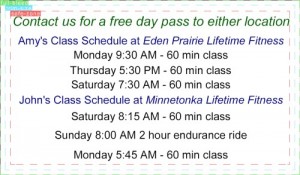
There are a bunch of websites online where you could quickly create a simple Spotify/Promotional card that you could have available to hand out. I ordered mine through www.vistaprint.com and paid $15.95 with shipping. Because my schedule changes so often, I choose not to include it – but you could easily add yours to the back.
Originally posted 2013-04-02 15:51:43.
by John | Jan 29, 2021 | Instructor Training, Master Instructor Blog, Product Reviews, Training With Power
NOTE: this was a previous review from 2013 that continues to remain accurate when applied to any of the magnetic friction Indoor Cycles available today.
Many Indoor Cycle manufacturers claim a connection with cycling outdoors:
100% Authentic – Spinning is authentic. It’s true to its cycling roots, yet refined to a simplicity that makes it the perfect program for any age or ability.
FreeMotion says; Drive System Mimics Outdoor Riding
The Schwinn® Authentic Cyclingâ„¢ Series is based on one simple principle: we believe that riding a bike indoors should feel as much like riding an outdoor bike as possible.
There are of course multiple similarities between riding indoors vs riding outdoors. Beyond the obvious differences, not needing to balance an indoor cycle for one, the claimed connection is that their Indoor Cycle feels like riding a bicycle outdoors.
But what does that mean? A feeling can be pretty subjective after all.
My review of the new Spinner® Blade Ion included a comment that I was a little disappointed that Star Trac continued with a friction resistance system, vs. the magnetic systems used by FreeMotion, Schwinn and Keiser.
I also teased you at the end of the post with:
Later that morning I also tried a little experiment that I’ve wanted to do for years…
What happens to your Power / Wattage when you accelerate from a set point, say; 100 watts @ 60 rpm to 90 rpm on friction based system, as compared to a magnetic system? Do they react the same way?
My apologies for the delay. I'm just getting to this today.
The ” little experiment” I conducted was something that I'd wanted to confirm/quantify for years, actually since I first started teaching on a Schwinn AC in 2010.
My early experiences riding/teaching with magnetic resistance, along with a discussion I had with Keiser's President Dennis Keiser, demonstrated to me that the amount of resistance created by the magnetic (Eddy Current) resistance system increased in lock step with a faster cadence / RPM. The faster you pedaled the harder (more force required) it was to turn the pedals.
Which is pretty much what you experience riding a bicycle outdoors, at speeds over 18mph. As you pedal faster (assuming you stay in the same gear) you and the bike move faster through the air. The faster you go, the more the resistance from the air pushes against you, making it harder and harder to turn the pedals.
There's a handy calculator to compute the amount of work it takes to overcome the resistance of the air here.
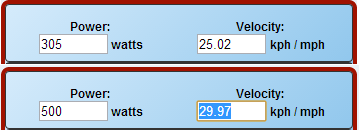
The difference in power needed to ride 25 mph vs 30 mph
So it takes apx. 300 watts to ride at 25 mph. To ride at 30 mph (just a 20% increase) you need to create over 60% more power. You can't make the power with additional leg speed – you're probably near your maximum efficient cadence already at 25 mph. To get to 30 mph you'll need to shift to a lower gear and push harder… A LOT HARDER!
Very different from the conventional friction system on an NXT – which (to me) feels like it gets easier to pedal, the faster I pedaled. In fact most of us can take what is a high level of load (at a slow cadence) and accelerate to the point where our legs spin-out and won't move any faster.
Side note: It's extremely rare to see someone riding with excessively high cadence on a magnetic resistance indoor cycle.
I've discussed this concept here in the past, but I couldn't prove or demonstrate it. I even went so far as contacting LOOK and Garmin to see if they would lend me a set of those new pedals with the built in power meter. They wouldn't and the crank arm from my FreeMotion doesn't fit on a NXT. It remained a mystery until now.
So while I was at the IHRSA convention, I finally had the chance to compare the new Blade Ion and the FreeMotion. With both cycles offering “measured power” I felt it would be a fair comparison; Magnetic vs Friction Resistance. Which best replicates riding outdoors?
Although I wasn't exactly “scientific” in my test protocol, nonetheless the results were very interesting.

Fun with graphs!
Here's what I did
My test was admittedly simple. After completing an early AM ride with Josh Taylor, I spent some time riding both the Spinner Blade Ion and FreeMotion S11.9. I began by establishing a steady 60 rpm cadence. Then I added resistance until the power meter showed 100 watts @ the 60 rpm. Then I accelerated to (and sustained) 90 rpm and took notes on what happened. I rode both cycles twice and the results were consistent. The blue Magnetic Watts line is more squiggly than the red Friction Watts line because I used the actual date set I downloaded directly from the FreeMotion's USB port.
I'd already tested the FreeMotion S11.9, so I knew that the 50% increase in cadence would result in a doubling of power. Perfectly consistent with my understanding of how Eddy Currents increase linearly with speed. A 50% increase in RPM = a 50% increase in resistance. Although math isn't my strong suit, it's easy to see how a 50% increase in Speed multiplied by a 50% increase in the amount of force required to turn the pedals = a 100% doubling in power/wattage. While not the same effect as what you'll find chasing down a breakaway at 27 mph, it is enough to force your students to work hard in a way that will help prepare them to hang with the “A” group.
The Spinner Blade Ion reflects the inherent weakness of using a friction pad with a heavy, perimeter weighted flywheel. The graph above clearly shows how the amount of resistance doesn't increase with additional speed – it actually goes down, validating what I had hoped to demonstrate. If it just stayed the same I should have observed 150 watts @ 90 rpm, I only saw 135 watts. So where did the other 15 watts disappear to? That's a math thing I'll leave to others smarter than me to answer. I will offer a guess that if I had continued on to 120 rpm, I would have seen a progressively lower increase in wattage vs what would be expected from a doubling of speed.
So what's this all mean?
Short answer – it's my opinion that magnetic resistance is superior in every way to a friction system. Besides being zero maintenance, the linear increase in resistance is much closer to what your participants will experience outdoors. Combined with the reduced inertia of the aluminum flywheel, magnetic cycles require more work to ride and force everyone to develop better pedaling technique. IMO the net results is that the members of your club or studio will (if they take advantage of it and you coach them properly) receive a more effective workout, that will translate to them becoming stronger outdoor cyclists.
So does that mean you wouldn't recomend the Spinner Blade Ion?
Not at all… it's an awesome cycle and that battery charger rocks. The purpose of this article was to demonstrate the differences so you can make an informed decision on your own. Besides, if you're a Spinning® studio, what other choice do you have?
P.S. If you're going to be at WSSC – I'd love for you to try and replicate my test on a Blade Ion for yourself. Then report back with what you find 🙂
Originally posted 2013-05-04 17:03:45.
