OK, so mid August may be a little bit early to start asking people to come back to your class. But I don't feel that there's any harm in giving some thought (and maybe some preparation) in how you plan to encourage past students to return to class this Fall.
Here is an excellent article from Club Industry contributor Christine Thalwitz that reinforces the need to collect contact info on participants throughout the Indoor Cycling season.
Blame it on the down economy, poor service or a life change. Whatever the reason, most health clubs lose at least 20 percent to 40 percent of their members each year. The good news is that many former members are ready to come back if you just ask them.
At my club, ACAC Fitness and Wellness Centers, referrals from existing members are our top source for new membership sales, but former members who rejoin are a strong second. Many companies do not take any special steps to recapture lost members, but ignoring these individuals constitutes a massive missed opportunity.
Last week, while I was riding a century, the course took me past a restaurant that Amy and I used to eat at occasionally – but haven't for years. Why haven't we gone back there? I thought. I really liked it, but I've completely forgotten about this place. Had they sent me an occasional letter or email there's a good chance we would have returned. But they didn't – so we didn't return.
Back in September of 2008 I recorded ICI Podcast #5 — ten steps to building up your class numbers. In it I share my strategies for class promotion. These steps have worked for me and I hope, if you haven't heard them before, that they help you fill your class this fall!
One note: In the Podcast I encourage you to start your own Blog, which obviously dates when I published this. Now my recommendation is to start a Facebook group where you can communicate what's happening in your class.
Maybe a better title for this blog would have been “The Devil’s In The Details”. Fortunately I did receive some offers from some real suckers… er… I mean some really nice riders who want to help me out as we take our walk in the enchanted forest of Muscular Endurance. But as any adventure worth taking goes, there is the planning and paperwork that must go along with it.
First there’s the inevitable “If you die it’s not my fault” waiver — every fitness facility and cycling studio has to have one, and if you do metabolic testing or mad scientist stuff like we are want to do, then you have to have a really BIG one.
Next you need some basic instructions to give to your test subjects unless you plan on supervising every minute of every trial. Don’t really have the time for that? I didn’t think so. No one does, but yet it is imperative that we keep everyone on the “same page”. What better way than to copy that page and give it to each one of them — we call that our data collection protocols (see how scientific sounding we make things). It’s really just instructions. it’s not rocket science, but it’s these little things that when missed, is like catching you napping in the poppy fields.
Data Integrity & Consistency
If we want to draw any sort of conclusions at all about our results, we need to make sure that we both execute the drill in a consistent manner, and collect or document each trial (the specific drills assigned to the study participants) accurately. Aside from being detailed in our instructions, we also should provide a spreadsheet or at least a paper form that will somewhat “force” each rider to speak the same language.
This not only helps with the consistency of reporting, but it will also make aggregating the data across each of the subjects easier to complete. I have therefore prepared a spreadsheet that has tables for recording both the Baseline (Pre-research or “before”) test and the Performance (the after-research) test. In addition, I have prepared 1 table for each of the 4 weeks in our study.
Oh My!
Finally, the “Oh My!” part of this adventure is here as I assumed that our subjects would want to print out the spreadsheet to help them record their numbers soon after their workouts since there is that risk of memory leakage (some of us more than others J ). Anyway, I looked at the “print view” and yep — that’s when I said “Oh My!” as I had to scrap 3 of the 4 tables and reformat the first one so it could be more easily printed — and then of course export them for both Mac and Windows versions. So you see, it really was a dark and scary forest with flying monkeys after all.
Any last minute volunteers are still welcome. I still don’t have 10 volunteers, but I must get started. Please comment on this post if you are going to participate, and you can find the forms and spreadsheets at this dropbox link. I have several versions of the spreadsheet so hopefully it will work for most participants: https://www.dropbox.com/sh/6bugjlb8wtew1iy/HdspfwB7D_
We start collecting data on Saturday 8/11, so please email me your waivers and any questions you might have. See you in OZ!
Recently, I started a discussion over at Pedal-on.com, a forum for cyclists, many of whom are indoor cycle instructors. The discussion dealt with using current, high-quality, coached video as a substitute for the sub.
Additionally, here on ICI/PRO, Jim Karanas tossed out the possibility of video subs, and John Macgowan did some research on how safe indoor cycling really is. You can access and read these posts, if you haven’t already.
The responses varied but were generally negative. Although many thought it OK to have video on hand “just in case” or “in a pinch”, none thought it a good idea as a general practice.
Much of the commentary included concerns for the safety of unsupervised riders (read John’s post: “How Safe or Unsafe Are Indoor Cycling Classes?”). Others felt the nickel-and-dime approach that clubs have adopted has eroded the member experience, and video subs are just another way to save a buck at the members’ expense. One particularly honest respondent just said, “Hopefully, this won’t be the newest thing to happen. What would we all do?”
What would we all do? It seems to me that’s not the question. The question is, rather, what are we doing to improve our craft?
Indoor cycling and instructors have been around for about 20 years. In that time, many changes have taken place. But the same old eight-hour certification is still the norm. And the same company from “back in the day” is still the leading provider, as well as the one most program directors recognize.
That is changing (maybe too slowly), and for indoor cycling, that’s good.
By far, the most notable changes are in bike technology and design. Today there are far more indoor cycles to choose from, with option packages that parallel those with the purchase of a car. Keiser M3, Schwinn AC, Free Motion S11.9, and the ICG® LIVESTRONG® bike are the major competitors of you-know-who.
For those of us wishing to improve our craft, it’s good news. With each new bike comes a college of education. And they’re sharing with us right here.
Most of the education is centered on how to use the new bike and its unique qualities to teach indoor cycling. These talented people, many of whom I’ve worked with closely, have done some remarkable work.
And it’s not just bike companies. That there’s an internet presence like ICI/PRO, dedicated to the sole purpose of helping us improve our craft, is a shining example of what I mean.
In just the past couple of years, Cycling Fusion® has blended the racing and certification arm of Stage5 Cycling with Sally Edwards Heart Zones Cycling to produce compelling education, especially around training indoors to ride outdoors. Sister company Global Ride® has been, and is, traveling around the world, filming video for DVDs that work equally well for live or virtual coaching.
FreeMotion’s Stages, led by Cameron Chinatti, has shown how much fun it can be to train with power. Please read her stuff here on ICI/PRO. I particularly like the discussion of getting back to RPE. True RPE.
Enter Team ICG®. They own the market share of indoor cycles in Europe. Here in the US, led by Jim Karanas, they teamed with Virtual Active to create MyRide®+. A thousand minutes of stunning Hollywood-caliber HD video in one stand-alone unit are programmed to allow an almost infinite number of forward motion video experiences. All of that is coupled with LIVESTRONG bikes, from which a percentage of the proceeds goes to fund cancer research.
It is not just the Johnny and Jay show anymore.
All of those mentioned above have their own web presence. Most can be accessed from ICI/PRO. There’s a ton of great free education, information and ideas with easy access that can rejuvenate your instruction. In my next post, I’ll talk about how to use these resources to add new dimensions to your teaching.
Have we hit the ceiling as indoor cycle instructors? No way!
So why not improve your craft? Consider it a personal challenge. What’s in it for you? How about renewed vigor for teaching? Or larger classes, more fun, meeting new people as word gets out about how great your classes are?
Will you make more money? Perhaps not right away, but you’ll go a long way toward securing your place on the lead bike, rather than being replace-able by a virtual coach.
We don’t sit up there on the lead bike just for the money. Affirmation from our riders is huge for us. Admit it.
I had no plan or strategy. I was looking for a way to promote my then new invention; the Red Pedal Tool that solved the problem facing Instructors who taught where the cycles use the Schwinn Triple Link pedals and the evil shoe baskets that refused to come off without sacrificing one of your fingernails. It didn't take long for me to realize that my calling in life was to create a platform where I could promote others who had real value they could impart to others.
The rest, as the say, is history 🙂
Since that first interview with Suzelle Snowden with FitBodiesInc, where we explored how you could leverage your Instructor talents into a very low cost working fitness vacation, we have published 220 episodes of the Podcast. Guests have featured Indoor Cycling notables like Johnny G to the obscure (but very helpful) like Scott – the Name Tag Guy.
When I started the Podcast my biggest concern was – what will we talk about? Like many self imposed limitations, I quickly realized that my concerns were unfounded. There was an unlimited number of very talented people out there who could provide helpful guidance to our readers and listeners.
If you've been listening since the beginning; THANK YOU! I truly appreciate you and the comments and emails you have sent !
If you are relativity new here – jump in… the water is warm 🙂
We are as strong and commited as ever to providing you with the care and feeding you need to excel as an Indoor Cycling Instructor.
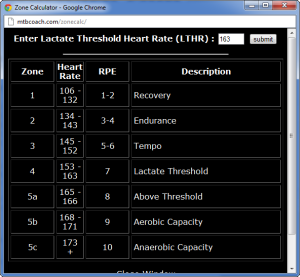
Math, for some of us, isn't our strong suit… especially when you are trying to compute specific training zones on the fly using Lactic/Anaerobic Thresholds (LT/AT) or Functional Threshold Power (FTP)
MTB coach Curt Wilhelm has created two easy to use, online tools you can find here.
And for you data junkies, Cycling Power Models has a very comprehensive tool that is sure to satisfy you for years.
A word of caution
The computer world has a saying; “garbage in = garbage out” which describes how using inaccurate (garbage) data to compute with can only lead to inaccurate (more garbage) results. The calculators above are designed for endurance athletes who have achieved a level of fitness and learned to tolerate the pain/discomfort of working at or above LT/AT or LT2 (upper Threshold) for extended periods of time.
In this three part series from last year; Is a 20 Minute Threshold Field Test realistic for your class? I discussed multiple reasons why I question using 20 minute field tests to determine Threshold Heart Rates for the “typical” student in your class. If you haven't read them I'd encourage you to do so now. My biggest issue with 20 minute field tests is that many of the Club Athletes in our classes haven't learned or developed the pain tolerance needed to sustain the Threshold level of intensity necessary to find an accurate average HR… but instead find some number below Threshold = “garbage in” 🙁
[wlm_firstname] if you feel you have a good understanding of your AT/LT/LT2 I'd like you to try one of the calculator above. Then consider what will happen if instead of entering a true Threshold HR, you use a HR 5%-8% below it.
Can you see how “garbage in” could have some students under training?
In case you are wondering, I see using HR training zones based on LT1 (Aerobic Threshold) as much more accurate for Club Athletes, especially when combined with the simplified Two Threshold – Three Zone system advocated by ACE – The American Council on Exercise.
Every now and then you come across a track out of the blue that just grabs you with it's energy and power that you makes it one you have to use in your next class, and Frank Eddie's (the new project from Lemon Jelly) Bite That is just that.
This 134bpm track clocks in just under 4 minutes but if you are versatile using MixMeister you can easily lengthen it out to 4 minutes.
This song is an aural recharge for tired legs and maybe flagging spirits of your riders on a long climbs as you use the energy and drive of the track to get them to kick the hills behind to show it who is the boss.
I love how this track first starts of building up just like calling down to the legs to keep it going and maybe even pick the pace up or get the class to take it out of the saddle as we all charge for the top.