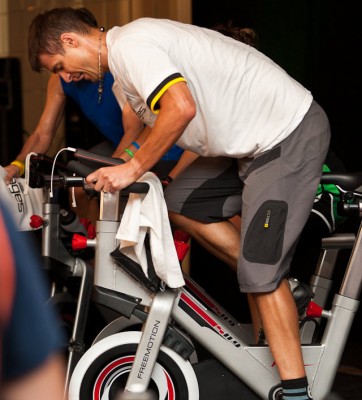
With the announcement that ICI/PRO Team Member Doug Rusho had joined Stages Indoor Cycling, I thought it would be interesting to learn the selection process that Cameron Chinatti used to pick Doug as their newest educator.
In this episode of the Podcast, Cameron, Doug and I discuss what Cameron was looking for in a potential Master Instructor and how Doug's willingness to “put himself out there” demonstrated who Doug is and his commitment to our industry.
This Friday brings you a 91 bpm flat that John “would never listen to”. However, it grabbed me, and my class liked it a lot last night as we worked sprints. It has some Michael Jackson flashback sounds (RIP Michael) and we held our working leg speed and high endurance heart rate for a 4:08 steady state break from sprinting. Chris Brown does a nice job on “She Ain’t You” from his F.A.M.E. CD. (By the way, John will end up listening to this when he takes my class on a Saturday morning!)
So the holidays are behind us, and hopefully the overabundant goodies. Some of our students may be back on a familiar January weight-loss track. I thought I’d address the topic of alcohol because it’s often consumed throughout the year and can definitely interfere with weight loss. There are several sabotaging factors in alcohol consumption.
– High calorie density. Alcohol has 7 calories per gram, while protein and carbs are 4 calories per gram. Only fats have greater density at 9 calories per gram.
– High insulin impact. Alcohol is a short-chain molecule that triggers high levels of insulin secretion. Insulin inhibits fat oxidation, lowering the 24-hour fat oxidation rate — an important factor in weight management — and promoting storage of dietary fat.
– Effect on appetite. Alcohol induces the release of beta-endorphin, which inhibits the satiety center of the brain. This may lead to a stronger and more frequent desire for food and a tendency to eat more at a given meal.
– Effect on food preferences. Alcohol’s beta-endorphin release may shift food preferences and cravings in the direction of sugars and fats. Eating more of those foods can lead to higher calorie intake, weight gain, even insulin resistance. Insulin resistance isn’t just the result of overweight, as is commonly believed; it can also be a cause.
– Effect on mood. Neurochemical alterations due to alcohol may result in such negative moods as depression or anxiety, as well as insomnia or disturbed sleep. These can cause a variety of issues that may affect weight:
a) Any negative mood may cause cravings, particularly for sugars or other refined carbs, and increase food consumption.
b) Serotonin is typically reduced with chronic alcohol use, and that can worsen mood and increase impulsivity. The combination may make it more likely that the student will get cravings and have difficulty resisting them.
c) Increased intake of sugars and refined carbs may lead to greater calorie intake and weight gain, further negative moods, or insomnia.
d) Alcohol disturbs sleep by interfering with the deep stages (theta- and delta-wave) that are most restorative.
e) Because of its high impact on insulin secretion, alcohol may trigger reactive hypoglycemia in susceptible individuals, which can disturb sleep by waking someone in the middle of the night and making it difficult to get back to sleep. Hypoglycemia may also result in undesirable moods, cravings and increased appetite.
f) Lack of sleep is known to raise ghrelin levels. Ghrelin has been shown to increase appetite and food intake while slowing metabolism.
g) Lack of sleep may make it difficult to train well or show up for early morning classes, and can lead to depression or other negative moods.
h) Negative moods may decrease motivation with respect to exercise altogether.
As you can tell, alcohol can get in the way of a student’s attempts to lose weight, and the sabotage goes far beyond the so-called “simple arithmetic” of calories in/calories out. What’s even worse is that, with the exception of calorie density, most of the factors above hold true for sugar, as well.
Meet Emmy Ragali, the owner of Go Cycle Studio in Chicago IL. Emmy is the first Beta instillation site for the Top Power Display System from Performance IQ.
I wanted to learn first hand what Emmy's experiences were using the Top Power display to show the wattage and RPM of each Keiser M3 her participants are riding.
You may have concerns about bringing competition into your class and so do I. During the interview I asked Emmy some specific questions about how her class accepted the competitive atmosphere that develops by having everyone's data displayed on a big screen.
While I was reviewing the Go Cycle website I noticed this link to an evaluation form where participants can give feed back on the quality of the Instructor and their class – I see this as an excellent idea and Emmy explained to me that it has been very helpful to her and her Instructors.
Listen to the Podcast below to hear all about Top Power.
No, I don't do the whole “Friday the 13th” bit.
But today's Free Music Friday is a bit unconventional in that it's a number of very long songs that you could incorporate into one of your endurance classes.
I'm really getting into the whole “Zen” thing and Trance music at the right BPM is really working and my class seems to enjoy it 🙂
These tracks aren't on Spotify – but you can download it for free.
What's cool about Magic Show (15 mins @ 100 BPM) is there is a fade to 3 minutes of quiet at the end. Not normally what you want, but I suggest giving it a try. My experience is that everyone will stay quite and use the quiet as a time to recover – maybe get a drink – all without me needing to say anything. Magic Show by David Steinlage
Right Click > Save As to download to your computer
I sure enjoyed talking with everyone who participated in Sunday's training 🙂
I'll be scheduling the next Spotify LIVE training soon – click here to get on the early notification list.
A number of you were interested in the little Tap to the Beat BPM counter I used when I sample music. Right Click the image to download. This is a very simple tool, tap your Space Bar or Enter Key in time with the music. Click the reset button to clear and start over. It doesn't do anything beyond display the average BPM you are tapping – it won't add the results to the song.
One of the best parts of conducting these live interactions is that I learn more about what is confusing to you – so I can help!
One PRO member asked the question; “when I click the link to one of the PRO Playlists for an Audio PROfile I see it in the main screen of Spotify, but it isn't added to my list of Playlists.
I see now that this is confusing, so here's what you need to do to save a PRO Playlist or a Playlist that was shared with you from another Spotify user.
1) Click the Spotify link included in each Audio PROfile.
2) The link will open a new browser window showing something similar to this;
Clicking the gray button will open the Playlist in Spotify:
Next you will see the new Playlist added to your list 🙂
Alternatively, if someone shares a Playlist directly with you, it will show in your Spotify Inbox