I've been bugging Gene Nacey at Cycling Fusion to send me some video clips of the classes they have been filming. He's finally caught up enough to begin providing them for you to watch.
There will be two versions avalible;
In the right hand side bar – scroll down to see it.
As ICI/PRO member only videos.
We are trying to get these on a somewhat regular schedule 🙂
Today I am introducing a rock band composed of classically trained cellists. Their music borrows elements from many genres including classical music, neo-classical metal, post-grunge, progressive metal, thrash metal and symphonic metal.
Riders in my class look up and ask, “Who is this????”, when their music comes on. It is moving, inspiring and just plain fabulous!
I have to give you three Friday Favorite’s from Apocalyptica today, because I simply cannot give you just one! All are from their most recent CD, 7th Symphony. The first is “Not Strong Enough”. With a cadence of 90, I have been using it for intense flat road work. Starting with just cellos, there is :10 for us to cue before Brent Smith (Shinedown) comes in with his awesome vocals. At :47 the chorus starts with increasing intensity for a nice build and then backs off at 1:10. I use the :35 seconds here to 1:45 to gently remind my class about form for the upcoming increase in load to the end of the song at 3:37. I think possibly a few of us can also relate to the lyrics. Take a look and listen here, but don’t go away, because I have more for you:
Also from the 7th Symphony CD (featuring Lacey from FlyLeaf), I love “Broken
Pieces”. I use it as a flat road resistance build over 3:55 (cadence 90), taking our
work zone right up to threshold. I go right into holding our threshold number
with the next track from 7th Symphony called, “On the Rooftop With Quasimodo”.
This is completely instrumental, but very layered and intense. It works perfectly
in helping riders focus on maintaining a specific heart rate number at threshold
for 5:00, which is challenging and needs very motivating music. This is it! Here are
videos of both songs:
I am not a super heavy metal girl, but if you are a fan, some of their stuff gets
really intense. Check it out and enjoy, enjoy, enjoy!
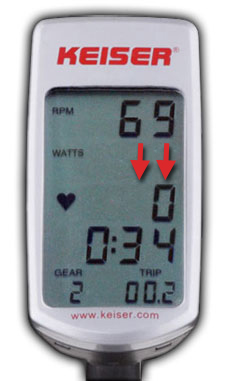
I coached one of the last weeks of Cycling Fusion’s winter training program with a focus on developing muscular strength. The indoor ride consisted of a 15-minute warm-up, 2 openers (short, high intensity efforts) and then 4 climbing strength intervals. The goal of the intervals was to sustain the maximum load (resistance) while maintaining a slower cadence for 3 minutes. Although I told the riders that the climbing cadences for all of the efforts were between 60 and 70 RPM, I failed to stress the importance of this leg speed for achieving the desired result — strength. I also failed to alert the class that their power output would be less than what they were accustomed (they were riding on Keiser M3 bikes).
As we started to tick off the intervals, I observed the cadences of many of the riders increasing noticeably above what was indicated. As usual, I had the music tempo set to the desired leg speed for each climb. As riders were cooling down after the last interval, I walked around the room to chat and see how different people did. It was interesting to note that many of the riders increased their power (watts) during each climb. Although in almost all circumstances this would have been a good thing, in this case it was not.
Now keep in mind that this group of riders was used to training with power and was also used to seeing a certain (higher) power number when climbing. In addition, they were used to climbing at tempos closer to 70-80 RPM. So when I asked them to climb at a leg speed of 60 RPM, they immediately noticed a lower power number. They associated this lower power output as “not good” and thus FIXED it by backing off some resistance and increasing their cadence. Were they wrong in doing this? Well, in a general sense, no. It actually shows they understand the impact of cadence (velocity) on power output. However, in this case, the focus was on developing muscular strength which demands an emphasis on workload and not power output. The goal was to apply maximum force (stress) to the muscles of the legs for the entire 3 minutes. So during this workout, it was more important to target a slower (60 RPM) leg speed in order to maximize strength development.
SIDE NOTE: Having power meters during drills like this are still very important. Even though we are not going to expect the highest watts, we do want to make sure we are maintaining a consistent power output for each interval. This is one of the ways power is such a valuable tool. If we only have a heart rate monitor, we may observe the same or higher heart rates for each of the 4 climbing efforts. This only shows what the effort is costing our body and not how much is being produced. The addition of power allows us to see if we are maintaining a constant power output for each effort or if our power is dropping even though our heart rate remains the same or increases.
So if you are designing a class that focuses on developing leg strength, avoid the error I made and emphasis the importance of a sustainable 60-70 RPM cadence. I would also encourage the use of music that matches the desired leg speed so riders can feel the pulse. Music at 60 RPM (or 120 RPM/BPM) is usually the easiest to find since dance music is often at this tempo. And, as always, make sure your riders maintain good form and are instructed to work at their own pace particularly if they are nursing leg, back or neck injuries.
In this post I mentioned that I was using a Blink Heart Rate monitor because I can't see the numbers any more. It's flashing light shows me when I'm below JRA ( T1 or aerobic threshold), between T1 and T2 (T2 is anaerobic threshold) or above T2. Very simple. I like simple when it comes to trying to communicate with my class.
ICI/PRO member Chuck Cali has a fun video he shot as a way for users to learn a very simple assessment of T1 and T2. Except he doesn't call them T1 and T2… Instead he talks about Blue, Yellow and Red. Very simple 🙂
Please watch this and consider if this would be something you could teach on the bike as an introduction to Heart Rate training.
I was completely over-the-top ecstatic to come across an article in this month's Sports Medicine relating to new recommendations for exercise during pregnancy (Zavorsky & Longo, 2011). My experience during my medical training thus far is that, with pregnant patients just as non-pregnant patients, there is not a whole lot of discussion about exercise intensity. It's either “it's safe to exercise, and you should” vs. “it's not safe to exercise; don't.” For some pregnant patients, this is adequate; for many, it's not. So when this latest contribution to the medical literature purported to provide recommendations for exercise intensity during pregnancy with specificity unlike any before it, I was beside myself. That's what I get for getting this excited over a journal article…
A bit of history: In 2002, the American College of Obstetricians and Gynecologists issued guidelines for exercise during pregnancy and the immediate postpartum period. While very helpful in terms of issuing absolute and relative contraindications for exercise, criticism arose in response to its lack of specificity about intensity and duration. In 2003, the Society for Obstetricians and Gynecologists of Canada took a stab at its own guidelines, and prescribed a thorough set of heart rate guidelines (as in, specific heart rates — imagine?) for women with uncomplicated pregnancies, theoretically based on modified calculations for maximum heart rate (Zavorsky & Longo, 2011). Sigh. So here we are in 2011, where the authors of this latest review of evidence are advocating for calculating heart rate reserve percentages (as in, another formula that includes maximum heart rate). You know how we at ICI feel about maximum heart rate formulas.
But rather than be disappointed about the lack of practicality that I feel these specific intensity guidelines provide for me both for the pregnant women I train or the pregnant women I see in clinic, I think there is still some general principles we can learn from my synopsis of all three sets of recommendations. Note: I will be speaking with reference to only uncomplicated pregnancies.
1. In the absence of medical contraindications, regular exercise during pregnancy is good.
There is evidence that it can prevent and help manage gestational diabetes, help reduce excessive weight gain during pregnancy (Zavorsky & Longo, 2011) – for women with normal pre-pregnancy weights, we aim for pregnancy weight gain of 25–35 lbs. All pregnant women should be evaluated by their physician to evaluate whether there are any absolute or relative contraindications to exercise (Artal & O'Toole, 2003; Davies et al, 2003). If you have riders in your indoor cycling class who are pregnant, you should ask them if they have been evaluated by their doctors and whether they have been advised of any restrictions. There are a lot of good books from respected experts you may want to read.
2. ACOG has described warning signs that pregnant women should stop exercising. You should be aware of these warning signs in case you see them, and refer your clients to medical attention.
These include vaginal bleeding, shortness of breath before beginning exercise, dizziness, headache, chest pain, weakness, calf pain/swelling (I actually saw this during my 1st week as an indoor cycling instructor — I'd had no medical training at that time but decided it didn't look right, and told my client I thought she should leave class and call her doctor immediately. She did and, turns out, she had a deep venous thrombosis — or blood clot — in her calf. High levels of estrogen during pregnancy predispose people to blood clots.), amniotic fluid leakage, signs of preterm labor (Artal & O'Toole, 2003; Davies et al, 2003).
3. If I leave you with nothing else: Turn the AC/fans on.
Go dig up Gene Nacey's epic article about why we need ventilation to facilitate evaporative cooling during an indoor cycling class, and how dangerous it is to fail to do so. Take that, and magnify the risk for a pregnant woman. During pregnancy, core body temperature is elevated at baseline. During exercise, core body temperature rises further. If a pregnant women exercises in a neutral or cool temperature, as well as maintains adequate hydration and electrolyte balance, there should be no negative impact on the fetus. The best indicator of whether thermoregulation is going ok is the pregnant woman's subjective account (Artal & O'Toole, 2003). If she feels too hot, she is too hot and needs to change her environment; she should feel comfortable at all times, regardless of her (or her co-riders') desire to sweat buckets in your class.
4. Pregnant women need to accommodate for the normal physiological changes that occur to their musculoskeletal and cardiovascular (among other) systems. With knowledge about what is happening, modifications to exercise regimens should be based on common sense.
During pregnancy, connective tissue gets more lax (one might reason that looser ligaments are a pretty convenient adaptation, given what needs to happen during labor). With ligament instability in addition to weight gain causing increase force across the hips and knees, pregnant women may be more prone to musculoskeletal injury. Walking lunges may be particularly risky with lax pelvic ligaments, and should be avoided. Strength-training is best done with light weights/high repetitions (we know that women won't be accomplishing much in the way of muscle strength building — and that's ok. The idea is to keep building muscular endurance). Heavy weights or isometric exercises should be avoided, due to theoretical compromise in fetal blood flow. Women should also be advised not to lift anything while laying on their backs — this position puts pressure on an important vein called the inferior vena cava, which decreases cardiac output (doing the same exercise on an inclined bench is fine). Strength-training with resistance bands may be safer than free weights, given the possibility of inadvertently knocking into the abdomen (Zavorsky & Longo, 2011). Speaking of which: Contact sports should be avoided, as should activities that increase risk of falling (a stationary bike should theoretically be fine). With increased basal metabolic rate, pregnant women have increased nutritional requirements — she needs to replete even more fuel before, during, and after exercise than she did prior to pregnancy. Lastly, there are dramatic changes to the cardiovascular system: increase in blood volume, heart rate, stroke volume (how much blood is ejected from the heart with each heart muscle contraction) increase; the resistance within blood vessels decreases (leading to a drop in blood pressure). So even a well-trained athlete is going to experience a different response to the same intensity of exercise, and may need to scale back her efforts (Artal & O'Toole, 2003).
5. Stay aerobic.
For all the discussion of METs and % HRR and blah blah maximum heart rate formulas, it all comes down to this: all the research on safety in exercise, even “vigorous” exercise, during pregnancy is referring to intensity levels that we would still define as sub-lactate threshold, even if the researchers never call it that. I am not a doctor yet, but I will be recommending to my future patients that they “stay aerobic” during pregnancy. If you have a pregnant rider in your class where you are incorporating anaerobic intervals, I would strongly suggest encouraging her to modify her efforts. Use of a heart rate monitor during pregnancy is difficult — evidence is mixed for how HR responds to exercise during pregnancy (Zavorksy & Longo, 2011): some women have a blunted HR response (as in taking a beta blocker!); some do not. Most women have an increase in resting HR (Artal & O'Toole, 2003). Due to these irregularities, rate of perceived exertion (RPE) is the way to go.
6. Pregnancy is not a time for achieving peak fitness or any sort of hardcore training. The idea is to keep moving and keep comfortable.
30 minutes most, if not all, days at that “light” to “somewhat hard” RPE (Davies et al, 2003). If a woman is exercising longer or more intensely than that, the number of days per week can be decreased (Artal & O'Toole, 2003). If a woman had been previously inactive, she should begin with 15 minute sessions and gradually increase to 30 minutes (Davies et al, 2003). As explained earlier, attention should be given to adequate nutrition, hydration, and proper evaporative cooling (i.e., turn the AC on). In the absence of complications and medical restrictions, this should be continued throughout the pregnancy (Zavorsky & Longo, 2011).
You can go a long way with your pregnant clients just by asking if there is anything that is making them uncomfortable, and making common-sense recommendations for them to modify what they're doing. For example, early in my career I had a rider in an indoor cycling class who refused to acknowledge my gentle cueing to hold onto the handlebars during class. I was a substitute instructor and lacked confidence that I'd be able to accomplish anything, so decided to “let it go.” Then it occurred to me to ask her about it. “I can't help but notice that you're not holding onto the handlebars. How did you come to decide to do that?” She told me that she was pregnant, and that leading forward on to grasp the handlebars caused her a lot of pressure in her abdomen. I smiled and showed her that we could raise the handlebars so that she wouldn't have to lean over (remember: proper handlebar setup is only based on comfort!). She was thrilled! And just like that, we worked together so that she could enjoy her indoor cycling experience and derive all of its physical and psychological benefits — safely.
Both in pregnancy and non-pregnancy, the idea is that folks should listen to their bodies. We all have clients who struggle with this, and perhaps we struggle with it ourselves. In pregnancy, however, there is the “permissive” external motivation to decide when enough is enough — and for that to be perfectly okay. (Note: it's always okay.)
References
Artal R, O'Toole M. (2003) Guidelines of the American College of Obstetricians and Gynecologists for exercise during pregnancy the postpartum period. British Journal of Sports Med; 37:6-12
Davies GAL, Wolfe LA, Mottola MF, MacKinnon C. (2003). Exercise in Pregnancy and the Postpartum Period. Joint SOGC/CSEP Clinical Practice Guidelines, No. 129, June 2003
Zavorsky GS, Longo LD. (2011). Exercise Guidelines in Pregnancy: New perspectives. Sports Medicine, 41(5): 345-360
The author is in her final year of medical school at the University of Vermont College of Medicine in Burlington, Vermont. Author of the popular coaching motivation blog, Spintastic (http://spintastic.blogspot.com), her research interests include the psychological effects of heart rate training and use of heart rate monitors for anxiety treatment.
Have a medical research question for the ICI team? E-mail melissa.marotta@uvm.edu.
I am not typically a fan of “live” CD’s, and usually prefer the studio cuts, but
this “live” version rocks. It has just the right amount of crowd in the background
and newness to the tunes. We have been jamming up a moderate climb in my
class to Sting’s (If You Love Someone) Set Them Free, from his All This Time (Live)
CD. The cadence is 68 and the song lasts 4:57 minutes. It builds beautifully at
2:40, 3:15 and blasts wide open at 4:00 to a huge “Sting freestyle”! This concert
was recorded in Italy on September 11, 2001 and Sting dedicated the concert to
all that lost their lives that day in the New York terrorist attack. Here he is that
night doing his thing:
Two other great cycle class tunes on the All This Time (Live) CD:
If I Ever Lose My Faith In You RPM 60, 4:31. Great horns and strings!
Brand New Day RPM 60, 4:47. Kind of a “Big Band” rendition. I am definitely
using this soon.
See you all next Friday!
Here's this weeks free tracks.
Both of these are off a new release from the band Blame Sally and I can hear using them back to back as a nice climb and then a fun downhill recovery.



 Today I am introducing a rock band composed of classically trained cellists. Their music borrows elements from many genres including classical music, neo-classical metal, post-grunge, progressive metal, thrash metal and symphonic metal.
 “Gogglebox”
 Buy at




 you may want to read.
 Buy at