When I heard about a SPINNING® Certification Workshop being offered just minutes from my home-base in Eden Prairie, Minnesota, I jumped at the opportunity to sign up. Believe it or not, I have been teaching indoor cycling for nearly four years, but never received formal training on the bike. The workshop I attended was held in Minnetonka, Minnesota, on July 23rd, 2011, and was led by Seth Dedmon, from Tennessee. Seth epitomizes what it means to be a great workshop facilitator. His energy, sense of humor, and thick Tennessee accent made me want to listen, and his knowledge base from years of experience had me jotting down notes and quotes almost non-stop.
The nine-hour event was broken down into four sections:
– Bike Setup/Safety
– Form
– Heart Rate Training
– Class Design
Bike Setup/Safety
We spent the early part of the workshop learning how to properly set someone up on the bike. Because I had never been formally trained to teach indoor cycling; I knew that the bend in the knee should not be more than 25 degrees, but not much else. After completing this portion of the workshop, I now have a systematic approach to bike setup and feel completely confident with the entire process.
Form
Second on the agenda was form. During this part of the workshop, we were on the bikes for over an hour with absolutely no music (Imagine that!) and Seth led us through a series of drills while teaching us proper form for seated and standing flats, climbs, jumps, sprints, and running with resistance. Many of the participants — including me — realized form is something even we need help with from time-to-time.
Heart Rate Training
As someone who does not own a heart rate monitor, this was the time of the day when Seth convinced me to buy one. Additionally, he discussed the five types of cycling workouts — recovery, endurance, strength, interval, and race day — and their corresponding heart rates. Seth’s instruction helped me understand the benefit of workout periodization and encouraged me to make certain each class has a specific purpose.
Class Design
Finally, we learned about class design. As a team, we worked together to build unique profiles (workout routines) and also talked about the importance of using music to create feeling and emotion in class. It has always been a personal priority of mine to consistently create new playlists, but Seth encouraged me to broaden my horizons and search for songs from a wider spectrum of genres — from reggae and classical to tribal and alternative.
Sample Class
To top off the day’s experience, Seth had us get back on the bikes for a sample class, and he actually instructed off the bike. To our surprise, he encouraged us to do the same from time-to-time, as it allows the instructor to give riders personal attention, correct form when necessary, and check in on participant heart rates. Quite honestly, his brief, 30 minute class was one of, if not the best, cycling experiences I have ever had because of the ambience he created in the room. It motivated me to become a better instructor.
The Takeaway
In addition to what I learned about bike setup/safety, form, heart rate training, and class design, I learned two things. First, I discovered that indoor cycling is very much a mind/body form of exercise and have a stronger desire to encourage visualization through music, class design, and my words. Additionally, I realized that instructors reach plateaus in their teaching just as the everyday exerciser reaches ruts in their training. The entire day left me feeling empowered to continually improve my teaching so that participants — our number one priority — remain excited about their health and fitness.
*Jennifer Lintz is a Nutritionist, AFAA Certified Group Exercise Instructor, Certified SPINNING® Instructor, and ACE Certified Personal Trainer. Visit her web site at www.wellnessbyjennifer.com.
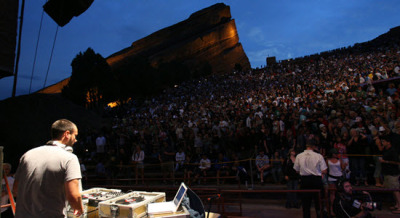
DJ Scott Melker playing the Red Rocks Amphitheatre in Golden, CO
As many of you know I've worn many hats in the fitness industry, I've been an Assistant General Manager, Operations Manager, Fitness Director, Triathlon Coach, Master Swim Team Coach, Master Educator, Personal Trainer, Group Exercise and Indoor Cycling Instructor. Throughout my almost 25 years in this customer service industry I have heard many member comments, complaints and compliments. Through these years I have grown a thick skin but the one comment that still cuts the deepest is when I hear that someone complains about my music. Being an indoor cycling instructor has, forever, changed the way I listen to all music. Music is now put into two categories; will this song work in class or not. I'm on a never ending search for the perfect indoor cycling song. This search reminds me of the story of Sisyphus from Greek mythology. He was punished for chronic deceitfulness by being compelled to roll an immense boulder up a hill, only to watch it roll back down, and to repeat this action forever. After I find the “perfect” indoor cycling song I feel I'm on the same journey at Sisyphus. I find the song, listen to it, probably 20 times, find all the beat and energy changes, figure out a profile for it, listen to it another 20 times imagining my profile being used with the song, use it in a class, make changes, use it again in a class, perfect it, then when I finally push this boulder to the top of the hill and have produced the perfect mix of music, movement, rhythm and riding it's time to start this process all over again because riders are getting tired of this “perfect” song.
Around the same time John and Scott announced their “ICI/Pro DJ Scott Melker Music Playlist Contest” I was in a state of the dreaded “profile writers block” and I was told that a club member had commented about the lack of variety in my music. Yes, at first I was offended, but then I thought maybe the announcement of this contest and these negative comments were a sign. I decided to take on the challenge of using Scott's playlist and building the best profile I could. This project was extremely challenging for me, I'm usually a profile first music second type of class builder, this forced me to swap my way of thinking. Scott's playlist included some songs that I never imagined playing in an indoor cycling class, when I first heard them I immediately put them in the song category of “will not work in a class”, but I was being forced to use them so I had to figure out how to make them work. After countless hours of listening to Scott's playlist and tweaking my profile, I believe I have come up with a class that uses the artistry and energy of a playlist put together by one of the world's top DJs, while staying true to my scientifically proven teaching methods.
I hope you find this class profile both fun and effective, my class sure did.
I challenge you to step out of your comfort zone and create your own profile for this contest.
Scott Melker's Playlist, to download Right Click > Save As / Save Target As to download. Open in iTunes and then you'll see this in your Spotify Local File folder.
Building a class profile can be one of the most enjoyable aspects of teaching Indoor Cycling. Instructors sometimes find it stressful because they feel they’re “out of ideas.”
There are many approaches to class design. A few possibilities are: music as the road; duplicating an actual ride profile with which you’re familiar; fully interacting with selected videos; teaching cycling principles and philosophy; and eliciting specific training adaptations.
A general approach can become static over time. That’s what’s so much fun. Because of the many training elements that indoor cycling utilizes, any general approach can remain fresh and inspiring. Indoor cycling lends itself to structure, so it’s easy to formulate new and exciting variations on common training formats.
Intervals are a perfect example; every instructor uses them. There are thousands of ways to put a class through intervals. But the creative instructor is the one who comes up with an interval format you haven’t experienced before.
Once I decide on my approach to building my class for the day, my mind searches for an organizational format that supports the approach. For example, I decide that my approach to today’s class will be to teach a cycling principle. The principle will be cadence. With my approach and underlying principle selected, I need a structure to support that principle — and make the class enjoyable at the same time. It’s that last part that may take some creativity.
Having planned thousands of classes over the years, I frequently return to four basic organizational formats: Intervals, Ladders (or Ramps), Pyramids, or Steady State. These four organizational formats form the backbone that supports any indoor cycling class. The key to creative instruction is to find new ways to use them.
INTERVALS
Interval training is a common training technique designed to improve strength, power, aerobic capacity or endurance. It alternates periods of higher-intensity work with periods of recovery (i.e., lower-intensity work). Depending on the length of the work and rest periods, intervals may be aerobic or anaerobic. The higher-intensity periods instructors typically use are at, or close to, an anaerobic level of effort, but they can actually be of any intensity. That fact alone can generate a great deal of variation in a class.
The ratio of work to recovery will usually vary with the intensity of the work effort. Max-effort intervals, for example, are necessarily short, with recovery periods of equal or greater duration than the work interval. Aerobic intervals may be longer and require much briefer recovery. The recovery periods may permit either complete recovery (full drop in heart rate) or limited recovery of lower, but not resting-level, intensity.
Sample interval workout:
5 minutes of warm-up: light ride, low intensity, gradually increasing at the end of the warm-up period
1 minute of moderate or high intensity, followed by 1 minute of low intensity. Repeat six to eight times.
5 minutes of cool-down: light ride, low intensity, gradually decreasing by the end of the cool-down period
The above is a standard interval format that every indoor cycling instructor has used in his or her class at one time or another.
How can the intervals be varied? Here are some suggestions.
Use different durations for the work and recovery efforts. A 2:1 format, with 2 minutes of seated climb at 75 RPM and 1 minute of recovery spin at 100 RPM is a good rollers simulation.
Alternate the difference. 2:1, 1:2, 2:1, 1:2. 2 minutes moderately hard with 1 minute of recovery, followed by 1 minute very hard with 2 minutes of recovery.
Vary the recovery. 2:1, 2:3, 2:1, 2:3. 2 minutes very hard with 1 minute of limited recovery, followed by another 2 minutes very hard with 3 minutes of full recovery.
Vary with no pattern. This is called “fartlek.” The name is Swedish for “speed play”. It consists of hard-effort bursts of different durations, followed by recovery of different durations. The lack of predictability increases overall intensity, compared with standard interval training. 2:1, 4:1, 2:5, 3:3, 1:2, 4:3.
LADDERS
A ladder, also known as a ramp, is a training technique that involves progressive, incremental increases in one or more training variables, such as duration, resistance, cadence or heart rate. The progression can either increase or decrease. The ladder can be continuous or in interval format.
Here are some examples of a ladder, using an interval format:
Increase the work duration, keeping the recovery constant. 1:1, 2:1, 3:1, 4:1.
Decrease the work duration, keeping the recovery constant. 4:1, 3:1, 2:1, 1:1. These “descending intervals” are a commonly used form of a decreasing ladder. As the interval duration decreases, some other training variable increases.
Maintain the work duration while decreasing the recovery. 1min:1min, 1min:45sec, 1min:30sec, 1min:15sec.
Increase the work and decrease the recovery. 0:2min, 30sec:1min, 45sec:45sec, 1min:30sec, 2min:0. Easy for 2 minutes, followed by 30 sec hard with 1 minute easy, followed by 45 sec hard and 45 sec easy, followed by 1 min hard and 30 sec easy, catch your breath quickly and hammer the last 2 minutes.
A ladder can also be continuous. My favorite is a 10-minute, 4-3-2-1 format: 4 minutes easy, 3 minutes a little harder, 2 minutes a little harder, and 1 minute hard. These are done with no recovery between them. The often-used song Mojave by Afro Celt Sound System is perfect for a 10-minute, 4-3-2-1 ladder.
The next post will cover variations in pyramids and steady state training.
By Jennifer Lintz, RD, LD, and ICI/PRO Contributor
Isn't it nice to get a pat on the back from time-to-time?
Even though coming to a cycle class – or working out, period – may not be a big deal for some of our participants, it can be a huge feat for others. One of my goals recently has been to make sure I let my participants know how awesome it is that they simply showed up.
To be clear, I am striving to say more than “I'm so glad you came today!” and “Good job!”
I truly want to drive home the message that our students – whether rookie or veteran – are amazing. Sure, some people may not need to hear a peep of praise, but others would love a little genuine encouragement and recognition.
Here are some examples.
Early Risers – I teach a class at 5:15 a.m. once a week, and am constantly impressed by the number of people who regularly come to class at this hour. For this crowd, I might say something like: “Talk about starting your day on the right foot. It's 5:15 a.m. and there are a lot of people still sleeping. You could have hit snooze and caught a few more minutes of sleep, but instead, you showed up to work hard. Kudos to you for that.”
Weekend Crew – At one of my colleague's Saturday morning class this fall, I specifically remember her telling us (the class) how stellar we were for getting up before 8 a.m. on a weekend. Not expecting recognition for showing up, her comment caught me off guard; but, it was very well-received. The unexpected encouragement and positive comment motivated from the get-go.
Evening Group – I teach a couple of classes in the evening throughout the week, and have found several ways to give a shout out to the folks in this time frame. For example, “I know how easy it is to find excuses to skip a workout after a long day, but the fact that you all showed up speaks leaps and bounds about how committed you are.” Or, “There were probably a long list of obstacles that could have kept you away from this class; the couch, a TV show, your pajamas, or just feeling tired. What's awesome is that you resisted those temptations, didn't give into excuses, and are here.”
Thursday Devotees – Where I instruct, Thursday is one of the lowest-utilized days, not just in cycle, but throughout the entire facility. My Thursday night crew knows it! Why? I tell them. They hear me say things like “This is the day of the week when the fewest amount of people come to the gym. None of you fall into that category. You are here and, therefore, you are amazing. Thank you for showing up!”
These are just a few samples of what I might say to guys and gals who come to my classes. I understand that, some days, it is HARD to find any energy, motivation, desire – you name it – to exercise. I get that there are things that come up. I'll be the first to admit that there are days when I struggle to get my workouts in, too.
Because I know how difficult it can be, I have a burning desire to let my students know just how much they ROCK for dodging all of the obstacles that may have been in their way.
I would love to hear about the ways you commend your students for just showing up.
In this article, Dr. Haley Perlus discusses how to use KISS (kiss-keep-it-simple-and-specific) principles in your class communication. Here is a great example of KISS in practice. I took this picture at a class taught by our very own Master Instructor Jennifer Sage 🙂
Hey John,
As the Olympics have started – I wondered if you could remind me of some of the class profiles that ICI/Pro has published that involve participation from the class as a group ; ie. friendly competition? I am pretty sure there was at least one post like that – I just can't seem to recall the title.
Thanks again. ICI Pro has been a great resource for me.
Best,
Barb
Thanks Barb – Yes, we do indeed have just such a ride 🙂
Created by Stages Indoor Cycling Master Trainers; Cameron Chinatti and Pam Benchley, Saturday with Stages BIG RIDE is a team focused class and a big hit at our our last ICI/PRO conference in 2011. Wouldn't it be cool if we could do this again?
At the time of this conference, the FreeMotion Indoor Cycles were brand new – we were so honored to have them as a sponsor of this event. In retrospect, watching this video now two years later, it's easy to see why Cameron and co. have become such an important players in our industry!
The film crew from Cycling Fusion shot this video during the event. Unfortunately our license to display this video ended a while back – so we haven't had it available. Barb's email prompted me to ask Gene Nacey and he's letting us display this video profile yet again 🙂
[!private ‘PRO-Platinum|PRO-Monthly|PRO-Gratis|PRO-Seasonal|Platinum-trial|Monthly-trial|PRO-Military|30-Days-of-PRO|90 Day PRO|Stages-Instructor|Schwinn-Instructor|Instructor-Bonus|28 Day Challenge']
Cameron and I also recorded a companion Audio PROfile to go along with this video + a pdf you can download and print out. I'm re-publishing it so it will trigger the auto-email announcement 🙂