As our outdoor season, at least road bike
season — there is still plenty of Mtn Biking to be had, comes to an end we are
all faced with the question of what to do with our gear. Unlike running or
swimming where all your gear can be stored in a backpack in your closet, a bike
is a pretty large piece of equipment that requires much more real estate in
your home or garage. Multiply this several times over (N+1 rule, please), and
you'll have a mess on your hands.
There's a whole host of
ways to store your bike inside, but we'll address a few of the most common
methods. Of course, simply leaving a bike or three in the hallway is always an
option, but in case your significant other isn't OK with that, these are some
great alternatives.
Bike Hoist
One of the more complex
storage solutions out there, a bike hoist is exactly what it sounds like: a way
to lift your bike off the ground and store it in the rafters. It utilizes a
pully system where you simply hook the bike's saddle and handlebars and slowly
lift the bike by pulling on the rope. This storage method is perfect for rooms
or garages with high ceilings where having a bike hanging above won't pose a
risk for cars pulling in or people walking by.
Ceiling Mounts
For houses or apartments
with limited floor storage space, ceiling mounts are a great solution. Similar
to a bike hoist, this method stores bikes upside-down, off the ground by means
of hooks. I have used hooks in the garage for years and one of the great
things is that the bike is usually high enough that you can get the hood of
your car under it to maximize space.
Wall Mounts
Leaning a bike leaning
against a wall in the garage poses a risk of it being knocked over (usually in
slow motion, with a crash, bang and a few cuss words thrown in). A wall mount
still keeps a bike parallel to the wall, but it suspends it off the ground by
cradling the bike with hooks on the top tube. It's more secure, and depending
on the size of the bike, wall mounts will often allow one bike to be stored
above the other on the same wall.
Note that some
ultra-lightweight carbon frame manufacturers suggest no pressure be put on the
top tube. Keep this in mind when deciding if a wall mount is right for
you.
Gravity Stands
If you're renting your
living space, you may not want to put holes in the wall to mount hooks or
hardware to store your bike. Gravity stands are a nice alternative–they keep
your bike (in this case, bikes) off the ground and are designed to
safely lean against a wall. They're compact, adjustable and give you the
flexibility to store your bikes wherever you move the stand.
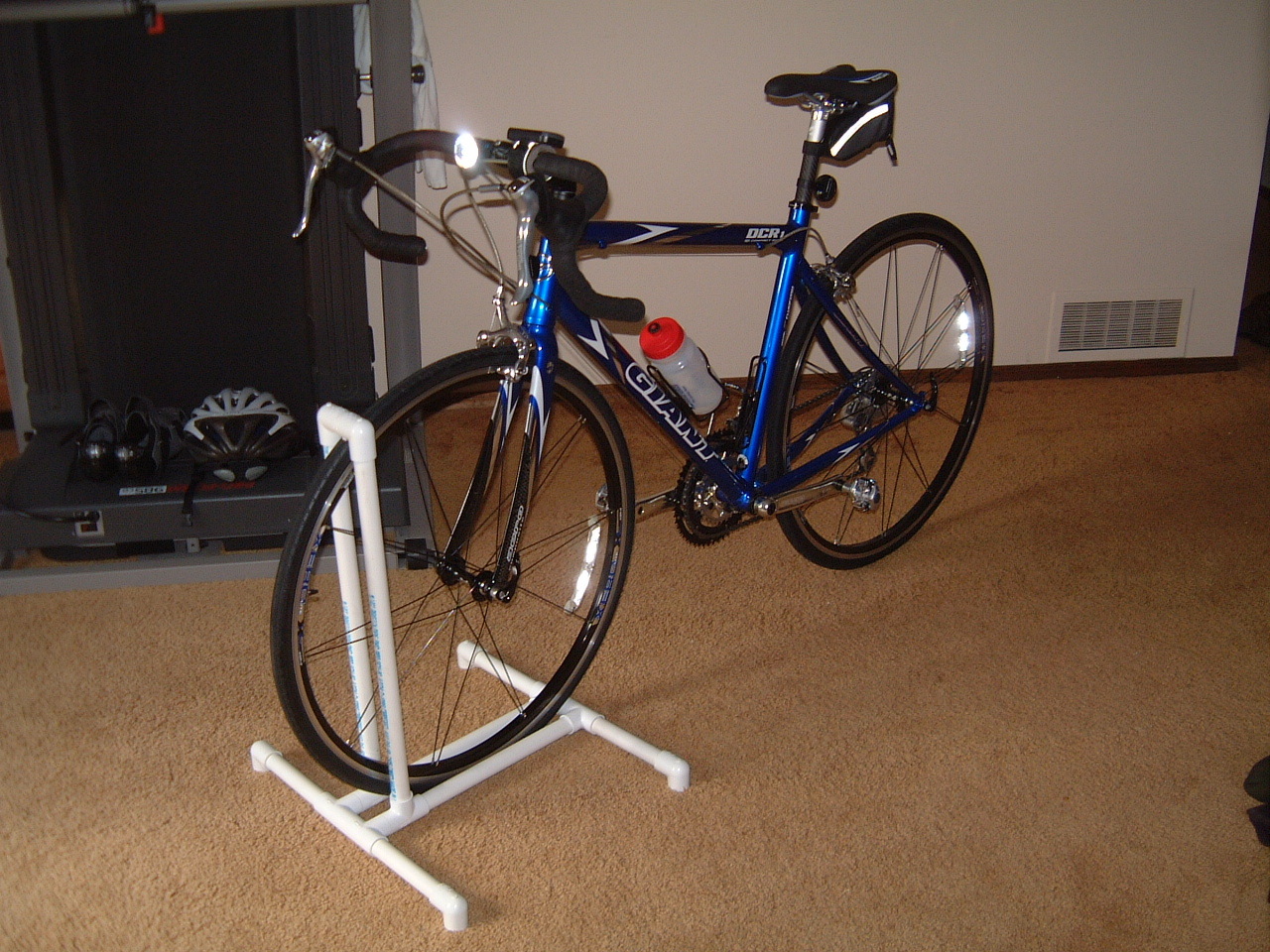
Floor Stands
Floor stands have come a
long way since the fixed metal bike racks at your school when you were a kid,
although the four bike one currently in my basement still looks a lot like that.
While you can still find racks that hold your bike upright by sliding the wheel
into the slot (the one that I have), it's more and more common to see floor
stands that prop a bike up by its rear hub. These floor stands utilize the gap
between the frame and the hub, and are often compatible with both road and
mountain bikes.
I hope this helps you to
organize your space a little bit while you get ready for the Winter Training
season.
[wlm_private ‘PRO-Platinum|PRO-Monthly|PRO-Gratis|PRO-Seasonal|Platinum-trial|Monthly-trial|PRO-Military|30-Days-of-PRO|90 Day PRO|Stages-Instructor|Schwinn-Instructor|Instructor-Bonus|28 Day Challenge']
Note: Gino's articles are supposed to be for ICI/PRO members only. He feels very strongly about this subject and asked that I make it available for everyone. – John
As an Indoor Cycling / Spinning® instructor, you know how important good air flow is. Don’t you? What??? You LIKE your students to sweat buckets!?! It proves how “kick-ass” your class is? Uh… well… not so fast. If that were true, then just build a bunch of steam rooms and saunas and let people sit and sweat. Ah, but it’s not that simple is it? You know they don’t lose real weight that way. It’s just water. But really, it’s worse than that.
Short of provoking a sexual harassment suit, this maybe the best way to get your class excited about what you have in store for them.
I’m grateful because my riders often take the time to leave comment cards at the club’s front desk after class and my group fitness directors continually share the feedback with me. One “positive” comment that has been consistent is that members feels that I “set them up for success” from the start. When pushed further, they said, “Tom always tells us what his goal for us is and then how we are going to accomplish it”.
I — MUST — HAVE — AN – OBJECTIVE
As an indoor cycling instructor, I’m a slave to my coaching tendencies. Simply put, I can’t design a ride unless I have a clear objective. Because of my cyclist tunnel vision, I consider indoor classes either a training session or event (something we have trained for). So before I start selecting drills or music, I first determine my overall goal for the ride. Am I trying to help them develop some aspect of their fitness (if so, what is it)? Is the goal to climb to the top of a feared moutain? Are we racing in a stage of the Tour de France or a local criterium? I can’t help myself — I MUST HAVE A PURPOSE! Fortunately, this seems to be viewed as a positive.
Do You Have An Objective For Your Class?
Instructors often mistake all of the tedious work that goes into a profile as the objective. I do not doubt that a tremendous amount of time was invested in creating our ride profile, but more specifically, was the class designed around an objective. To find out, ask yourself, “What is the purpose of this ride? What does it produce or help my riders achieve?” Unfortunately, an answer of “to develop general fitness” usually doesn’t cut it.
Do You Explain the Objective To Your Class?
I proctor numerous auditions for instructors and sometimes sit in on classes (usually spying). In most cases, I’ll take a moment to talk with the instructor afterwards to introduce myself and ask a few questions about the ride. I’ve been pleasantly surprised to discover that many instructors have some cool objectives for their ride, but never told the class. They were equally surprised that riders would be interested in that level of detail. “Absolutely, it demonstrates not only a purpose for the ride, but the amount of thought and planning that went into designing it. Your class wants to know what to expect (physical demands), as well as, what (long-term) value it will provide.”
A Sample From This Week’s Ride
Here is the objective I communicated to my class for this weeks leg speed development ride:
“One key element of cycling fitness is steady, fast and powerful leg speed. Since we are in our base training mode, this is a perfect time to focus on it. We are going to approach this by first performing a drill that helps engage more muscle followed by a series of drills that trains the brain to send the signal to the muscle quicker so we can pedal faster and stronger.
Keep in mind, as you look at today’s profile (I hang an 11”x17” color laminated chart for each class) you will see a number of consecutive drills before we receive more substantial recovery. So pace yourself. Finally, remember that leg speed is a skill that must be trained. Be patient as you develop your own leg speed. It takes time.”
———————————
If you are in the habit of creating classes with a specific focus or training objective, make it known to your riders AND reiterate after class the value they received. If you have not been approaching your rides with a specific purpose, I want to encourage you to start. You don’t have to be “Joe Coach”, but it should be something that can be explained to your riders. Practice saying your objective out-loud and to yourself. If you are finding it difficult to come up with an objective for an existing class, well…. you may want to revisit the profile and tweak it until you can explain its purpose.
Just to clarify, “fun” is not a purpose, but rather how you deliver it. So Have fun! Really!
Gene Nacey and Tom Scotto kept this a secret during the ICI/PRO conference … Cycling Fusion and Stage 5 Cycling have merged their Indoor Cycling certifications into one. They will operate under Cycling Fusion for Indoor Cycle Certification and Stage 5 Cycling will continue to provide Outdoor Cyclist training.
Lots to understand about what this means and we try to answer your potential questions in this interview with Gene Nacey and Tom Scotto. Information about our lost Podcast episodes is here ICI Podcast — The Lost Episodes