What Rocket Scientist at Spotify thought this would be a good idea?
What the @#$%^& was Spotify thinking by removing the total playlist time in the latest update? The number of followers has zero value to me when I'm building a playlist.
Last week my Spotify displayed this message offering to update, which I regrettably did.
Don't upgrade Spotify if you want to keep your playlist timer.
Now I have no clue about the total length of the playlist. Chris Hawthorne and I are trying to find a work-around, but for now I suggest using the little X in the right hand corner of the update notice if you haven't updated yet.
Cycling performance is all about oxygen. Muscle cells need oxygen to burn fuel and produce the energy necessary to power the muscle contractions that move us. This is known as cellular respiration.
All indoor-cycling instructors have received rudimentary training around proper breathing on the bicycle, but it’s rarely the focus of a class. Think about it. Can you create and lead a class profile that focuses just on breathing exercises and make it compelling for 45-60 minutes?
OK, you’re thinking, “Why would I want to?” But evidence indicates that we can improve breathing capacity with “inspiratory” muscle training and improve both performance and comfort. In “Endurance training of respiratory muscles improves cycling performance in fit young cyclists” by Holm et al (2004), riders rode a simulated 40-kilometer race on a computerized exercise bike after weeks of inspiratory training. Neither control group improved, but the experimental group rode 4.7 percent faster.
The trained riders found breathing hard more comfortable. The respiratory muscles didn't tire, so they filled and emptied their lungs more often with less fatigue. The fact that the athletes could breathe harder with no change in effort is an important finding because many people stop exercising due to severe shortness of breath.
Have you ever wondered what creates the need to breathe?
Of course, we breathe because we need O2. But the urge to breathe is triggered by a high concentration of CO2 in the blood, not a lack of oxygen. When we hyperventilate, we’re trying to dispel that CO2 and balance the pH of our blood. Inspiratory muscle training improves not only breathing capacity but also tolerance for CO2.
So where do you start? Some of the following techniques may help.
1. Integrate nasal breathing in your on-the-bike training.
Start with a short, low-intensity section of a ride. See how it feels to breathe only through your nose. Your anxiety may rise a bit with the sensation of not getting enough air. Carbon dioxide receptors adjust to this in time, however, and the urgency disappears.
2. Develop a regular practice of conscious breathing.
Develop a closer relationship with your breath. Don’t think about your breath more or try to control it. Just become aware of it. As you warm up on the bicycle, at what moment do you first become aware of your breath? Be more fully in the experience of breathing — really feel the sensation of your breath moving in and out of your body.
3. Learn diaphragmatic breathing.
As you concentrate on deep breathing, you push your diaphragm down and the abdominals out. If you’re doing it correctly, your abs will expand more than your chest. I’m amazed when I hear an indoor cycling instructor still telling students to “hold their abdominals firm” to support the forward flexed body position on a bicycle. (Support for forward flexion comes from the posterior core muscles, but that will be another post.)
4. Synchronize your breathing with your pedaling.
Try to synchronize your respiratory rhythm with your pedal cadence. Start by focusing on pedaling. Once you establish your cadence, organize your breathing with the turning of the pedals. Inhale and exhale for the same number of pedal strokes. This gives you a focal point while you’re cycling and keeps your breathing calm and regular, which moves more oxygen.
5. Change your rhythm.
Once you’ve established your inhale/exhale pattern and coordinated it with your pedal stroke, change it. This idea has been expounded by numerous sources, most notably Ian Jackson in his book BreathPlay. I’ve used BreathPlay techniques for a long time and find them helpful. To strengthen the inspiratory muscles, you must do things that cause you discomfort.
The central BreathPlay skill is “upside-down breathing.” It involves pushing the air out and letting it in, instead of sucking it in and letting it out. The change is simple but profound. First, settle into a cadence. Then explore pulling your belly back for a three-count out-breath and relaxing it for a two-count, passive in-breath. Emphasize the three/two pattern. Next, fit the breathing pattern to your pedal stroke: three turns on the exhale and two turns on the inhale.
The 3/2 count is an easy way to start learning odd-count upside-down breathing patterns. Once you feel comfortable with the out/in 3/2 count, practice until you have the same level of comfort with a 5/2 count, a 2/1 count, a 4/1 count, a 4/3 count, and a 6/3 count. Whether you're out on the road or (in the studio), you'll need to be able to change breathing gears to accommodate changing work rates, and this repertoire of breathing patterns will give you a breathing gearbox. – Ian Jackson
Long-held patterns of breathing may actually have separated us from some of the natural strength, calmness, and energy we have within us. Changing them could reconnect us with those. Is anything more fundamental in our moment-to-moment experience, consciousness and awareness than our breath?
Week #2 of my Performance Cycle class and I introduced the concept of using your stage average watts as a “riding buddy” today + had a nice email when I got home.
Hi John-
Thank you so much for the great class this morning. I took a picture of my results when I was finished. My avg watts was 148, not 212. I have no clue where I got that number. 😉
I also took your advice and upgraded my membership, so if it's ok with you, I would like to take advantage of the class next Sunday as well. Do I need to come early to be tested or will this take place during your class?
My goal is to get strong and gain endurance. I have an Ironman in 2014 that I would love to CRUSH! 😉
Thanks again for the great morning!!
Tina (Smiley, Orange Shoes girl)
This gal is an animal – the 212 watts she refers to was her average for both of the 10 climbs we did, with only a minute of recovery in between them. Here's the picture she took.
Those are awesome #s for anyone.
Now to the Riding Buddy
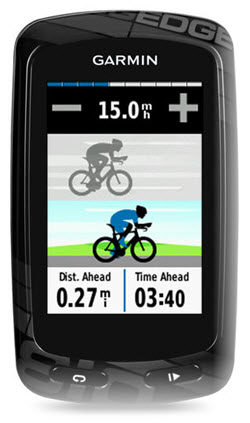
Pictured on the right is a Garmin 810 cycling computer. Beyond measuring and displaying all the typical stuff; RPM, MPH, Distance, Time elapse, etc… these computers allow you to race against a Virtual Partner, which is yourself previously riding over a known course. Racing against yourself is afascinating concept which allows you to compare today vs last week or last year. Are you getting stronger/faster/fitter? Yes? No?
http://youtu.be/o8YhrAAvh7w
After all, it's just you, who you're really racing against.
I use the stage average timer in class as a sort of Riding Buddy, comparing a specific intervals against earlier efforts. Asking; are you keeping up? Yes? No?
Warm Up — 10 minutes. 5 minutes of gradual increases in wattage. During the second 5 mins. we’re finding the wattage where everyone is first noticing a change in breathing; VT1 / Aerobic Threshold = the top of the Recover Zone shown above. This establishes a rough understanding of a base wattage that we use throughout the rest of class.
3 x 30 sec. Hard / 30 sec. Easy – Openers to AT/LT. I cue these by first having everyone find the amount of load @ 70 RPM that has them feeling they should (not just could) come out of the saddle. The 30 sec. Hard is then simply accelerating to 90+ RPM which results in some pretty impressive power numbers. The 30 sec. Easy is back to 70 RPM — many will stand during the Easy portion.
3 minutes rest – I encourage riders to focus on their recovery. Once they feel calm in their breathing, bring back the Base level work wattage.
5 min. Short Hill — Here's were we do our 5 min. “Best Effort” to establish a benchmark PTP Personal Threshold Power (top of the Perform Zone) or ride at 110% of FTP if known. It’s very helpful to riders to have that understanding of their personal upper wattage number. The “Best Effort” Threshold # + the Base Threshold # we found earlier form the three Power working zones I use in class.
– 1 min. build at preferred cadence (suggested as 85-95 rpm) — press the Stage Button to reset the averages.
– 5 min. “Best Effort” This should hurt, but be do-able. I ask everyone to observe their average at the end and then…
2 minutes rest
3 x 5 min. Medium Hill @ 1 min Rest – Now that everyone knows how hard they can go for 5 minutes, we worked at ~90% of PTP on each of the three, five minute climbs. The recoveries and transitions back to climbing are simplified by leaving resistance where it is and do what I call Walking. Have everyone stand and pedal slowly “walk” for a minute. Load should be too high for seated soft-pedaling. Then accelerating up to preferred cadence brings everyone back to ~90% of PTP.
3 minutes rest
2 x 10 min. Long Hill @ 2.5 min. Rest – the songs I used were a little short so I had everyone up to RPM/Watts before starting the songs and hitting the Stage button to establish averages. I prefaced the first climb with; “As Endurance Athletes, you recognize that you get stronger as the class goes on.” Here's where I got a few smiles and hoots… “so my expectation is that you can all climb this at your PTP (5 min. Best Effort wattage)” and we did 🙂 The Spinervals profile calls for near constant changes in gears and cadence, which is easy to do on a bicycle… not so easy on an Indoor Cycle. So instead we made 3-4 changes in load/RPM + alternated in & out of the saddle.
Here's where I was cuing everyone to focus on their Riding Buddy. No matter the change, it is imperative that you keep your instantaneous watts at or above the average, so you keep up with your Riding Buddy.
5 minutes at Base wattage @ 90RPM – which becomes a recovery > step down in intensity while we stay aerobic.
Cool Down
I'm very excited to be able to teach these Performance Cycle classes – they fit me and my personality perfectly and we have an excellent group of athletes to ride with.
Next Sunday 1/5 is the official kickoff of the winter training program > FTP assessment day. Feel free to contact me if you'd like to ride with us.
I was reading this post over at Pedal-On this morning. In it an Instructor was asking about securing a teaching position with Life Time Fitness – where Amy and I have taught for years and feel we know the company well.
After posting my response a thought occurred to me; “teaching for a large multi-location chain like Life Time Fitness, with thousands of members and huge studios has it's own unique challenges… and I don't know that our existing resources really address the needs of a Big Box Instructor.”
So as a new service for our ICI/PRO members we will begin offering resources that are designed specificily toward helping those of you who teach at a Life Time Fitness, LA Fitness, 24 Hour Fitness, Equinox or other large Big Box health club.
You will be able to find this new category under the Instructor Training > Big Box Instructor navigation drop downs above.
Here was my response to the question about Life Time Fitness:
I've taught for Life Time Fitness for 6 years. I have scheduled classes at two Athletic (Diamond) level clubs here in MPLS where it's all about the members. I also sub regularly at the Chanhassen club that shares the parking lot with the LTF corporate headquarters. For you or anyone else looking to join LTF as an Instructor I can offer this advice:
1) Memorize the LTF mission statement –
Our Mission is to provide an Educational, Entertaining, Friendly and Inviting, Functional and Innovative experience of uncompromising quality that meets the health and fitness needs of the entire family.
I'm not kidding when I say memorize it as you will be expected to deliver it as part of any interview or Instructor audition.
2) Contact the club's Group Fitness dept head and ask to schedule a time for a call or better to meet with them in person. Do not call and just ask if they are holding instructor auditions. Your objective is to meet the Dept Head to learn what she/he is looking for in the Instructors they hire… which may be very different than who is currently teaching classes at the club. If the club is looking for someone or has a scheduled audition time they will tell you. Also, my experience is that Dept Head's do have some authority to hire someone without holding any auditions if they like/need you.
3) LTF is very focused on their Club within a Club initiative where they create small groups of interest; Run Club, Cycle Club, Tri Club, Swim Club, etc… If you are an outdoor cyclist I suggest contacting Cycle Club coordinator at the location and become their friend LTF is very interested in Instructors who could potentially take their Indoor class participants outdoors.
4) Understand that first and foremost your role as an instructor is to deliver a fun and entertaining experience for the members. You may teach the most real/authentic cycling class on the planet, but if it's boring because you feel constrained by focusing too much on what not to do, it will show in your class presentation and your chances of getting hired are slim. LTF's head of Instructor training Jeff Rosga said it best; “first you need to give them what they want, and then give them what they need.”
5) If you do get an audition, teach a class that's appropriate to the audience. LTF wants to see that you are flexible as an Instructor and can teach appropriately to varying member groups. You may teach a very “cycling specific” class, but that isn't what a room full of housewives want during a 9:30am class. (See #4)
6) Once you do get hired you can typically teach the class you want, remembering #4, as long as your numbers are reasonable, without interference from management. You are expected to follow the periodization schedule as to the objective of the class – but that doesn't dictate the actual profile you use.
Now I know there are many of you who instinctively revolt at the whole “you need to internalize our Mission Statement” group think thing. I know I did at first.
But when you consider that Life Time has thousands of Instructors, who are in front of something like half a million members each month, you really do need to find ways to keep some consistency of instruction… without forcing Instructors into little boxes that crush all of their creativity and passion for fitness.
I can think of a bunch of people I could have on the Podcast to explore the challenges and issues facing the Big Box Instructor. Stay tuned…
First I have to apologize for taking almost 2 months to report on results that were secured after just 4 weeks of data collection. That’s part of the problem with Evidence Based Cycling; once you do herd all those cats on bikes (see last post) and send them on their way to collect data, you have to eventually herd them over again to retrieve the data. I only got the final piece of performance data last week.
I won’t hold you in suspense any longer, the results appear below in summary form — with the bottom line of: “What effect if any did this protocol or riding drill have?“ or perhaps more simply stated “Did we get an better?” or better yet, would it be more appropriately states as “can this protocol be used as a specific prescription for improving Muscular Endurance in cyclists?” Frankly, I want to know that for myself and my own riding, as much as I want to or need to know it for the riders I coach personally.
Summary Results
The summary results shown here simply compared the Baseline Test (our method for determining their power generation and sustainability levels at the start of the test) to their Performance Test that sought to measure the same thing, on the same bike, in the same manner. The results seem to suggest that this riding drill for improving Muscular Endurance works.
SUMMARY RESULTS
Muscular Improvement
Endurance Improvement
Efficiency Improvement
Average Change:
5.03%
3.35%
17.29%
Throwing out High & Low:
5.04%
5.04%
13.90%
The one fact that can, and often does bring seemingly good findings into question is the sample size. While we started with 11, we ended up with only 8 riders who completed the study. There are a variety of reasons for this, none of which had anything to do with the test itself. In any event, to be considered valid by almost any rigorous standard, this type of study would have to be repeated with a bigger sample size. May this preliminary “investigative type research” would inspire some budding graduate student in the physiological sciences to pursue a wider study.
Are The Results Statistically Significant?
In terms of whether we can consider these results meaningful or not, we must first introduce the term or phrase associated with this question; “statistical significance”. In regards to research findings, it has a fairly specific definition. Wikipedia explains it this way: “Statistical significance” is a statistical assessment of whether observations reflect a pattern rather than just chance…” It further defines the level or degree of significance this way: “The choice of significance level is somewhat arbitrary, but for many applications, a level of 5% is chosen by convention.[3][4]”
As you can see from the summary results, by all accounts calculated, only the Average Change in Endurance would come into question. This is quite understandable given the fact that these results were assessed only 4 weeks after the study began. In training other athletes, and in training myself as a semi-retired racer, I can tell you that most real and lasting training effects take 6 weeks to be “established”; established as in the gains are likely to not be reversed any time soon, and that there was a real cause and effect relationship between the work and the result.
The Gory Detail
Below is the table with all the numbers that make up the summary findings above. Data geeks control yourself — these numbers only represent 4 weeks of following the M.E. protocol, and we need much more data to begin to think of implications beyond the obvious conclusions drawn from what we see here. That will be the focus on our next blog post — what all can we see and say about this data and its implications for both training and further research.
This is the companion Audio PROfile for the Epic Planet DVD Epic Wine Country. You can use it as the basis for an exciting and entertaining class. It features a 20 minute endurance section where you can conduct a T1 Aerobic Threshold assessment and pre-fatigue everyone’s legs, during the flats, before heading into the hills. The 25 minute mark signals the start of 2 major climbs of 9:22 and 10:56 with very little recovery in between. The key to your student’s success on these long climbs is to balance the work between their cardiovascular and muscular systems. To do so, we want to encourage everyone to keep their cadence up above 70 RPM for the entire class.
PRO members can purchase this DVD at a 30% discount using Coupon code ICIPRO30% athttp://epicplanet.tv/
Here's your Spotify PRO/Playlist!Deezer. We have made every attempt to replicate the original playlist. In some instances the tracks specified were unavailable in Spotify. When necessary we have substituted individual songs of similar length and tried to maintain the Instructor's intent.




 By Team ICG® Master Trainer Jim Karanas

 LTF is very interested in Instructors who could potentially take their Indoor class participants outdoors.

