No more hunting for new music or counting out cues to develop your ride profile. Here is your ready to ride profile for a fully choreographed ride, that can be displayed from your phone, or printed out onto cue cards for your class. This ride is timed out, down to the second, to make your life as easy as possible!
No more hunting for new music or counting out cues to develop your ride profile. Here is your ready to ride profile for a fully choreographed ride, that can be displayed from your phone, or printed out onto cue cards for your class. This ride is timed out, down to the second, to make your life as easy as possible!
ICI/PRO member Joey, a Cycling Fusion Master Instructor and routine contributor to The Weekly Ride on ICI/PRO, delivers a ride. THIS IS THE COMBINED FILE THAT INCLUDES THE MUSIC AND THE VOICE. IT IS NOT AVAILABLE ON ITUNES.
This ride is from Joey!! – “This ride is designed as a decreasing cadence endurance ride with three repeats. The goal is to work through the various levels from primarily cardio work (cadences 90+) through muscular endurance work (cadences 70-89) and finish up with strength work (cadences 69 or less) to produce complete fatigue in the rider's legs by starting with the slow twitch fibers and progressing through the fast twitch fibers for total exhaustion.” Joey
Meet Dave Norfleet, the creator of an amazing Indoor Cycling Class ride delivery and Cycling Class Profile app My Fitness DJ. Joey and Dave talk about the app and class structure and design through this 50 minute episode.
We have a special treat for you with a FREE class profile that you can directly download into MFDJ and not have to program a cue or find a song, we have done it all for you. You can find that class here: DOWNLOAD CLASS
The steps to download this profile into your device are:
1) Open page from the device with MyFitnessDJ installed
2) Tap the link
3) Choose “Open in MyFitnessDJ”
4) Select playlist in MyFitnessDJ – each track will play a few seconds, as it's added to your Apple Music library
Listen to Joey Delivering the ride and get all of the ride details here (it is all free): RIDE RECORDING
From the My Fitness DJ Site (http://www.myfitnessdj.com/):
Helping make you even better
Announcing #MFDJtrending! Share you ideas and inspiration with others by adding your best tracks to the #MFDJtrending list then promote with a Facebook post. Tracks are boosted in the list with more likes from your peers. Take a look.
I really wish I could play sound effects in MFDJ. Guess what? It's in there! Along with lots of other feature that are regularly requested, yet already a part of the MFDJ feature set.
MyFitnessDJ is everything you need to make a better workout. Your class or personal workout doesn't have to change, but your focus and efficiency will.
Listen to the Podcast below or subscribe using iTunes or Zune.
During a class I attending yesterday, the Instructor had everyone doing one-legged pedaling drills… one legged as in pedaling with one foot un-clipped and held out to the side or rested on the frame.
That's wrong/contraindicated… isn't it?
My initial reaction was to do what I normally do in this situation, I would just ignore his cue. Unfortunately I was setup in the dead center of the room and I quickly saw that I would be the one rider (of about thirty) NOT riding with just one leg. So I popped my left foot out and joined everyone else.
OK, so what's wrong with this? Was my first thought, as I began focusing on smoothing out my pedal stroke. This feels like what I remember from riding my old Schwinn Paramount road bike, on a trainer, back in the 90's
Looking around the room, I didn't see anyone riding with any difficulty or appear to be off balance or unsafe. All I saw were cyclists doing exactly what they're supposed to be doing during one-legged drills; trying to make up for the missing leg's influence at the “dead spots” in the pedal rotation – which is the purpose of the exercise. This wasn't a class of cyclists, but rather the typical diverse group of club athletes we all see each week.
So why is one-legged cycling viewed as contraindicated in our classes?
I did a few Google searches for “one-legged indoor cycling class” and found a number of articles, from knowledgeable people, recommending against removing (un-clipping) one foot while pedaling here, here, and here. That last link is from pdf from Spinning called Keep if Safe and includes this:
PEDAl STROKE
Do not pedal backwards or with one foot out of the toe cage or cleat. Pedaling with one leg is an advanced drill that elite cyclists practice on trainers–not fixed-gear bikes like the Spinner bike. On a Spinner bike, these drills have absolutely no benefit, since muscles work the same and burn equal numbers of calories pedaling forward and backward.
While I completely agree that pedaling backwards is dumb/goofy, pedaling with one leg is a very commonly recommended technique, for cyclists of any level.
Another Google search returns dozens of articles and videos advocating for this exercise. None of them issue any caution that this is an exercise reserved for a professional, on the contrary. It's the new cyclist who needs to learn to pedal properly and efficiently.
Here's none other than Joe Friel describing his recommended pedaling drills:
Let’s get rid of the energy wasters in this Base period. Drills will help you to pedal better. Following are the common ones I use with the athletes I coach. They may be mixed together in a single workout or each may be done by itself as a workout.
* Isolated leg training (ILT) drill. This is the quintessential pedaling drill, the one you should do a lot in the early weeks of Base. It’s done on an indoor trainer. Unclip one foot and rest it on a chair next to the bike so you are left to pedal with only one leg. With the bike in a low (easy) gear turn the crank at a comfortable cadence. The first thing you’ll notice is that getting through the top of the stroke, the 12-o’clock position, is difficult. Focus on smoothing this top transition. At first you may only last a few seconds before the hip flexors fatigue. When that happens switch to the other leg. When it fatigues clip both feet in and pedal for a few minutes applying what you have learned in the single-leg pedaling. Repeat the drill several times throughout the workout.
While I'm the first to raise my hand and say; “just because Joe Friel says something, it doesn't automatically mean that it's applicable to our classes“, I'm using him as an example of the clear conflict between what's recommended for indoor cycling vs. outdoor cyclists. Mr. Friel says this is the quintessential peddling drill (representing the most perfect or typical example of a quality) and yet others are saying this will hurt your participants – or is completely useless.
So where's the concern coming from?
Clearly there's a fundamental difference between a bicycle on a trainer and an Indoor Cycle. The bicycle has a freewheel that prevents the monument of the drive-train from pedaling you = you have control to easily stop the rotation. Indoor Cycles (with the exception of the CycleOPs) are fixed gear. The perceived (rightly) danger comes from the heavy, weighted flywheel spinning out of control and potentially carrying the loose pedal into the free leg of the rider.
So why didn't that appear to be a problem yesterday?
We were riding indoor cycles with magnetic resistance. I perceive this has two design differences that mitigate the safety issues that exist, as compared to Indoor Cycles that use friction resistance. If you've had the chance to ride (or your club has updated to) the Schwinn AC, Keiser M3 or Freemotion S11 you'll probably recognise the following;
My perception (and I've ridden everything) is that magnetic cycles have less rotational flywheel inertia than friction. By design, the weighting of the flywheel of friction cycles is around the perimeter, which creates a greater amount of inertia = harder to control or stop. Magnetic cycles have either a smaller flywheel (M3) or in the case of the AC and S11, the outer diameter is aluminum. In all three there's a feeling of less of the flywheel's influence / control of your pedals.
The amount of resistance created by the magnets increases with RPM = you don't see run-away pedals, even starting with a very low level of resistance.
Is this right for your class?
If you're teaching on a magnetic cycle, you'll have to decide for yourself if you want to add Single/Isolated leg training drills into your class. I wouldn't consider this if you are on friction resistance cycle.
Start by experimenting alone by yourself. Spend some time practicing with one foot detached. How does if feel to you? Could you safely introduce this into your class? Maybe as part of the warmup? How would you cue this?
I'm going to begin on Thursday. My initial thoughts are to offer it, with a modification to stay clipped in of course. I'll find a fun track around 70ish RPM, have everyone dial on a nice flat road feel – just below their base wattage and let everyone experience what it feels like.
I'll let you know the classes reaction 🙂
NOTE: If you're teaching on the FreeMotion S11.9 cycles, the power readings will be disrupted with either foot un-clipped. You'll want to explain to your class that the power is measured off the left crank. Removing the left foot and using just your right, results in near zero wattage displayed. Peddling with just the left foot appears to confuse the computer and I was seeing what looked like double the wattage. Both the Schwinn AC and Keiser M3 will display correctly.
Frequently, I recommend protein powder to supplement dietary protein, but my clients aren't always sure exactly what to do once they have it. That’s the topic of this post.
Why Protein Is Important
Protein has numerous functions in the body, starting with the obvious one that it can be converted to glucose for energy.
Because I’ve covered protein in previous posts, I’ll keep this part brief. Protein is used to form hormones, enzymes, blood, body tissue, hemoglobin, antibodies, transport proteins, and much more.
As protein enters the small intestine, it triggers CCK, a powerful satiety hormone. CCK curbs carb cravings significantly. People who don’t get adequate protein often have strong sugar cravings.
Protein provides the amino acid precursors for brain chemicals that have many functions. Those amino acids can, for example, raise dopamine and norepinephrine for alertness and improved mood. Eating sufficient protein can reduce the need for caffeine — which triggers the same brain chemicals. But while caffeine depletes those chemicals, protein increases their production.
Another example is tryptophan, used by the brain to make serotonin. Serotonin enhances satiety and mood.
And protein provides several B vitamins that act as catalysts in forming all three of the brain chemicals above.
Why Protein Powder?
I’m not suggesting that you give up real foods and use protein powder instead. But protein powder is convenient. It’s light and portable and needs no refrigeration. Here are some suggestions for specific situations.[wlm_private ‘PRO-Platinum|PRO-Monthly|PRO-Gratis|PRO-Seasonal|Platinum-trial|Monthly-trial|PRO-Military|30-Days-of-PRO|90 Day PRO|Stages-Instructor|Schwinn-Instructor|Instructor-Bonus|28 Day Challenge']
Vegetarians / Vegans
Powdered protein is great for those who don’t want to eat meat. For vegans, who don’t eat any animal products, vegetable protein powder might be the best way to get high-quality protein in the diet.
Please recall that non-animal sources of ‘protein’ often aren’t. Nuts are not protein; they’re unsaturated fat. Beans, rice and quinoa are definitely carbs.
Vegans often experience sugar cravings. Vegetable protein powder could be a top method for vegans to stop cravings long-term.
Post-Training Fuel
As detailed in a previous post, refueling within 30 minutes is ideal. The best post-training meal is a combination of carb and protein in about a 3-to-1 ratio (the original research used 2 to 1).
Powdered protein will keep in a gym locker and mix with water as part of a solid post-workout “meal.” Just add good starch. Potatoes are excellent after workouts; other starches work, too.
Travel
Travel is an obvious time for the convenience of protein powder. A couple of years ago, I attended a 5-day seminar in a remote area. We were told it would feature only vegetarian cuisine. I brought 15 envelopes of raw vegetable protein powder and mixed one with water at the start of each meal. With my protein needs taken care of, I could enjoy the meal with no problem.
Conquering Sugar Addiction
For reasons explained above, having protein throughout the day can help you end sugar addiction by changing brain chemistry and preventing sugar cravings. Many brands of protein powder are out there, so find one with no junk — especially no sugar.
Don’t make the same mistake as a client of mine who had a serious sugar addiction. Instead of buying plain, unsweetened powder and mixing it with water (per my instructions), she bought French Vanilla and mixed it with orange juice. “The protein drinks are delicious!” she told me, but her sugar cravings got worse.
“Delicious” is usually a telltale sugar sign. Unsweetened protein — whey, pea, vegetable, soy, other — plus water won’t be delicious but will be helpful.
On the Go
Away from the office and a snack room, it might be difficult to find protein if you can’t stop for a meal. Depending on the hours you’ll be in the field, protein powder may help. Carbs are easy; we can find salads and other carbs almost anywhere.
Plan B
As suggested in a previous post, leave an envelope or two of protein powder in your car for emergencies. Take care of the protein and the rest of the meal will fall in place.
So skip granola bars, “energy” bars, chocolate-hazelnut spread, electrolyte drinks. The main benefit of protein powder is it’s a true protein source when ordinary foods aren’t available.

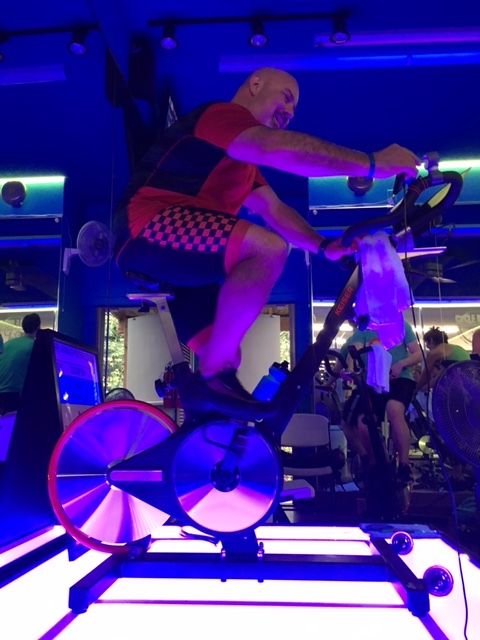

 ICI/PRO member Joey, a Cycling Fusion Master Instructor and routine contributor to The Weekly Ride on ICI/PRO, delivers a ride. THIS IS THE COMBINED FILE THAT INCLUDES THE MUSIC AND THE VOICE. IT IS NOT AVAILABLE ON ITUNES.