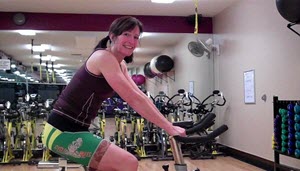
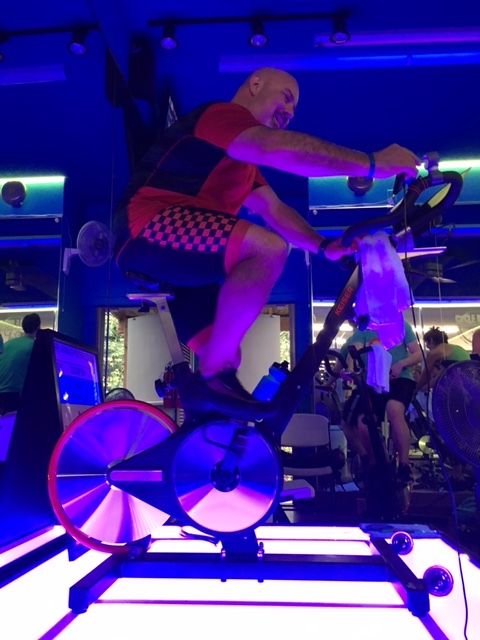
Have you ever been on your bike, inside or outside, and your hands go numb when you ride?
Then you take your numb hand off the handlebars, shake it around for a bit, drop it to your side, and wait for the tingling to stop and the feeling to come back.
A couple of nights ago in one of our cycling classes, this very question came up about “numb hands” when you ride. I want to help you have a more comfortable ride — both indoor and out side. Here's a video that shows it all!
Roll Your Wrists No “cocked” wrists for any position on your handlebars! You should have a nice long line from your forearm to the top of your hand. If you are bent at your wrist (with your wrist down), you are putting a lot of pressure on the carpal tunnel and medial nerve. Use a Light Grip No death grip on your handlebars. Hands should have enough grip for balance and steering, and that’s about it. Of course, if you are on a mountain bike trail, you are actually using your arms and body to lift your front wheel or bike from time to time, so you’ll have a tighter grip when you need it.
Redistribute your Weight No heavy leaning on your handlebars. Weight should be in your saddle. If your “reach” to your handlebars is too long, you may be putting too much weight on your handlebars. This can be changed by bringing your handlebars closer to your saddle (indoor cycle adjustment, out door bike shorter handlebar stem) OR bringing your saddle closer to your handelbars. If the latter, be careful that you don’t throw your knee to foot alignment off — when your foot is in the 3:00 o’clock position (forward), you want your knee aligned with where the pedal attaches to the pedal arm. If your knee is forward of this point, you are putting too much forward force pressure on your knee and may feel pain in the front of your knee pain.
Soft Elbows No stiff straight arms! Keep a slight bend in your elbows all of the time. This is like the “athletic ready” position with a slight bend in your knees, except …..that it is in your elbows. Not only will this help your circulation, but you’ll be ready to absorb bumps and road noise when you are outside.
Relaxed Shoulders Take your shoulders out of your ears…try this exercise: Take in a big breath and raise your shoulders as close as you can to your ears, now as you exhale, relax your shoulders all the way down. This is where you want them when you ride.
People often tell me stories about how they lost weight. The stories begin with, “All I did was…” and end with something like: become vegetarian (or vegan); eliminate gluten; “go raw”; or cut out sugar.
A couple of these make sense, but others don’t. Let’s look at each one.
Becoming Vegetarian or Vegan
The two are different, but I’ll cover them together because my observations are the same in both cases.
Depending on which animal products someone was eating before changing her/his diet — and how they were prepared — eliminating animal products might result in considerable weight loss.
But there may be more to this story. Maybe the new vegan/vegetarian has eliminated dairy products, for example — and given up that pint of Ben & Jerry’s every night. Getting rid of all the fat and sugar in the ice cream could very well have had a profound effect on weight loss.
That change might even have helped by itself. So maybe it wasn’t just about animal products.
Eliminating Gluten
My first question is always, “How much gluten was this person eating before?”
It’s logical to blame gluten if the now-lean person was eating a stack of pancakes for breakfast, a large submarine-type sandwich for lunch, and a mountain of pasta with his dinner.
Cutting moderate gluten intake — say, a standard sandwich on 2 ordinary slices of bread per day — might not yield the same dramatic results.
But again, is there more to the story? The butter and syrup on the pancakes, high-fat sauce on the pasta, mayo and who-knows-what-else on the sub sandwich? Those changes would factor in just as much as the gluten.
Giving Up Sugar or “Going Raw”
Okay, in this case, I can definitely believe we may have found the “one thing” that helps someone lose weight — especially if the switch covers all sugar.
Giving up sugar would include giving up pastries, cookies, cakes, brownies, candy bars, ice cream, and more. Those so-called foods often contain fat, white flour, and yes, gluten — plus other junk, along with the sugar.
Someone switching to a raw diet would also eliminate most foods on the list above.
The drawback with a raw diet is that there are two “tracks.” The healthful track emphasizes vegetables. The less healthful track emphasizes fruit, various concoctions that contain fruit or fruit juice, and even cookies that look like Oreos, with some sort of creamy fruit puree filling between 2 cookies made of crumbled nuts.
I recommend the veggie track, but that may be a topic for another post.
Of course I’m in favor of anything that helps someone make a change for better health. But it may take a few things, not just one. And that’s not a bad thing.
That being said, the decision to eliminate sugar can, and often does, have far-reaching benefits: cardiovascular health, blood pressure, mood, appetite, focus.
So if you are still looking for the One Thing that helps you lose weight … giving up sugar might be that thing.
And if you’re looking for help with eliminating sugar — for weight loss or other health issues — perfect! That’s what I do. Just visit www.FoodAddictionSolutions.com and grab your FREE copy of “3 Biggest Mistakes People Make When Trying To Quit Sugar.” Find out how you can make a big shift in your health with small changes that are easy and do-able.
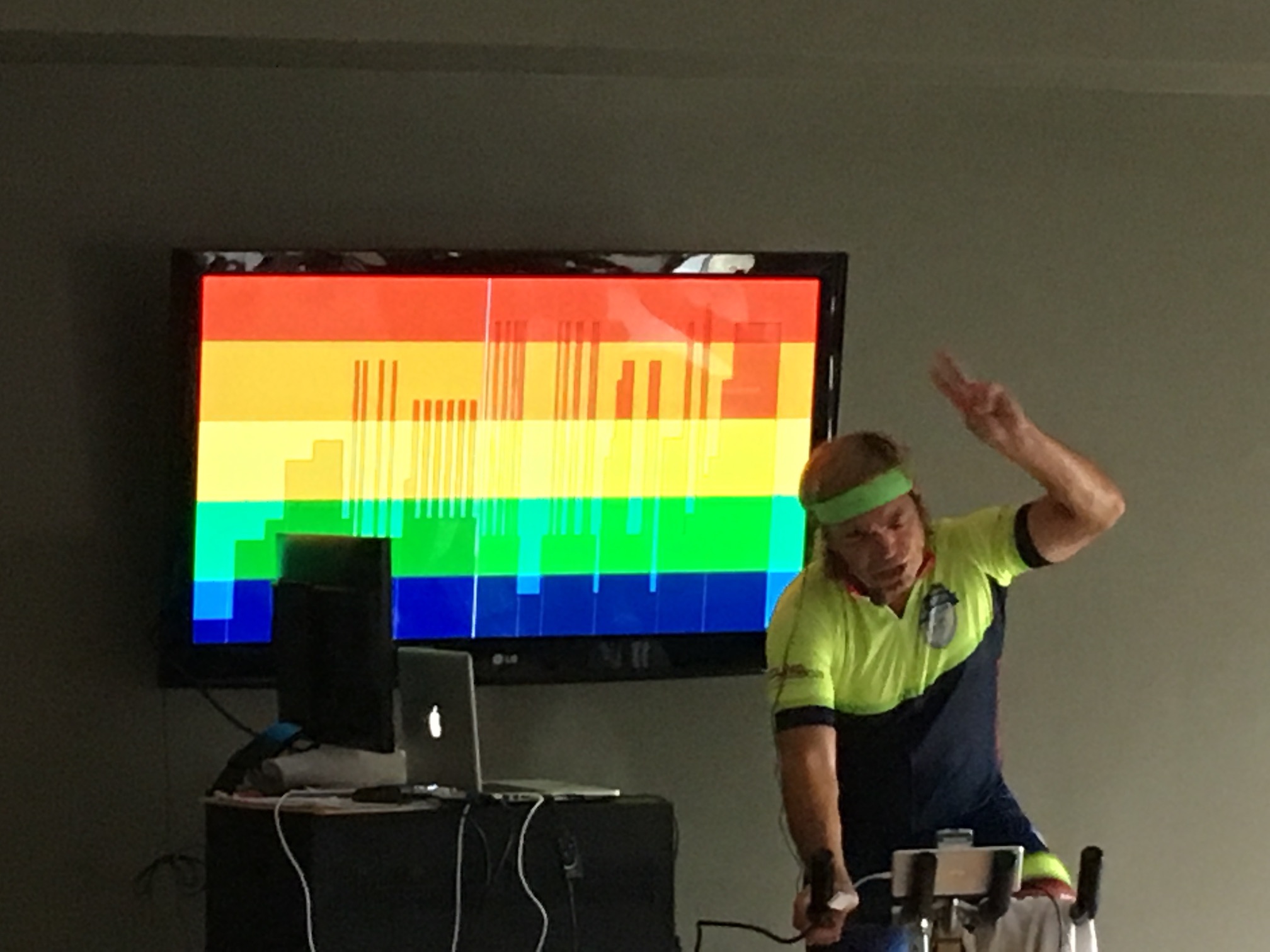
This ride is from Joey!! – “PLEASE: Listen to the podcast of Joey (me) delivering this ride at www.indoorcycleinstructor.com (ICI/Pro). This class is focused on explosive power with some seated and standing strength that is primarily used to pre-exhaust the legs for the explosive sections. I hope you enjoy this ride as much as I enjoyed riding and recording it.” Joey
Over the past week, I've observed or participated in 11 Indoor Cycling classes, lead by Master Trainers and everyday Instructors. In the very first class I attended, by a popular MI, I found myself critiquing the quality of her amplified voice. It was terrible. I could hardly understand what she was saying and it really diminished what she was presenting. I'm sure that if she was aware of how poorly she sounded, she would have taken steps to correct the problem.
I'm super anal about the sound quality of my guests on the Podcast. I request demand that we use Skype when recording remotely. It's typically crystal clear and has the guest sounding like they're in the same room with me. I'll only accept using a phone line on very rare occasions.
So with all that in mind I made a point of critiquing every class I attended, listening for the following:
Can I clearly understand what's being said?
Was there a clear difference in volume between their speaking voice and the music?
I'm not going to call out anyone in specific, but in a number of the workshops and classes I had a difficult time understanding the cues given. None of the classes lead by men had the issue – only the women… and only those with naturally high voices. Now I realize that many of these classes were at a conference, with temporary sound systems, but that didn't appear to contribute to the difficulty understanding the presenters. I sat in on two team taught rides, where multiple presenters spoke (male and female) and it was only the female presenters who I had trouble understanding. I wanted to be sure it wasn't just me, so each time I had trouble hearing I asked other's in the class. In each instance they confirmed the issue.
The importance of hearing it for yourself.
I've encouraged you to record your class, so you can hear firsthand what your class hears. We devoted an entire podcast to the subject that featured communication expert Alexa Fischer.
You maybe surprised by what you hear.
I recorded this short sample a few months ago for another Instructor. She cringed when she heard it and instantly understood that she needed to make some major changes, if she wanted her class to understand what she was cuing. As it was, you barely understand anything she said 🙁
So, what are potential solutions?
#1 Get off your bike. When was the last time you walked to the middle of the room while you're teaching? If you've been reluctant to do this, here's another reason to hop off and work the room; you'll hear your amplified voice as your class hears it. If you don't like what you hear, then make some changes and run back out to see if it's improved.
NOTE: I don't feel you can depend on your class to give you accurate feedback. If you ask “how do I sound?” they don't have anything to compare to and will typically say “great” so they don't hurt your feelings. Better to hear for yourself.
#2Deliver from your lower register. Women (and men) with high-pitched voices need to learn to deliver their voice from their diaphragm. The feeling should be that you're breathing out while speaking, not like holding your breath.
#3 S l o w d o w n y o u r s p e e c h… Slow down and breath = your words will come across much better. If you ever feel short of breath while teaching, your vocal quality is probably suffering. The easiest fix for this is just stop talking until or limit your cues to short sentences.
#4 Consider purchasing a different microphone. I don't have specific knowledge about what mics work best with what voice type, but I do know that every mic is different and you may improve your delivery with a different mic. Would this make for an interesting Podcast?
Cameron Chinatti with Stages Indoor Cycling has an interesting webinar series going that she calls “The 7 Layer Cue Cake”.
Calling all indoor cycling instructors: It's time to get cookin'! If you spend countless hours slaving away over your playlists, substantial time concocting the perfect class plan and you still feel at a loss for the right words, then this webinar series is for you! Join CameronChinatti, Director of Education for Stages Indoor Cycling for this 7-part webinar series dedicated entirely to the art and science of meaningful cuing.
You can learn more and register for the other live presentations here.
Download the first presentation here > Right Click > Save As. Or click the link and it should open in a player. It's a big video file so you'll need to wait for it 🙂
This ride is from Gene Nacey!! – “This week’s episode of The Weekly Ride was an amazing pleasure for me; I was able to take, and record, Gene Nacey delivering this weeks ride, which he authored.
As an instructor, I find that I have very little time to get out an take classes that I am not delivering. But when I can break free for a class, it is a pleasure. As many of you may know, Gene and I have been friends, and business associates, for years now, and getting to take one of his classes is a rare treat as when we are together at a studio, we are usually working.
This class was an interval based ride design, and boy was it hard. As always, use your discretion when cueing intensity and tension. Gene delivered this ride using Keiser Bikes, so you will hear him refer to “gears” but you can certainly cue tension without the gears you need to.
Remember, you can get the full PDF of the ride choreography, the Apple Music and Spotify playlists, and the downloadable file to put all of the cues into MyFitnessDJ, as well as the link to purchase the class for iClass Builder at indoorcycleinstructor.com. There is no other monthly service out there that does as much for you, the instructor.
I hope you enjoy this ride as much as I enjoyed riding and recording it.” Joey