ICI/PRO Podcast host Joey Stabile talks with Suhail Maqsood of the Wheel House in San Francisco and John Bogosian of Zingfit about the importance of keeping your customers.
This was a great conversation, and many of us overlook the most valuable asset that we have in our businesses, our customers. Suhail and I have a great talk about the importance of the customers and what we can do to increase their experience with our club and how we can safeguard their privacy while retaining our branding.
You can learn more about The Wheel House here at their website.
You can learn more about Zingfit here at their website.
Over the last 8 years, I’ve come across a number of indoor cycling studios that don’t provide a microphone for the instructor. Albeit, these studios are generally small (but not all were) and all of the instructors appeared confident that a microphone wasn’t needed. “My voice really projects” was the common response I got from instructors. I dare say that not one of the classes I’ve seen taught without a microphone (near 100 from around the country) was acceptable. Now I’m not saying the instructors were not good. Many were excellent. However, the absence of a microphone stole their effectiveness as an instructor and robbed the riders of a much better experience.
I Don’t Feel No Music!
One of the ways instructors can compensate from lack of vocal support is to lower the volume of the music. Makes sense. However, music is a major motivator and an excellent tool when training indoors and out. Without a microphone, the music was so weak that any emotional component was lost. Although I am biased on this point (being a musician), many research studies have been conducted that prove the body’s response to pulse, volume and emotion of music. This is the reason we spend so much time on our playlists. The music is an inseparable part of the workout.
The Angry Instructor
If the music volume is appropriate, then most-often the instructor is simply yelling at the class the entire time. I’ve even seen instructors try to smile the entire time (while they yelled). This just made them look mad (not as in angry). Even with the yelling, which is NOT projecting by the way, I could still barely make out what they were saying. Forget giving any audible instruction, they were just short guttural tones “SAANN…….SIIAA……SAANN…..SIIAA!” This was the instruction given for 8 MINUTES of jumps. Of course it didn’t help that I don’t do jumps (not in the way they have been traditionally taught) which made all of the harsh yelling and ineffective movement all the more aggravating.
Effective Vocal Inflection
It is not just that we need to be heard clearly, our voice is an instructional tool that guides riders through the physical and emotional profile of the class. Yelling or even speaking at the same volume and/or tone for the entire class is not only boring, eventually riders will tune you out. We need to build a vocabulary (pun sort of intended) of vocal volume, emotion and even cadence (the speed and rhythm at which we speak) that keeps riders engaged and matches the intensity, focus and characteristics of our class. You should have a vocal inflection for educating, recovering, steady-state work, hard efforts and the like. I honestly think more instructors have the ability to do this, but they are either hindered by lack of sound reinforcement of they’ve never been taught properly how to mix their voice and the music.
We Want to KEEP Teaching
One of the major reasons I was distracted watching these instructors unknowingly strain to deliver their class, was the potential vocal damage they were causing. As a drummer, I didn’t experience much of the vocal issues personally, but have watched a good many singers in my bands suffer. They experienced vocal nodules, polyps, cysts (these are all lesions or bumps on the vocal folds), and even vocal fold hemorrhage (blood vessels on the surface of the vocal fold ruptures and bleeds). As indoor cycling instructors (microphone or not), we may be at a greater risk due to a lack of vocal training, high physical exertion while teaching, temperatures and improper breathing (I’ll talk about this more in another post).
Dr. Lee M. Akst, director of the John Hopkins Voice Center, said “Red flags for an over-used voice are frequent hoarseness, a sense of strain while talking, or discomfort while speaking. Chronic hoarseness is an occupational hazard not just for singers, but for coaches, teachers, broadcast journalists, clergy, attorneys and other people who use their voices a lot as part of their professional responsibilities.” Some of his suggestions for protecting your voice: drink plenty of water, don’t overuse your voice (like talking too much on a cell phone), don’t smoke, pay attention to how your voices feels and sounds so you know when it needs time to recovery AND use a microphone.
We do what we do because we love it. We love the fitness, the teaching and seeing people's lives change for the better because of what we give. Let’s ensure we can keep giving buy protecting one of our needed assets — our voice.
I beg you…PLEASE, PLEASE, PLEASE…if you do not teach with a microphone, talk to your facility about obtaining the proper sound equipment. It's not about being loud(er), it is about being safe and professional.
TIP: Place a recording device somewhere in your class and listen back to what your riders are hearing and pay attention to how your voice sounds. Our voice and ability to teach and coach is such an important part of our effectiveness as instructors. Let’s continue to sharpen our skills together.
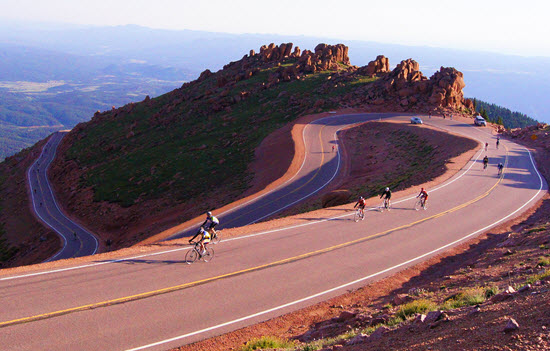
You'll be quicker up Pikes Peak after a winter training indoors with power!
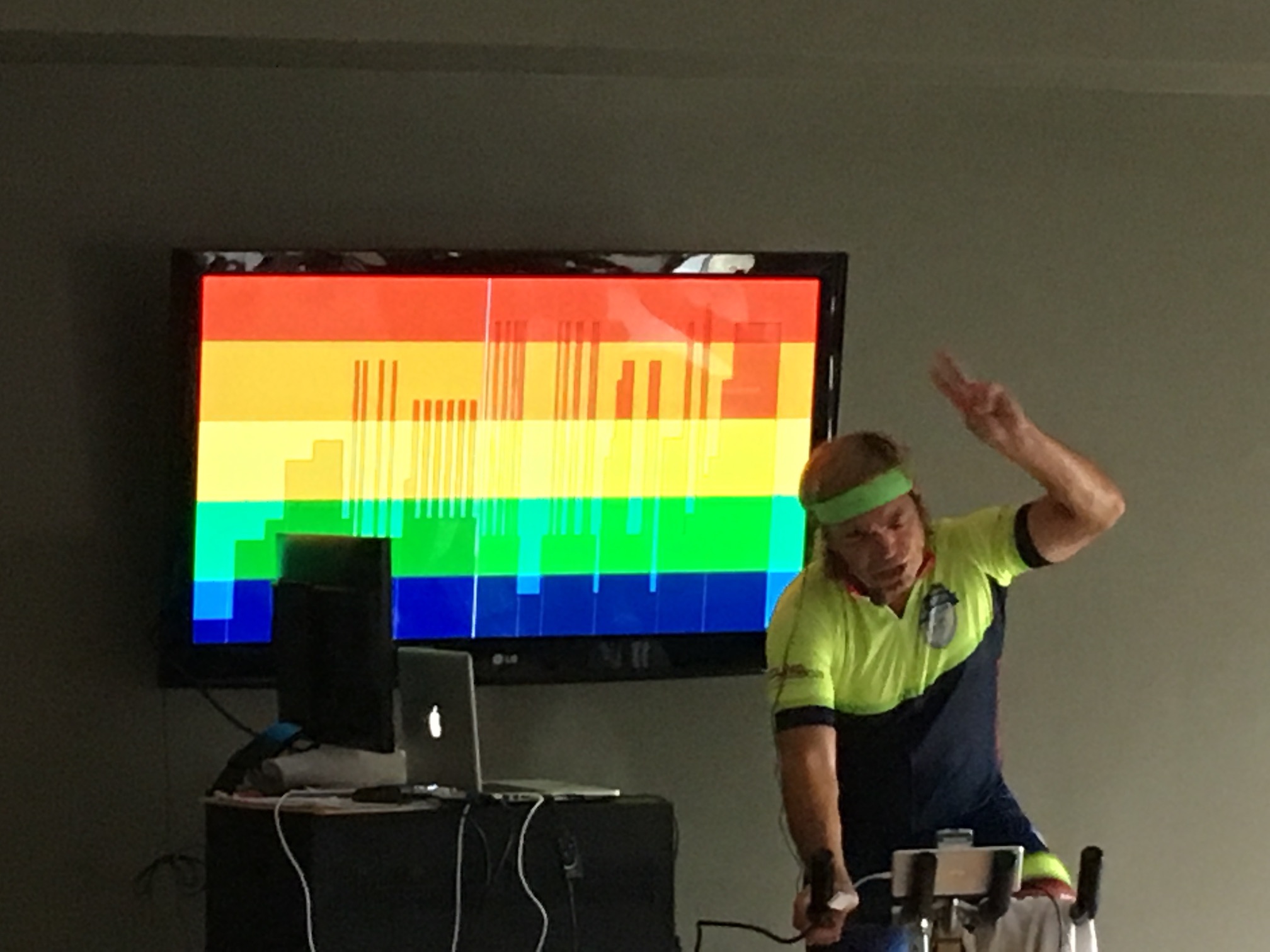
While Performance Enhancement Specialist Dennis Mellon and I were getting warmed up to record his Audio Class PROfile Mashup – HIIT vs. Party on the Bike, we spent a few minutes discussing his thoughts and observations on coaching with power.
Were his participants seeing any improvement after a full winter training indoors with power?
If so, how are they comparing their performance year to year?
Has Star Trac been able to improve the consistence / accuracy of the Blade Ions?
Can we depend on riders bringing their own technology (HR Monitor, iPhone App, ect…) to class for the purpose of tracking performance?
Or is it better to provide rider data/metrics tracking as a service of the studio?
During our conversation Dennis makes an interesting comment about a summer class format, that could be of interest to the cyclists and endurance athletes who abandoned you this Spring. Many training plans call for very specific HIIT (High Intensity Interval Training) – which is difficult to complete on the road, but easy to do indoors. It may make sense to ask one of the local endurance coaches in your area if they would be interested in bringing their athletes indoors once a week to your studio.
You can learn more about Dennis here at his website.
Listen to our discussion below or
If you'd like to learn more about automated rider data/performance tracking from Performance IQ with the Spinner Blade Ion or any of the other Indoor Cycles with power, please contact me and I'll connect you with the right people.
Indoor Triathlons are very popular here in the frozen north, offering club triathletes the chance to swim bike and run long before its warm enough to be outside.
In the past, the Life Time club where I teach used Spinner NXTs with a Spinning computer for the bike leg. Participants would run up from the pool, jump on a bike and pedal as fast as they can until the reached the prescribed distance. The clever one's figured out that the amount of resistance they used had no effect on how quickly the computer added mileage, so you had a bunch of flailing legs @ 130 RPM with no resistance = not really doing any real work 🙁
But not this year…
With all of our NXTs being replaced with Indoor Cycles with power, the participants in the Indoor Tri actually needed to “TRY” and ended up really working for their mileage this year!
I took this picture while I was riding a FreeMotion S11.0 at 115 RPM, but with no resistance. You can see in the display that even though I was pedaling very fast, I wasn't producing any power because I had zero resistance. No power = no speed and more importantly, no distance is recorded.
I talked with a couple of finishers about their experience, especially what the bike leg was like, compared to last year.
“It was a lot harder.”
“More like riding outdoors.”
“I completely over did it trying to keep up with the guy next to me. My legs were junk by the time I started the run.”