No more hunting for new music or counting out cues to develop your ride profile. Here is your ready to ride profile for a fully choreographed ride, that can be displayed from your phone, or printed out onto cue cards for your class. This ride is timed out, down to the second, to make your life as easy as possible!
Type 2 diabetes is epidemic in this country, and typically begins with insulin resistance.
What we usually read or hear about insulin resistance is that it’s a result of overweight/obesity. This is not always the case, since the reverse can be true. Insulin resistance (IR) may actually cause overweight. What’s important to remember is that no matter which comes first — IR or overweight — the metabolic consequences are exactly the same.
This post is on the role that dietary sugar and fructose can play in causing insulin resistance, and the ways in which that can happen. IR appears to result from changes in both receptor number and receptor activity or sensitivity.
A high-carbohydrate diet can lead to IR, particularly if the carbs are high on the glycemic index. Sugar would be a prime example of a high-glycemic carb. High-glycemic carbs are quickly absorbed and trigger a high insulin response. The high levels of insulin secretion can in turn lead to a diminished response by the body to insulin, due to something known as “down-regulation”. Down-regulation is a term originally borrowed from brain chemistry research. It refers to a reduction in both the number of insulin receptors and the sensitivity of the receptors. The changes mean that whatever insulin is available no longer works as well as it did before.
Down-regulation is even more likely to occur for someone who is carbohydrate sensitive. Carb sensitivity is an exaggerated insulin response to sucrose or other carbs. The possibility of down-regulation of insulin receptors is even greater with that extra-high insulin release. And down-regulation of insulin receptors occurs fairly rapidly.
So eating sugar — especially lots of sugar, as might occur with sugar addiction — can cause insulin resistance.
What about fructose?
There’s a rather odd adaptation here. Fructose has been shown to change muscle fibers from type 1 to type 2b. Type 1 is a high-endurance fiber that responds well to insulin, while Type 2b is better for explosive power but less responsive to insulin. It has been suggested that this is the mechanism behind the well-known fact that fructose triggers IR. Yes, the original research was done on animals, but studies on human subjects have shown similar results — although training can modify the results somewhat.
The bottom line is that fructose — which, as you may recall, is half of the sucrose molecule — may cause insulin resistance in this interesting way. It might even be hypothesized that sucrose (granulated table sugar that everyone knows is junk) is capable of causing insulin resistance through both mechanisms: down-regulation of insulin receptors and modified muscle fiber type due to the fructose in it. Especially if it’s eaten in large quantities — for example, by someone who's addicted to sugar.
Please recall that all research seems to confirm that the fructose in sucrose is what makes sucrose the junk that it is.
Healthful recommendations? Skip the sugar, definitely skip processed fructose or concentrated fruit juice used as a sweetener, and get your wholesome nutrients primarily from vegetables and only incidentally from fruit. It’s not what you’ll hear most places, but it may work better than what you will hear elsewhere.
This look may not always be appropriate when you teach.
This was awkward. Have you ever had a dream where you're naked in some public space? Well yesterday I wasn't dreaming, I was dressed, but inappropriately it turned out. The feeling I had was very similar.
That's because yesterday I had the privilege of taking a class at The Firm in Minneapolis. They were the very first official Johnny G Spinning® studio in the Midwest – introducing Indoor Cycling to us here in the frozen north around 1995*. As far as I know, they could be the oldest operating indoor cycling studio. Do you know of another?
I had met the one of the owners, Neil Miyamoto, at IHRSA. I sheepishly told him that I hadn't been to his studio for about 20 years. Turned out he understood us suburban folks don't stray far from home. To remedy that, Neil invited me to come downtown to see his club and meet his wife Kelly. She actually started The Firm back in 1986. Our plan was for me to take a class and schedule a time for me to interview Kelly. I'm guessing there's a lot of new studio owners who would love to know how The Firm as been so successful, for so long.
So yesterday was the day and as I'm driving into the city, I'm thinking; who comes to a 3:00 pm class, on a Saturday?
I got checked in, quickly dressed and ran up the stairs to a nearly full studio. My quick count showed about 50 riders… many of them watched me as I walked in. And a number continued to look at me. Not in an unfriendly way, no. Their expressions seemed friendly enough, some even smiled as they continued their appraisal of me. I started getting that awkward, I'm standing out like a sore thumb, feeling as I set up my bike.
What are they looking at? Could I be the only new guy here… Is that it?
Then it dawned on me. I was the only person in the room wearing a full cycling kit – my Life Time Cycle Team bicycle jersey and matching bib shorts. There were lots of t-shirts, running shirts, ripped sweatshirts, women's workout tops, gym shorts, regular shorts and yoga pants – but nothing remotely like what I typically teach in. 50+ people and I only could see three pair of bike shorts. No wonder people were looking at me funny. I couldn't help but think how silly and out of place I looked. What was I thinking?
They're not cyclists
This experience has me re-considering something I feel I've mistakenly believed; at some level all indoor cycling participants are cyclists and I should look like a proper cyclist (to set a good example) when I teach.
These folks at the Firm seemed to really enjoy riding indoors, wearing whatever they wanted, but by no stretch were they cyclists.
Kelly (the Instructor) was wearing a cute top and yoga pants. Nothing to distinguish her role as the leader. She looked like her tribe and her tribe looked like her… and they fill the place, on a Saturday afternoon, in part because she makes everyone feel comfortable. There was no pretentious; look at how cool I look in my fancy getup.
In fact the entire club is much the same. Simple concrete floors and white walls. Quite a change from the cherry walls and bamboo flooring where I normally conduct class.
So what to wear?
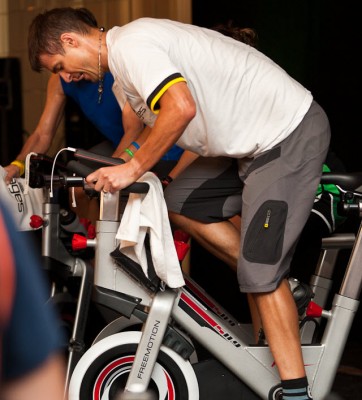
This picture is of Stages Indoor Cycling Master Trainer Doug Rusho, at a past ICI/PRO conference. Notice there's nothing that screams I'M A VERY SMART LOOKING CYCLIST in what Doug is wearing. He looks sharp and professional, but nothing about his shorts or shirt would communicate; I'm a hard-core cyclist. If you aren't a hard-core cyclist like me, well… you might not fit in here. Which I'm now concerned I have been communicating (and not always subtly) to the people who come to my classes.
*1995 is my best guess. Amy was originally certified and her club (The Flagship Athletic – now a Life Time) added Spinning around 1996.
A client at her final prepaid session recently said, “I think I’m okay on my own. I’m not bored yet.” From that, I knew she’d fail if we didn’t continue.
Now I confess. I’m a nutritionist who finds standard nutrition boring. Important, but boring.
Here’s one historic example. In 1991, the Food Guide Pyramid was released. We were also promised ’91 food labels that, among other things, would list the percent of calories from fat — because fats were the bad guys then. Food politics and finagling postponed the release of the labels until — in 1994 — we finally got the labels still in use today.
That year, every nutritionist I knew offered a seminar on how to read the new nutrition labels.
I offered a seminar on the lies and deception by the product developers that brought us the ’94 labels — instead of what they promised in ’91. I explained how to figure out what you really need to know despite the labels.
So I understand boredom with nutrition.
When Boredom’s Just What You Need
When it comes to food, though, we may need a little boredom. A good food plan needs to be a set-it-and-forget-it thing.
In fact, at a weekend financial course, the instructor told us, “Money should be boring.” She meant we should plan ahead and follow the plan, no matter what. If you’re really excited when unexpected money shows up, she said, you’re not following the plan.
She could have been talking about food. Food should be boring, too. No, you don’t have to eat the same foods every day, every week.
But the foods that provide thrills are typically junk — and often addictive. Think of sugar. Its effect on brain chemistry is the reason it’s not boring.
And that’s precisely the problem. With brain chemistry, stability is the key to feeling great long-term. That’s the focus of psychoactive nutrition, which is what I do.
When addictive foods are removed from the diet, we receive stronger signals from the body about its true needs. Control goes up. Appetite goes down. Moods even out. Reactivity to junk drops way down. We become less reactive to triggers — the sight of addictive foods, the smells and the sounds of the preparation or cooking.
Making nutrition internal is what I help my clients do. The time it takes to detox from addictive foods — sugar is the prime example — is relatively short. The time it takes to make a food plan part of you so it becomes “The Way You Eat” may be longer.
Making Your Food Plan Part Of You
A good plan makes you nonreactive to old triggers. It helps you form habits that skyrocket your energy. It changes your brain chemistry so you don’t crave the junk that kept you stuck. It makes you want to get back on the plan anytime you lapse because you can feel the difference.
It’s asking before you eat, “Will this stabilize me or de-stabilize me?”
It’s about no longer looking to food for its thrills.
When your food plan becomes part of you, your success — health, weight, relief of depression, appetite control — is your priority.
I discussed all of these things with my almost-finished client, and she renewed for several months more. The plan will be perfect for her, and she’ll succeed. Which is exactly what I want her to do.
One of the best ways to make your food plan part of you is to work with a coach. Coaching can help you make a positive impact on your health long-term. It’s your willpower when you have none, motivation when your excitement dies.
If you’re ready to reach your goals no matter what, please visit www.FoodAddictionSolutions.com/Coaching and request a Food Freedom consult, absolutely free. Find out how fantastic you can feel on foods you love.
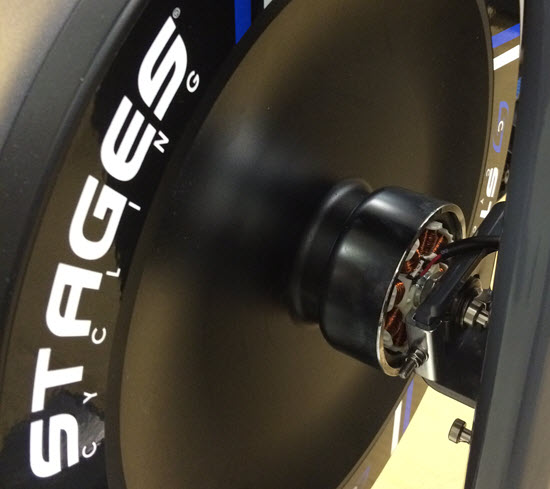
I had the privilege of visiting the Stages Cycling HQ and factory in Boulder Colorado with my buddy Randy Erwin. Director of Indoor Cycling education Cameron Chinatti, along with Stages vice president Pat Warner, were our tour guides. We spent a fascinating couple of hours learning exactly what goes into building the Stages single side crank arm power meter used on the new Stages SC3 Indoor Cycle and available for most road/mountain bicycles.
You know these people are cyclists the moment you walk into the place. Everywhere you look there are bicycles; tucked into every corner, hanging from the ceiling, along every wall – heck, their conference room has probably the coolest table I've ever seen. Instead of legs, the table top is supported by a pair of 70's vintage Schwinn Sting-Ray bicycles.
Cameron explained the hiring process, “you pretty much have to be a passionate cyclist to even be considered… many of these guys have been riding buddies for years.” And I'll add that these “cyclists” are also some of the most brilliant people I've ever met 🙂
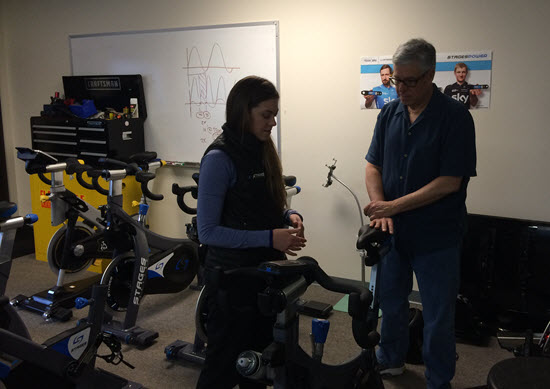
Cameron explaining all the cool features of the Stages SC3 to cyclist Randy Erwin
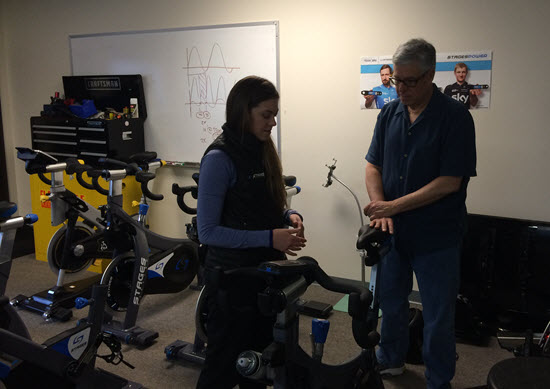
Cameron met Randy and me and our tour started in their official “training room” except it won't be for long. Stages is growing so fast that half of this room has been taken over by manufacturing stations. My friend Randy was very interested in the new SC3 because the Westminster, CO Life Time Fitness (where he's a member) will be the very first location to get these new cycles. Now if we could get Dennis Mellon in there as an instructor…
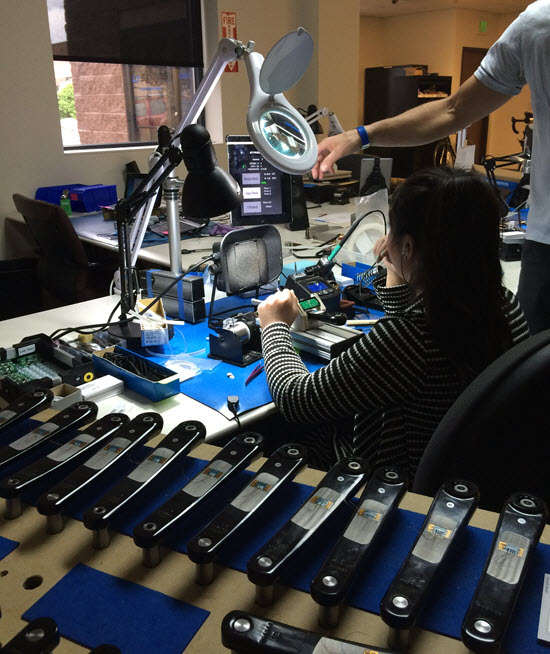
New power meters being installed and tested – this is super technical stuff.
Early in the our factory tour, I asked Pat; “why aren't your power meters built in Asia, like most other technology companies?” His responses made perfect sense to me; “there are multiple reasons actually.” “Stages has become the leading provider of bicycle power meters, after only a few years. We can't afford any preventable issues when it comes to quality or availability. It's critically important that we control the quality of these power meters… we can't if we're dependent on a third party supplier's factory, regardless of where it's located.”
Pat explained how keeping everything in-house provided a solution to a unique challenge they faced. “We manufacture power meters for 16 different model bicycle crank arms, from major suppliers (Shimano, SRAM, Cannondale and FSA) plus the power meter for the SC3 Indoor Cycle. Bicycle cranks aren't made just one size. Multiply each model bicycle crank by the four or more available crank arm lengths and we have to stock over 60 part numbers. Sure, 172.5 is the most common size for a road bike, but how many of each should we be building? The lead time for overseas manufacturers is measured in months – customer's won't accept waiting that long. We have thousands of stock crank arms on hand and we're setup to quickly change production. So if we receive an order for an out of stock power meter, we can normally build one and ship it within a few days!”
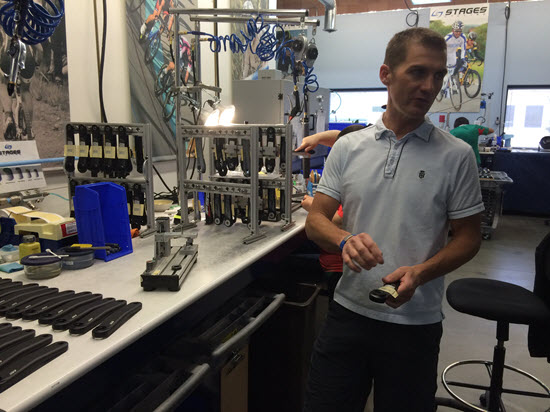
Pat Warner explaining the complicated process that attaches the power meter to the crank arm.
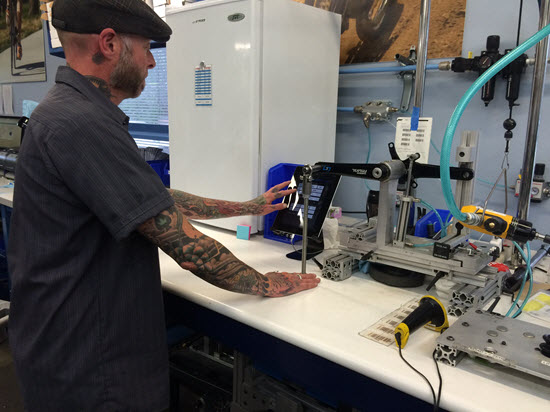
Every power meter is checked for proper calibration and the results captured using a iPad with custom software that's developed in-house too!
The Stages SC3 is build by Giant Bicycles in Taiwan – Pat told me,”those Giant guys are experts at mass producing high quality bicycles and fitness equipment, so we leave that part to the experts. We still produce the SC3's power meter here in Boulder and then ship them out for installation on the cycle.”
Stages has a separate facility, near their main offices, that's use for product endurance and destructive testing. We just missed the completion of a test rig that repeatably pressed down on a handle bar, tens of thousands of times without any failure.
Want to know how long the drive train will last pedaling at a continuous 360 watts? This video shows the test rig that pedals 24/7 for weeks at a time. Not only are they watching to see if something will break, or wear out, but they also record the actual power readings vs what they know their electric motor is pushing.
Quality control – Early production Stages SC3 cycles are unboxed and checked for any defects.
Feel free to leave the lights on! There's the battery charger for the Stages SC3 power meter.
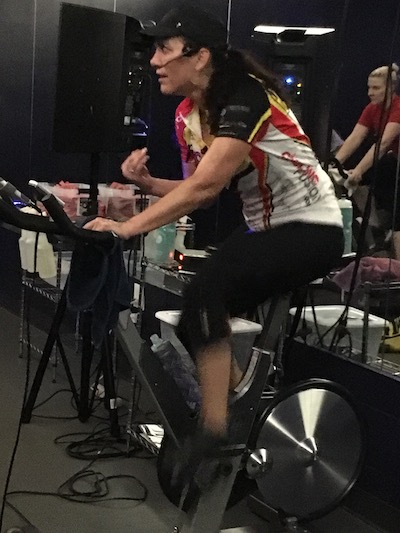
ICI/PRO member Amy, a Cycling Fusion Master Instructor and routine contributor to The Weekly Ride on ICI/PRO, delivers a ride. THIS IS THE COMBINED FILE THAT INCLUDES THE MUSIC AND THE VOICE. IT IS NOT AVAILABLE ON ITUNES.
Amy Smith and her Race Week Ride: “This is a race week. On this course I have less hills so we have to keep them on target in the saddle pushing to zone 4 with some high zone three's for them to catch a drink or two. As always allow them to ride their own ride /race.” Amy






 ICI/PRO member Amy, a Cycling Fusion Master Instructor and routine contributor to The Weekly Ride on ICI/PRO, delivers a ride. THIS IS THE COMBINED FILE THAT INCLUDES THE MUSIC AND THE VOICE. IT IS NOT AVAILABLE ON ITUNES.