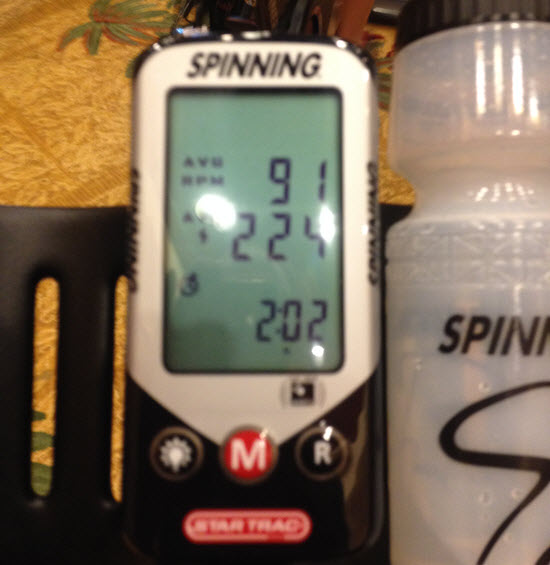
At WSSC I had the opportunity to complete a PST (Personal Spinning® Threshold) test – which is (their words) the key to Spinpower success. I couldn't agree more as knowing your maximum sustainable power or Heart Rate, and then building training zones around a known metric BPM/Watts is crucial to effective training. Here's some notes on this session and the discovery process MI Janet Toussaint lead us through to determine our Personal Spinning® Threshold.
PST is something we can change
Janet's session included a lecture period before we climbed on the Blade Ions for the PST test. During her presentation she made three very profound points that I feel are important for anyone teaching with power, to convey to their participants…
It is possible to change/raise/improve your PST. You maybe familiar with the statement; if you can test it you can improve it. In the past the Spinning program was based on Maximum Heart Rate – a number that doesn't change no matter how hard you train. Yes you can become more efficient at Fat utilization, except that's difficult to measure without a metabolic cart. Sustainable power at threshold (PST) is something you can easily see changing and that can be very motivating.
PST is based on Maximal Efficient Effort – key word being efficient, as in where efficiency drops off during the graded intensity ramp test. This isn't a test where COME HELL OR HIGH WATER I'M GOING TO PUT UP THIS HUGE WATTAGE NUMBER!!! Janet made the point a number of times that you have to be careful not to let these assessments become a competition, where people are trying to prove something.
Your PST is specific to this sport – actually Angie Sturtevant made similar statements. The wattage you see as a PST only applies to a Spinning class – not your road bike with a power meter. I would add that it also only applies to the specific brand of Indoor Cycle.
I snapped this picture showing the ramp test protocol used to asses the PST used to create the 6 power zones in the SpinPower program.
Constants and Variables
The constant during this test is cadence/RPM which doesn't change during the test. Janet suggests you not mandate a cadence, instead ask every one find “where they hang out” = natural cadence. What will vary will be the amount of resistance, and the resulting changes in HR and perceived exertion/RPE.
Start everyone warming up in zone one, finding that natural cadence for 10 or more minutes. Include a few brief accelerations – but not too intense or long.
Every two minutes you'll add resistance / ramp up. How much? Janet recommends 10-20 watts from women and 15-30 watts for men.
After you've added the new ramp, push the reset button to record your average for that ramp – remembering the previous ramp's wattage.
When you can't maintain your cadence, for the whole two minutes, you're done. Your PST is the watts from the last fully completed ramp.
How many ramps is the right amount? Janet explained that there is no “right amount”. You need to run the assessment until everyone has completed the test. There were some questions about this and it sounds like you should see at least 4 ramps until failure. Less than that probably means that the rider is adding too many watts with each ramp.
My experience during the test was as I got closer to PST, I wanted to reduce the size of each ramp's increase. I also knew very quickly when I wouldn't be able to finish a ramp. My numbers are in the image above. I couldn't complete my last ramp of 240 watts, which actually isn't that far off what I'm used to seeing as my threshold on the FreeMotion bikes I teach on at Life Time.
Thinking about conducting an assessment like this in your class? I would suggest that you practice on yourself first, so you understand what your riders will be experiencing.
If you are teaching on Spinner Blade Ions I would love to talk to you. Please contact me.
John Manrique from Revolutions Cycling Studio in Jupiter, Florida joins me to explain how his riders have pedaled 200,000 miles. Along the way John and his wife Michelle have really forged a connection with their riders.
Since opening in December 2012, the folks at Revolutions Cycling Studio have been doing one thing: pedaling. A whole lot. As the only studio in Jupiter that exclusively offers indoor cycling (aka “spinning”) classes, Revolutions' founders Michelle and John Manrique estimate that the more than 11,000 individual rides completed over the last eighteen months will reach the 200,000 mile mark in May.
“We started Revolutions based on our shared passion for indoor cycling,” said Michelle, who along with husband John, moved to Jupiter in 2001. “Since there wasn't a ‘cycling only' place in town, we saw an opportunity to open a studio for people like us who like to ride hard and get a great workout in a fun, family environment.”
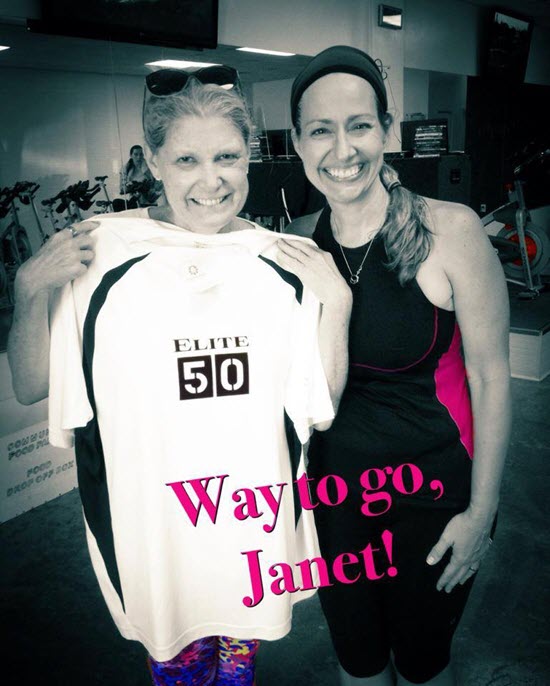
During our interview, John offers a number of great ideas you can implement to reward your riders – such as the special t-shirts shown above.
For those of you who aren't an “Excel Spreadsheet Geek” like John Manrique, there are simple options for collecting and disseminating rider data collected from these indoor cycles with power; Keiser M3i, FreeMotion S11.9, Schwinn AC and Spinner Blade Ions.
Performance IQ used in conjunction with Station/Bike Reservations and My Stats will connect riders with their data and send out an email at the conclusion of class automatically. Amy's an expert on how these systems intigrate and would love to show you a demo – feel free to call her 320-685-0183 or amy.macgowan@getliveedit.com
How cool is this? I hadn't experienced an Indoor Cycling studio that offered reserved seats before. It had me feeling like a VIP when Amy and I visited CB Cyclebarn, Karen Casler's studio last month.
The website system she uses integrates her Mindbody account with the class rider data collected by Performance IQ. I thought you might like to see the string of conformation and followup emails the system creates automatically.
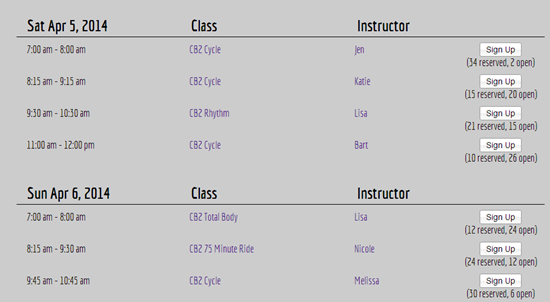
First let's reserve a spot in the class. I didn't think to take a screen shot at the time so I'm showing tomorrow's schedule.
Better hurry and sign up now for Jen's 7 am class! There's only 2 spots left.
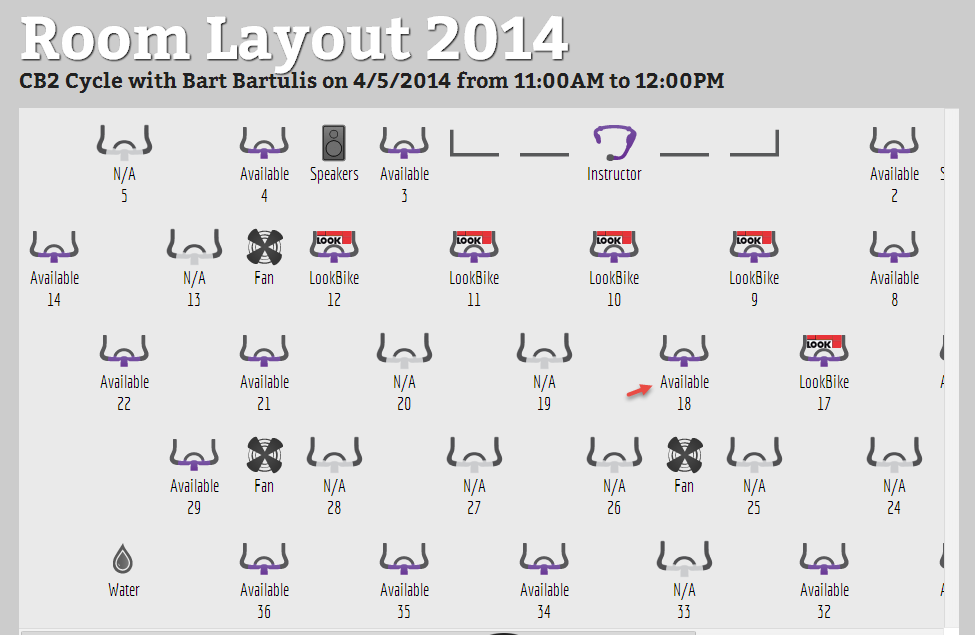
Next you select your bike – just like picking a seat on an airplane or at a concert. The image is for Bart's 11:00 am class. Note how you can pick a bike that has your type of pedals.
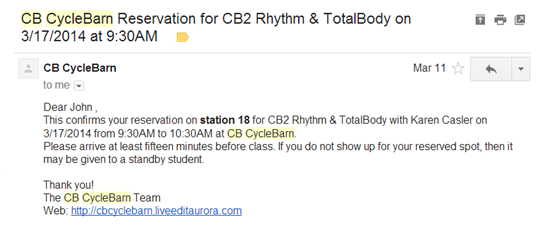
Once you've completed your purchase you receive a conformation email – all this happens automatically.
Having a confirmed seat, in a sold out class, is awesome.
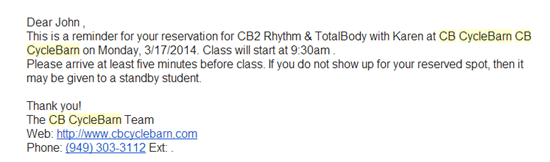
A friendly reminder is appreciated by scatter brains like me.
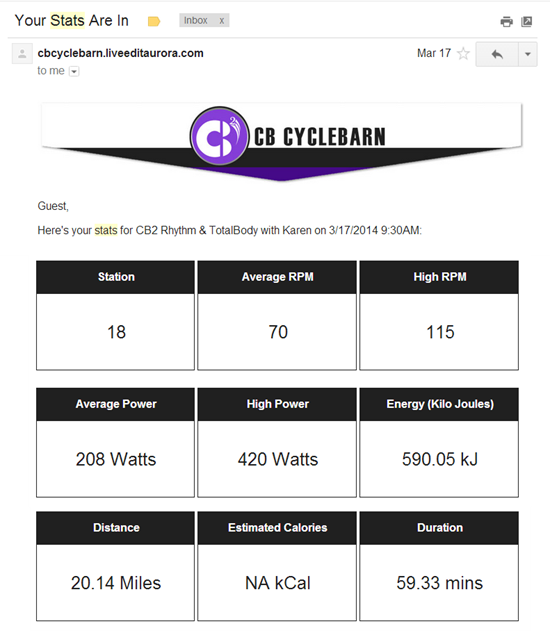
After the class I checked my email and saw all of my performance data. I wasn't wearing a heart rate strap in this class. If I had that data would show as well.
Receiving this information had me wanting to return to see if I could improve my average.
Amy and I were very impressed by this system and feel it will really get your participants excited about training with power on a consistent schedule! The website integration system is offered by LiveEdit and will work with these Indoor Cycles with power; FreeMotion S11.9, Spinner® Blade Ion and the Schwinn AC Performance.
Disclosure – Amy recently joined LiveEdit as a representative, specializing in helping new Indoor Cycling Studios. She would enjoy answering your questions. Amy.Macgowan@getliveedit.com or feel free to call her 320-685-0183
Over the past month or so we're published multiple posts related to the accuracy and consistency of the indoor cycles in our studios. Gene Nacey chronicled his experiments toward finding a method of handicapping his cycles, in the hope of addressing the differences in wattage he is seeing between bikes and my series on the results from our survey both pointed to the same conclusion; Indoor Cycle manufactures have work to do to ensure a level of consistency that will give both Instructors and participants the confidence we need to really use power as a training tool in our classes.
Last week at IHRSA, Amy and I had the chance to sit down with Keiser founder Dennis Keiser, before he formally announced that his engineering team had secured the first European EN-ISO 20957-1 accreditation for an Indoor Cycle that displays power – the new Keiser M3i.
The Keiser M3 group fitness cycle has been the first product of its kind to receive prestigious EN-ISO 20957-1 recognition for the accuracy of its power display.
“This is a big step. Our industry needs to validate the numbers that our users are seeing,” said Keiser founder and President Dennis Keiser. “This gives our customers a level of comfort at what they are seeing in our display.” The accuracy certification represents the first time that TUV Product Services, a European safety organization, has tested for accuracy in a data reporting system on an indoor group exercise cycle. To achieve EN-ISO 20957-1 recognition, TUV requires a group fitness cycle consistently perform within plus or minus 10% of accuracy. “To be the first in our industry to receive this is a great achievement and an honor,” expressed Keiser Vice President-Europe Alastair Watson. “It is important to everyone at Keiser that our customers know they are getting the best bike in the industry and the most accurate reporting system as this designation confirms.” Keiser has been the undisputed industry leader, the first to employ magnetic resistance, introduce power, and now the first to receive accuracy certification. “It’s very easy for someone to talk about the accuracy of power but this test is very difficult. To achieve what we have is significant,” explained Dennis Keiser. “We have been the leader and intend to remain the leader in indoor group cycling.”
Dennis explained to us that the primary focus of EN-ISO 20957-1 (ISO is the International Organization for Standardization) is safety. Passing is required to sell new fitness equipment in many European countries. The certification of any power displayed is a sub-category of EN-ISO 20957-1 that's been initiated to bring more consistency to our industry – something Dennis expressed is long overdue and I completely agree.
Now while a +-10% accuracy may not sound all that impressive in these days of super accurate (and expensive) bicycle power meters, that's the maximum allowable variation from any randomly sampled production M3i. To achieve that level of accuracy, while making allowances for production tolerances, Keiser's engineers designed the M3i to have single digit accuracy.
Upgrade for older Keiser M3s
So why would this be important to a club or studio who own the older versions of the Keiser M3? My understanding is that Keiser will be offering retrofit kits for older M3's. By replacing the console, a small circuit board near the magnet carrier and the magnet carrier you'll be able to bring your M3s up to this new certification's level of accuracy. Included with the kit will be the new power console that incorporates BLE Bluetooth Low Energy which will easily pair with an iPhone/Android phone + work with the new Keiser GX group exercise projection system for on-screen power and heart rate display in class. More about that soon.
Both are supposed to be available later this summer – I'll be posting the details on cost and how to order once it's been finalized.
That's Coach Robin Robinson in the pink jersey at IHRSA
A compendium (plural: compendia) is a concise, yet comprehensive compilation of a body of knowledge. A compendium may summarize a larger work.
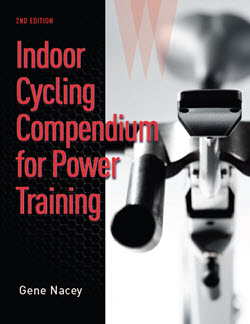
Gene Nacey with Cycling Fusion knows Training with Power – indoors and out. The Indoor Cycling Compendium for Power Training is a newebook resource that Instructors can purchase to be well informed and comfortable communicating the finer points of Power Training into your classes.
Here's an excerpt from Sally Edwards' Forward to Indoor Cycling Compendium for Power Training
‘Power Training’ is the first book to accomplish that goal. Everything else you read is focused on the outdoor rider, but Gene knows that it is the combination of the two that builds fit cyclists. His unique approach targets the IC rider specifically, as he shows you how the principles he uses inside also work outside. Training with power meters was once reserved for only the elite cyclist, but Gene has demystified it, creating a tool and a program that the average recreational rider can easily understand. He accomplishes this feat using an agnostic approach, inviting you to apply the information in this book to every manufacturer’s power meter on every power meter—equipped indoor bike. As long as you have the data from the power meter, you can follow his comprehensive system. You’ll love the charts and the workout tools in the book – each provides a way to translate the numbers on an IC power-meter bike into something tangible and easy to use for both the IC instructor or you, the rider.
Listen to our discussion below and then leave your thoughts about bringing this level of detailed knowledge into your classes.
Here's the link to pre-order either an iBook or eBook version and save $10.00
Take away their common language and destroy a great team. Wikipedia image
In the biblical story about the Tower of Babel, God wanted to prevent Man from building a tower that reached into the heavens. Construction of the tower was going along very well as everyone was working efficiently toward their common goal of reaching into the sky. Now I'm sure God could have just sent a storm to knock down the semi completed tower… but then Man would have simply started over. So instead he wrecked their construction team by causing everyone to speak a different language. Confusion was rampant since no one understood what the other's were saying. Construction halted and the team disbanded. Problem solved.
The recent survey we conducted included a number of questions about Teaching with Power – to get some understanding of “how's it going?” and the impact power has on your classes.
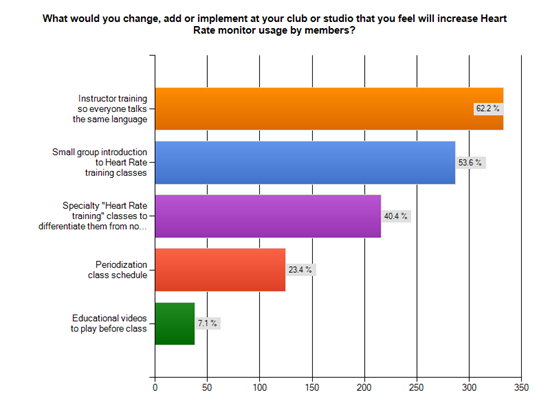
I see Instructors as bright people, who understand the root of many of the problems they encounter in class. So I asked the question:
Back during the Spring of 2011 we surveyed Instructors, asking the exact same questions – only about Heart Rate training. Unsurprisingly we got similar results.
So what can you do?
First you need to decide; “how much do I care about this issue?” Are you content to ignore it? Or are you someone who sees a problem and then looks for a way to solve it?
At the risk of sounding simplistic, all you need to do is create a common language between you and the other members of your Instructor team. Easier said than done, but don't make it too complicated.
And don't wait for Management – or expect them effectively solve this even if your Dept Head is 100% committed to the cause. Anything imposed on you and your team, without the voluntary buy-in from each team member, is guaranteed to fail. If you're in a Big Box and have experienced multiple new branded class formats, you know exactly what I'm talking about. Two weeks after the “big change”, everyone is back to their old style of teaching 🙁
My suggestion is to discuss this amongst yourselves. You could lead off by asking the question in an email with the intent to find a few other Instructors who see the problem:
Hi Team,
Do you feel like I do… that our class communication would be improved if we all spoke the same language around; Heart Rate and/or Power – Watts?
And then see what happens. Nobody wants to be forced into changing – but a few maybe willing to hear more from you. If you find some like-minded Instructors try to get them together – you might even offer to buy coffee. Present a simple solution; “my vote is we agree to only use 3/4/5 HR or Power Zones.” Just pick a number that everyone will agree on. Then discuss how do you decide the actual personal numbers that form the zones; Metabolic testing, Threshold tests, etc… Again you're looking for agreement, not who's right.


 At WSSC I had the opportunity to complete a PST (Personal Spinning® Threshold) test – which is (their words) the key to Spinpower success. I couldn't agree more as knowing your maximum sustainable power or Heart Rate, and then building training zones around a known metric BPM/Watts is crucial to effective training. Here's some notes on this session and the discovery process MI Janet Toussaint lead us through to determine our Personal Spinning® Threshold.